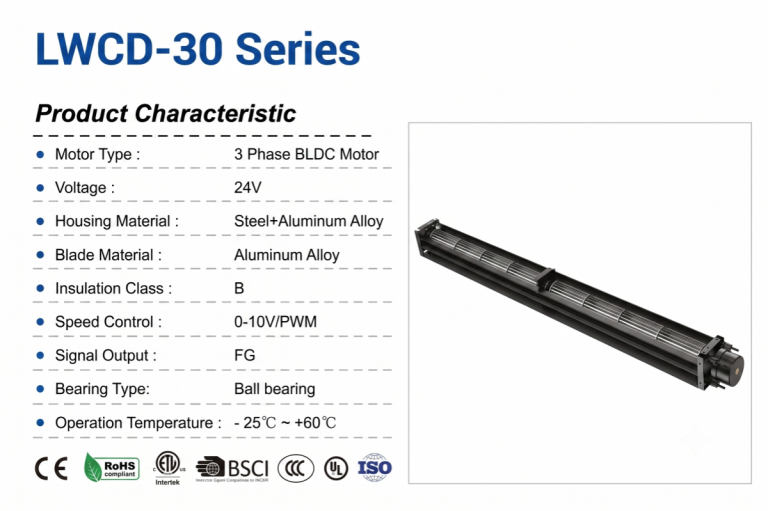
Meeting Space Limits with a Dual Voltage Cross Flow Fan
The customer had a low-profile electronic box. This machine needed a special dual voltage cross flow fan. First, the space inside the box was very tight. The design only fit an exact 30 mm wheel.
Furthermore, the total length could not pass 214 mm from end to end. Next, the buyer needed two distinct voltage types. They asked for 12V and 24V units, which is what makes this a dual voltage cross flow fan rather than two products. Meanwhile, the air flow had to hit 43 m³/h.
Also, the tight box creates severe air drag. Therefore, the fan must push 13 Pa of static pressure. However, noise was a strict limit for this project. The sound could not pass 27 dB(A) because people work right next to the unit.
Finally, the box sits outdoors in rough weather. Consequently, the operating heat range spans from -25C to +60C. The system must meet UL 507 rules for safety. Furthermore, it must pass IEC/EN 60335 checks.
So, the main rule was a strict two-wire setup. They only wanted a red positive wire and a black ground wire. They did not want any speed control. In short, they needed a pure plug-and-play part.
Engineering the Dual Voltage Cross Flow Fan
We looked at our standard models first. Our normal 30mm fans use a four-wire setup. These models have smart chips for PWM speed control and signal lines. However, we rejected the standard four-wire board. We made this choice to save space. Furthermore, capping unused wires inside a tight box creates a short circuit risk. So, we built a custom DC cross flow fan instead. Next, we removed the smart chips from the motor board. The customer did not need to pay for parts they would not use. Consequently, the motor only takes straight 12V or 24V power. Therefore, it runs at a constant 2400 RPM all day. By contrast, a smart fan slows down to reduce noise. Instead, this stripped unit stays fixed at 27 dB(A). This choice cost the user their quiet time. Even so, the simpler board saved them money and removed a point of failure.
Mechanical Parts for the Build
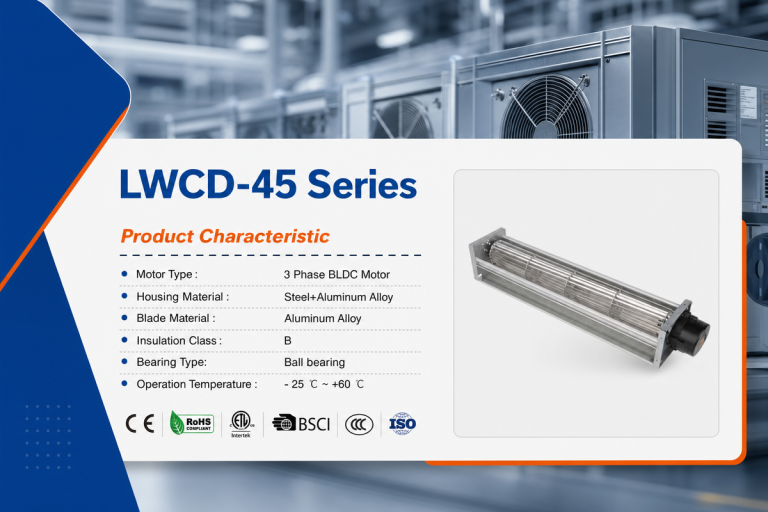
Next, we locked in the hard parts. This dual voltage cross flow fan uses an aluminum alloy wheel. The wheel spans exactly 160 mm. It holds 20 tiny blades. Meanwhile, cheap plastic blades bend at +60C. Therefore, we used metal to stop heat damage over time. Furthermore, we added thick iron side plates to the ends. These metal plates keep the whole frame stiff. Next, we changed the wire length. Standard fan wires are often too short. So, we used a custom 500 mm cable. Consequently, the user plugs it straight into their main power board. This long cable skips a messy splice joint on the factory floor. Finally, we picked ball bearings. Sleeve bearings wear out fast at 2400 RPM. Instead, ball bearings handle the constant hard work. Therefore, the fan runs reliably from -25C to +60C.
Technical Specifications
| Parameter | LWCD-30150LN-06 (12V) | LWCD-30150MN-07 (24V) |
|---|---|---|
| Airflow | 43 m³/h | 43 m³/h |
| Static Pressure | 13 Pa | 13 Pa |
| Input Voltage | 12 VDC | 24 VDC |
| Current | 0.1A ± 10% | 0.05A ± 10% |
| Speed | 2400 RPM ± 10% | 2400 RPM ± 10% |
| Impeller Diameter | 30 mm | 30 mm |
| Impeller Length | 160 mm ± 1 mm | 160 mm ± 1 mm |
| Overall Length | 214 mm ± 2 mm | 214 mm ± 2 mm |
| Noise Level | 27 dB(A) | 27 dB(A) |
| Operating Temperature | -25C to +60C | -25C to +60C |
| Cable Length | 500 mm | 500 mm |
| Bearings | Ball bearing | Ball bearing |
| Insulation Class | Class B | Class B |
| Certifications | CE, RoHS, UL, ETL, BSCI, CCC, ISO | CE, RoHS, UL, ETL, BSCI, CCC, ISO |
First, the 43 m³/h air flow row is the most vital metric. This moving air removes heat from the hot chips. Next, look at the input voltage rows. The client builds two machine types. So, we made an exact match for both 12V and 24V power setups. Finally, the class B insulation handles the internal motor heat safely. Therefore, the simple design works well.
Reference: AMCA 210 covers the test method behind these figures.
Technical Documentation
First, mechanical teams need the exact outer sizes. So, view the 12V drawing. This file shows the 214 mm length and the custom 500 mm wires. Next, system planners need to see how the air moves. Therefore, look at the test chart below.
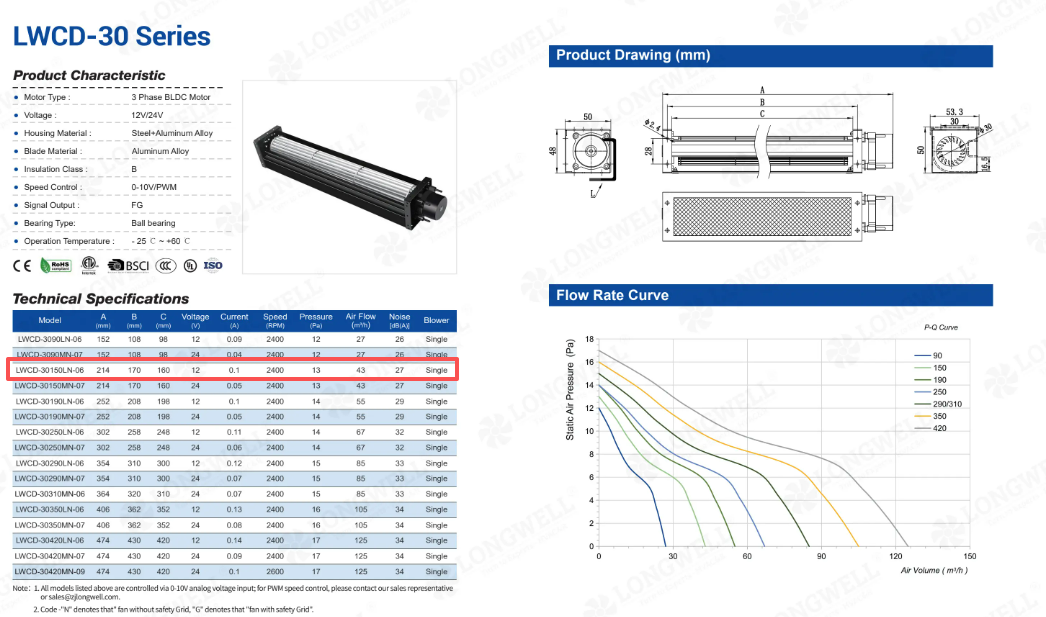
This chart maps the DC cross flow fan moving 43 m³/h against the 13 Pa drag. Finally, electrical designers must size the power blocks. Consequently, view the 24V drawing. This file lists the exact 0.05A current draw.
How to Spec Fixed-Speed Cooling
Engineers making a simple two-wire cooling setup should check a few key rules.
- First, a two-wire dual voltage cross flow fan lacks a smart chip. Consequently, any drop in the main 12V or 24V line will slow the fan. This voltage drop cuts your cooling power fast.
- Next, test your room noise limits. By contrast to smart fans, this unit never slows down. Therefore, your space must handle the full 27 dB(A) noise all day long.
- Furthermore, trace your wire paths inside the box. Standard wires are often too short for deep racks. Instead, ask for the exact length you need. So, a custom 500 mm wire prevents bad splices.
- Finally, model your air drag carefully. We test the air flow to strict AMCA 210-16 methods. Even so, a cramped box blocks the air path. Therefore, your real flow will drop below the chart numbers.
Related: Cross Flow Fans.
Design Questions
Technical Documentation & Resources
Browse our cross-flow fans range, the AC cross-flow fans section, or cross-flow impellers.
Have a Similar Fan Requirement?
Longwell’s engineering team delivers custom spec sheets and samples within 90 days. Since 1990, we have supplied EC fans and blowers to OEMs across HVAC, cold chain, data center, and industrial applications worldwide.
Browse Related Products:
🏆 ISO 9001 / ISO 14001 / ISO 45001 | CE (TÜV) | UL/ETL | ATEX Zone 21/22 | AMCA 210-16 / ISO 5801 tested