Defining Constraints for a Scaled Fan Series
A commercial equipment builder contacted us with a strict rule. They needed a matched series of AC inline duct fans. First, the new product line required four exact sizes. The pipe diameters were 150mm, 180mm, 200mm, and 300mm.
Furthermore, the customer set a hard speed limit. Every single unit had to spin at exactly 2800 RPM. Consequently, this uniform speed allowed them to use very simple electrical relays. Next, all units had to use standard 220V power at 50Hz.
The physical space was extremely tight. For example, the 150mm model had to fit inside a short 140mm housing. Meanwhile, the large 300mm model was restricted to a 160mm length. This short length means the fans will sit in cramped ceiling spaces.
Therefore, standard long bodies would fail here. The requested air volumes ranged from 780 m³/h up to 3000 m³/h. We tested all prototype airflow targets to AMCA 210-16 methods. Finally, they needed two samples of each size. A production batch of 100 units per size would follow approval.
Fixing High-Speed Motor Flaws in the AC Inline Duct Fans
We reviewed the original customer specification closely. First, we focused on the largest 300mm model. Usually, a large 300mm fan spins much slower. For instance, we considered using a slower 1400 RPM motor.
Consequently, this slower speed would drastically cut the noise level. It would also reduce stress on the steel bearings. However, we rejected this 1400 RPM design. The customer demanded a strict 2800 RPM speed profile.
They needed simple, single-speed logic across all AC inline duct fans. Instead, we built the fans with high-speed motors.
Upgrading the Small Motor Design
Next, we checked the smallest 150mm fan. The initial specification sheet asked for a basic 20W motor. We immediately rejected this low 20W power rating. Moving 780 m³/h of air at 2800 RPM takes serious force.
A 20W stator lacks the raw power to push air through a tight 150mm pipe. Therefore, the motor would stall against the static pressure. Once stalled, it would quickly overheat and burn out. To fix this fatal flaw, we redesigned the stator completely.
We upgraded the 150mm model to a stronger 40W motor. In short, this power increase ensures the AC inline duct fans runs safely for years.
The Heavy Cost of Uniform Speed
Every engineering choice carries a clear penalty. Forcing the large 300mm unit to spin at 2800 RPM required a massive 120W motor. Furthermore, turning a wide metal blade at high speed creates severe air noise. The acoustic penalty is quite high.
Even so, the customer accepted the extra noise. By contrast, they gained a perfectly unified electrical control system. The 180mm fan achieved 1000 m³/h using a 60W motor. Meanwhile, the 200mm model reached 1300 m³/h with an 80W motor.
Finally, we kept the housing lengths incredibly short. We packed the upgraded 40W motor into the strict 140mm length limit. We also forced the large 120W motor into the 160mm length box.
Performance Testing and Validation
We built the first samples for all four sizes. Next, we placed each fan inside our testing chamber. We tested the true airflow performance to AMCA 210-16 test methods. The test results proved our motor upgrades were correct.
The 150mm fan easily held 2800 RPM under a heavy air load. Meanwhile, the large 300mm unit delivered the full 3000 m³/h target. Consequently, we approved the final designs. The customer received the required test samples on time.
Technical Specifications
The table below details the final performance metrics for all four AC inline duct fans.
| Model | Impeller (mm) | Length (mm) | Voltage (V) | Frequency (Hz) | Power (W) | Speed (RPM) | Airflow (m³/h) |
|---|---|---|---|---|---|---|---|
| LWDA-150(6″)S-MWN-08 | 150 | 140 | 220 | 50 | 40 | 2800 | 780 |
| LWDA-180(7″)S-MWN-01 | 180 | 140 | 220 | 50 | 60 | 2800 | 1000 |
| LWDA-200(8″)S-MWN-08 | 200 | 150 | 220 | 50 | 80 | 2800 | 1300 |
| LWDA-300(12″)S-MWN-05 | 300 | 160 | 220 | 50 | 120 | 2800 | 3000 |
The motor power column shows the steep energy cost of high speeds. Specifically, keeping a 2800 RPM speed requires huge power on large blades. The 300mm model needs a 120W motor. By contrast, the 150mm model only needs a 40W motor.
Reference: AMCA 210 covers the test method behind these figures.
Technical Documentation
View the 150mm drawing to see the upgraded 40W motor footprint.
Open the 300mm layout file to check the tight 160mm total length.
Review the 200mm specification sheet for the exact mounting hole layout.
Read the 180mm performance data for the 60W power profile details.
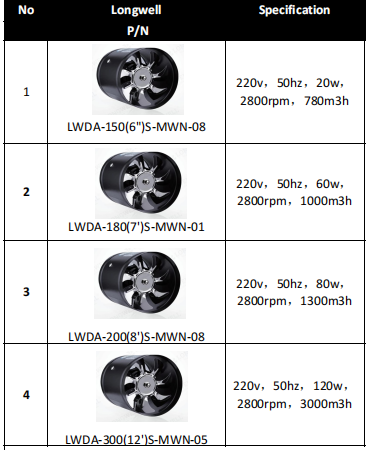
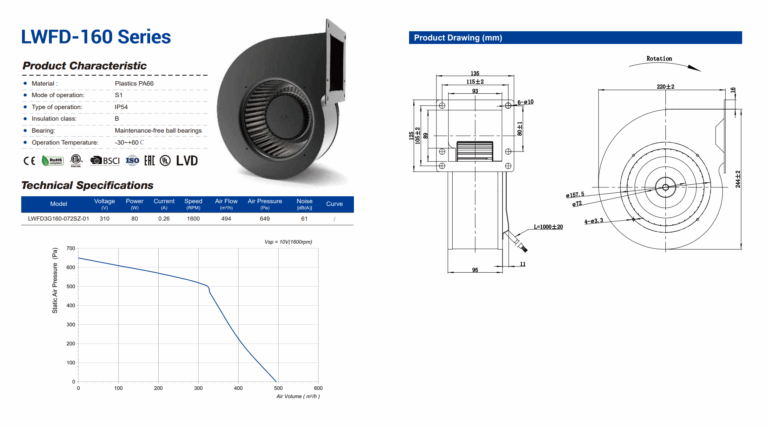
This image shows the original customer request for AC inline duct fans with a weak 20W motor.
Scaling Fan Lines Across Different Pipe Sizes
When building a full series of AC inline duct fans, uniform speeds hide major problems. Consider these core rules before you finalize your specifications.
- First, calculate the actual tip speed of your largest fan blade. A 300mm blade spinning at 2800 RPM creates intense air noise. Therefore, you must add thick acoustic insulation to your outer ductwork.
- Next, remember that motor wattage never scales in a straight line. Pushing huge air volumes takes exponentially more torque to hold the speed. Consequently, expect large models to draw massive amounts of power.
- Instead of guessing, specify your strict physical length limits upfront. Short housing limits force us to use tightly packed motor windings. In short, strict length caps will dictate which motors can physically fit inside.
- Finally, always challenge early power estimates for small pipes. Small tubes create very high internal drag forces. As a result, small fans often need large motors just to beat this basic resistance.
Related: Duct Fans.
Common Engineering Questions
Technical Documentation & Resources
Browse our duct fans range, the inline duct fans section, or mixed flow fans.
Have a Similar Fan Requirement?
Longwell’s engineering team delivers custom spec sheets and samples within 90 days. Since 1990, we have supplied EC fans and blowers to OEMs across HVAC, cold chain, data center, and industrial applications worldwide.
Browse Related Products:
🏆 ISO 9001 / ISO 14001 / ISO 45001 | CE (TÜV) | UL/ETL | ATEX Zone 21/22 | AMCA 210-16 / ISO 5801 tested