Specifying Paired Cross Flow Fans for Tight Spaces
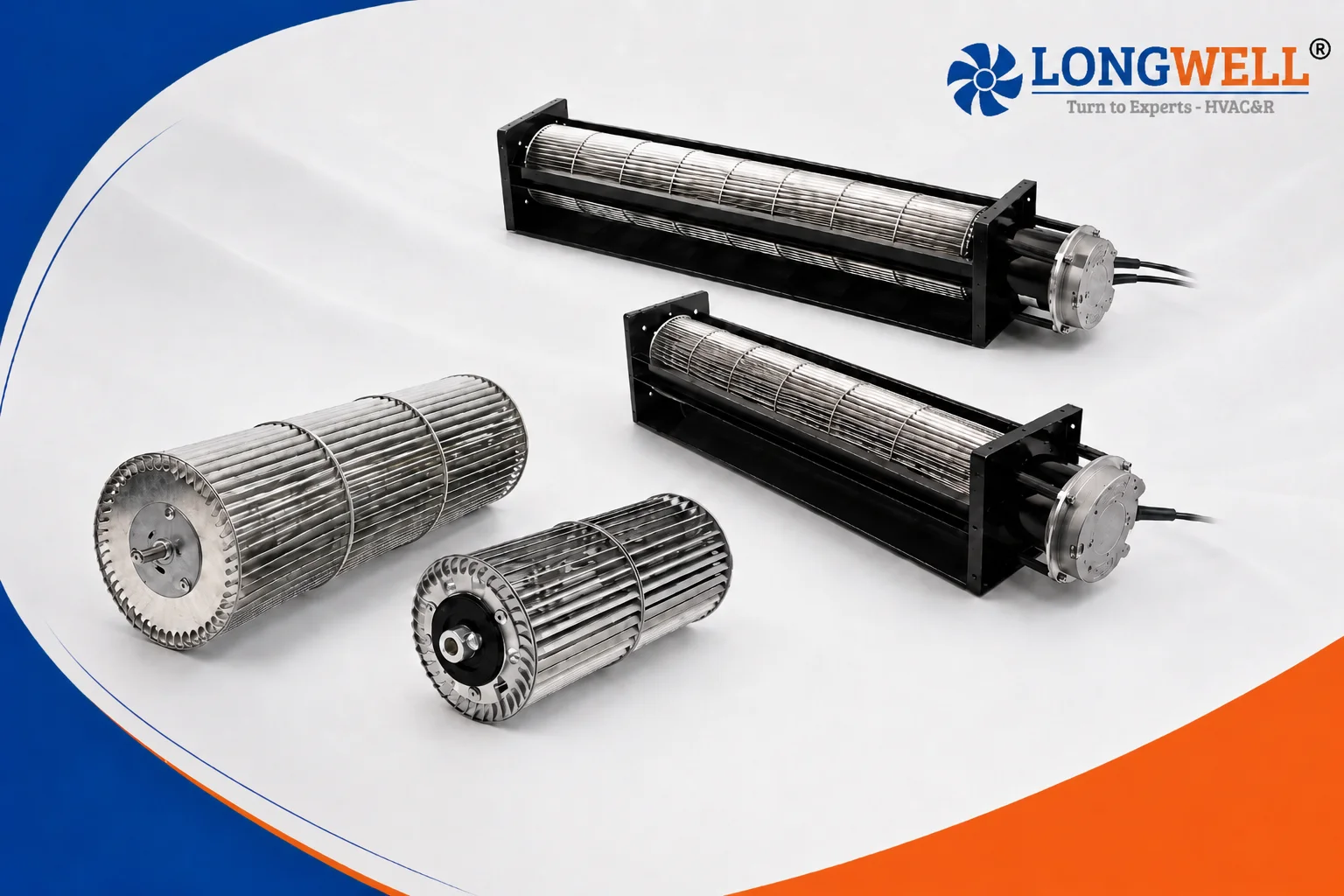
The customer had a tight space for their equipment cooling gear. First, they needed paired cross flow fans to cover a very wide thermal area. These fans cool the vital parts inside the heavy machine. Next, the setup needed a distinct left and right unit.
This approach keeps the whole frame balanced, which is the point of specifying paired cross flow fans rather than one long rotor. Also, the paired cross flow fans had to push a large volume of air while fitting a very small space. Therefore, the frame size could not pass a 60 mm square profile. Furthermore, the main system board gave exactly 24V DC power.
Meanwhile, the raw heat load was high, so it needed over 65 CFM of air flow. So, we aimed for 110 m3/h per fan. This metric gives a solid safety margin. In short, the small space meant high internal speeds.
So, the motor had to turn at 3800 RPM. This high speed hits the hard pressure target. Even so, the noise and shake limits were strict. Finally, the test build cycle was fast.
We had to ship samples before May 10th. As a result, the design had to pass safe design rules quickly. We test all air flow parts to AMCA 210-16 methods. This standard proves they hit the strict targets.
Engineering the 60mm Profile and Symmetrical Airflow
We had to make smart choices to hit 65 CFM. The fans had to stay inside a strict 60 mm space. First, we thought about using one long 400 mm part. One motor would drive it right in the middle.
However, this idea had major mechanical risks. A long metal cylinder spins at 3800 RPM. This action bends the main shaft down in the center. Therefore, we rejected the single long part.
We wanted to stop the metal from bending over time. Instead, we split the required length into two 200 mm parts. By contrast, two parts need two whole drive systems. So, the buyer pays a materially higher motor cost.
Also, wiring two parts takes more physical work on the assembly line. Even so, this choice makes the system last much longer. It removes the grave risk of a bent central shaft.
Motor Choice for High Speed
Next, we looked at motor options. The customer asked for a three-phase motor. This design saves basic electrical power. Consequently, we chose the 3725 series brushless motor.
We built it directly into both side plates. This exact motor keeps the total frame width at 60 mm. It fits the box perfectly without sticking out. Meanwhile, it brings enough torque to hold 3800 RPM under load.
Furthermore, this motor takes a direct 0-10V control signal. Therefore, the main brain can slow the fan down automatically. It does this when the machine heat drops. In short, this cuts down on loud running noise during idle times.
Balancing Speed Against Bearing Life
First, running parts at high speeds wears them out quickly. A constant 3800 RPM speed is very hard on the rotating joints. Next, we chose high-grade ball bearings to handle this stress. We rejected cheap sleeve bearings.
As a result, the bearing life meets hard daily use. Cheap bearings fail fast at these extreme speeds. Finally, the approved models became LWCD-40200MN-07-00 and LWCD-40200MN-08-00. The 07 model puts the heavy motor on the left.
The 08 model puts it firmly on the right. Therefore, the buyer gets a perfectly mirrored DC cross flow fan pair. Each unit runs on 24V DC. Each pushes 110 m3/h on its own.
Technical Specifications
The table shows the exact rules for the paired cross flow fans units.
| Voltage (VDC) | 24 |
| Speed (RPM) | ≥ 3800 |
| Max Air Flow (m3/h) | ≥ 110 |
| Bearings | Ball bearing |
| Motor Type | 3725 Three-Phase |
| Frame Width (mm) | 60 |
| Impeller Length (mm) | 200 |
| Overall Length (mm) | 250 ± 2 |
| Impeller Material | Aluminum |
| Side Plate Material | Iron |
| Control Cable | 4-core, L=500 mm |
First, the table shows the strict 3800 RPM speed minimum. This high speed lets the fan hit the tough air flow target. Next, the light aluminum part keeps the spinning weight very low. Therefore, the high-speed work stays physically safe.
Reference: ISO 21940 covers the test method behind these figures.
Technical Documentation
These drawings define the physical lines for the DC cross flow fan project.
longwell-wi-6980657055-technical-doc-01.pdf
First, the left-hand drawing shows the motor on the left side for the system builders.
longwell-wi-6980657055-spec-sheet-02.pdf
Next, the right-hand drawing checks the flipped layout so assembly workers wire it right.
Tips for Buying Paired Cross Flow Fans
When you buy a paired cross flow fans, check your space early. Small physical details often cause big design delays.
- First, measure the exact dead space between your two fans. Two paired units always leave a solid gap where their flat plates meet.
- Next, spell out your exact control logic on the first draft. You must tell the factory if you use a 0-10V signal or a simple switch.
- Furthermore, expect a lot of raw air noise from small fans. Pushing air fast through a tight 60 mm gap always makes loud wind sounds.
- Finally, plan your wire paths clearly for both sides. The left side and right side will route cables in distinct ways to reach the board.
Therefore, clearing these points early gets you much faster factory quotes. We make our impellers in our own plant, which cuts custom times down to 90 days.
Related: Cross Flow Fans.
Questions About Mirrored Fan Units
Q: Why use mirrored left and right units instead of turning one DC cross flow fan around? A: First, the outer casing only blows air in one direction. If you turn the fan around, it blows air straight into the wall. Therefore, you must use distinct left and right parts to point the air out.
Finally, this design keeps the screw holes lined up on both sides. Q: How does the 0-10V wire attach to the main 24V power? A: The 3725 motor uses four separate wire paths. First, a red and a black wire take the heavy 24V DC power.
Next, a white wire takes the weak 0-10V signal. Meanwhile, a yellow wire sends the actual speed numbers back to the main board. Q: What makes a fan shake the most at 3800 RPM? A: A badly weighted fan wheel causes the worst high-speed shakes.
First, a thin 200 mm metal tube bends when it spins very fast. Therefore, we balance each wheel closely before we put it inside the frame. Finally, thick iron side plates stop the frame from twisting.
Technical Documentation & Resources
Browse our cross-flow fans range, the AC cross-flow fans section, or cross-flow impellers.
Have a Similar Fan Requirement?
Longwell’s engineering team delivers custom spec sheets and samples within 90 days. Since 1990, we have supplied EC fans and blowers to OEMs across HVAC, cold chain, data center, and industrial applications worldwide.
Browse Related Products:
🏆 ISO 9001 / ISO 14001 / ISO 45001 | CE (TÜV) | UL/ETL | ATEX Zone 21/22 | AMCA 210-16 / ISO 5801 tested