Meeting the 270 mm Footprint Constraint
The customer sent a mounting bracket drawing for review. It required an EC centrifugal fan. This fan fits inside a tight commercial HVAC enclosure. Therefore, the physical footprint was heavily restricted by nearby parts.
Their technical drawing showed a strict rectangular cutout on the sheet metal. First, the exact bolt pattern measured 129 mm by 254 mm. This small metal opening heavily limited the blower discharge size. Next, the actual application demanded a steady 1236 m3/h of airflow.
The required static pressure resistance was exactly 438 Pa. Furthermore, the final equipment operates outdoors in harsh weather conditions. Ambient site temperatures swing dramatically from -25°C up to 60°C. Consequently, thermal durability was a hard engineering constraint for the motor.
The main power supply provides a single-phase 230VAC connection. However, the local grid voltage fluctuates constantly between 184V and 270V. Control logic requires a direct 0-10VDC or PWM control signal. Finally, the internal fan must manage acoustic noise levels during low demand.
Safety rules mandate strict electrical compliance with the EN 60335-1 standard. Meanwhile, fan performance testing must follow standard ISO 5801-1997 airway methods. The target European market also requires full CE certification documentation. In short, a standard large cooling fan would simply not fit.
Engineers had to pack massive airflow capability into a 270 mm width. They also had to keep peak noise under a 72 dB(A) limit. So, this combination of size and power created a difficult mechanical challenge.
Engineering the Forward Curved Geometry
We explored multiple aerodynamic ways to meet the strict 270 mm width limit. First, we analyzed a standard backward-curved motorized impeller design. Backward-curved wheels offer excellent energy efficiency and low noise profiles. However, they need a large radial space footprint to build high pressure.
A wheel fitting strictly inside this tight space could not reach 1236 m3/h. Therefore, we rejected the backward-curved fan option completely. Its strict physical diameter limit severely capped its internal pressure capacity. Instead, we chose a forward-curved dual-inlet blower geometry.
Forward-curved wheels use many short and shallow blades around the rim. These specialized blades cup the moving air very effectively. Consequently, they move much more air volume for their physical size. A dual-inlet fan model pulls fresh air from both open sides. So, it maximizes total flow passing through a very narrow discharge.
Selecting the EC Centrifugal Fan Components
This EC centrifugal fan geometry always requires clear engineering trade-offs. Forward-curved metal blades react strongly to sudden static pressure changes. Furthermore, they generate slightly more blade noise at high motor speeds. Reaching the required 438 Pa meant running the internal motor at 1700 RPM.
This specific speed choice cost the customer a noticeable acoustic penalty. Next, the measured noise level hits 72 dB(A) at peak airflow operation. By contrast, a much larger backward-curved fan would run significantly quieter. The hard spatial constraints made this specific noise penalty completely unavoidable.
Even so, we could still reduce the total electrical energy consumption. We added our proprietary SmartEC motor technology to the core design. The chosen EC centrifugal fan keeps high energy efficiency across varying grid voltages. Input electrical power stays safely at 190W while drawing only 1.4A.
Finally, the final assembled unit uses a 146 mm galvanized steel impeller. Metal adds substantial physical weight compared to a common plastic fan wheel. However, solid metal survives the 60°C maximum ambient heat without warping. The metal blower flange bolts directly to the 129 mm by 254 mm customer hole pattern. In short, this custom unit trades silent acoustic stealth for maximum spatial density.
Technical Specifications
The detailed table below lists all tested performance metrics. These exact numbers apply to the approved EC centrifugal fan production model.
| Nominal Voltage | 230 VAC |
| Voltage Range | 184~270 VAC |
| Frequency | 50/60 Hz |
| Speed | 1700 RPM |
| Current | 1.4 A |
| Input Power | 190 W |
| Airflow | 1236 m3/h (727 CFM) |
| Static Pressure | 438 Pa |
| Noise Level | 72 dB(A) |
| Operating Temperature | -25°C to 60°C |
| Insulation Class | Class B |
| IP Class | IP44 |
| Certifications | CE, RoHS, Reach |
The 438 Pa static pressure limit primarily drove this strict engineering design. Meanwhile, the low 190W power input proves the EC external rotor motor efficiency. Furthermore, the IP44 protection rating provides safe operation in damp outdoor environments.
Reference: AMCA 210 covers the test method behind these figures.
Technical Documentation
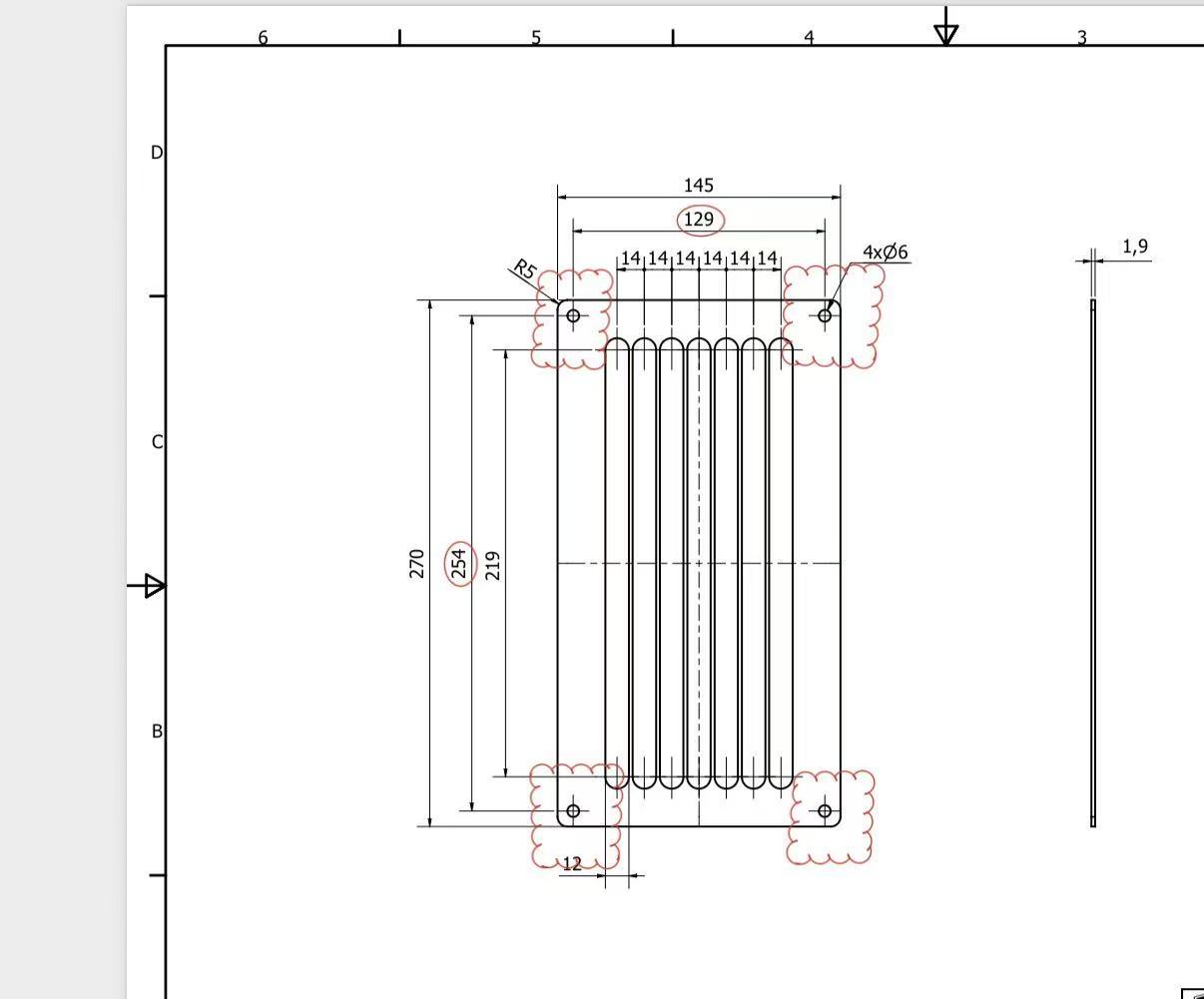
This original customer drawing shows the rigid 145 mm by 270 mm enclosure boundary for the EC centrifugal fan. Therefore, it strictly dictates the exact metal discharge dimensions we could use.
LWFE3G146-092DS-10-00 Specification
This approved technical document contains the precise P-Q aerodynamic performance curve. Next, it provides the required wiring diagrams for direct electrical control integration.
Fitting Blowers into Restricted Enclosures
Fitting blowers into tight commercial HVAC layouts often forces a clash between size and airflow. If you face a similar layout constraint, carefully check these physical factors.
- First, measure the true available depth directly behind your mounting plate. Forward-curved dual-inlet fans need open clearance on both sides of the scroll housing. If the surrounding enclosure walls block the inlets, your total airflow will drop drastically.
- Next, define your absolute maximum noise ceiling at peak motor speed. Pushing high static pressures with small diameter impellers always creates loud air noise. A 146 mm wheel running at a fast 1700 RPM will easily exceed 70 dB(A).
- Furthermore, verify the real electrical voltage range of your field installation sites. Single-phase utility lines often drop below 200V or spike far above 250V. EC motors handle these power swings much better than older traditional AC motors.
- Finally, supply your fan manufacturer with your specific 0-10V or PWM signal logic. Standby voltage activation thresholds vary widely across different electronic control boards.
Small enclosure cooling projects fail rapidly when engineers specify standard axial fans. By contrast, normal axial models cannot push air effectively against 438 Pa of system resistance.
Related: Centrifugal Fans.
Common Application Questions
Technical Documentation & Resources
Browse our centrifugal fans range, the backward-curved fans section, or forward-curved fans.
Have a Similar Fan Requirement?
Longwell’s engineering team delivers custom spec sheets and samples within 90 days. Since 1990, we have supplied EC fans and blowers to OEMs across HVAC, cold chain, data center, and industrial applications worldwide.
Browse Related Products:
🏆 ISO 9001 / ISO 14001 / ISO 45001 | CE (TÜV) | UL/ETL | ATEX Zone 21/22 | AMCA 210-16 / ISO 5801 tested