Cooling Mobile Systems on a Rough Electrical Bus
First, the customer brought us a hard transport cooling problem. They build large mobile systems. The vehicle needs a new brushless DC condenser fan. So, we looked at the tight space constraints.
The brushless dc condenser fan must fit exactly in a 332 mm hole. Next, the power supply on a truck is rough. The main bus runs at a normal 26V. However, the real voltage swings hard during daily work.
Therefore, the motor must run safely from 16V to 32V. It cannot trip a fault code. Next, the weather brings severe heat and cold. The unit sits completely outside all year.
Consequently, it must survive from -40°C up to a very hot 85°C. Furthermore, the electrical rules are very strict. The vehicle must pass ECE Reg 10-03 for electrical noise. Otherwise, it will mess with the truck radios.
Finally, the brushless dc condenser fan must move a massive amount of air against high static pressure. In short, the system needed strong cooling and perfect motor control. The customer needed an answer fast. Our team reviewed the sales input.
We saw the target was a high-end mobile unit. First, the application runs a heavy cooling cycle. It removes heat from a closed cabin. Consequently, a failure stops the whole machine.
Therefore, we had to guarantee a long life. The customer asked for an L10 life of 40,000 hours. Next, the duty cycle is continuous. The motor works under the S1 work system standard.
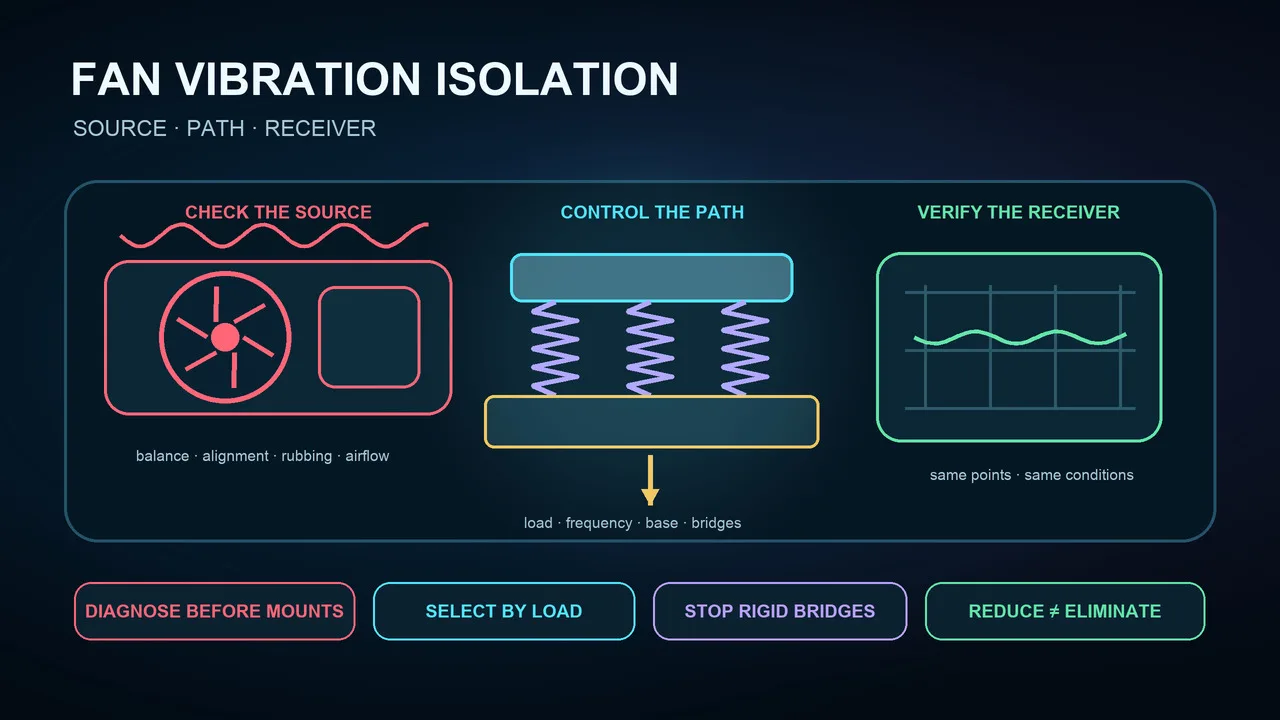
So, it never gets a break. Finally, the vehicle shakes constantly. The fan must handle constant road vibrations without cracking.
Selecting the Impeller and Sealing the Motor
We looked at several ways to build this fan. First, we thought about a standard brushed motor. However, brushed motors wear out too fast on the road. Their brushes grind down over time.
Consequently, they cannot reach the 40,000-hour life the customer requires. Instead, we chose an EC motor design. We designed a brushless DC condenser fan. This gives total control and long life.
Next, we had to pick the right blades. First, we tested a heavy metal fan wheel. However, the metal pushed too much weight onto the motor bearing. So, the fan failed our early shock tests.
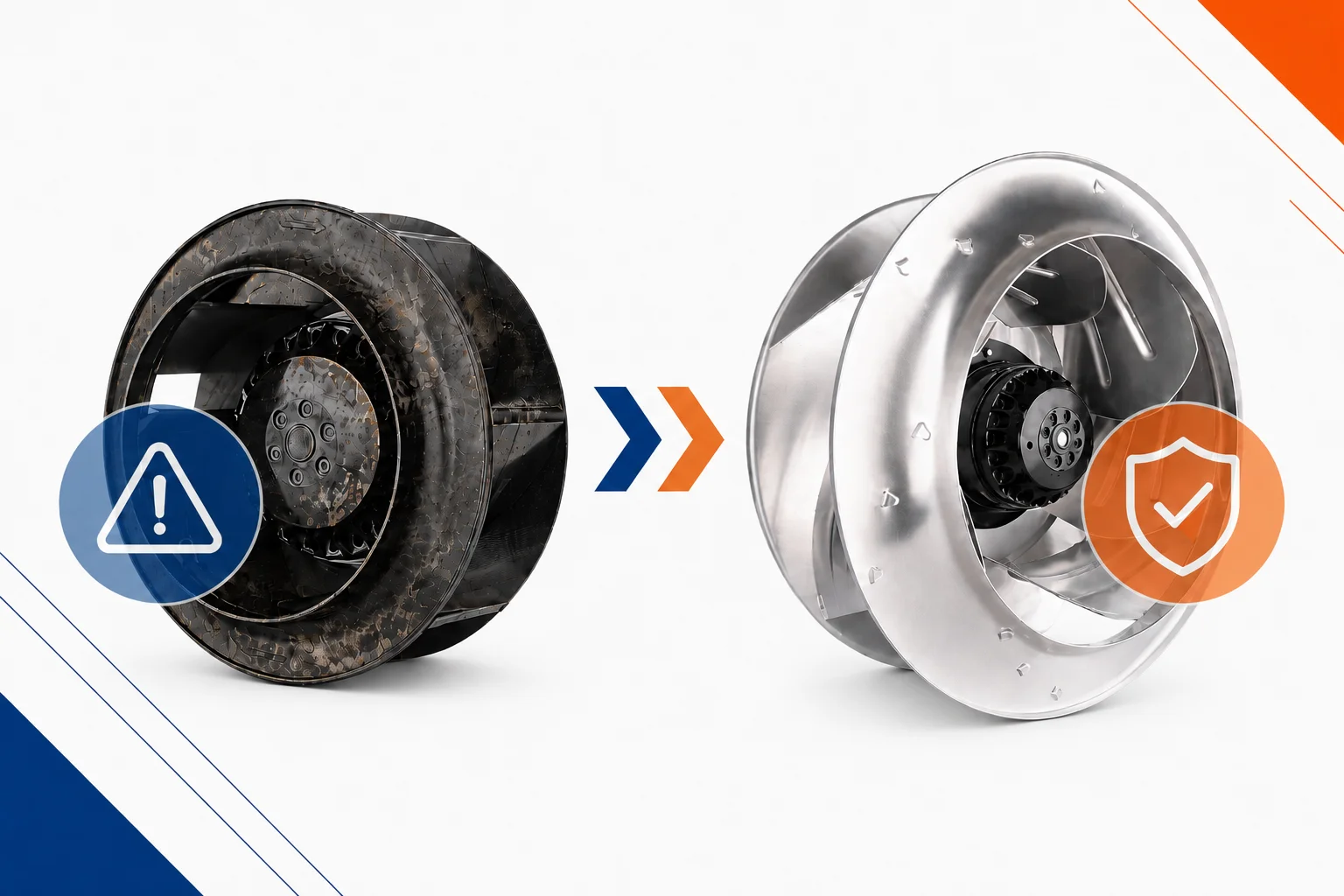
Therefore, we moved to a high-strength plastic. We chose a seven-blade PA66 plastic wheel. This material keeps the total weight to just 2.2 kg. Furthermore, PA66 plastic handles the extreme 85°C heat without warping. So, the motor bearings will last much longer on rough roads.
Static Pressure Trade-Offs for the Brushless DC Condenser Fan
The heat exchanger blocks a lot of air. Therefore, the fan must push very hard. First, the dense coil makes high flow resistance. Consequently, the seven-blade shape generates a very high static pressure.
It reaches a peak of 438 Pa. By contrast, this high pressure makes the fan loud. The noise level hits 76 dB(A) at the top speed of 2980 RPM. We accepted this noise penalty.
High air flow is far more important than quiet running here. Indeed, failing to clear the heat would stall the whole machine. Next, we looked at the motor controls. The customer needs to change speeds fast.
So, we added a yellow wire for PWM and linear voltage control. Furthermore, we built in a soft start feature. We also added stall protection. This protects the truck bus from big power spikes.
Sealing the Electronics from the Weather
Transport fans face rain, ice, and road dirt every day. First, standard fans use a simple IP54 seal. However, IP54 fails quickly under high-speed road spray. Water gets inside and ruins the board.
Therefore, we used our ThermoFlex design rules. We sealed the electronics to a full IP68 rating. This adds a materially higher cost to each unit. Potting the electronics takes more time and material.
Even so, the IP68 seal is absolutely vital for survival. In short, the final fan moves 2936 m3/h (1727 CFM) at 338W input power.
Technical Specifications
| Parameter | Value |
|---|---|
| Model | LWCC-DC300MB-01 |
| Nominal Voltage | 26 VDC |
| Voltage Range | 16~32 VDC |
| Rated Speed | 2980 RPM |
| Motor Power | 338 W |
| Air Flow | 2936 m3/h (1727 CFM) |
| Static Pressure (Peak) | 438 Pa |
| Noise Level (LpA) | 76 dB(A) |
| Ambient Temp Range | -40°C to 85°C |
| Protection Type | IP68 |
| Insulation Class | F |
| Life Expectance | 40,000 Hours (L10) |
| Weight | 2.2 kg |
| Blade Material | Plastic PA66 (7 Blades) |
| EMC Standards | ECE Reg 10-03, Directive 72/245/EC |
First, the wide 16-32V range matters most here. So, the fan keeps running when the truck battery drops. Next, the IP68 rating protects the motor from high-pressure water. Finally, the PA66 plastic keeps the weight very low.
Reference: IEC 60529 covers the test method behind these figures.
Technical Documentation
First, the engineering specification sheet lists the exact electrical limits. Next, the 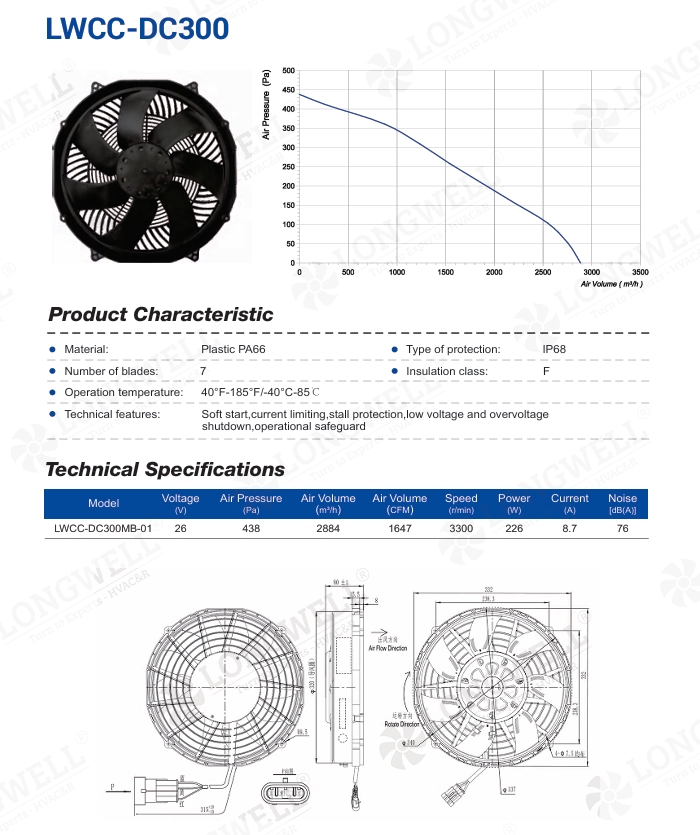 shows the size and the wiring diagram. Finally, the project reference document contains the internal notes on the EMC rules.
How to Specify a Transport Cooling Fan
If you need a new brushless DC condenser fan, follow these rules.
- First, test the real voltage on your vehicle bus. Do not just read the manual. Instead, record the lowest voltage drops during engine starts. A wide 16-32V range saves the fan.
- Next, measure the air blockages in the system. Mobile cooling coils get dirty very fast. Consequently, the static pressure often goes high. Therefore, pick a fan that can push past 400 Pa easily.
- Furthermore, match the water seal to the actual road conditions. If the fan faces forward on a truck, it needs an IP68 seal. Standard IP54 fans die fast in heavy rain.
- Finally, send your exact electrical rules to the factory early. Vehicle rules like ECE Reg 10-03 change the circuit board. So, send the rules first. Longwell tests air performance to AMCA 210-16 methods, which speeds up the process.
Related: DC Motors.
Frequently Asked Questions
Technical Documentation & Resources
Browse our axial fans range, the AC axial fans section, or EC axial fans.
Have a Similar Fan Requirement?
Longwell’s engineering team delivers custom spec sheets and samples within 90 days. Since 1990, we have supplied EC fans and blowers to OEMs across HVAC, cold chain, data center, and industrial applications worldwide.
Browse Related Products:
🏆 ISO 9001 / ISO 14001 / ISO 45001 | CE (TÜV) | UL/ETL | ATEX Zone 21/22 | AMCA 210-16 / ISO 5801 tested