Plug Fan vs AHU Fan: What is the Difference?
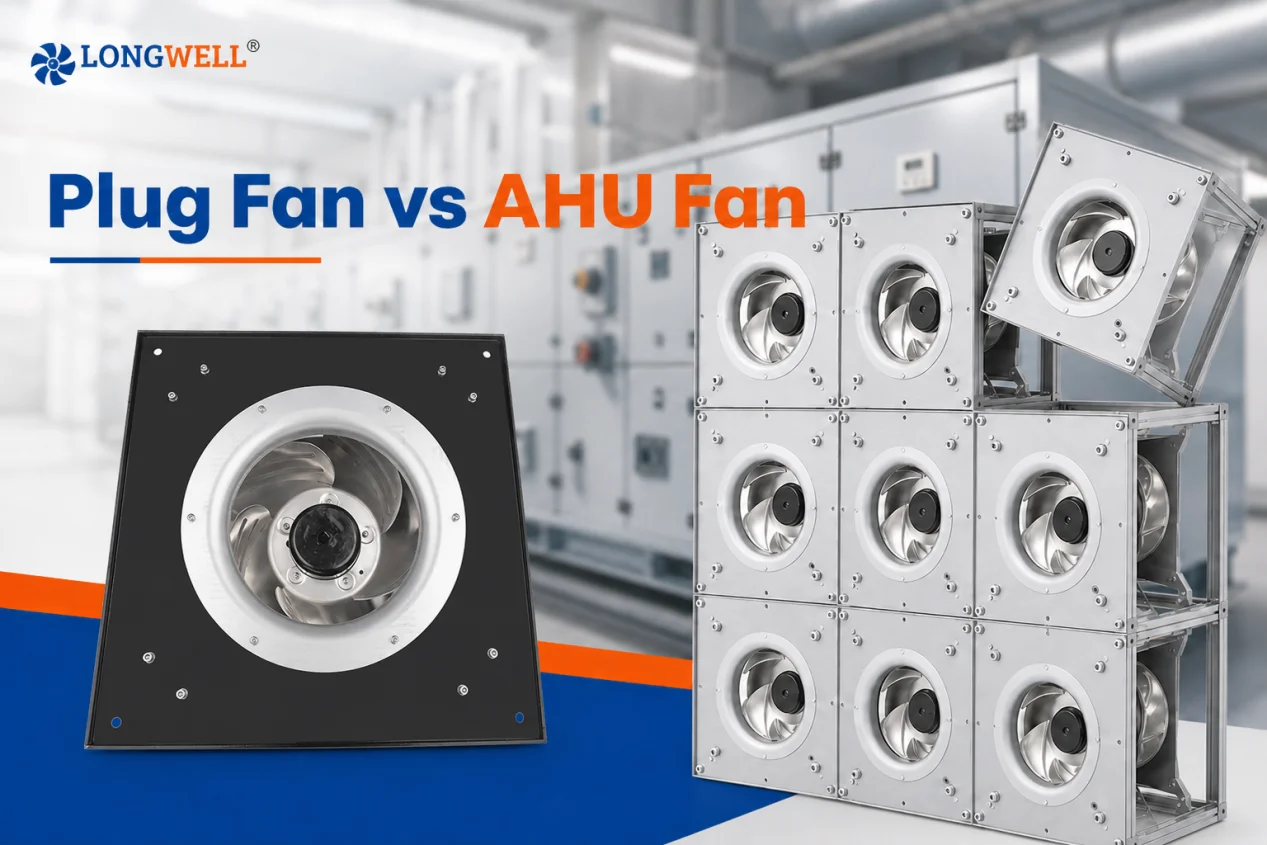
Buyers may ask the question if the plug fan and AHU fan are competing product on a shelf. They are not. The plug fan is a fan construction, while an AHU fan describes where the fan is used. This article explains what plug fans and AHU fans are separately and why more and more AHU OEMs move to EC plug fans.
The Short Answer
The short answer of differences between plug fan and AHU fan is that plug fan is a specific fan configuration, and AHU fan is a broader application term. The plug fan refers to an impeller-and-motor assembly that runs without a scroll housing. It is worth noting that the fan used in modern AHU systems is often plug fan.
What is a Plug Fan?
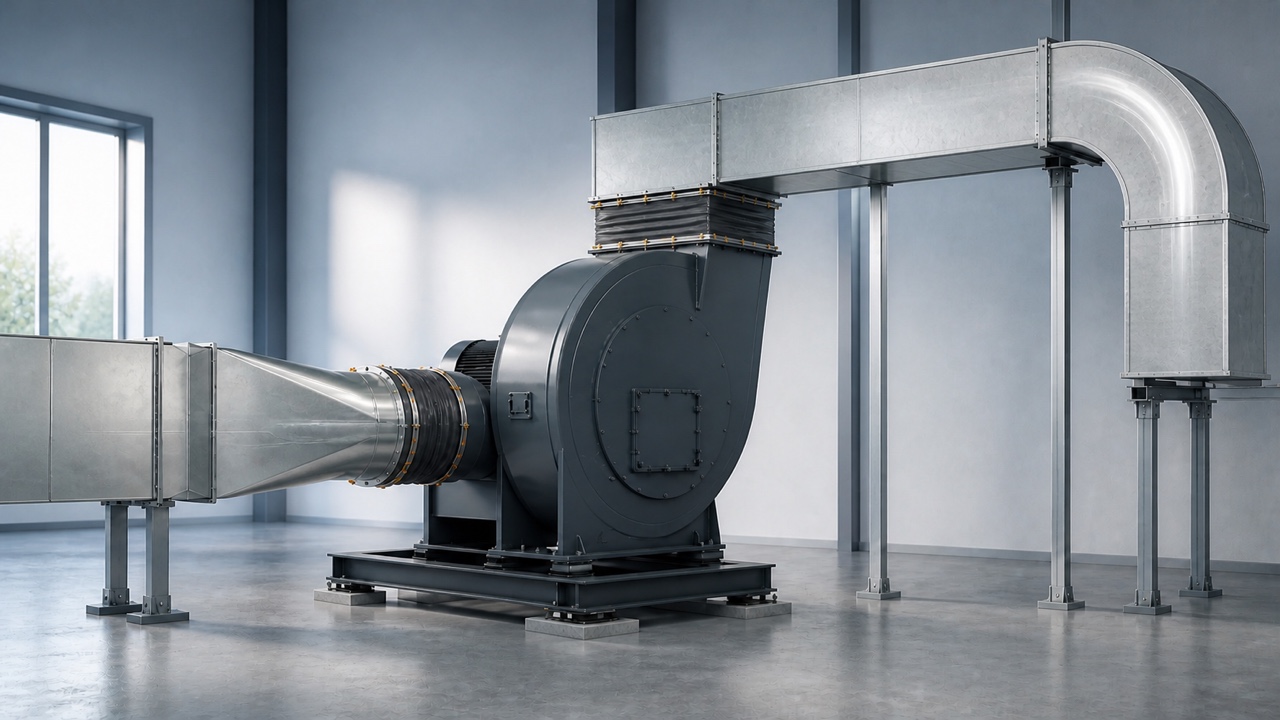
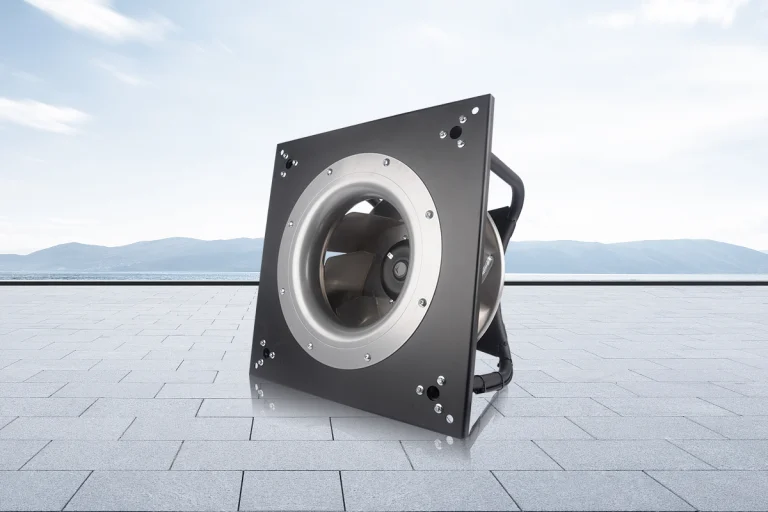
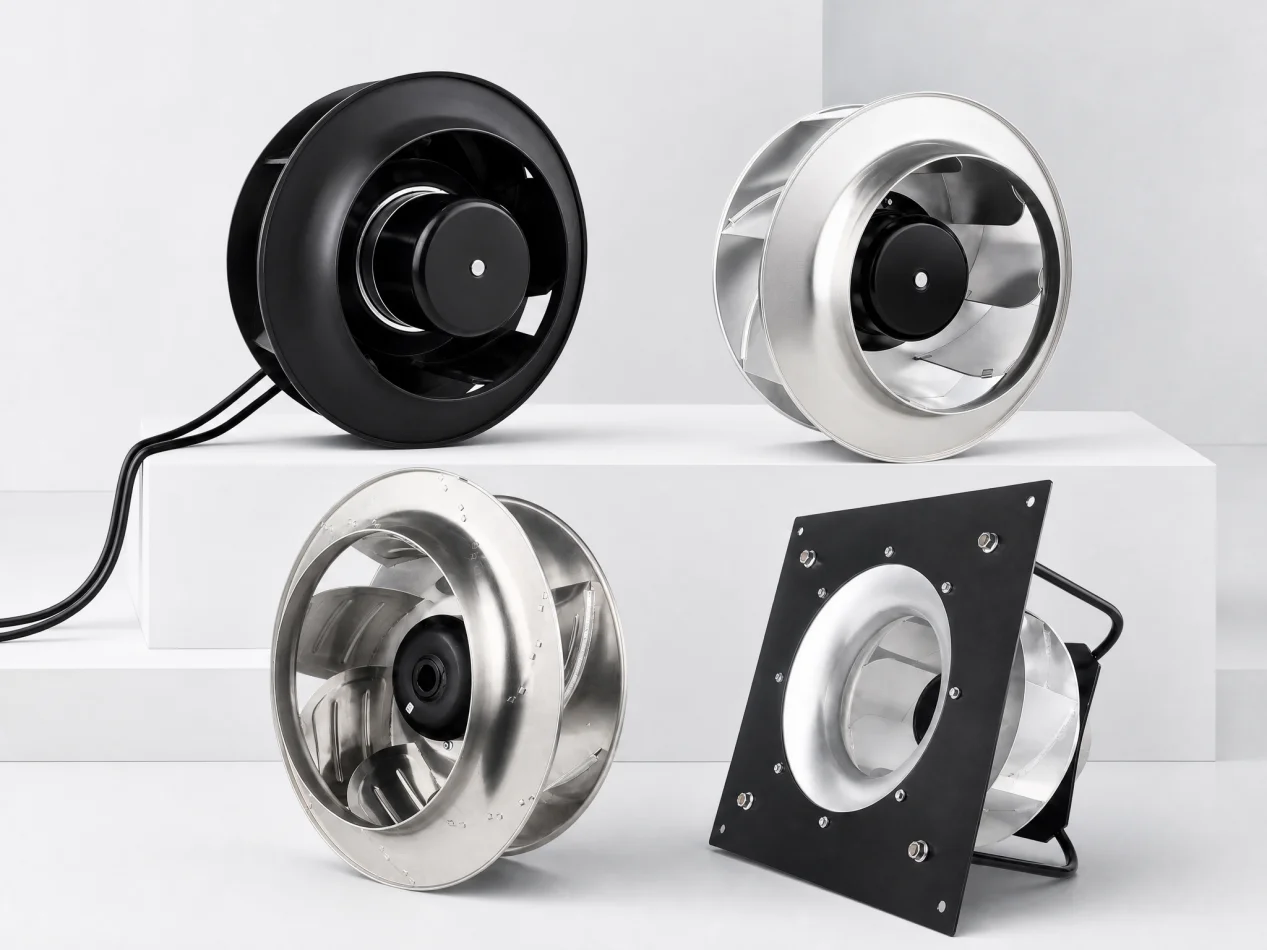
The plug fan is generally a centrifugal fan without the traditional spiral or scroll housing. The plug fan usually contains a backward-curved centrifugal impeller mounted directly on the motor shaft and the whole assembly is mounted through a hole in the panel wall of a plenum. As the name implies, the assembly “plugs” into the wall. The plenum itself recovers part of the velocity pressure, which is the job the scroll used to do. Plug fans have three important construction details:
- Direct drive. The rotor is dynamically balanced as one assembly, which is why a healthy plug fan runs without the vibration signature of a worn belt set.
- Backward-curved impeller (mostly). Plug fans usually use backward-curved impeller, providing stable pressure characteristics across a wide flow range, and efficiency that holds up at off-design points.
- Motor inside the airstream or on the plenum wall. The motor is cooled by the air it moves — check the temperature rating against your application. Cold-chain AHUs see minus 30 °C; heat-recovery units see 50 °C plus.
The LONGWELL plug fan family spans impeller diameters from 315 mm to 1000 mm and motor power from roughly 0.1 kW to 30 kW, in 380 V and 400 V three-phase versions. That size range matters for AHU designers, because it decides whether one fan, two fans, or a full FanGrid covers the duty.
What an AHU Fan Used to be?
The AHU fans is not one specific fan design. It refers to the fan used in an air handling unit to move air through filters, heating and cooling coils, heat exchangers, and ducts. In the past, “the fan in the AHU” meant the DWDI centrifugal fan. These fans were often driven by AC motors through belt-and-pulley systems. Belt drive itself gives up a few percentage points of efficiency before the air even starts moving. With the evolvement of HVAC system, direct-drive and EC plug fans have become increasingly popular in modern AHU.
Plug Fan vs Traditional AHU Fan Comparison Chart
|
Dimension |
Plug fan (EC, direct drive) |
Traditional AHU blower (DWDI, belt drive) |
|---|---|---|
|
What it is |
A construction: motor-impeller assembly, no scroll |
One specific architecture used inside AHUs |
|
Housing |
None |
Scroll / volute built into the fan section |
|
Drive |
Direct, motor on the impeller shaft |
Belt and sheaves, external motor |
|
Flow control |
Motor speed via 0–10 V / PWM / Modbus |
Dampers, or a VFD on the motor |
|
Part-load power |
Falls with the cube of speed |
High — dampers throttle without unloading the fan |
|
Maintenance items |
Bearings; impeller cleaning |
Belts, sheaves, belt guard, bearings, motor alignment |
|
Casing length |
Short |
Longer |
|
Redundancy |
Natural — multiple fans form a FanGrid |
Usually one large fan; redundancy needs a full second unit |
|
Initial cost |
Higher per fan |
Lower per fan |
|
Typical home |
High-efficiency AHUs, CRAH units, cleanroom air handling, retrofits |
Constant-flow units, price-driven standard AHUs |
Why AHU OEMs Moved to EC Plug Fans?
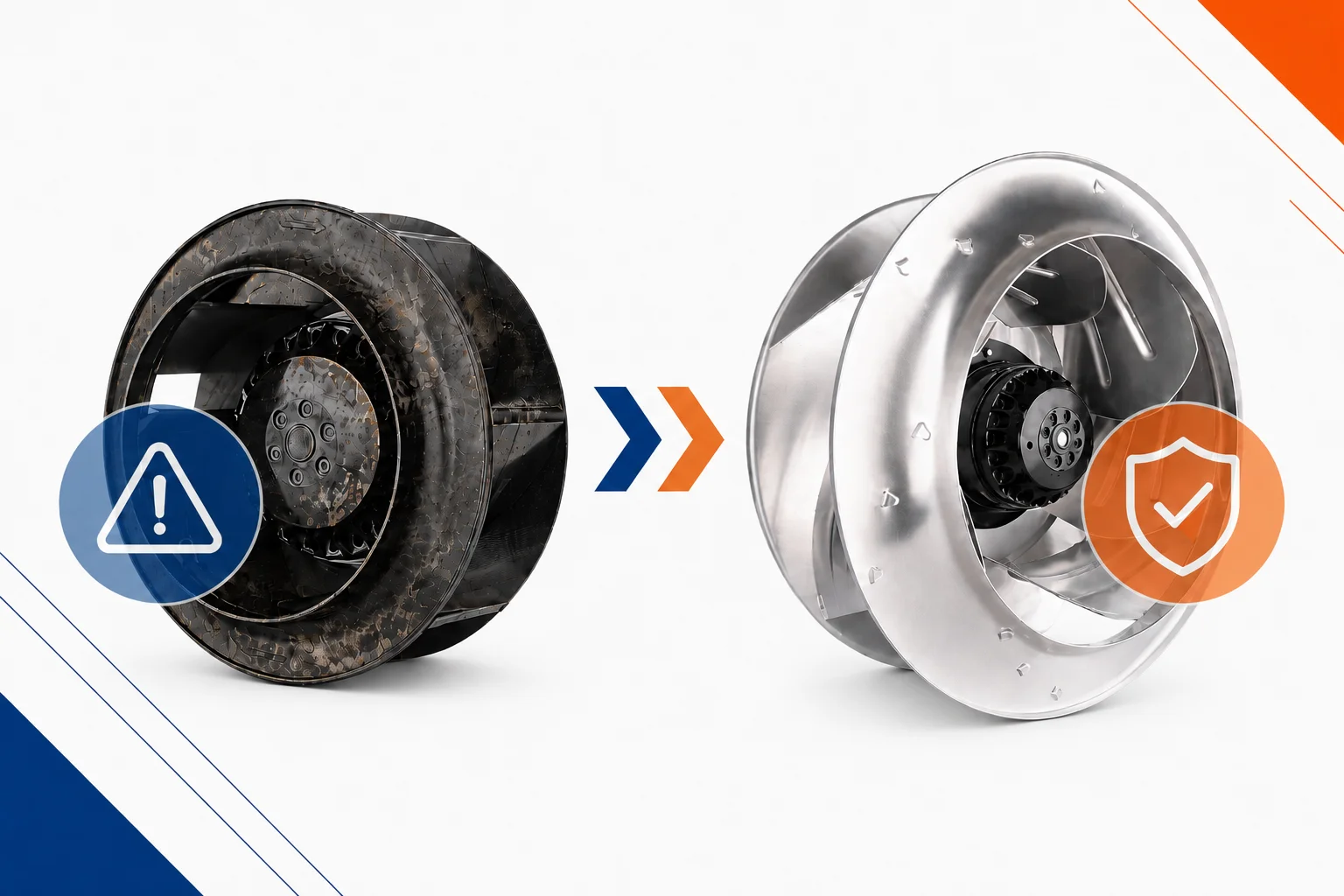
As HVAC manufacturers face growing demand for lower energy consumption, flexible airflow control, and reduced maintenance, more and more AHU OEMs are moving from belt-driven blowers to EC plug fans. The old setups can lose energy through the belt, while EC plug fans don’t require a large scroll housing and they provide higher efficiency. EC plug fans cut fan power 30–50% at typical operating points, remove the belt drive and its maintenance window, deliver n+1 redundancy in a compact footprint, and are the only realistic way to meet current ErP efficiency tiers in a plug-fan format. For most AHU duty points, the payback is 1–3 years.
For AHU OEMs, the shift is not just about changing one fan type to another. It is about improving the overall efficiency, controllability, reliability, and integration of the AHU.
Single Plug Fan vs Fan Array
A fan array or fan grid replaces the large fan with several smaller plug fans working in parallel. An AHU might use four, six, or eight small plug fans, each fan contribute to part of the whole airflow. And each fan can be designed with individual speed control or common speed control or the combination of both. The benefits stack:
- N+1 redundancy. One fan fails, the neighbors speed up, the unit keeps running while you wait for a replacement.
- Staged service. Isolate and swap one fan without taking the AHU offline. In hospitals and cleanrooms this is the argument that closes the sale.
- Part-load sound. At reduced load the grid runs every fan slower instead of a few fans flat out, and A-weighted sound drops with tip speed.
Which Fan Type Fits Your Project?
|
Project |
Fan Type |
|---|---|
|
Airflow varies with occupancy or load |
EC plug fan |
|
Mechanical room is tight or the AHU section must shrink |
EC plug fan |
|
Uptime is contractual (hospital, cleanroom, data center) |
FanGrid of EC plug fans with engineered N+1 |
|
Replacing one large belt-driven blower in an aging unit |
Fan wall retrofit |
|
Constant flow, lowest first cost, belt service is routine |
DWDI belt-driven blower remains a defensible choice |
|
EU market, input power ≥ 125 W at BEP |
Either architecture — but demand the ErP 2024/1834 whole-fan efficiency declaration |
LONGWELL Selection Table
|
Item |
Market / legacy condition |
Engineering recommendation |
|---|---|---|
|
Term |
Meaning |
Typical LONGWELL link |
|
Plug fan |
Fan construction without scroll housing |
LWBE3G / AHU Plug Fan |
|
AHU fan |
Application inside an air-handling unit |
AHU Plug Fan |
|
FanGrid |
Multiple EC plug fans in one plenum |
Fan Grid system |
|
Forward-curved blower |
Compact low-pressure construction |
LWFC |
5 Often Mixed Up Concepts
- “A plug fan is an EC fan.” No. Plug fans come in AC versions, but EC fan is the common pairing in new AHU designs.
- “AHU fan” names a fan type. It names a location. A fan in an air-handling unit can be a plug fan, a DWDI blower, or in some packaged units an inline axial.
- “Plug fans win everywhere.” At constant full flow, the efficiency gap narrows — belt losses are a few points, not a canyon. The plug fan’s advantage compounds in modulating systems. A constant-flow process AHU that runs 24/7 at one duty point deserves an honest comparison of both curves, not a default.
- “More fans means redundancy for free.” It needs control zoning, design headroom and service access.
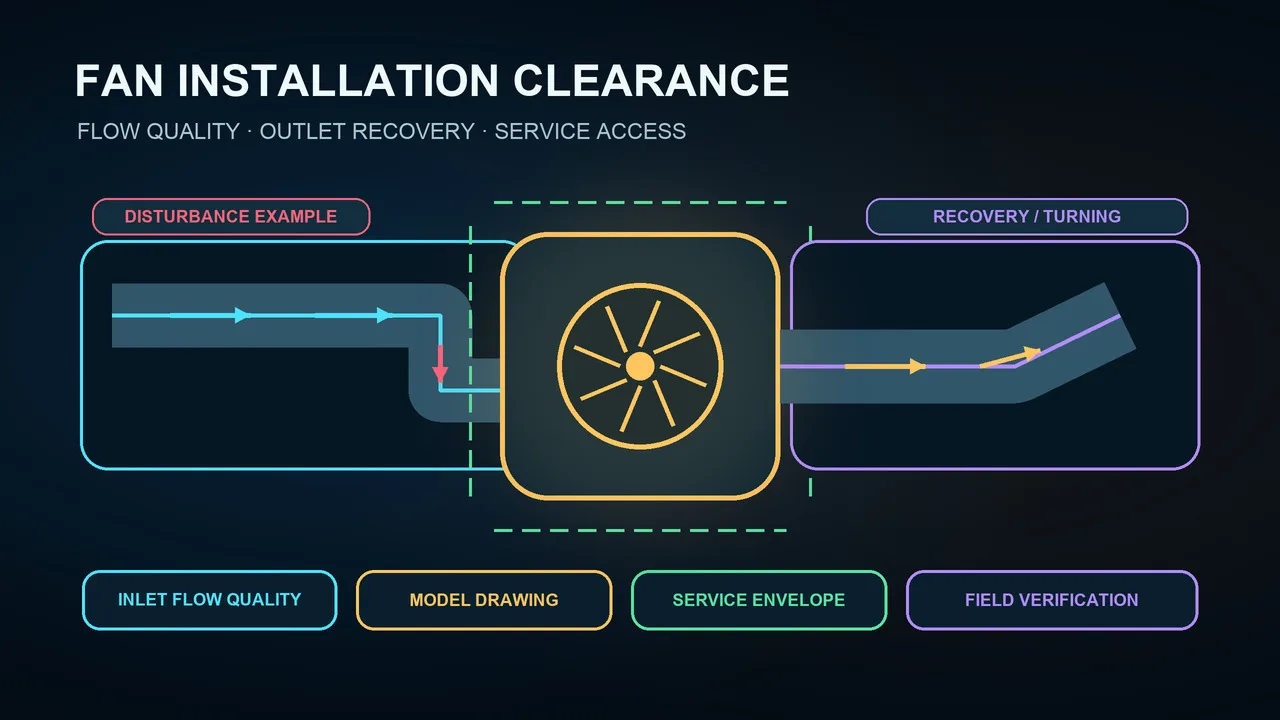
- “Any plug fan drops into any AHU.” Plenum depth, panel cutout diameter, inlet clearance, motor cooling path, and — in the EU — the ErP 2024/1834 efficiency grade all constrain the drop-in claim.
FAQs
Can an AHU use more than one plug fan?
Yes. Multiple plug fans in one shared plenum form a FanGrid, used for N+1 redundancy, staged maintenance and lower part-load sound. The redundancy only counts if the control strategy can detect a fan trip and redistribute airflow.
Is a plug fan always EC?
No. Plug fans exist in AC and EC versions — the construction and the motor technology are independent choices. EC dominates new AHU designs because speed control is built into the motor and part-load efficiency stays high.
Is a plug fan the same as a plenum fan?
In practice, yes — the names are used interchangeably. Both describe a direct-drive motor-impeller assembly mounted through the wall of a plenum, running without a scroll housing.
What is a fan array in an AHU retrofit?
A fan array in an AHU retrofit replaces a single large or outdated fan with multiple smaller fans operating in parallel.
Is a fan wall better than a fan array?
In most cases, they are the same thing. The terms describe related concepts, and the best configuration depends on the AHU design and application.