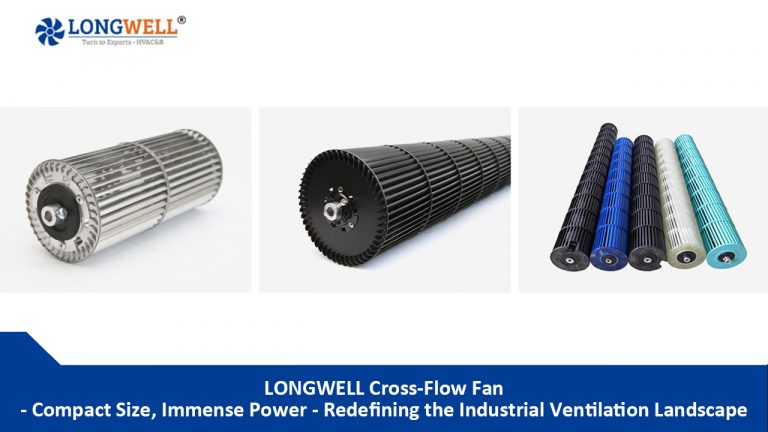
Efficient airflow and ventilation are essential for optimal equipment performance across the HVACR industry, electronic cooling, heat pumps, cold chain, and home appliance cooling. In applications where uniform airflow distribution is required, a cross flow fan has become a widely adopted solution due to its slim and compact structure. Some people may wonder whether tangential blowers and cross-flow fans are the same type of fan. In most cases, tangential fans and cross flow fans describe the same fan technology. But in fact, they have subtle differences under some conditions. Understanding the relationship between these terms helps engineers select the right fan solution.
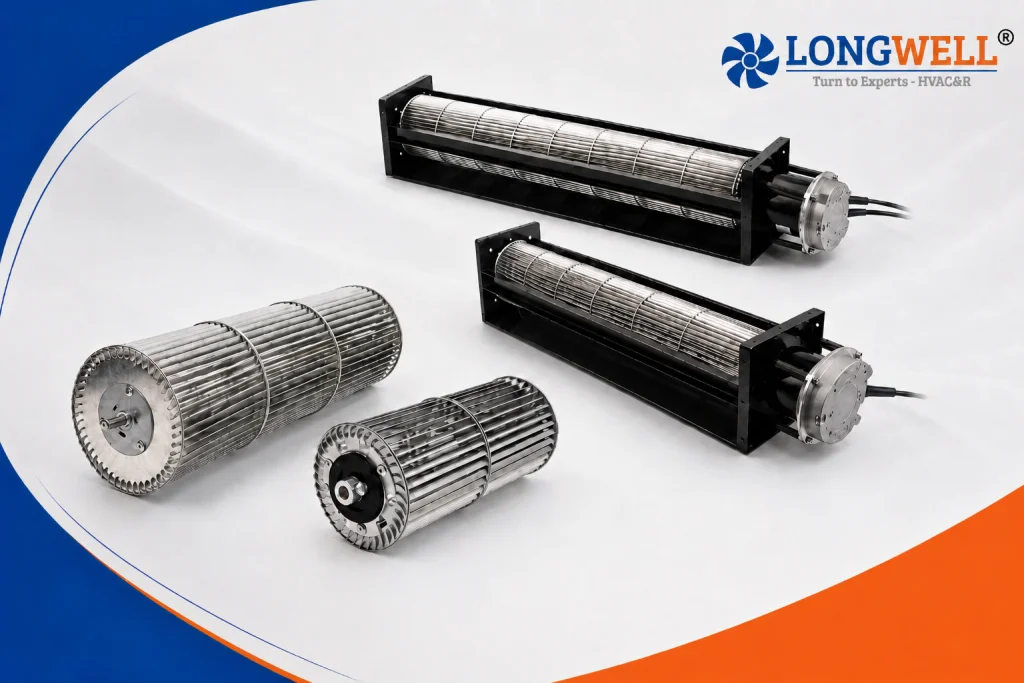
Tangential Blower vs Cross Flow Fan: What is the Difference?
What is a Tangential Blower?
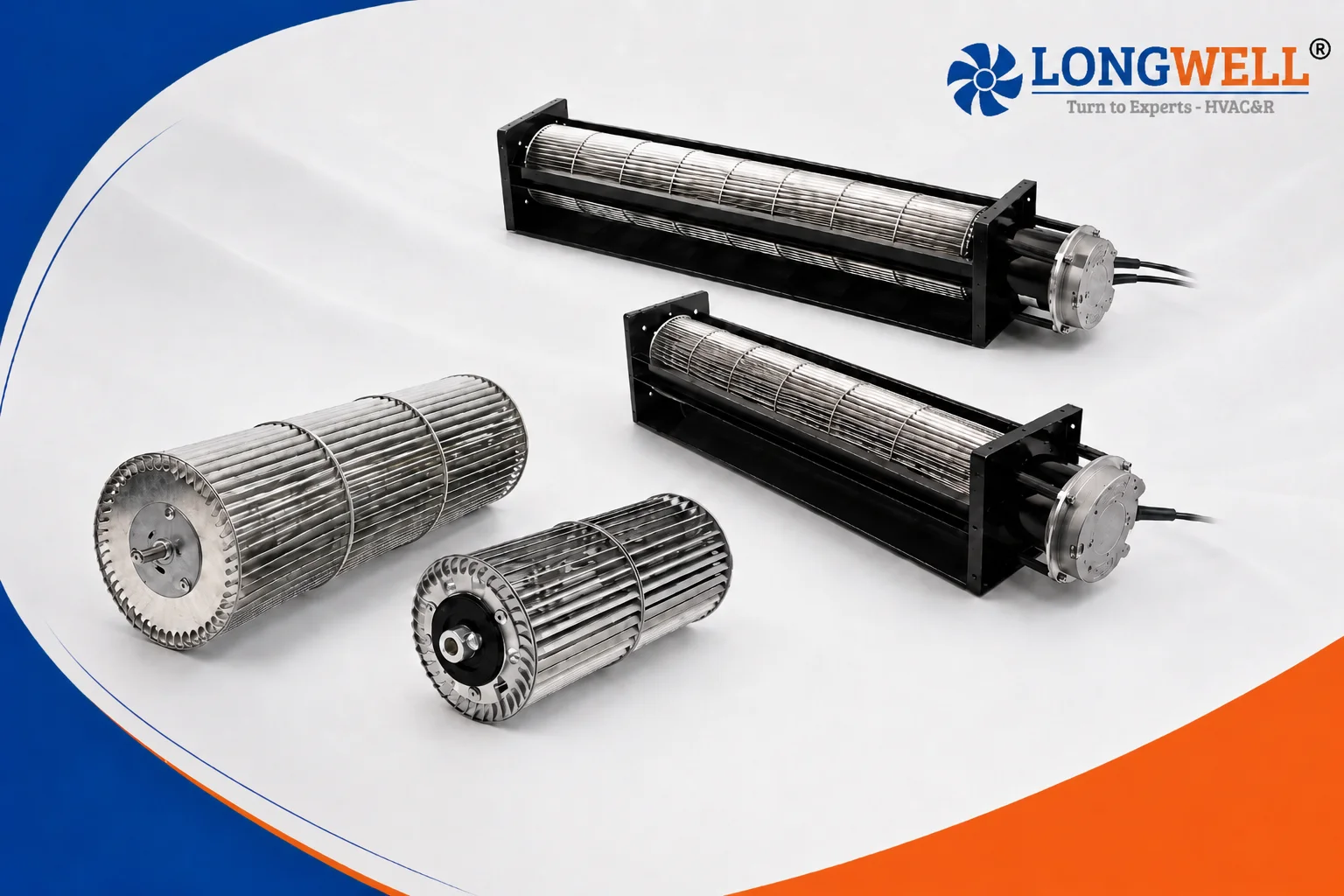
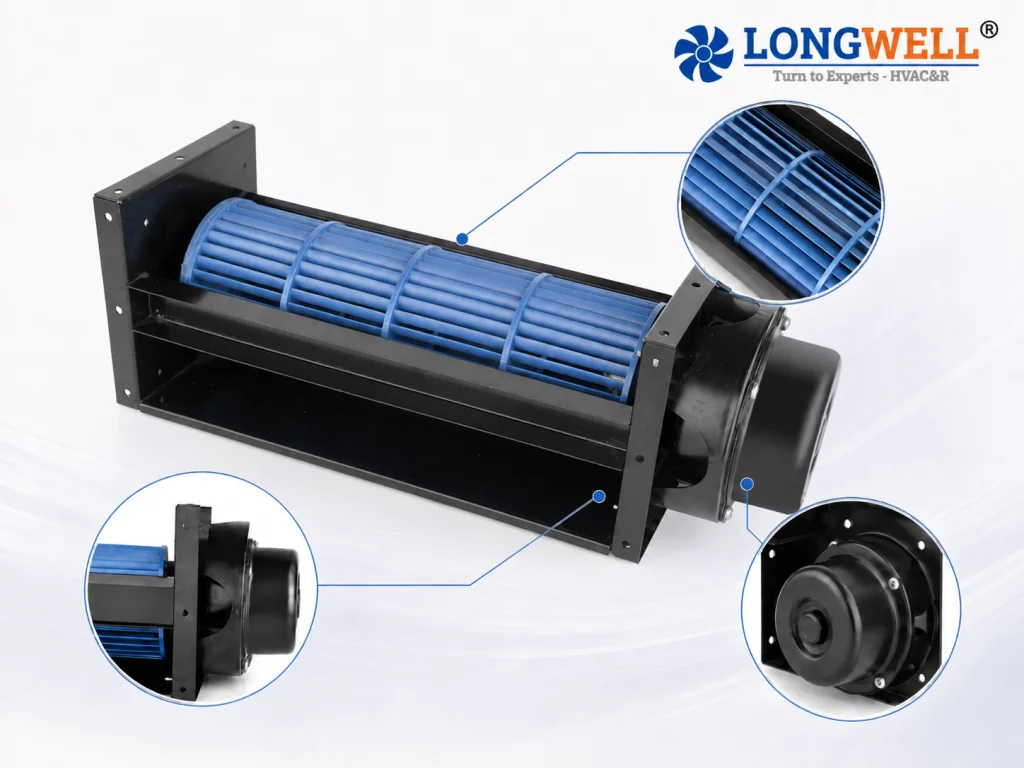
A tangential blower, often called a tangential fan, uses a long cylindrical impeller with forward-curved blades. Instead of producing a concentrated airstream, it delivers airflow along its long impeller. Air enters along the impeller and is discharged across a wide outlet, producing a broad and relatively uniform airflow pattern. One major advantage is its wide airflow coverage. A single long impeller can move enough air, reducing the requirement for installing several smaller fans in one piece of equipment.
Tangential blowers generally operate in low-to-medium pressure conditions, so they are more suitable for applications requiring wide airflow coverage. Their slim construction is also useful when installation depth is restricted. Tangential blowers are often considered for large HVAC units, heaters, commercial air curtains, and household appliances.
What is a Cross Flow Fan?
A cross flow fan is closely related to the tangential blower and can be considered a specialized form. Its name emphasizes the airflow path. When a cross flow fan operates, the rotating cylindrical impeller draws air into the fan from one side. The airflow passes through the rotating blades and moves across the impeller before leaving through the outlet. This unique airflow path creates a long and relatively uniform air stream along the entire length of the impeller.
During operation, the rotating blades transfer energy to the airflow and generate an internal vortex inside the impeller. This vortex helps stabilize the airflow movement and allows the cross flow fan to maintain a relatively even air distribution across the outlet. Compared with other types of fans, cross flow fans are designed to provide wider airflow coverage and lower noise levels with a compact structure.
Why Are Two Names Used?
When comparing tangential blowers and cross flow fans, the first question engineers often ask is whether these are two different fan designs. In most applications, the answer is no.
A tangential blower and a cross flow fan typically refer to the same type of fan. They feature a long cylindrical impeller with forward-curved blades that generate airflow across the length of the rotor.
Manufacturers and engineers chose different names based on what they wanted to focus on. The name tangential blower points to the way air moves. Air leaves the blade tips at a tangent. The name cross flow fan describes the path of the air. Air flows across the impeller from one side to the other. In practice, the two names describe the same general fan architecture from different perspectives.
Are Tangential Blowers the Same as Cross Flow Fans?
The terminology developed from different ways of describing the same general fan architecture. Tangential refers to the relationship between airflow and the rotating impeller, while cross flow emphasizes how air passes across the impeller. But under some conditions, they are not really the same thing. Tangential blowers are often used for low-to-medium static pressure applications like HVAC systems, heating systems, and industrial applications. Cross flow fans are ideal for surface cooling and electronic cooling and compact HVACR applications.
Manufacturers may therefore use a tangential fan, tangential blower, or cross flow fan for closely related products. When comparing suppliers, engineers should look beyond the product name and check the actual impeller dimensions, airflow, static pressure, speed, motor type, and installation configuration.
Note:
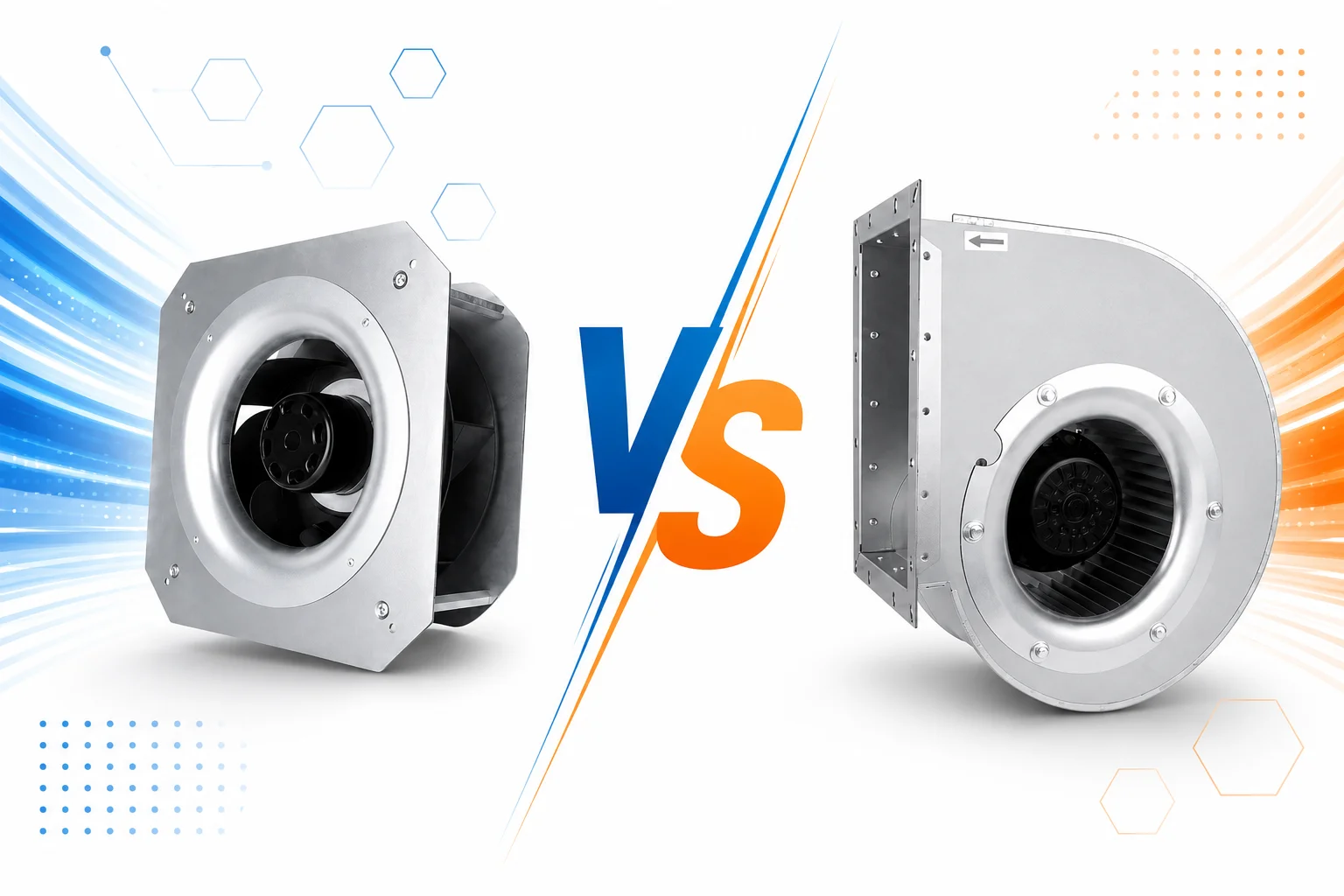
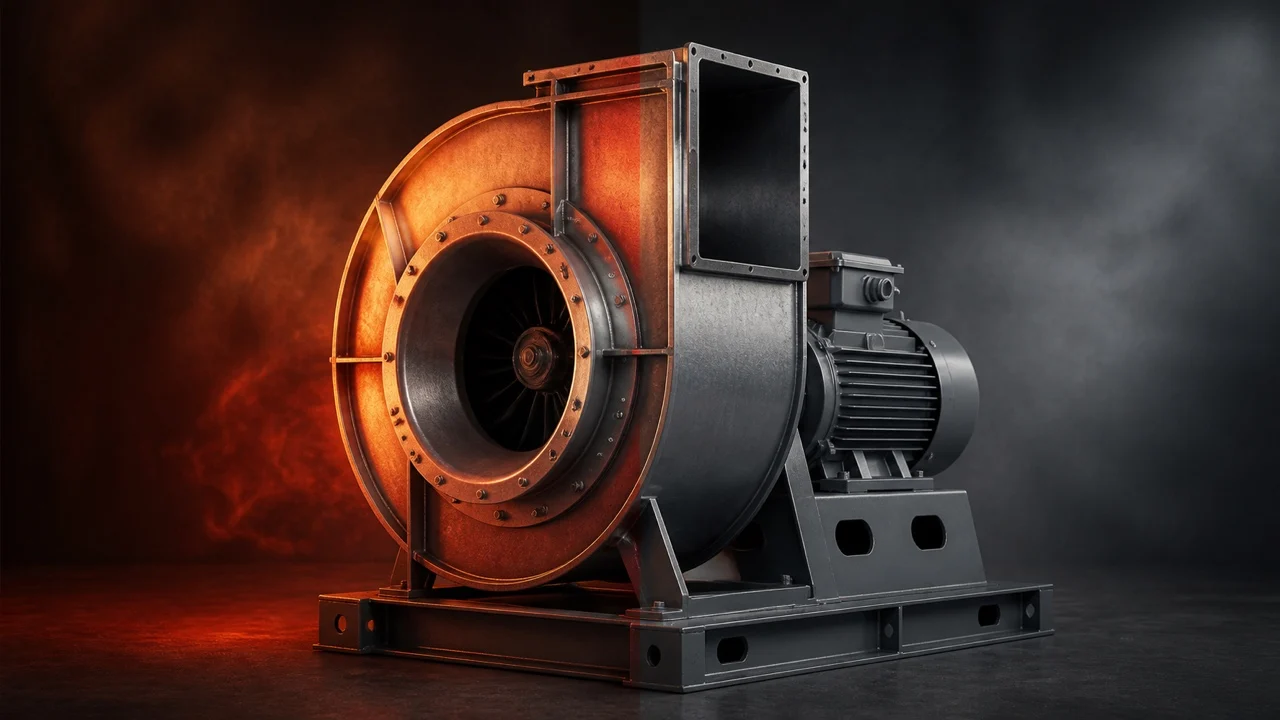
Tangential Blower vs Centrifugal Blower: Tangential blower and centrifugal blower both use rotating blades to move air, but they serve different purposes. The tangential blower focuses on providing a wide and uniform airflow distribution. Centrifugal blowers pull air into the impeller center and throw it outward through the fan housing outlet, turning rotational energy into static pressure. The centrifugal blowers are more suitable for industrial and commercial HVAC systems to overcome the high system resistance.
Axial Fan vs Cross Flow Fan: Both axial fan and cross flow fan designs work better in low static pressure environments. Axial fans are better suited for open airflow environments or low-resistance systems. They can move a large amount of air efficiently and create a focused jet of airflow. Typical applications for axial fans include electronics and electrical cabinet cooling, condenser units, cooling towers, and HVAC outdoor units.
Common Applications of Cross Flow Fans
Refrigerated and Cold Chain Solutions
Refrigeration equipment is moving toward higher efficiency, lower energy consumption, and more stable temperature control. In display cases, beverage coolers, and medical refrigeration equipment, airflow distribution directly affects temperature consistency and cooling performance. Cross flow fans generate a continuous and evenly distributed airflow stream across the full length of the impeller, helping reduce temperature variation inside refrigerated compartments. It also provides a consistent airflow to maintain a stable temperature throughout the storage area for cold chain applications.
Residential Ventilation Systems
Airflow uniformity is one of the most important factors in HVAC and residential ventilation systems, uneven air distribution can reduce heat exchange efficiency and then affect user comfort. The cross flow fans are commonly integrated into air conditioning indoor units, heat pump indoor modules, fan coil units, and air purification equipment. Their slim cylindrical structure allows compact installation while maintaining a wide airflow coverage area. With reduced turbulence airflow, the noise level of cross flow fans are usually lower.
Noise performance is a critical factor in residential applications, especially for equipment operating continuously in bedrooms and living rooms. LONGWELL cross flow fans optimize aerodynamic blade design and impeller balance to reduce airflow turbulence and mechanical vibration during operation.
| Specification | LONGWELL Cross Flow Fan Options |
| Impeller Diameter | 25 mm – 150 mm |
| Impeller Length | 76 mm – 1200 mm |
| Motor Type | AC, DC Brushless, EC Motor |
| Voltage Options | 12V, 24V, 48V, 115V, 230V |
| Housing Material | Aluminum alloy / metal housing |
| Bearing Options | Ball bearing |
| Operating Temperature | -20°C to +60°C (EC series) |
| Noise Performance | Down to 19 dBA (DC series) |
How to Select a Cross Flow Fan for OEM Applications?
Calculate Airflow and Static Pressure
Start with the required airflow in m³/h or CFM and the static pressure calculation. These two specifications should be evaluated together. The maximum airflow in the technical document does not represent the practical performance inside the equipment. Filters, heat exchangers, grilles, internal components, and narrow airflow passages all add resistance.
Actual Operating Point
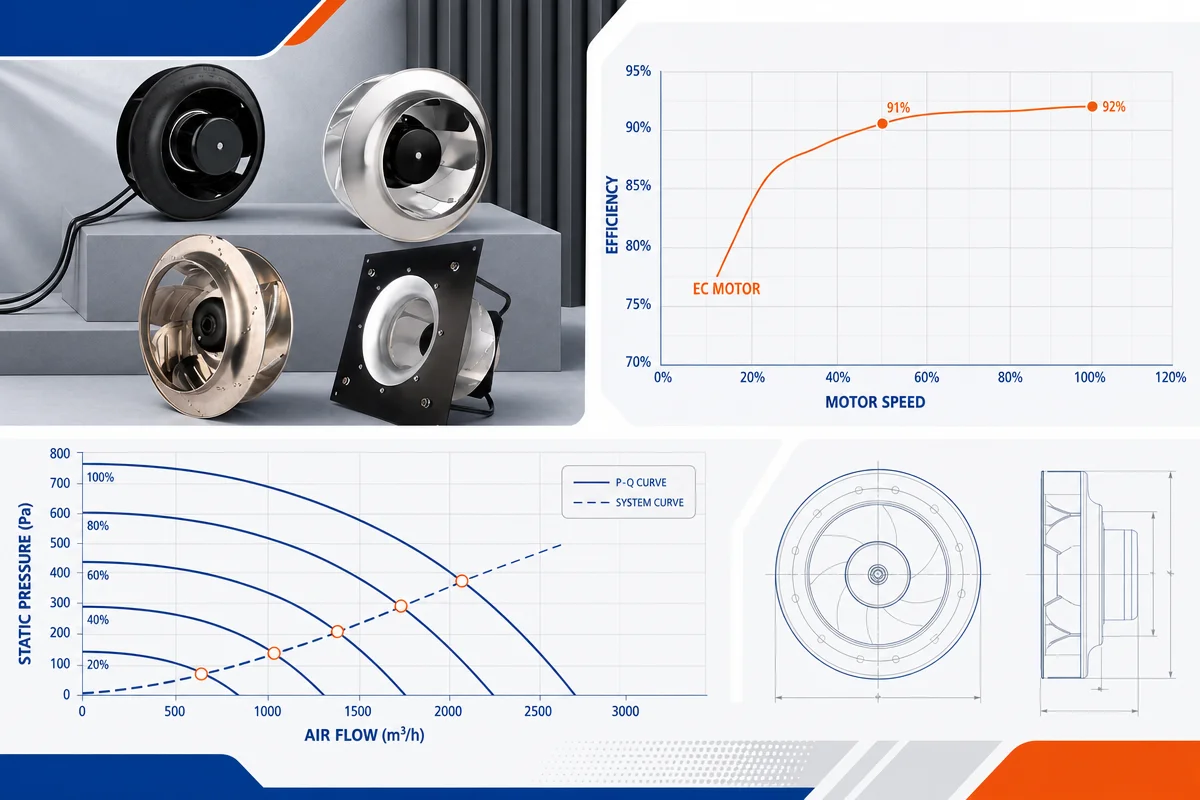
Combine the fan’s P-Q performance curve with the system resistance curve to confirm the operating point. This point gives a more realistic indication of fan performance than maximum airflow or maximum pressure values alone. For OEM applications, it is also useful to leave a reasonable performance margin for changes in resistance caused by filter loading or different operating conditions.
Fan Size and Installation Space
Cross flow fans are often selected for compact applications due to their long and slim structure. However, the selection should be based on impeller diameter and length, inlet clearance, outlet direction, and mounting space. These requirements all need to be matched with the equipment. For instance, the impeller length should also correspond to the width of the heat exchanger, heating element, or outlet area to achieve the required airflow distribution.
Evaluate Noise and Vibration
Noise is particularly important for residential HVAC, home appliances, and refrigeration displays. Fan speed, airflow resistance, bearing condition, impeller balance, and installation can all affect the final sound level. Rather than comparing dB(A) values alone, OEM engineers should check whether acoustic performance is measured under conditions close to the intended operating point.
Tangential Blower and Cross Flow Fan — LONGWELL is Your Best Choice
The tangential blower and cross flow fan generally refer to the same fan technology. At LONGWELL, we primarily use the term cross flow fan across our product categories and technical documents. This naming is intended to keep specifications consistent and make it easier for engineers and procurement teams to compare models and performance data.
LONGWELL cross flow fans are available with multiple impeller diameters from 30mm to 150mm, and lengths up to 1400mm. Fan configurations can be adapted to different airflow, static pressure, noise, voltage, control, and installation requirements for residential ventilation, home appliances, refrigeration equipment, or heating systems. Each cross flow fan can be tested to meet ISO9001, CE, UL/ETL, and RoHS standards.
Whether your project specification uses a tangential fan, tangential blower, or cross flow fan, LONGWELL can evaluate the application based on the actual operating requirements and recommend a suitable cross flow fan solution. Products that are not included in the standard catalogue will be provided with customized services. LONGWELL’s 90-day NPI process can provide OEMs from design confirmation to mass production within 90 days.
FAQ
Are tangential fan and cross flow fans the same thing?
Yes. In most HVAC and OEM applications, tangential fan and cross flow fan refer to the same fan technology.
How does a cross flow fan produce uniform airflow?
A cross flow fan uses a long cylindrical impeller to draw air perpendicular to the shaft and discharge it across the length of the rotor. The airflow is distributed along a long outlet, so that the airflow is uniform.
What noise levels can engineers expect from LONGWELL cross flow fans?
Noise depends on impeller diameter, fan length, operating speed, and airflow requirement. Some specs can have a noise level below 20 dBA.
Can a cross flow ventilator handle high static pressure applications?
Cross flow fans can generate static pressure, but they are generally not the preferred solution for high-static-pressure systems.