Cooling Outdoor Cabinets at High Altitudes
The customer asked us for a new RS485 EC axial fan. First, they needed it to cool an outdoor metal box. Next, the RS485 EC axial fan had to move exactly 4500 m³/h of air. It also had to push this air against 150 Pa of static pressure. Furthermore, the metal box did not have much extra room. So, the RS485 EC axial fan blade had to measure exactly 400 mm or 450 mm. The system board uses an RS485 Modbus RTU link. This link lets the customer check the fan speed from far away. Therefore, the fan housing needed a strict IP55 water rating. Finally, we added full PCB potting to keep rain out of the circuit board.
The weather rules for this job were very strict. First, the box sits on a mountain at 4,000 meters above sea level. Next, the winter air gets as cold as -35°C. Meanwhile, the summer heat reaches +60°C. Even so, the fan had to stay very quiet. The customer set a hard limit of 75 dB(A) for the noise. However, high mountain air is very thin. So, normal fans must spin much faster just to move enough air. Consequently, standard fans get too loud and fail this test. Finally, our team tests all airflow to strict ISO 5801 methods. In short, we knew exactly what the fan had to do.
Picking the Right Blade and Motor
The strict weather rules meant standard catalog fans would not work. First, we checked the 400 mm blade option. A 400 mm fan must spin extremely fast to push 4500 m³/h against 150 Pa. However, fast blades chop the air very hard. Consequently, the 400 mm fan made far too much noise. It easily broke the 75 dB(A) noise limit. Therefore, we rejected it right away. Instead, we picked the larger 450 mm PA6+GF plastic impeller. The bigger blade moves the exact same amount of air at a much slower speed. So, the noise drops down to a safe level. In short, the bigger blade solved the noise problem entirely.
Next, we looked at the tough winter temperature limits. The customer wanted the fan to start up perfectly at -35°C. However, standard steel bearings only work down to -25°C safely. To reach -35°C, the factory must pack the bearings with special aerospace grease. By contrast, normal grease gets too solid in deep cold. Even so, the special grease comes with a materially higher cost. Furthermore, it adds weeks to the factory lead time. We told the customer about this big cost jump. So, they decided to change their winter limit to -25°C. Therefore, we used standard bearings and saved them money.
Finalizing the RS485 EC Axial Fan Motor
Thin mountain air causes major problems for electric motors. First, thin air does not soak up heat very well. Consequently, a motor running at 4,000 meters gets much hotter than a motor at sea level. If we built a custom high-altitude motor, it would need heavy copper coils. Instead, we used a strong 1000 W motor designed for normal heights. Next, we gave it a Class F insulation rating. This rating lets the motor safely handle heat up to 60°C. Finally, we added our SmartEC control board to handle the data link. In short, this specific RS485 EC axial fan model does exactly what the customer needs without adding heavy iron.
Technical Specifications
| Model Number | LWAE3G450TS-5PEW-17-47 |
| Nominal Voltage | 3~380 VAC |
| Voltage Range | 300~460 VAC |
| Frequency | 50/60 Hz |
| Speed | 1900 ±5% RPM |
| Current | 1.7 A |
| Power Input | 1000 W |
| Air Flow (Max) | 8343 m³/h (4908 CFM) |
| Static Pressure (Max) | 345 Pa |
| Noise Level (LpA) | 83 dB(A) |
| Operating Temperature | -25°C to 60°C |
| Insulation Class | Class F |
| Protection Type | IP55 + PCB potting |
| Speed Control | 0~10VDC / PWM / RS485 |
| Certifications | CE, RoHS, REACH |
The table shows a maximum noise rating of 83 dB(A). However, this loud noise only happens when the fan hits its top speed of 1900 RPM. Instead, the smart controller keeps the fan running much slower to hit the exact 4500 m³/h target. Therefore, the actual noise in the field stays safely below the 75 dB(A) limit.
Reference: AMCA 210 covers the test method behind these figures.
Technical Documentation
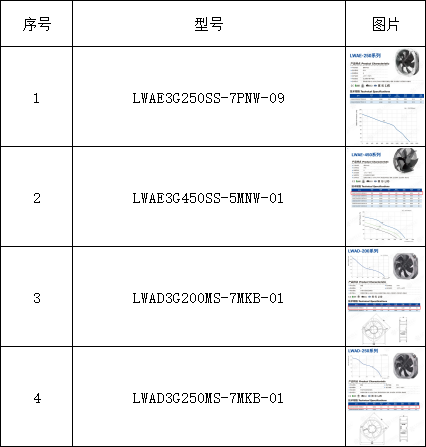
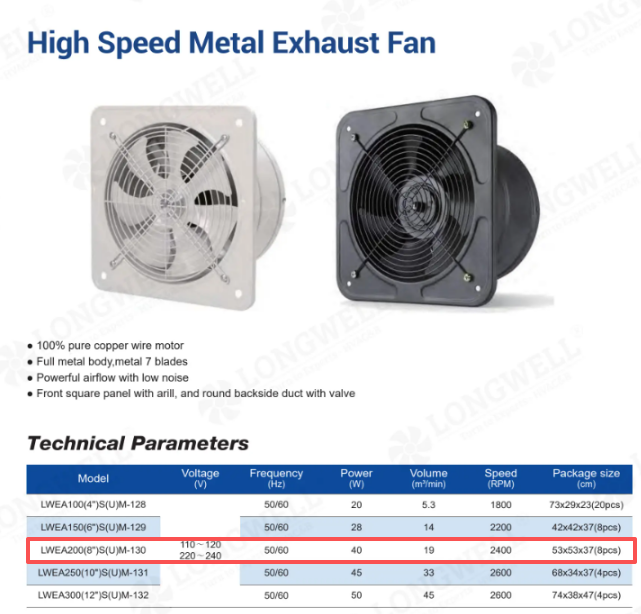
First, this picture shows the exact fan shape and the fully sealed motor housing.
LWAE3G450TS-5PEW-17-47 Technical Specification
Next, engineers use this data sheet to read the performance curve and copy the exact Modbus wiring plan.
How to Buy Fans for High Mountains
Building cooling systems for thin mountain air is a huge challenge. If you face a similar problem, you must test your limits carefully. Keep these rules in mind:
- First, you must verify your true lowest temperature. If you just guess and write down -35°C, you will pay a materially higher cost for custom bearing grease.
- Next, you must understand how thin air breaks motors. Thin air does not remove heat well. Therefore, you must specify a high motor heat rating like Class F.
- Furthermore, you should never pick a fan based only on its maximum noise score. A fan that hits 83 dB(A) at top speed might be perfectly silent at your real airflow point.
- Finally, you must clearly tell the factory about your control needs. The factory must know this early. Consequently, they can fully pot the circuit board to stop water from ruining the data link.
Related: Axial Fans.
Common Questions About Mountain Fans
Technical Documentation & Resources
Browse our axial fans range, the AC axial fans section, or EC axial fans.
Have a Similar Fan Requirement?
Longwell’s engineering team delivers custom spec sheets and samples within 90 days. Since 1990, we have supplied EC fans and blowers to OEMs across HVAC, cold chain, data center, and industrial applications worldwide.
Browse Related Products:
🏆 ISO 9001 / ISO 14001 / ISO 45001 | CE (TÜV) | UL/ETL | ATEX Zone 21/22 | AMCA 210-16 / ISO 5801 tested