Matching Thermal Loads with a 400mm EC Axial Fan
The customer asked us for a 400mm EC axial fan. First, they needed it for an outdoor air handling unit. This HVAC system runs all year long. Therefore, it faces harsh weather shifts.
The site sees deep winter freezing. Next, the summer heat gets very bad. The air temperature drops to -25C. Furthermore, it climbs up to 60C.
So, the fan must survive these massive temperature swings. We looked at the airflow target. The unit needs a steady flow of 4944 m3/h. This equals about 2908 CFM.
Meanwhile, the fan must push this air against internal parts. The outdoor unit sits near a data center. Consequently, the site has a strict noise limit. The fan must stay under 69 dB(A).
Furthermore, the local power grid is not stable. The standard main power is 220V AC. However, the voltage can drop to 176V. Sometimes, it spikes to 264V.
Even so, the fan cannot stop cooling. The customer uses a customized smart system. Finally, they wanted a fan with a 0-10V or PWM control input. This lets them change fan speed as the heat load shifts.
Any choice had to meet strict European safety rules. For example, it must pass CE and RoHS checks. In short, the project called for a tough, smart cooling tool. We test performance to standard ISO 5801 methods.
Engineering the Motor and Control Systems
We had to pick the right motor type. First, we looked at standard AC motors. However, we quickly dropped that idea. An AC motor runs at a fixed speed.
Instead, this system needs to speed up and slow down. So, we picked an electronically commutated motor. This motor matches the exact heat load. Next, we added our SmartEC control board.
The 400mm EC axial fan takes a PWM signal. Also, it accepts a simple 0-10V input. Therefore, the fan reads the customer system directly. It does not need a large outside drive. By contrast, an older AC setup would need a bulky box.
Choosing the Impeller Material
Next, we faced a choice about the fan blades. Many standard fans use plastic blades. Plastics are light and cheap. Furthermore, they speed up very fast.
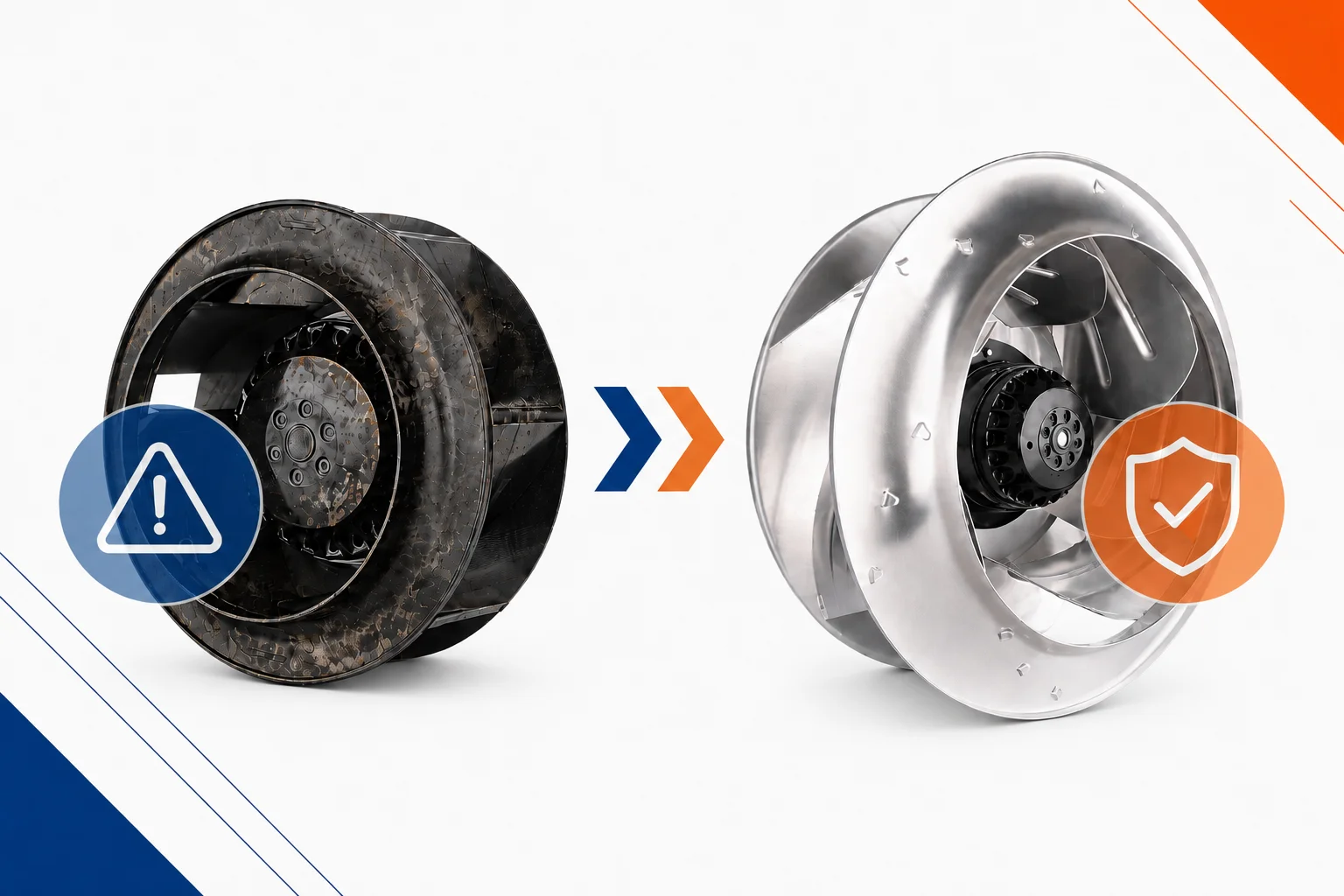
However, plastic fails in extreme cold. The -25C weather makes normal plastic very weak. It can snap under stress. Consequently, we picked a sheet steel impeller.
The strong metal will not crack in the cold. Also, it stays strong at 60C. This choice had a real cost. The metal blades weigh more than plastic.
Therefore, the fan takes longer to start. We had to program a slow start routine. In short, the motor takes up to 20 seconds to reach full speed. This protects the internal parts from sudden strain.
Balancing Speed Against Noise
We also had to balance speed and noise. The customer needed 4944 m3/h of air. First, we could spin the motor fast. A speed of 1800 RPM moves more air.
Even so, this fast speed makes too much noise. It would easily pass the 69 dB(A) limit. Therefore, we capped the top speed. The final design runs at exactly 1600 RPM.
This careful tuning keeps the fan quiet. Meanwhile, it still hits the airflow goal. The 400mm EC axial fan draws 315W of power. Finally, we used good deep groove ball bearings.
These bearings last for 40,000 hours. The custom design gave the customer exactly what they needed.
Technical Specifications
Here are the exact numbers for the 400mm EC axial fan.
| Parameter | Value |
|---|---|
| Airflow (Max) | 4944 m3/h (2908 CFM) |
| Input Power | 315 W |
| Speed | 1600 RPM |
| Voltage | 220 VAC (Range: 176~264 VAC) |
| Frequency | 50/60 Hz |
| Current | 1.4 A |
| Noise Level | 69 dB(A) |
| Operating Temperature | -25°C to 60°C |
| IP Rating | IP54 |
| Insulation Class | Class B |
| Certifications | CE, RoHS, Reach |
The wide voltage range matters most here. First, it stops the fan from quitting when the grid drops to 176V. Next, the IP54 class keeps dust and splashing water out of the motor. Finally, the Class B insulation stops the wires from melting at 60C.
Reference: AMCA 210 covers the test method behind these figures.
Technical Documentation
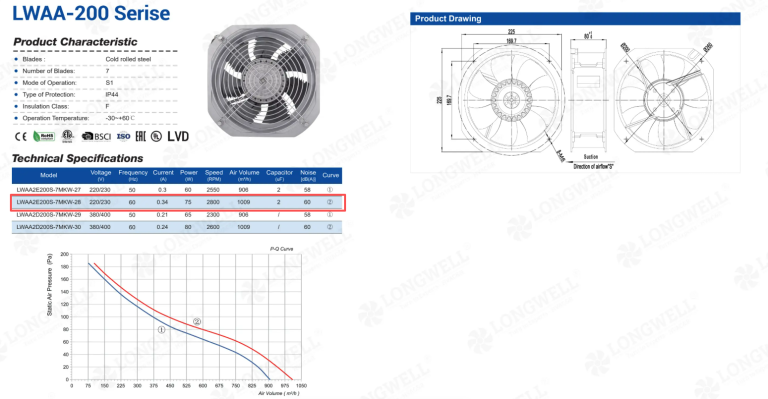
This spec sheet gives engineers the exact wiring steps, size numbers, and airflow curves.
Download the 400mm EC axial fan specification PDF
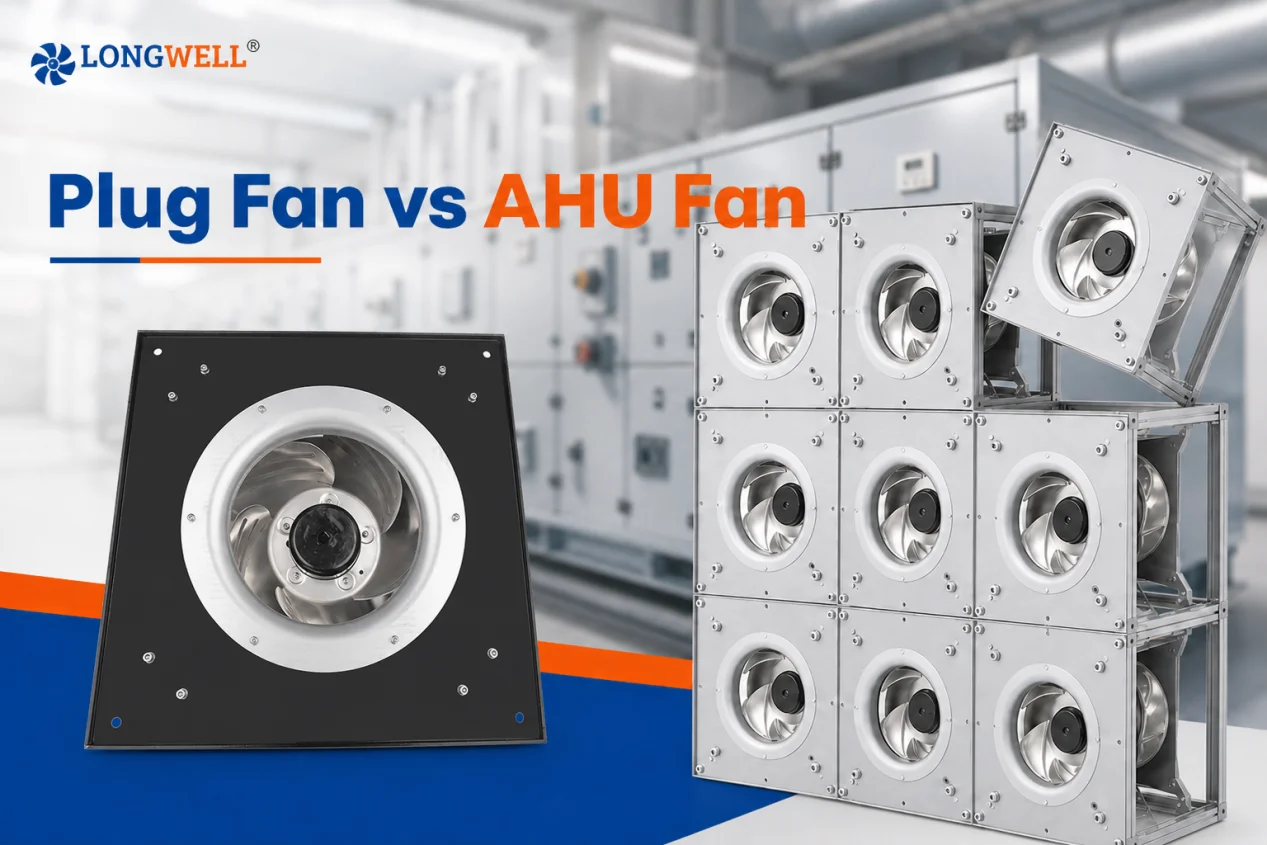
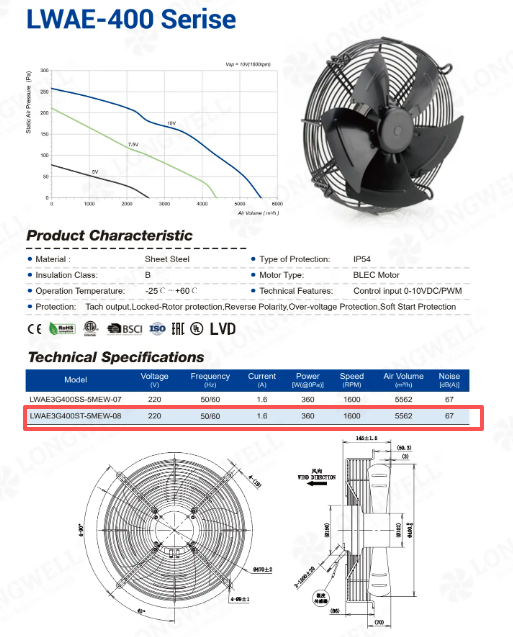
This picture shows the metal blades and the basic motor shape for system builders.
How to Spec Fans for Extreme Weather
Design teams must think about bad weather early in the process. Often, the deep cold causes more trouble than the high heat. Standard plastics turn to glass below freezing. They will break when the motor spins up. Therefore, you must match your materials to the real site data.
- Check your local power grid before you order. A wide voltage range keeps the fan running during grid dips.
- Give your supplier a hard noise limit in dB(A). First, they will tune the top RPM to stay under that line. Next, they can pick a blade shape that cuts noise.
- Plan for a slow start when you pick metal blades. Heavy metal needs almost 20 seconds to spin up safely. So, update your system alarms to ignore this delay.
- Ask about standby modes for your control board. A 1.0V DC signal should put the motor to sleep to save power.
- We finish custom NPI samples in just 90 days. This gives you time to test the fan in a real climate chamber.
Related: Axial Fans.
Common Questions About This 400mm EC Axial Fan
Technical Documentation & Resources
Browse our axial fans range, the AC axial fans section, or EC axial fans.
Have a Similar Fan Requirement?
Longwell’s engineering team delivers custom spec sheets and samples within 90 days. Since 1990, we have supplied EC fans and blowers to OEMs across HVAC, cold chain, data center, and industrial applications worldwide.
Browse Related Products:
🏆 ISO 9001 / ISO 14001 / ISO 45001 | CE (TÜV) | UL/ETL | ATEX Zone 21/22 | AMCA 210-16 / ISO 5801 tested