Enclosure Heating Needs and Limits
A customer needed to heat a small 8.93 cubic feet box. First, they wanted the air five degrees above room temperature, so the enclosure heating blower had to run with the heater rather than against it. So, they put a 10-30W heater right in the air path. Next, the system uses a strict 24V power rail.
The customer needed an enclosure heating blower to push the air. They ordered 50 units for the first batch. Furthermore, the heat load stays constant, which lets the enclosure heating blower run at one speed. Therefore, we did not need speed control logic.
The fan just runs at full speed. In short, the air outlet temp must stay between 30 and 40 degrees Celsius. However, we had to match the airflow perfectly to the tight space. Too much air makes hot spots.
By contrast, too little air lets the electronics get too cold. Finally, the bare heater had to meet the GB/T13933-2008 safety rule. We took these rules and designed a fan and PTC heater set.
Selecting the Enclosure Heating Blower
We looked at a few ways to move the air. First, we thought about using an axial fan with a separate heater block. Instead, we tossed out that idea quickly. An axial fan blows a tight, round cone of air.
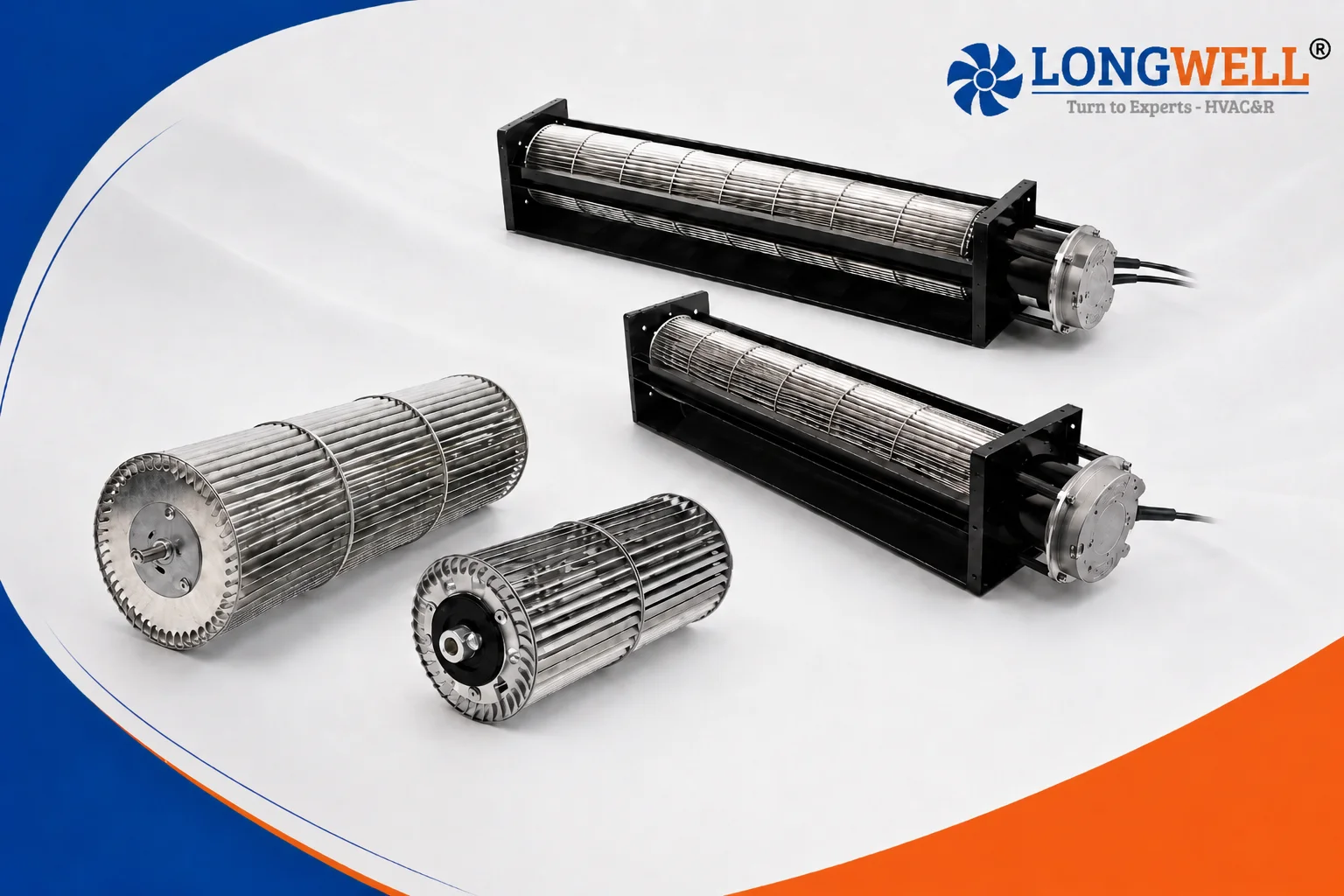
Spreading that air across a 360mm wide heater takes a lot of custom ducts. Consequently, those ducts cause big static pressure drops. They also take up too much room in the 8.93 cubic feet box. So, we picked a 90x360mm DC cross flow fan.
This type of blower makes a wide, flat wall of air. Its shape matches the 360mm length of the PTC heater perfectly. Therefore, the air hits the hot fins evenly without any extra ducts.
Noise and Heat Trade-Offs
Every tight design forces a choice. First, putting the PTC heater right at the outlet blocks the air. This choice cost us some airflow efficiency. The heater grid adds a harsh static pressure drop right at the exit.
Consequently, the noise goes up to 54 dB(A) while it runs. Even so, this direct setup makes sure all the air goes through the hot fins. In short, this method easily hits the 30 to 40 degrees Celsius air temp target. Next, we looked at the high heat on the fan blades.
The PTC part reaches a surface temp of 70 degrees Celsius. Therefore, we firmly rejected a standard plastic rotor. Instead, we made the impeller from hard aluminum alloy. This metal rotor has 35 bent blades.
Furthermore, it stays stiff and avoids warping under the steady heat. Finally, we matched the fan motor to the 24V limit. We locked the 3-phase motor at 1500 RPM to save money on control logic. Meanwhile, this setup draws just 24.5W of power.
It moves 607 m³/h of air against the 70 Pa system drag. So, it perfectly clears the customer’s heat limits.
Technical Specifications
| Parameter | Value |
| Airflow | 607 m³/h |
| Static Pressure | 70 Pa |
| Input Power | 24.5 W (±10%) |
| Speed | 1500 RPM |
| Voltage | 24 VDC |
| Overall Dimensions | 428 x 130 x 124 mm |
| Impeller Dimensions | 90 x 360 mm |
| Operating Temperature | -25°C to +60°C |
| Noise | 54 dB(A) |
| Insulation Class | Class B |
| Bearing Type | Ball bearing |
| Safety Standard (Heater) | GB/T13933-2008 |
The 70 Pa static pressure and 607 m³/h airflow matter most here. They show the real output when the heater grid is in place. By contrast, the 1500 RPM speed and 24.5W power draw prove the fan fits the tight 24V limits.
Reference: AMCA 210 covers the test method behind these figures.
Technical Documentation
LWHW-DC90360S-06 Heater Assembly Drawing
This sheet shows the outer case and the mounts for the heater.
LWCD-90360MN-06-14 Blower Specification
Engineers need this file to check the 24V wiring and the 428mm size limit.
90360 PTC Element Drawing
This drawing lists the 378mm length and the wire size for the bare heater.
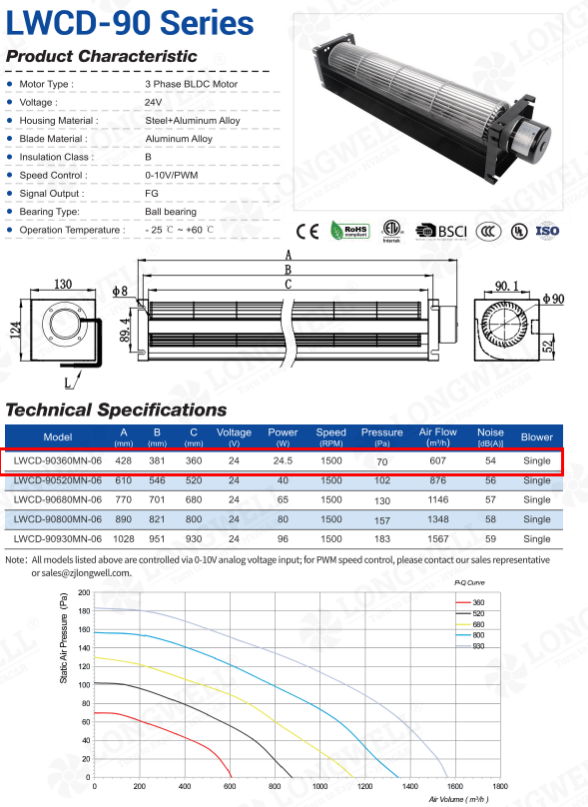
Buyers use this curve to map the 607 m³/h airflow against the 70 Pa drag.
Designing the Enclosure Heating Blower
If you need a steady stream of hot air, check your hard limits first.
- First, measure the exact static pressure drop of your chosen heater. A dense PTC grid blocks air and shifts the fan curve.
- Next, check if your system truly needs active speed control. Stripping out extra PWM logic on a steady-run fan cuts costs.
- Furthermore, the biggest error is ignoring the heat limit of the fan blades. Always use an aluminum alloy rotor if the heater gets above 60 degrees Celsius.
- Finally, state your voltage limits and box size clearly when you ask for a quote. We make our own impellers, so we can match the blade count to your exact airflow need.
Related: Cross Flow Fans.
Engineering Questions About Heated Blowers
Technical Documentation & Resources
Browse our blowers range, the exhaust blowers section, or centrifugal blowers.
Have a Similar Fan Requirement?
Longwell’s engineering team delivers custom spec sheets and samples within 90 days. Since 1990, we have supplied EC fans and blowers to OEMs across HVAC, cold chain, data center, and industrial applications worldwide.
Browse Related Products:
🏆 ISO 9001 / ISO 14001 / ISO 45001 | CE (TÜV) | UL/ETL | ATEX Zone 21/22 | AMCA 210-16 / ISO 5801 tested