Solving a High-Pressure Air Flow Problem
A customer needed to fix a severe air flow problem in a commercial building. Specifically, they had to push outside make-up air through thick filters and small ducts. This job required a strong EC circular duct fan. However, the space inside the ceiling was very small.
Therefore, the EC circular duct fan had to be extremely compact. First, the physical size limits were strict. The building used a standard 300 mm duct. Meanwhile, the total fan length could not exceed 255 mm.
Also, the system runs outdoors all year. Consequently, it faces hot summers and freezing winters. The required ambient range spanned from -20 C to +60 C. This wide range forced us to pick tough, weather-resistant materials.
Next, the air flow targets were very high. The system demanded a peak flow of 2600 m3/h (1529 CFM). Furthermore, the EC circular duct fan had to overcome a massive 747 Pa of static pressure. Finally, the end-user needed smart speed controls.
The main building computer changes fan speeds based on daily foot traffic. Thus, the motor required a standard 0-10V or PWM input signal. By contrast, basic off-the-shelf fans simply could not meet all these goals at once.
EC Circular Duct Fan Engineering Choices
We had to make clear choices to fit this tight space. First, we evaluated standard AC mixed-flow models. However, an AC motor cannot natively read a 0-10V signal. You must add a bulky external drive box to control the speed.
Therefore, we rejected the AC route entirely. Instead, we chose an EC circular duct fan design. Electronically commutated motors feature built-in speed controls. Consequently, the whole unit stays very compact.
It easily fits inside the strict 255 mm length limit. Next, we checked the pressure limits. Pushing 747 Pa through a narrow 300 mm tube is difficult. The impeller must spin extremely fast to build that much pressure. So, we set the nominal speed to 3200 RPM.
Balancing Speed, Noise, and Bearing Life
Of course, spinning at 3200 RPM creates intense air friction. The resulting acoustic output is 72 dB(A). The customer had to accept this specific noise level. In short, the trade-off for fitting a tiny ceiling space was a louder fan.
A large centrifugal blower would run much quieter. Even so, it simply would not fit the physical limits of the existing ductwork. Furthermore, running at high speed stresses the motor shaft. We looked at using heavy metal blades.
However, metal adds too much spinning mass. Heavy blades wear out bearings quickly. Instead, we molded the impeller from black PBT plastic. As a result, the total unit weight dropped to exactly 5.95 kg.
This light rotor removes stress from the main shaft. Finally, we used maintenance-free deep groove ball bearings. We balanced the whole unit to JB/T 9101-1999 G6.3 standards. Thus, the bearings easily reach a 50,000-hour L10 life span at a 25 C room temperature.
Ultimately, the final LWDE-300(12″)S-MWN-05-00 model works perfectly. It provides the massive pressure the system demands. Meanwhile, it keeps the physical footprint well within the hard 255 mm limit.
Technical Specifications
| Parameter | Value |
|---|---|
| Nominal Voltage | 220 VAC (Range: 220-240 VAC) |
| Frequency | 50/60 Hz |
| Rated Current | 2.6 A |
| Rated Input Power | 350 W |
| Speed | 3200 RPM |
| Maximum Airflow | 2600 m3/h (1529 CFM) |
| Maximum Static Pressure | 747 Pa |
| Noise Level (LpA) | 72 dB(A) |
| Operating Temperature | -20 C to +60 C |
| Weight | 5.95 KG |
| IP Rating | IP54 |
| Certifications | CE, FCC, RoHS, Reach |
These clear numbers show the real engineering limits. First, the 747 Pa static pressure stands out the most. This high pressure lets the unit push air through dense filters. Next, the 3200 RPM speed explains how that pressure is made. However, it also explains the 72 dB(A) noise level. Finally, the 350 W input power proves this small motor works hard. Therefore, the low 5.95 kg weight is crucial to keep bearing stress low.
Reference: AMCA 210 covers the test method behind these figures.
Technical Documentation
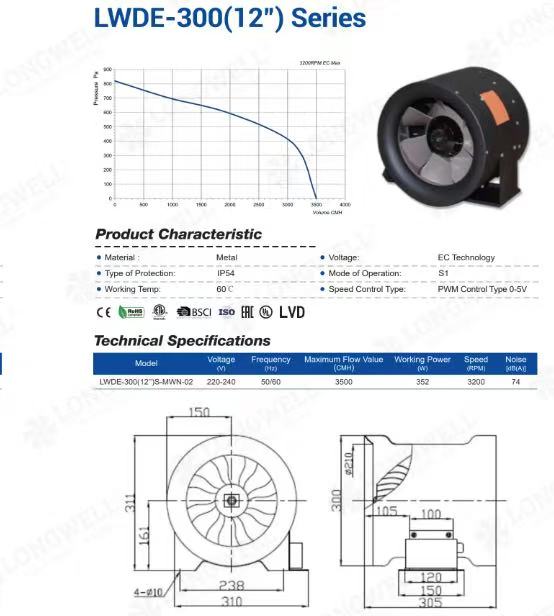
This graph shows the precise P-Q air flow curve. System designers use this exact curve to balance air paths.
LWDE-300(12″)S-MWN-05-00 Technical Drawing and Specs
This file gives installers the exact wire guides and dimensions. Field teams need this sheet to hook up the 0-10V control lines safely.
Specifying Fans for Small Spaces
Engineers facing tight spaces often struggle with air pressure. If you need to fit a strong fan into a small duct, follow these steps:
- First, measure your true system resistance. Thick filters and sharp bends cause massive pressure drops. Therefore, an undersized fan will fail long before it moves enough air.
- Next, accept the acoustic trade-offs. Pushing high pressure through a 300 mm pipe demands high RPM. Consequently, this high speed makes noise. If 72 dB(A) is too loud, you must use external sound dampers.
- Also, think about motor bearing life. High speeds ruin bearings if the rotor is too heavy. Thus, you should look for lightweight plastic impellers like black PBT.
- Finally, state your control needs in your first RFQ. If you want a 0-10V input, write it down early. This simple step ensures your supplier picks an EC motor from day one.
Related: Duct Fans.
Common Questions About High-Speed Fans
Technical Documentation & Resources
Browse our duct fans range, the inline duct fans section, or mixed flow fans.
Have a Similar Fan Requirement?
Longwell’s engineering team delivers custom spec sheets and samples within 90 days. Since 1990, we have supplied EC fans and blowers to OEMs across HVAC, cold chain, data center, and industrial applications worldwide.
Browse Related Products:
🏆 ISO 9001 / ISO 14001 / ISO 45001 | CE (TÜV) | UL/ETL | ATEX Zone 21/22 | AMCA 210-16 / ISO 5801 tested