Replacing Old Dry-Type Blower Units
A customer needed a new transformer cooling fan. They came to us for a
transformer cooling fan. Meanwhile, their old dry-type blower units were failing. First, they sent us strict rules to follow. Therefore, the old GFDD420-150 and GFDD370-155 models had to come out. Next, our new fans had to drop right into the same spot. In practice, the gear had a strict 195 mm height limit. Furthermore, the power supply was fixed. It ran on a 220V AC rail at 50 Hz.
The cabinet design forces a strict air path. So, the rules required a “Type A” setup. This layout pushes air straight up over the coils. Top-blowing keeps heat out of the power cabinets. Next, the buyer asked for pure copper AC motors. In short, copper stays cooler under heavy daily loads. Instead, they refused cheaper aluminum parts. Aluminum gets too hot and resists electrical flow too much.
We had to hit the exact air targets. The customer could not cut the metal housing. For the big unit, we needed 1200 cubic meters per hour. By contrast, the smaller fan pushed 1000 cubic meters per hour. Both models had to meet GB/T13933-2008 safety rules. Changing the size would force the user to cut their cabinet. Therefore, that was a firm deal breaker.
Engineering the 220V AC Replacements
Replacing an old transformer cooling fan means making hard choices. You can upgrade the motor or keep the old electrical setup. First, we looked at our SmartEC design. This gives you smart speed control. However, EC motors cost a lot more money. They also need a 0-10V signal to run. The old cabinet did not have that wiring. So, we dropped the EC idea. Instead, we used standard AC external rotor motors. These work perfectly with the old relays.
Matching the Copper Core and Size
The strict rule for pure copper shaped our plan. Copper moves power better than standard aluminum. As a result, the motor makes far less heat. Therefore, this keeps the internal ball bearings much cooler.
But the cost of copper is a much heavier rotor. So, the new LWF-D420-150AS-01 model needs strong supports. Heavy parts stop shaking at the 1400 RPM fan speed. Finally, we picked top-tier ball bearings.
They handle the extra weight during the 50 Hz cycle. Next, we locked in the hard mounting sizes. We matched the old GFDD parts perfectly. The old fans had a 160 mm base width.
They also had a 195 mm height. Consequently, our LWF units hit those marks exactly. We built the big model to be 420 mm long. It uses a 380 mm mounting hole pitch.
Meanwhile, the smaller LWF-D370-155AS-01 is 370 mm long. The housing uses a tight 330 mm hole pitch. Ultimately, both fans draw exactly 0.46 amps of power. This keeps them safe on the old circuit breakers.
Technical Specifications
| Parameter | LWF-D420-150AS-01 | LWF-D370-155AS-01 |
|---|---|---|
| Operating Voltage | 220 V AC | 220 V AC |
| Frequency | 50 Hz | 50 Hz |
| Current | 0.46 A | 0.46 A |
| Input Power | 80 W | 65 W |
| Operating Speed | 1400 RPM | 1400 RPM |
| Airflow Target | 1200 m³/h | 1000 m³/h |
| Housing Length | 420 ±2.5 mm | 370 ±2.5 mm |
| Mounting Hole Pitch | 380 mm | 330 mm |
| Height x Base Width | 195 mm x 160 mm | 195 mm x 160 mm |
A 195 mm height is the most vital metric. The exact hole pitch matters just as much. Because of this, crews can bolt these right in. They do not have to drill new holes to mount the transformer cooling fan.
Reference: AMCA 210 covers the test method behind these figures.
Technical Documentation

First, this list shows the old parts we had to replace.
View the general cross flow series catalog (PDF).
System builders use this book to pick a Type A or Type B flow.
View the LWF-D420-150AS-01 specification sheet (PDF).
Engineers check this sheet to find the exact 380 mm hole spacing.
View the LWF-D370-155AS-01 specification sheet (PDF).
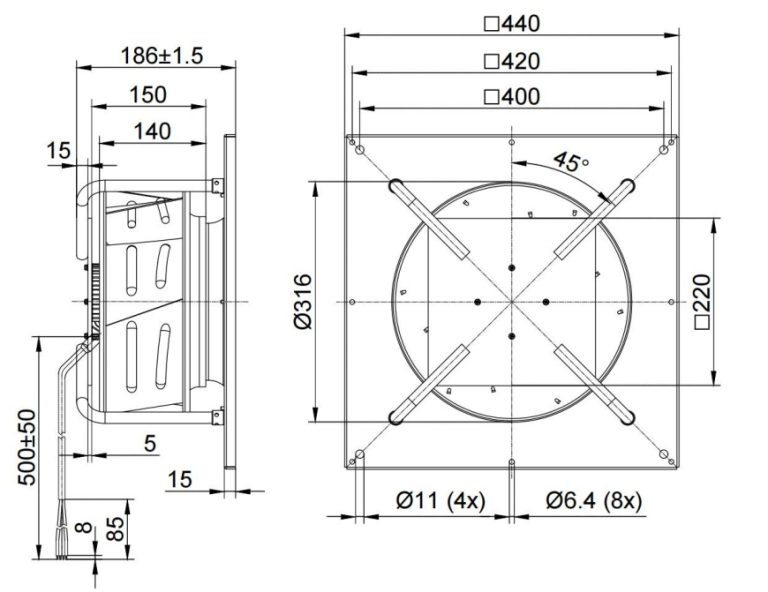
Lastly, this drawing proves the small fan hits 1000 cubic meters per hour.
Specifying a Transformer Cooling Fan Replacement
A wrong size will ruin a
transformer cooling fan project. It causes most site failures. So, buyers should check these details before asking for prices:
- Measure the mounting pitch. The total housing length matters far less. The gap between the mounting holes is the true key. Even so, a longer fan might fit, but bad hole spacing wastes time.
- Check the airflow path. These blowers can blow straight up or out the side. A side-blowing fan will blast air at the cabinet walls. Instead, it must blow over the coils.
- Pick the motor metal. Always demand pure copper for hot sites. Therefore, this stops makers from quoting weak aluminum parts.
- Check the control voltage. EC fans need extra control wires to run. By contrast, standard AC external rotor motors drop right into old panels.
Related: Cross Flow Fans.
Common Engineering Questions
Technical Documentation & Resources
Browse our axial fans range, the AC axial fans section, or EC axial fans.
Have a Similar Fan Requirement?
Longwell’s engineering team delivers custom spec sheets and samples within 90 days. Since 1990, we have supplied EC fans and blowers to OEMs across HVAC, cold chain, data center, and industrial applications worldwide.
Browse Related Products:
🏆 ISO 9001 / ISO 14001 / ISO 45001 | CE (TÜV) | UL/ETL | ATEX Zone 21/22 | AMCA 210-16 / ISO 5801 tested