Air Handler Space Limits and Demands
A customer needed a new forward curved centrifugal blower for an indoor air handler project. The sales team sent us the input details. First, the unit had to run on a standard 220V, 50Hz single-phase power line. Next, the physical cabinet set strict limits on size.
The internal space restricted the total fan width to just 360 mm. Furthermore, the scroll housing itself could not exceed 270 mm in width. They also needed exact dimensional drawings before placing the final order. Therefore, they asked us to confirm the fitment.
The system needed to move a high volume of air. Specifically, the curves show it must handle 3000 m³/h against 700 Pa of static pressure. Meanwhile, the application operates strictly indoors. So, a basic IP20 protection class was sufficient.
By contrast, a higher IP rating would add needless cost and weight. The panel controls required a simple 3-speed setup. Consequently, we needed an AC motor with multiple winding taps. Finally, the customer required performance data mapped out clearly. We test our fan designs to AMCA 210-16 methods to prove these airflow numbers.
Picking the Right Fan for the Cabinet
We had to pick the best fan type for this tight space. A backward-curved wheel often runs with higher energy efficiency. However, it needs a much wider diameter to build 700 Pa of pressure. Therefore, that choice would not fit inside the 270 mm scroll housing limit.
Instead, we chose a double-inlet forward curved centrifugal blower design. This shape packs more blade surface area into a smaller footprint. Next, we reviewed the motor options. An EC motor gives excellent speed control and saves power.
Even so, the customer’s panel only used basic mechanical relays for High, Medium, and Low speeds. Consequently, a standard 4-pole AC motor made the most sense. It avoided the heavy cost of a completely new control board.
Managing Speed and Shaft Dynamics
The chosen 4-pole motor spins the impeller at 1250 RPM. At this high speed, the central shaft takes on strong twisting forces. Therefore, we set strict limits on how much the wheel can wobble. First, we restrict the radial runout to less than 1.2 mm.
Next, the axial runout must stay under 1.0 mm. We also balance the metal wheel very carefully. Consequently, the residual unbalance drops below 15 grams. In short, this tight balance stops the 17.7 kg assembly from shaking the cabinet. It protects the motor bearings from early failure during heavy use.
Heat and Noise Trade-offs
Every engineering choice comes with a real cost. First, this 550W AC motor draws a solid 4.9 amps under full load. This current creates significant heat inside the enclosed metal cabinet. So, we selected Class F insulation for the copper windings.
This rating allows the internal parts to reach 155°C safely. Meanwhile, the noise level presents another known trade-off. The highest sound power hits 77.7 dB(A) at peak flow. Furthermore, the 1kHz band reaches 72.8 dB(A) on its own.
The customer must add thick acoustic foam to their cabinet panels. Finally, the heavy 17.7 kg total weight forces the customer to install stronger mounting rails.
Technical Specifications
The forward curved centrifugal blower specifications rely directly on the project documents. First, the table below shows the exact physical and electrical values. Next, it lists the noise and protection data.
| Parameter | Value |
|---|---|
| Model | DD10-8I-002 |
| Motor Type | 550W-4P |
| Voltage | 220 V |
| Frequency | 50 Hz |
| Speed | 1250 RPM |
| Current | 4.9 A |
| Input Power | 550 W |
| Weight | 17.7 kg |
| Scroll Housing Width | 270 mm |
| Max Assembly Width | 360 mm |
| Insulation Class | CLF (Class F) |
| Protection Class | IP20 |
In short, the 4.9 A current and 550 W power dictate the AHU wire size. Furthermore, the IP20 rating restricts the fan entirely to dry indoor spaces.
Reference: AMCA 210 covers the test method behind these figures.
Technical Documentation
The customer needs exact drawings to finish their assembly line layout. First, the spec sheet details the acoustic bands. Next, the drawing confirms the physical mount points.
DD10-8I Series Specifications provides the dimensional tolerances.
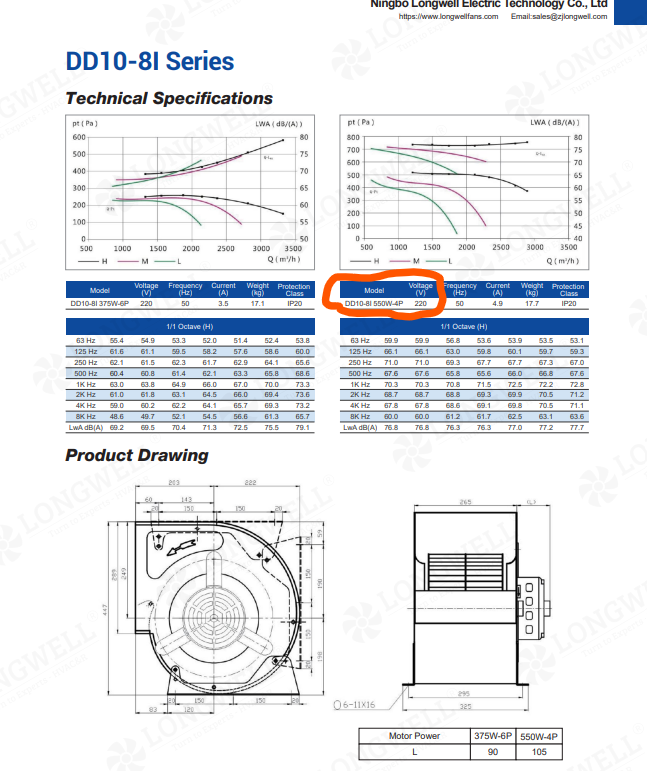
This image maps the static pressure limits against the airflow rates.
Specifying a forward curved centrifugal blower for Cabinets
Designing an air handler around a forward curved centrifugal blower requires careful internal planning. First, measure your hard physical limits before looking at fan curves. A double-inlet housing needs clear space on both sides. Blocking one side ruins the airflow completely.
Next, check your control panel logic. An AC motor with taps works well for simple relays. Instead, a smart panel might require an EC motor upgrade. Furthermore, you must define the acoustic limits of your space.
Do not just look at the total noise. Look closely at the specific octave bands. Finally, note your environmental risks. An IP20 rating provides zero protection against water.
So, it only belongs in a dry, sealed room. We build these wheels and scroll housings in our own factory. Therefore, we can adjust the mounting brackets to fit your exact cabinet. Related:
Centrifugal Fans.
Common Engineering Questions
Technical Documentation & Resources
Browse our centrifugal fans range, the backward-curved fans section, or forward-curved fans.
Have a Similar Fan Requirement?
Longwell’s engineering team delivers custom spec sheets and samples within 90 days. Since 1990, we have supplied EC fans and blowers to OEMs across HVAC, cold chain, data center, and industrial applications worldwide.
Browse Related Products:
🏆 ISO 9001 / ISO 14001 / ISO 45001 | CE (TÜV) | UL/ETL | ATEX Zone 21/22 | AMCA 210-16 / ISO 5801 tested