Replacing a Weak Factory Blower With a 280mm Centrifugal Fan
A client came to us with a hard problem. They build large air units for factories. So they needed a new 280mm centrifugal fan. They wanted a
280mm centrifugal fan for a tough job. The old part was a standard catalog model. The client showed us a page for an old H280-135 fan. But this old part failed their new tests. First, they changed the 280mm centrifugal fan location. The fan now sits in a dirty spot. So, the new rules asked for a tight IP55 rating. This blocks heavy dust and strong water jets. The old fan was only IP44. That was too weak.
Next, the main electric panel changed. It had a strict power limit. The new fan could draw no more than 400 watts. By contrast, the old fan used 500 watts under full load. If they used the old fan, the main breaker would trip. Meanwhile, the power line stayed at a standard 3-phase, 380V and 50Hz. Also, the air targets did not change. The 280mm centrifugal fan still had to push exactly 2250 cubic meters per hour. It had to do this at a high 400 Pascals of static pressure. The metal box was also very tight. The fan depth had to stay under 220 millimeters. It also needed to fit a strict 280 millimeter inlet ring. So, they needed a custom design. The order size was steady. They plan to buy 1,600 units a year.
Building a Low Power IP55 Motor
We looked at standard parts first. Our team wanted to use a stock 3-phase 380V motor for this
280mm centrifugal fan. Standard motors can hit 2250 cubic meters per hour at 400 Pascals. However, they use too much power to do it. A stock motor pulls about 500 watts. This breaks the 400-watt rule set by the client. Therefore, we threw out the stock motor idea fast. We had to build a special electric motor. We changed the copper windings inside. This made the motor run better at exactly the 400-Pascal point.
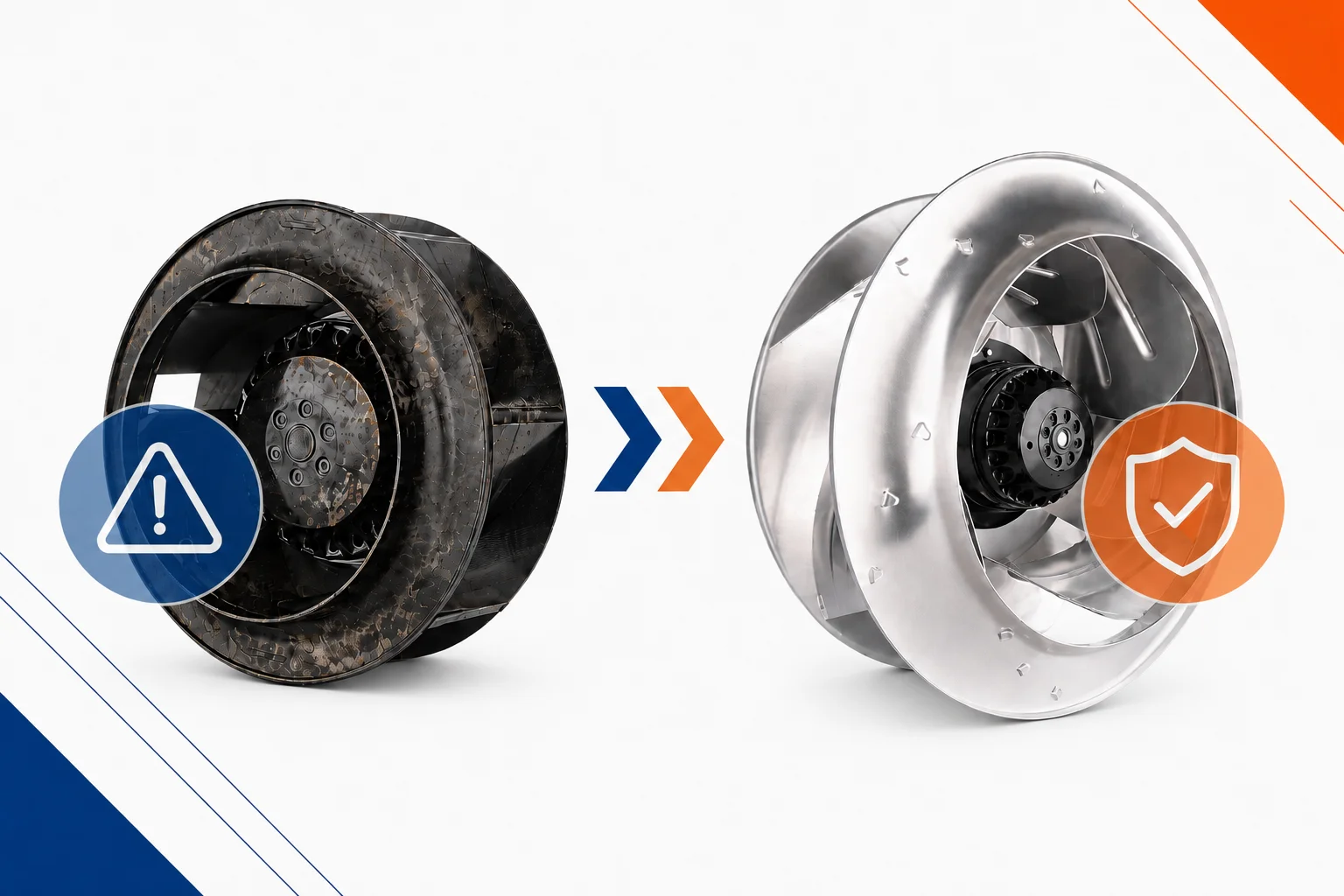
Next, we worked on the IP rating upgrade. An IP44 fan has loose gaps in the metal case. By contrast, an IP55 fan needs tight physical seals. We added better rubber seals to the motor shaft. This keeps out dust and heavy water drops. But, good seals trap hot air inside. A closed motor gets hot very fast. Even so, the motor must not burn out. We picked Class F parts. These parts handle high heat safely over long shifts. So, the new motor stays cool enough under full heavy load.
Blade Shapes and Part Costs
First, we looked at the fan blades to save power. The client had strict space rules for the metal box. We had to keep the exact 280 millimeter size. We also had to stay strictly under 220 millimeters deep.
If we changed the depth, the client would have to cut their metal box. That costs too much time and money. Instead, we changed the blade shape. We tuned the backward curved blades.
They now move more air with less motor effort. This directly helps the fan stay safely under the 400-watt limit. Every engineering choice costs real money. A tight IP55 seal costs more to make than a standard IP44 seal.
Custom copper coils also add to the final unit price. So, the new fan costs more than a basic stock item. However, the custom part saved the client from a full system redesign. It fits right into their old factory space.
Our team worked very fast on this. We sent the new specs and 3D files in just two days. Finally, this custom Longwell model meets the exact air and power rules.
Technical Specifications
| Longwell Part Number | LWBA2D280-138NT-27-00 |
| Airflow | 2250 m3/h |
| Static Pressure | 400 Pa |
| Input Power | < 400 W |
| Voltage | 380 V |
| Frequency | 50 Hz |
| Phase | 3-Phase AC |
| Impeller Diameter | 280 mm |
| Maximum Depth | < 220 mm |
| IP Rating | IP55 |
| Insulation Class | F |
| Annual Volume | 1600 units |
The input power and the IP class rows drove the whole plan. Consequently, any 280mm centrifugal fan that draws over 400 watts would fail the main test. So, our new design focused purely on electrical efficiency.
Reference: IEC 60529 covers the test method behind these figures.
Technical Documentation
Here are the exact files for this project.
Dimensional Rules Document
First, this text file shows the exact physical limits for the mechanical engineers.
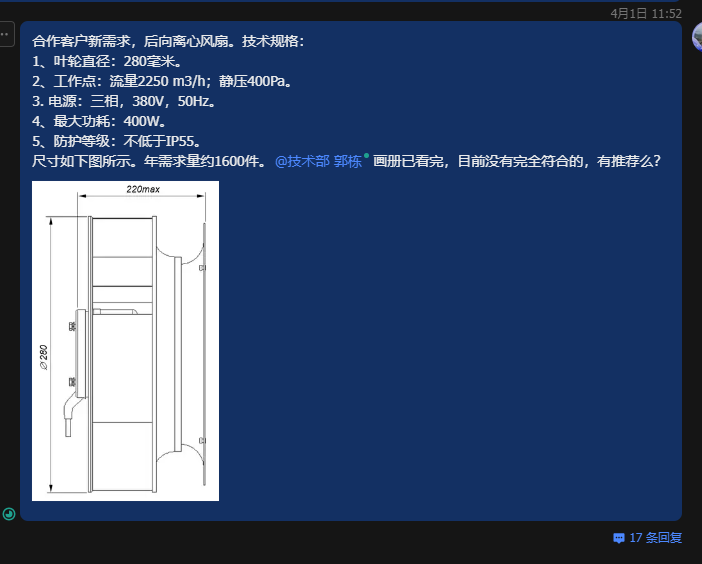
Next, this chat log proves we finished the new plan in two days.

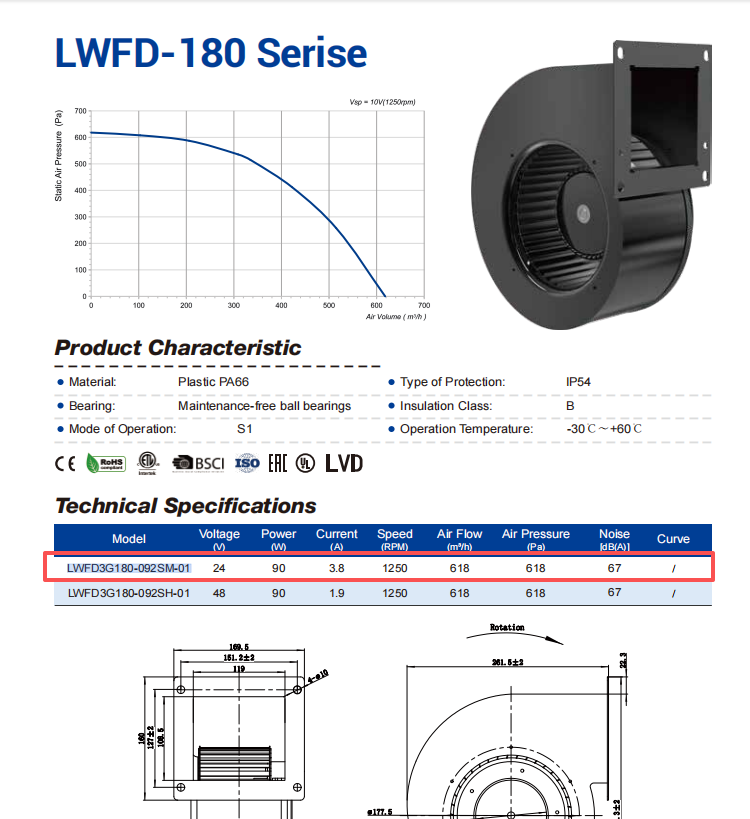
Meanwhile, this old catalog page shows the weak 500-watt and IP44 limits.
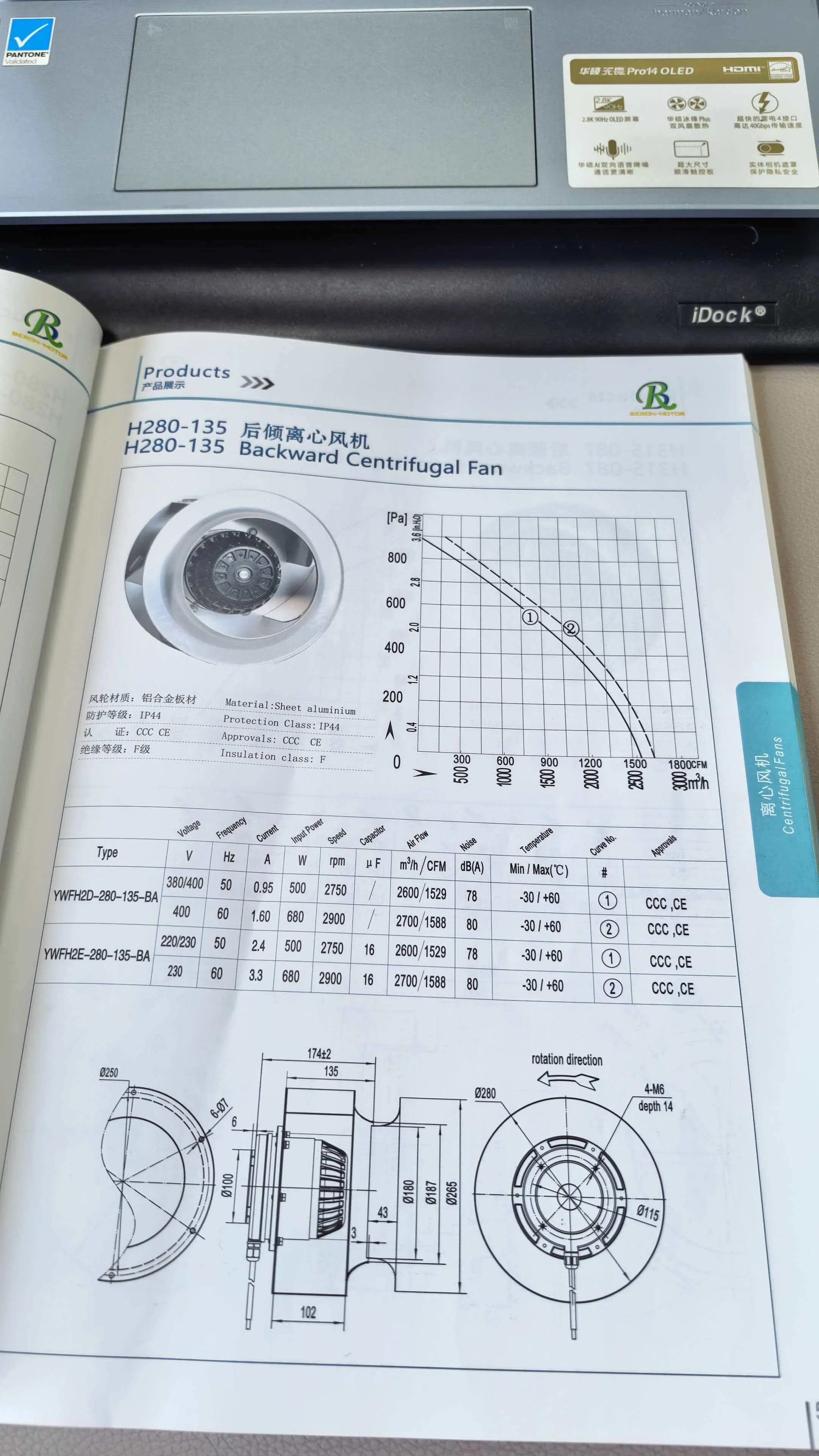
Finally, this graph shows the exact air flow and pressure targets for the system.
How to Plan Your Fan Project
What should you do if you face a similar problem? You must check your real system limits before you specify a
280mm centrifugal fan.
- Measure the real static pressure in your metal box first. A fan might hit the right air flow but struggle with high pressure. If the pressure is too high, the motor works harder. This makes it draw too many watts.
- Check your true power limit carefully. Many stock fans work well but pull huge amps at startup. So, you must read your breaker panel rules clearly to avoid trips.
- Look closely at where the unit will live. Putting an IP44 fan in a wet place is a bad idea. Dust and water will wreck the bearings fast. Always pick IP55 or higher for tough factory spots.
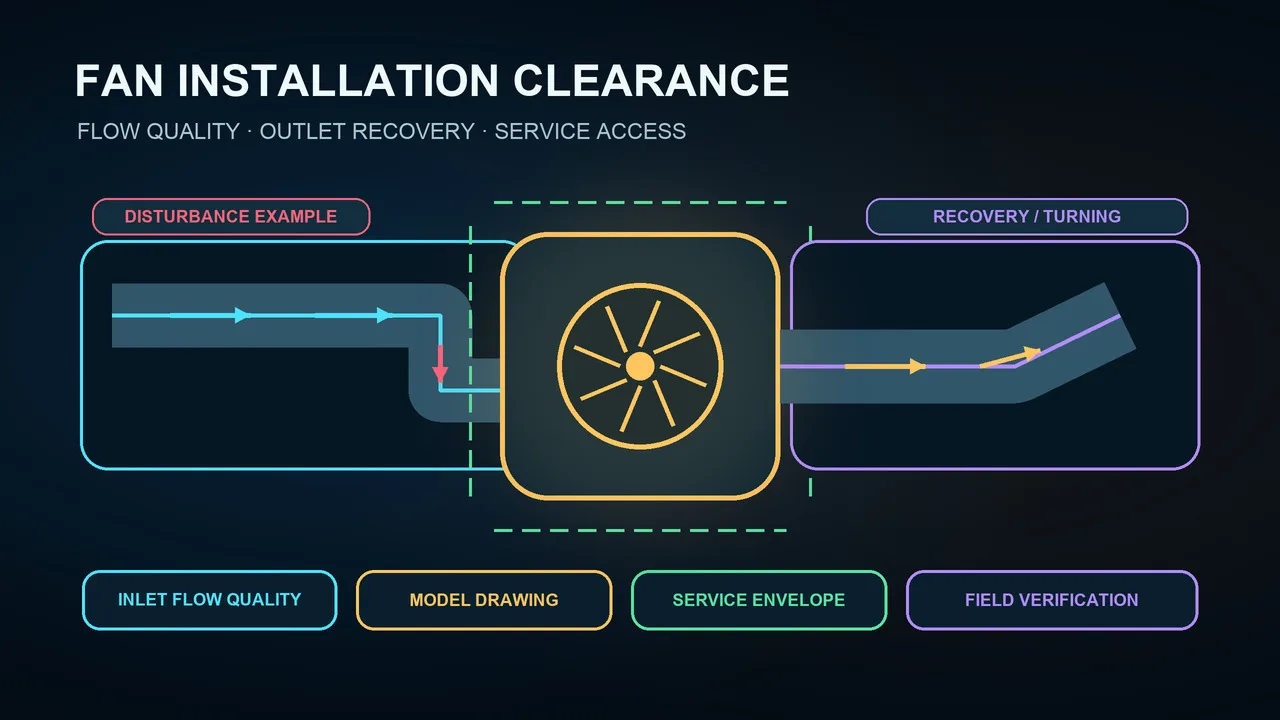
- Send your exact space limits to the supplier early. Because our team tests to strict AMCA 210-16 rules, we can match your space exactly. This stops you from having to cut your metal cases later.
In short, firm rules save you time and money. Related: Centrifugal Fans.
Technical Questions on IP55 Upgrades
Technical Documentation & Resources
Browse our blowers range, the exhaust blowers section, or centrifugal blowers.
Have a Similar Fan Requirement?
Longwell’s engineering team delivers custom spec sheets and samples within 90 days. Since 1990, we have supplied EC fans and blowers to OEMs across HVAC, cold chain, data center, and industrial applications worldwide.
Browse Related Products:
🏆 ISO 9001 / ISO 14001 / ISO 45001 | CE (TÜV) | UL/ETL | ATEX Zone 21/22 | AMCA 210-16 / ISO 5801 tested