Defining Constraints for an 800mm AC Axial Fan
The customer requested a tough 800mm AC axial fan for a large industrial condenser. Specifically, they needed an
800mm AC axial fan. First, the unit had to survive outdoors. Extreme winter cold is common in their deployment region. Therefore, the 800mm ac axial fan needed to work perfectly from -40°C up to +60°C. Next, we reviewed the strict power supply limits. Meanwhile, the facility uses a 3-phase, 380 VAC electrical grid. However, heavy machinery causes voltage swings often. So, the motor had to accept a wide range of 342 to 418 VAC without failing.
Furthermore, the physical housing size was locked. Therefore, the frame width was limited to exactly 952 mm. The maximum installation depth was just 340 mm. By contrast, the airflow goals were very high. At a static pressure of 185 Pa, the fan had to push an impressive 27,089 m3/h. In practice, this volume equals 15,935 CFM.
Finally, the market requires strict safety and testing labels. Meanwhile, the 800mm ac axial fan had to meet EN 60335-1 safety rules. Next, it required full CE certification. Therefore, furthermore, the airflow performance had to follow ISO 5801-1997 testing methods. We also test performance to standard AMCA 210-16 guidelines. Meanwhile, acoustic noise could not exceed 83 dB(A). Pushing so much air creates loud aerodynamic noise. Therefore, keeping the sound under this 83 dB(A) limit was a major design challenge for our team.
Engineering the Rotor and Motor Setup
Building this heavy-duty
800mm AC axial fan required hard choices. First, we looked at the impeller material. Standard plastic blades get very weak in extreme cold. In practice, at -40°C, a fast-spinning plastic blade can shatter under stress. Instead, we used a thick aluminum alloy impeller. As a result, this metal stays strong and safe in severe winter weather.
However, this choice created a weight penalty. Meanwhile, the metal blades are much heavier than plastic ones. The total fan weight reached 48 kg. Therefore, we needed a stronger motor to spin this heavy rotor. The motor had to push the blades to 920 RPM safely. Therefore, furthermore, the motor had to handle the 185 Pa static pressure without stalling.
Motor Drive and Component Choices
Next, we reviewed the motor drive type. In practice, some engineers prefer EC motors for smooth variable speed control. However, this specific condenser runs constantly at full speed. As a result, it uses an S1 continuous work system.
Therefore, complex EC controls were not needed. By contrast, an AC motor matched the 3-phase, 50 Hz power grid perfectly. We chose a simple AC motor. Consequently, this lowered the material cost materially.
The tradeoff was a high fixed power draw. Moreover, the input power is 2,200 W. The 800mm ac axial fan draws 3.8 A constantly from the grid. Finally, we focused on motor lifespan.
We used maintenance-free deep groove ball bearings. Next, we added Class F insulation. These precise choices give the fan a 30,000-hour life at a standard 40°C room temperature.
Thermal Protection Limits
Even so, heavy motors need strict heat protection. We included a thermal disconnect switch inside the motor. First, the switch cuts power if the heat reaches 150 to 160°C. Next, the fan stays completely off while it cools down.
It will reset the circuit only when temperatures drop to 100 to 130°C. In short, we designed this unit for extreme weather and constant heavy duty. It trades low weight and variable speed for sheer air volume and winter durability.
Technical Specifications
| Nominal Voltage | 3~380 VAC |
| Voltage Range | 342~418 VAC |
| Frequency | 50 Hz |
| Speed | 920 RPM |
| Current | 3.8 A |
| Power Input | 2200 W |
| Air Flow (Max) | 27,089 m3/h (15,935 CFM) |
| Static Pressure | 185 Pa |
| Noise Level | 83 dB(A) |
| Ambient Temperature | -40°C to +60°C |
| Insulation Class | Class F |
| Protection Type | IP54 |
| Work System | S1 (Continuous) |
| Dimensions | 952 mm width, 340 mm depth |
| Weight | 48 kg |
| Certifications | CE, RoHS, Reach |
| Life Expectancy | 30,000 Hours (L10) at 40°C |
| Vibration Standard | JB/T 8689 |
| Balancing Standard | G6.3 |
| Altitude Range | < 1000m |
First, the wide voltage range helps the fan survive poor power grids. Next, the low temperature rating proves it works in harsh winter zones. In short, these specific rows show why the 800mm AC axial fan handles bad conditions well.
Reference: AMCA 210 covers the test method behind these figures.
Technical Documentation
First, view the main engineering data sheet:
longwell-lwaa6d800s-7myb-15-technical-doc-01.pdf. This file details the exact power needs, safety standards, and wiring rules for the motor.
Next, the original project text file is here: longwell-lwaa6d800s-7myb-15-project-image-02.docx. Engineers use this file to review the early design requests.
Finally, look at the visual charts and mechanical drawing:

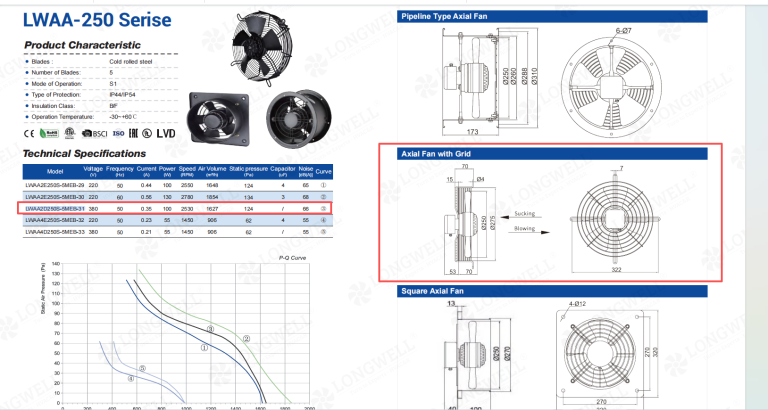
This image shows the exact P-Q performance curve and frame sizes. Therefore, system builders can use it to verify chassis mounting holes easily.
Specifying Condenser Fans for Extreme Weather
Engineers face specific risks when selecting an
800mm AC axial fan for cold outdoor spaces. First, proper planning prevents field failures.
- First, define your exact voltage shifts. A simple 380V motor burns out quickly if the grid power drops. Instead, ask for a wide working range like 342 to 418 VAC.
- Next, verify your true ambient temperatures. Standard plastic blades crack under -20°C. Therefore, you must specify an aluminum alloy impeller for -40°C zones.
- Furthermore, check your required work system. If your condenser runs non-stop at full speed, an S1 continuous AC motor works best. It costs materially less than an EC motor.
- Instead of carrying the unit by the wires, use the main metal frame. Lifting a 48 kg fan by the thin wires will destroy the internal connections.
- Finally, provide your exact space limits. A fixed 952 mm width and 340 mm depth rules out many deep fan models immediately.
Related: Axial Fans.
Common Questions
Technical Documentation & Resources
Browse our axial fans range, the AC axial fans section, or EC axial fans.
Have a Similar Fan Requirement?
Longwell’s engineering team delivers custom spec sheets and samples within 90 days. Since 1990, we have supplied EC fans and blowers to OEMs across HVAC, cold chain, data center, and industrial applications worldwide.
Browse Related Products:
🏆 ISO 9001 / ISO 14001 / ISO 45001 | CE (TÜV) | UL/ETL | ATEX Zone 21/22 | AMCA 210-16 / ISO 5801 tested