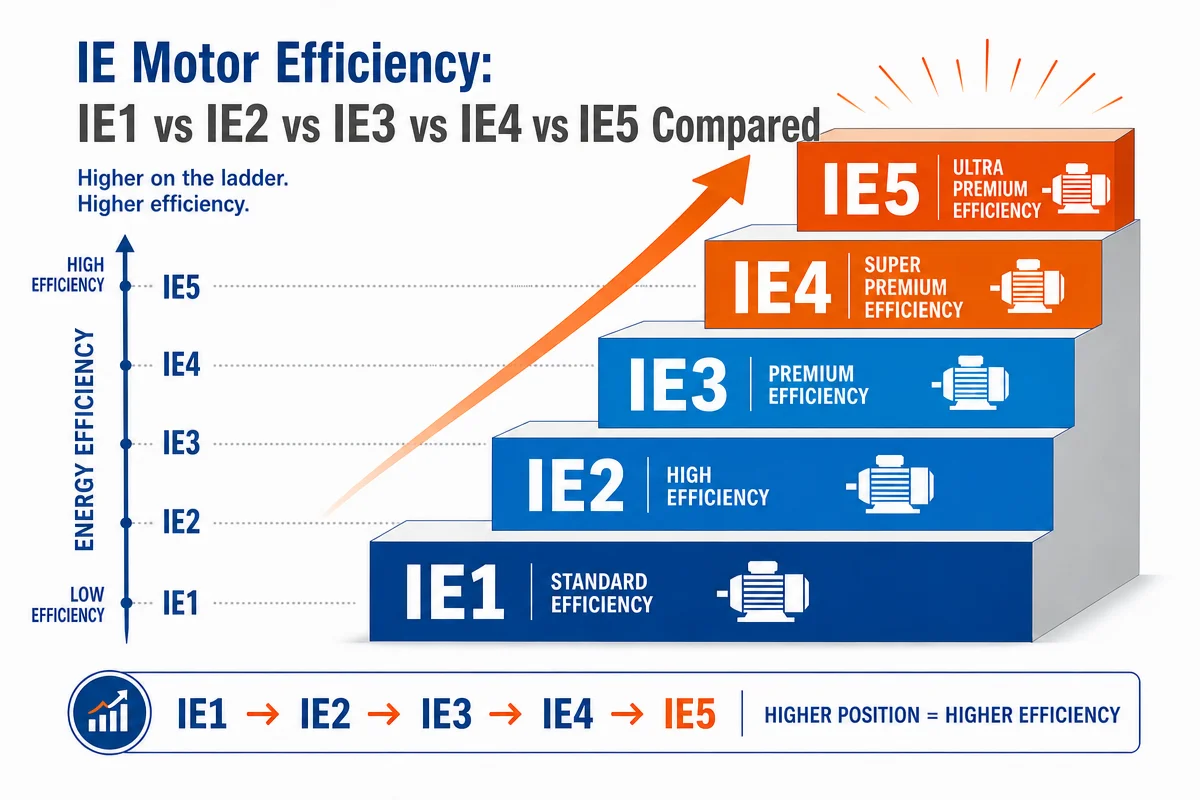
Selecting the wrong EC fan can cost your countdown and excess noise. Each of these mistakes is recurring across HVAC, data center, heat pump, BESS, cold chain, semiconductor, and medical projects we review. Each one carries real cost — typically 10–30% energy waste, premature failure, missed acoustic compliance, or 14-week procurement delay. Most are fixable in 30 seconds at the spec stage. Most are catastrophic to undo after install.
What is EC Fan?
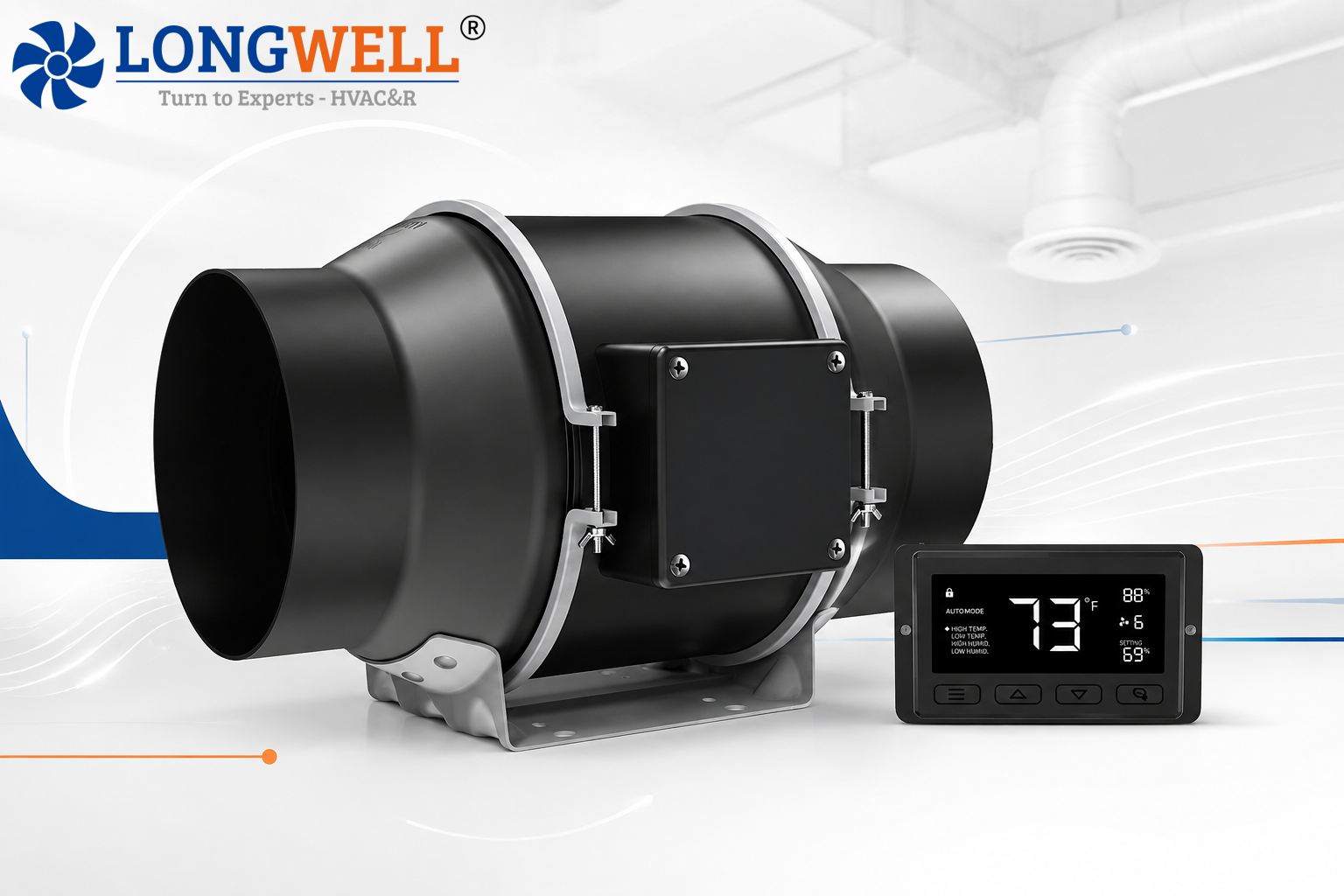
As the name suggests, EC fans are powered by EC motors. An EC fan usually features an on-board electronic controller that include a rectifier converting AC supply to DC power. The controller uses electronic commutation to precisely energize the stator windings in sequence. At the same time, high-performance permanent magnet mounted on the rotor interact with the alternating magnetic fields generated by the stator. The continuous attraction and repulsion between the rotor magnets and stator poles produce smooth, high-torque rotation without the need for mechanical brushes.
EC fans are commonly used in ventilation systems such as efficient HVAC systems, refrigeration units, data center cooling, and medical cleanroom.
Whether you are an HVAC engineer, equipment manufacturer, system integrator, or distributor, specifying EC fans in bulk can be challenging. Even experienced buyers can overlook these factors that affect airflow performance, energy efficiency, and project cost. In the following section, LONGWELL highlights the 10 most common mistakes made when selecting and specifying EC fans.
MISTAKE #1 Overlooking Part-Load Performance When Specifying EC Fans
Walk into any EC fan selection process and the first number everyone looks is BEP – wire-to-air η at Best Efficiency Point (BEP). In real HVAC duty, the fan spends most of its operating hours away from BEP — typically 40–80% of design airflow as building loads vary through the day and seasons. For example, two fans with identical 90% peak η can have radically different annual energy bills if one holds 85% across the 40–95% load range while the other collapses to 60% at 50% load. The integral of (η × runtime) over the year matters, not the single peak point.
WHAT IT COSTS
Choosing on peak η alone typically wastes 18–32% of annual fan energy vs the actually-best fan for your load profile. On a 50-fan data center FanGrid at €0.18/kWh and 80% load factor, that’s €85,000–€150,000 over 10 years.
The Engineering Solution
Ask the manufacturer for the η curve from 30% to 100% load (not just the peak number). Weight against your expected load profile. EC fans intrinsically hold flatter η curves than AC + VFD — a major reason they win on real annual energy even when peak η is similar.
MISTAKE #2 Oversizing the Fan “for safety”
Adding 25% to required airflow may seem like a prudent engineering case, but in fact it can lead to lower efficiency in most HVAC applications. An oversized fan operates left of BEP on its PQ curve, in the unstable region where flow reverses periodically (stall), causing increased noise, vibration, and energy waste.
Below ~60% of design airflow, centrifugal fan blades approach stall. Even with EC variable-speed control, you can’t always run far enough below rated to recover BEP — bearings, airflow uniformity, and acoustic suffer.
WHAT IT COSTS
A 25%-oversized AHU fan typically operates at 50–70% η instead of the design 88%. Energy penalty 25–40% over its working life. Plus higher noise and earlier mechanical failure.
The Engineering Solution
Right-size to the calculated design point. EC fans modulate down gracefully when load is lower than expected — you don’t need “headroom” the way you did with old AC + damper systems. Use the LONGWELL selection calculator to verify the operating point is on the right side of BEP.
MISTAKE #3 Choosing an Inadequate IP Rating for Outdoor and Coastal Installations
An IP54 motor specified for an outdoor RTU in a coastal site (Florida, UK south coast, Singapore, Dubai) survives ~2–4 years before salt + moisture penetration kills the electronics. The replacement cycle costs more than IP67 + ASTM B117 1000-hour salt spray would have at install.
Salt aerosol is hygroscopic — it pulls moisture from the air even in low ambient humidity, creating a continuously-wet salty film on motor electronics. IP54 gates particle ingress but not capillary water + salt. IP67 + epoxy-encapsulated electronics + stainless 316L hardware breaks the failure path.
WHAT IT COSTS
Premature replacement: $500–$2,000 per failed unit plus downtime + crane access on rooftop installs. On a 200-unit hotel chain rollout, this can be $200,000–$400,000 over 5 years.
The Engineering Solution
Choose IP55 minimum rating for outdoor environments, IP67 for coastal / marine / de-icing-salt zones. Add ASTM B117 1000-hour salt-spray validation to the spec. Cost premium at install is typically 5–8% of fan CapEx.
MISTAKE #4 Ignoring System Effect — Using Catalog η as Installed η
Datasheet η is measured under ideal AMCA 210 / ISO 5801 lab conditions: long straight inlet, uniform velocity, no obstructions. Your actual AHU has a 90° elbow 200 mm upstream of the fan inlet, a coil immediately downstream, and a damper in the wrong place.
System effect — the η loss from non-ideal inlet/outlet conditions — typically derates installed η by 5–15 percentage points vs catalog. A 90% catalog fan in a poorly-laid-out AHU plenum delivers 75–85% installed.
WHAT IT COSTS
A 10-point installed-η loss on a 5 kW fan running 24/7 = 4,400 kWh/year extra = €800–€1,300/year. Plus you may fail energy compliance code.
The Engineering Solution
Ask the AHU designer for system effect coefficients on the proposed layout. AMCA Publication 201 gives factors for common configurations. LONGWELL Selection Center includes a system effect calculator. Either fix the layout (straighten the inlet, move the damper) or size up the fan to compensate.
MISTAKE #5 Use the Wrong Fan Types
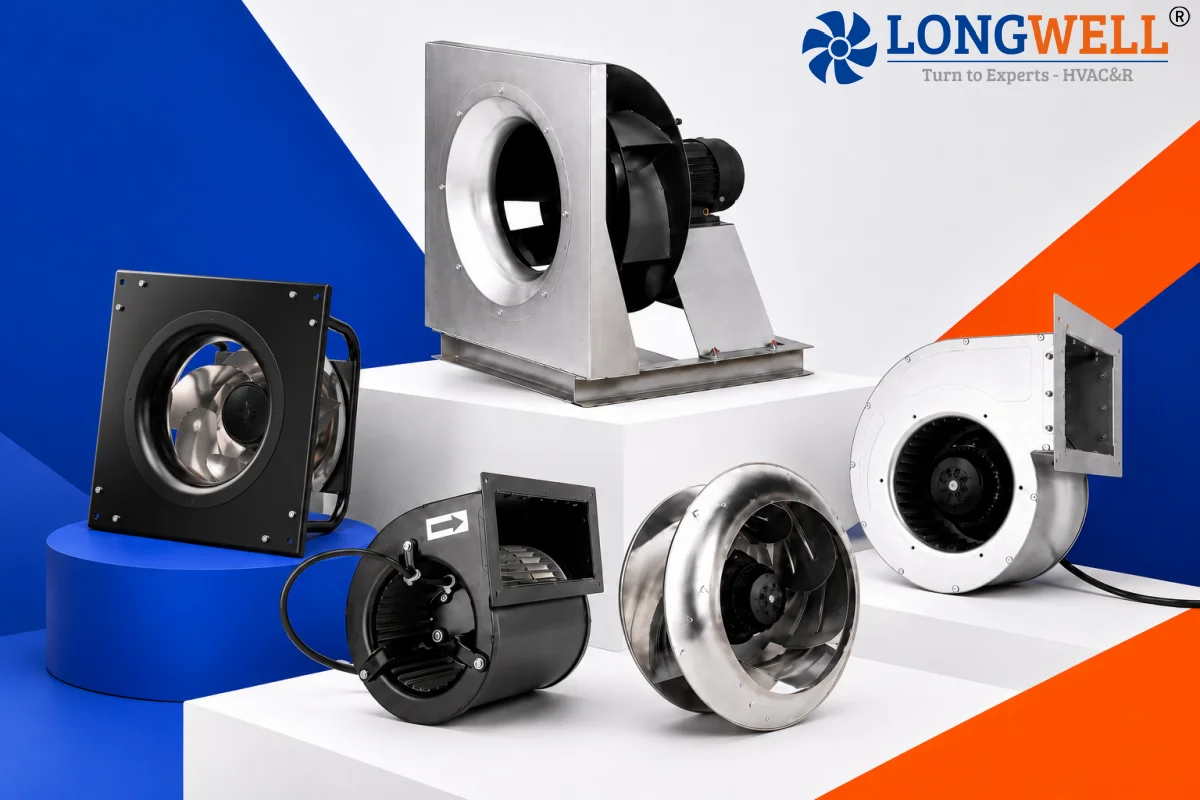
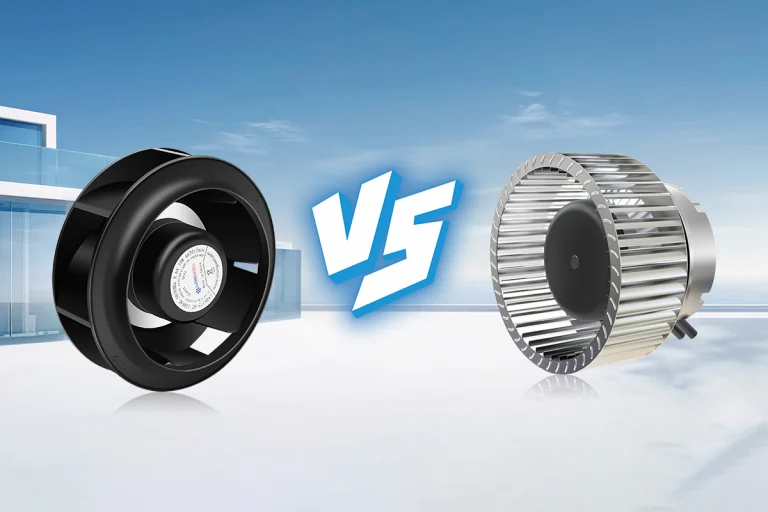
Forward-curved (FC) fans are cheap and compact. Engineers sometimes spec them in commercial AHU duty because of cost or space — where backward-curved (BC) plug fans should be. The result: 65% peak η max instead of 88–90%, plus much higher noise.
FC blades produce high airflow at low static pressure with high noise — appropriate for residential HVAC, fan-coil indoor units, small appliances. BC blades hold efficiency at higher static (up to 1,800 Pa) with lower acoustic at part-load — appropriate for AHU, CRAH, FFU, professional ventilation.
WHAT IT COSTS
η penalty 20–25 pp = 30–40% more annual energy. On a 2 kW office AHU running 8 hr/day: ~€1,500/year extra. Plus likely noise compliance failure in office acoustic codes.
The Engineering Solution
FC for total Pa < 400 + tight space + low first cost. BC plug for Pa = 400–1,800 + reasonable plenum space + life-cycle cost matters. High-pressure plug (LWHV / ebm-papst high-static) for Pa > 1,800. Axial for Pa < 400 + high CFM + free condenser space.
MISTAKE #6 Sticking With Legacy AC + VFD Instead of EC at Part-load Duty
“We already have VFDs in stock and the trades know AC motors” feels safer. For 24/7 part-load duty, EC delivers 20–35% better installed efficiency, lower acoustic, smaller breaker, faster start, native digital control, integrated diagnostics — and the energy savings pay back the upgrade CapEx in 2–4 years.
AC induction motor + VFD: motor η peaks at 80–82% at full load, drops to 60–70% at 50% load. Plus VFD adds 3–5% conversion loss. EC motor with onboard FOC: 88–92% wire-to-air η across most of the load range, no separate VFD, no conversion loss.
WHAT IT COSTS
A typical 5 kW CRAH AC fan operates ~3.5 kW average. Switching to EC saves ~30% = 1 kW. At 24/7 + €0.18/kWh = €1,580/year per fan. On a 50-fan CRAH retrofit: €790,000 over 10 years.
The Engineering Solution
Default to EC for new construction and CRAH FanGrid retrofits. Keep AC for fixed-speed, simple ventilation where part-load is rare (e.g., constant exhaust). LONGWELL provides drop-in retrofit kits to swap belt-drive AC FanWall for EC plug-fan arrays in 1–2 weekend shifts per CRAH.
MISTAKE #7 Overlooking EMC Requirements in Sensitive Environments
Standard CE-marked EC fans pass EN 55014 Class A (industrial). Some applications require Class B (residential) or EN 60601-1-2 (medical) — and standard fans interfere with adjacent sensitive equipment.
EC drives switch IGBTs at 16–20 kHz, generating RF emissions in the 30 MHz – 1 GHz band. Class A allows higher emissions than Class B. In lithography fabs, MRI rooms, and high-precision metrology, Class A noise raises tool error rates measurably.
WHAT IT COSTS
EUV lithography tool downtime from EMC interference: $50,000–$200,000 per hour. MRI image quality degradation from adjacent HVAC: forces shielding retrofit at $80,000–$300,000 per imaging room.
The Engineering Solution
Add EMC spec to the fan tender:
- Class A for general industrial
- CLASS B for residential / quiet office / hospital wards
- EN 60601-1-2 MEDICAL for OR / ICU / imaging rooms
- CLASS B + MAGNETIC SHIELDING for MRI rooms. Request test reports per shipment
MISTAKE #8 Ignoring 2026 Lead-time Reality on Premium European Brands
Engineers continue spec’ing ebm-papst K3G or Ziehl-Abegg RH series with 8-week lead-time assumption. The 2026 reality is 14–22 weeks (ebm-papst) and 12–18 weeks (Ziehl-Abegg) for most non-stock SKUs. Allocation continues from the 2023–2024 shortage.
European EC fan capacity expanded post-2023 but cannot keep pace with combined data center + heat pump + BESS + retrofit demand. Premium brands prioritize long-standing OEM contracts; spot retrofit and small projects queue.
WHAT IT COSTS
Project schedule slip: 14–22 weeks past PO before fan arrives. AHU build can’t start without specified fan. Lost critical-path can mean missed tenant move-in, missed data center commissioning, missed heat pump grant deadline.
The Engineering Solution
Either (a) accept the lead time and bake it into project schedule; or (b) spec dual-source with LONGWELL as the secondary / drop-in alternative at 15-day delivery — same mounting pattern, same control protocol, AMCA-tested η. Full cross-reference table here.
MISTAKE #9 Specifying Only One Manufacturer Without an Approved Alternative
Spec’ing a single brand without a documented drop-in alternative locks the project — and 10 years of maintenance — to one supply chain. When that supplier raises prices, goes on allocation, or discontinues a model, the customer has no leverage.
EC fan platforms are largely dimensionally interchangeable across major brands at the same diameter. Mounting hole patterns, inlet ring geometry, shaft height, and 0–10 V / Modbus RTU control protocols match within ±0.5 mm and protocol-identical. Multi-sourcing is technically feasible — engineering just has to specify it.
WHAT IT COSTS
Single-source lock typically adds 15–25% to 10-year TCO (price escalation + repair-replace cycle premium). For BESS / data center mass deployments, single-source supply risk during scaling is even more expensive.
The Engineering Solution
Write the spec as: “fan must meet [airflow, Pa, η, IP, EMC, dimensions]; acceptable manufacturers include ebm-papst K3G family, Ziehl-Abegg RH family, LONGWELL LWBE3G family, or equivalent.” This opens procurement to fair competitive bidding without compromising engineering quality.
MISTAKE #10 Specifying Acoustic at Datasheet Distance, Not Actual Install Distance
Datasheets typically report sound pressure Lp at 1 m or sound power Lw in reverberation room. The actual ambient noise the user / patient / occupant experiences depends on distance, room geometry, reflective surfaces, and parallel fan count. Engineers spec the datasheet number and then get complained at after install.
Sound pressure decreases ~6 dB per doubling of distance in free field, ~3–4 dB in semi-reverberant space. N parallel fans add 10·log₁₀(N) dB. A 38 dB(A) datasheet fan at 1 m becomes 26 dB(A) at 4 m alone, but 35 dB(A) for 8 fans at the same distance.
WHAT IT COSTS
Acoustic complaints post-install often force expensive remediation: silencers at $2,000–$8,000 each, larger Ø fans at lower RPM (cost premium 20–40%), or full re-spec. Municipal noise ordinance violations can halt project commissioning.
The Engineering Solution
Specify sound pressure at the actual user / neighbor / patient position, accounting for distance, room absorption, parallel fan count, and frequency spectrum. Use sound power Lw (octave-band) + room calculation, not Lp at 1 m. For residential ERV, target <25 dB(A) at bedroom. For OR / ICU, target <38 dB(A) at patient pillow. For BESS at residential boundary, target <42 dB(A) at fenceline.
Other Mistakes to Avoid When Specifying Fan
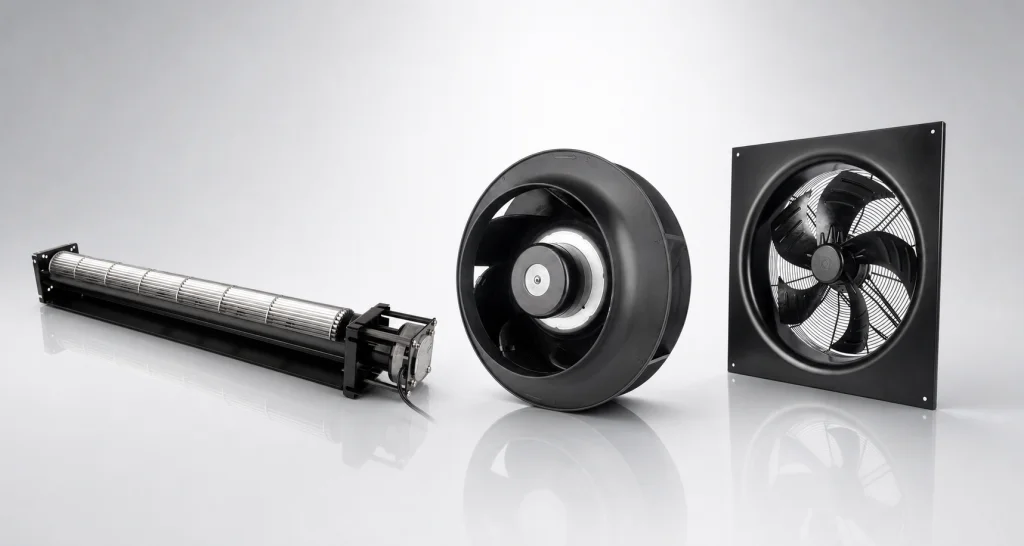
1. Mismatching Unsuitable Fan Types
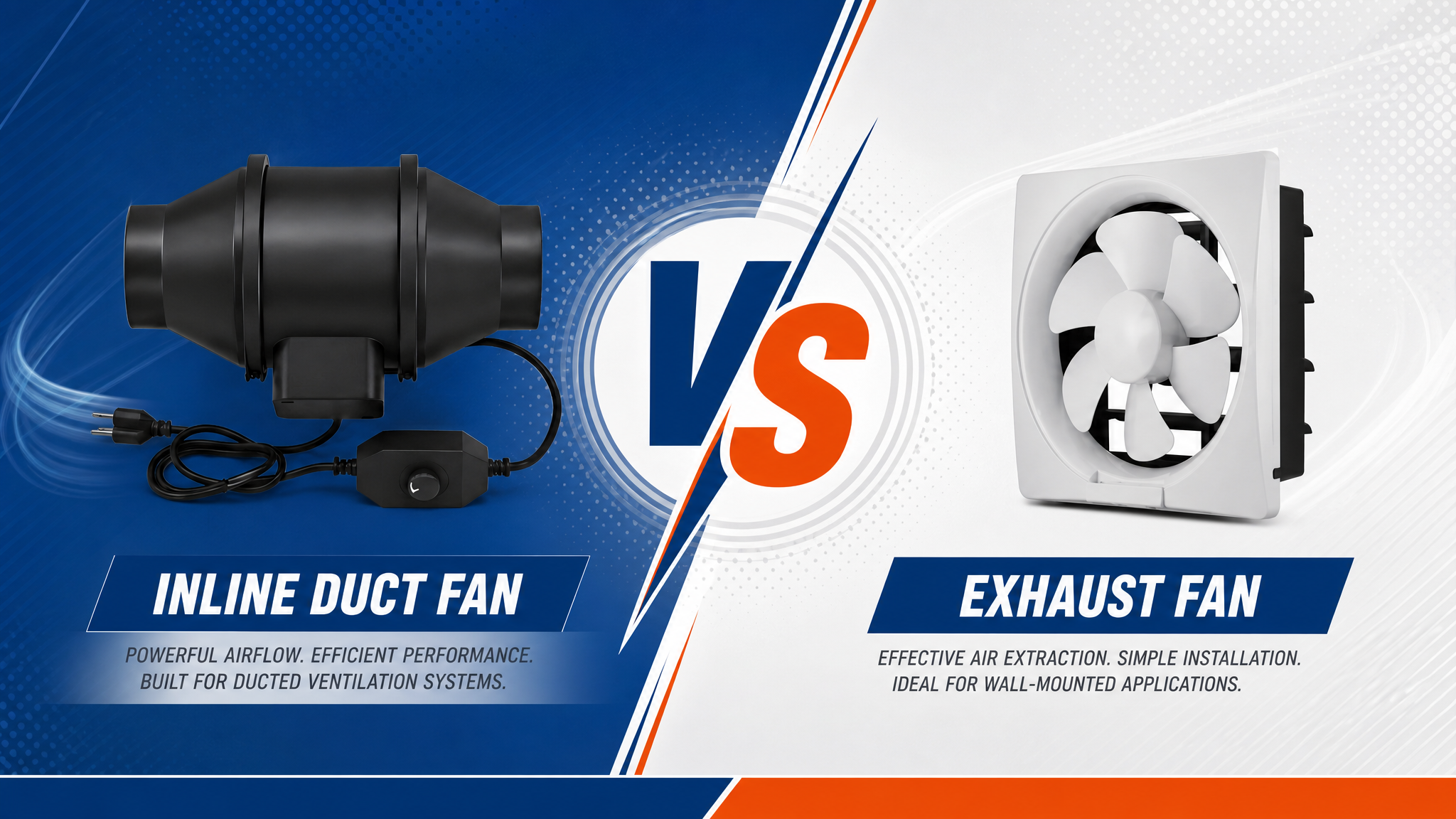
One fan type cannot fit all ventilation projects. Choosing a fan based solely on price or familiarity often results in poor system performance and a higher total cost of ownership.
- DC Fan: Fine PWM speed control and quiet operation requirement.
- EC Fan: Ideal for high-efficiency ventilation systems.
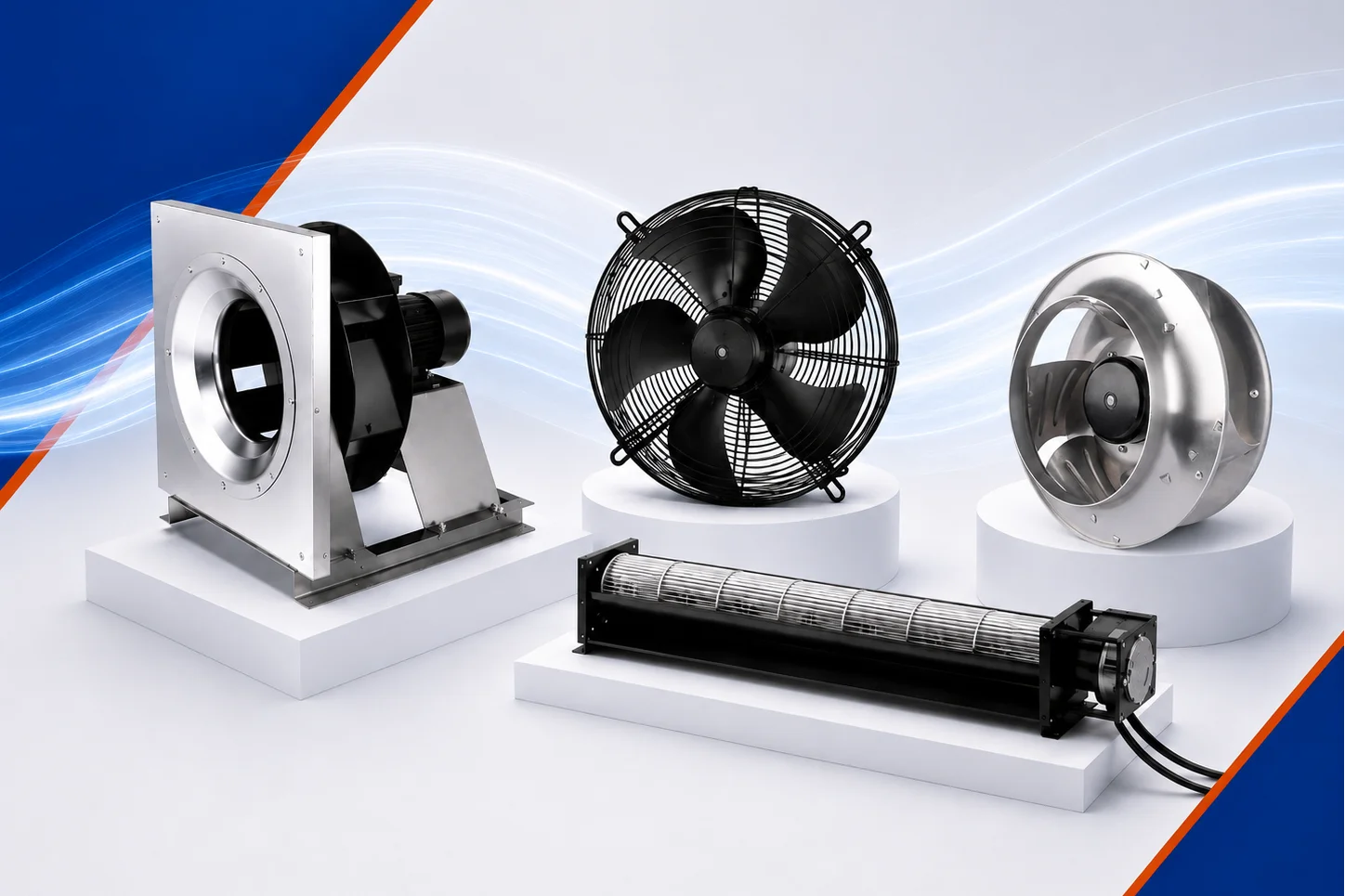
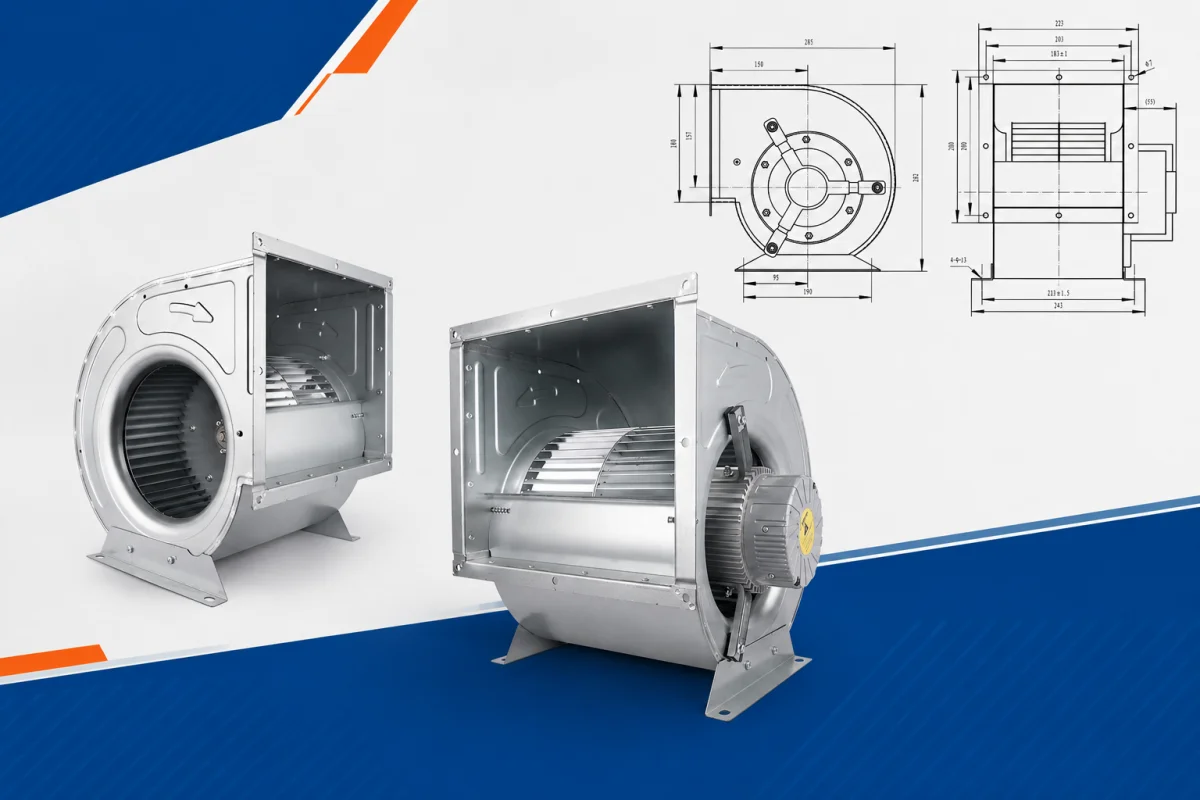
- Centrifugal Fan: Delivers high static pressure and stable airflow through ductwork, filters, coils, and heat exchangers.
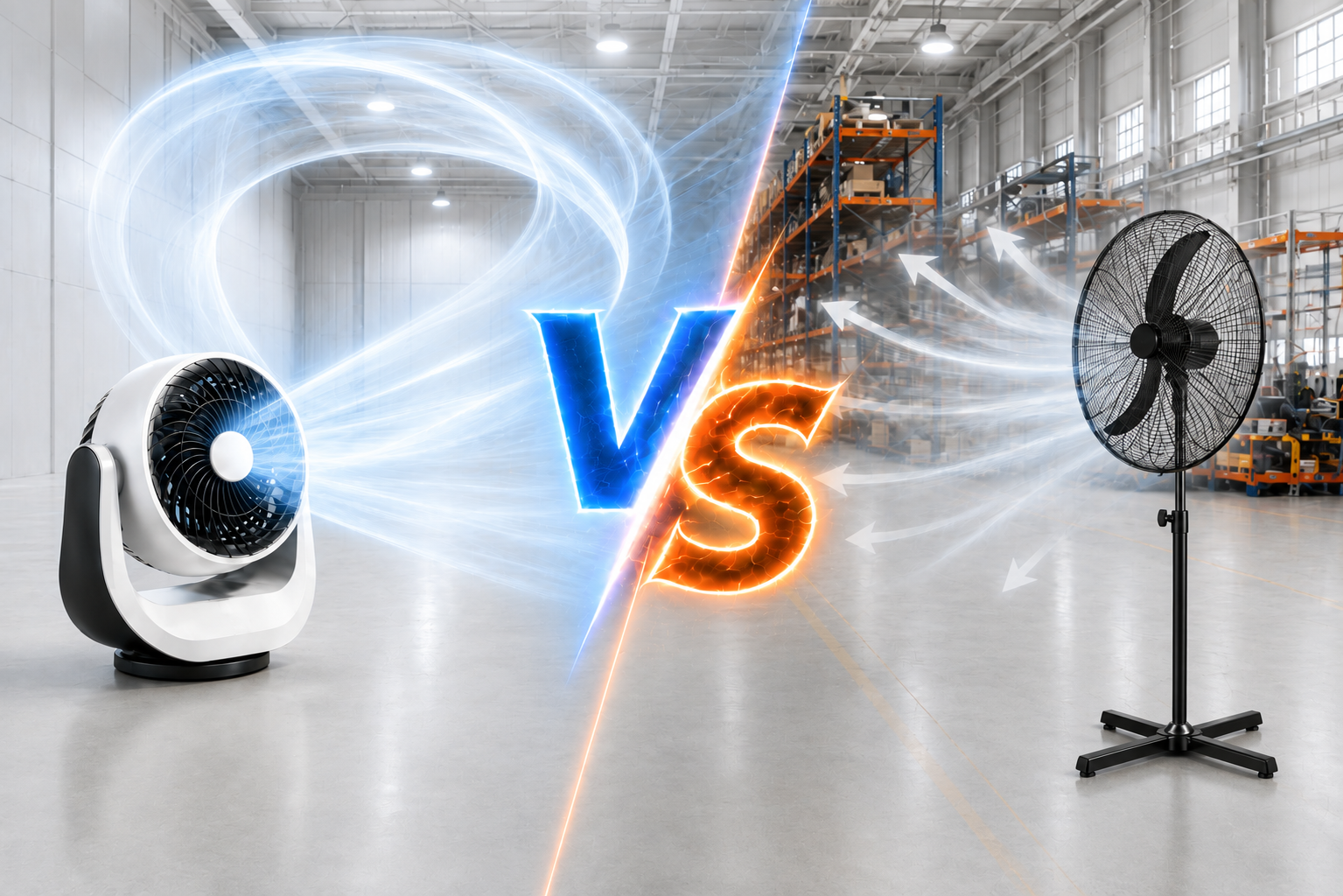
- Cross-flow Fan: Produces a wide, uniform airflow across a long outlet while maintaining low noise levels.
- Axial Fan: Delivers high airflow at relatively low static pressure.
2. Ignoring the Heat-load Calculation
Estimating your cooling requirement rather than performing an accurate heat load calculation may cause unwanted results. Oversizing cooling requirement can waste energy and increase noise, while undersizing heat load can lead to overheating, reduced equipment life, and system failure.
Always calculate the total heat dissipation of your system in Watts (W) before selecting a fan. Use the calculated heat load to determine the required airflow (CFM or m³/h) and the operating static pressure (inH₂O or Pa).
3. Neglecting Longevity and Maintenance
Many buyers may overlook a fan’s expected service life and maintenance requirements. To ensure fan longevity and maintenance, consider the bearing type, thermal protection, noise performance, and low maintenance. Ask LONGWELL for extended-life and low-noise versions when longevity is non-negotiable.