When the power density of a single cabinet jumps five times or even higher than before, the cooling system of data centers is undergoing a transformation driven by AI computing power. Under the surge of AI computing power, centrifugal fans, as one of the core cooling methods for data centers, have undergone a new evolution. The key to pushing the limits of computing power is learning how to use high-density server heat sinks in the limited space to achieve extreme static pressure penetration. At this point, high-efficiency centrifugal fans are no longer just simple heat dissipation components. These fans are becoming the key to keeping energy costs down and ensuring AI servers run efficiently.
In this blog, we will explore the data center cooling system and the matching centrifugal fans parameters, which can help you select the right fan.
Data Center Cooling System
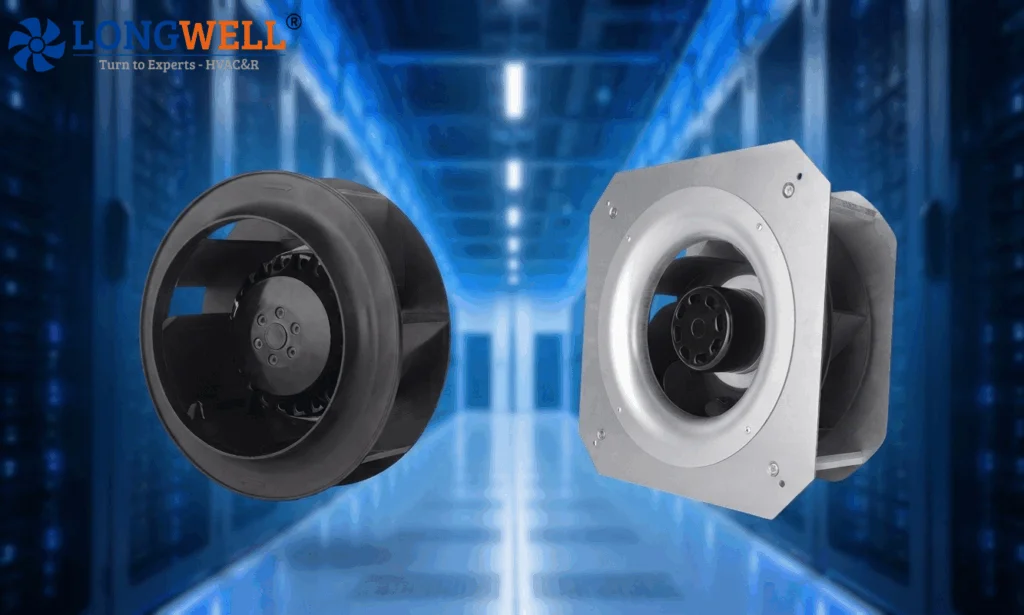
Data center cooling systems are often divided into four layers based on the physical scale of the heat transfer path and the changes in the engineering environment. Heat is generated by the server chips. It must go through the processes of being expelled from the cabinet interior, circulating within the data center, undergoing outdoor condensation treatment, and finally being discharged into the atmosphere. This layered structure precisely corresponds to the entire movement chain of heat from the source to the terminal. The physical environment, static pressure requirements, Power Usage Effectiveness (PUE), and reliability requirements at each level are completely different.
Each layer performs a distinct thermal management function, requiring different airflow characteristics and fan technologies. Centrifugal fans are primarily used in room-level and large scale cooling applications where higher static pressure and precise airflow control are required.
Data Center Cooling Centrifugal Fans
In this application, centrifugal fans are vital for maintaining the high-pressure airflow required for effective air distribution throughout the data center. It serves as the central hub for climate control within the data center, where Computer Room Air Conditioner (CRAC) or Computer Room Air Handler (CRAH) units are responsible for maintaining the required temperature for IT equipment. Room-level air distribution requires air to travel through raised floors, ducts, filters, cooling coils, and long airflow paths. These components create significant static pressure losses that need centrifugal fans provide high static pressure and efficiency.
- Eliminate Volute Impedance: Traditional centrifugal fans uses volute which remains inherent flow impedance. The design of plug fan eliminates the volute and directly forms free outflow within the unit, significantly reducing the ineffective pressure loss caused by space limitations.
- Dynamic Matching of Load: The EC motor has a wide range of speed adjustment capabilities and can be equipped with BMS and Modbus RTU protocols, enabling the fan to adjust its speed in real time according to the actual heat load of the machine room. Avoid running at full speed all the time, which is the most direct way to reduce the PUE.
- Modular Reliability: Using the Fan Wall array technology, multiple smaller-power fans are operated in parallel. When one of the fans malfunctions, the other fans in the fan wall can automatically increase their speed to replenish the air volume, thus preventing the occurrence of a single-point failure.
If you wish to gain a deeper understanding of how this structure alters the cooling landscape of data centers, you can refer to our special guide: What is a Plug Fan? The Ultimate Guide to Casingless Fan.
Why do Data Center Prefer Centrifugal Fans?
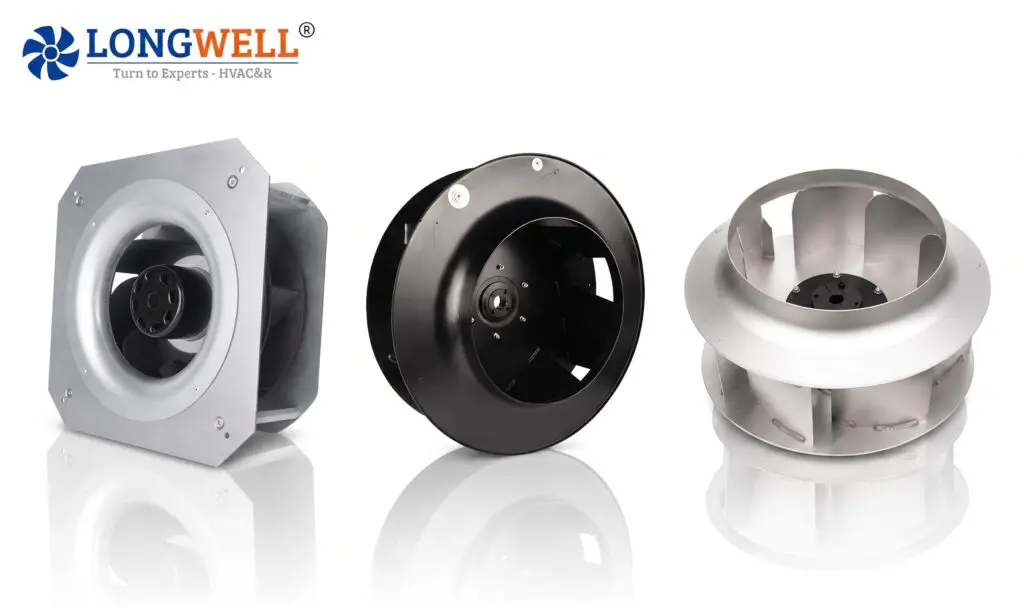
Precise airflow control is necessary in data centers to preserve constant temperatures and safeguard vital IT equipment. Since the airflow path in a data center is typically longer than under other circumstances, centrifugal fans must produce a steady, high static pressure. Centrifugal fans are frequently chosen in precision air-conditioning applications like CRAH units, CRAC units, and air handling systems, even though both axial and centrifugal fans are utilized throughout cooling systems. High static pressure causes axial flow fans’ efficiency to drastically decrease, making them unsuitable for cooling computer rooms.
- Managing airflow pathways with high resistance: In data centers, cooling airflows usually have to go via a small, crowded supply area. Strong, steady, high static pressure is efficiently produced by centrifugal fans.
- Achieving high-intensity directional air supply: The centrifugal fan can generate an airflow vertical to the rotation axis. This fluid mechanical characteristic is highly compatible with the compact structure of CRAH and CRAC cabinets. It can efficiently guide cold air to the server hotspots, achieving higher performance local cooling.
- Long-term operational reliability: It needs to operate in a data center environment that is available 24/7. The structural design of the centrifugal fan can withstand long-term high-load operation, ensuring the continuous stability of the cooling system. This is an essential condition for guaranteeing the continuous operation of AI servers.
Key Specifications to Evaluate
Airflow (CFM / m³/h)
The fan must maintain a suitable temperature rise across the system while supplying enough airflow to satisfy the data center’s cooling needs.
Static Pressure
Static pressure determines the fan’s ability to overcome airflow resistance caused by filters, cooling coils, ducts, and containment structures. This is often one of the most critical parameters in CRAH and CRAC applications.
Fan Efficiency
Fans with higher efficiency use less energy, which lowers operating expenses and enhances PUE performance.
Motor Technology
EC motors are increasingly preferred due to their higher efficiency, integrated speed control, and compatibility with intelligent building management systems.
Speed Control and Communication
Whether support for Modbus, PWM, 0–10 V, or other control protocols allows dynamic airflow adjustment and seamless integration with BMS and DCIM platforms.
Noise Level
Acoustic performance should be considered, especially in facilities where equipment rooms are located near occupied areas.
10 Steps to Select a Data Center Centrifugal Fan
- Cooling Load Demand: Calculating the total cooling demand based on IT equipment power density, rack layout, and expected heat generation.
- Airflow Requirement: Select the target airflow needed (CFM / m³/h).
- Static Pressure Capability: Calculate all sources of airflow resistance.
- Energy Efficiency: Verify the required airflow and pressure fall within the fan’s high efficiency operating range.
- Electromagnetic Compatibility (EMC): Check whether the fan controller meet Class B EMC standards to prevent interference with sensitive server and network signals.
- PUE Compliance:
| Region | PUE Target | Driver |
| European Union | ≤ 1.3 (mandatory by 2027) | EU EED Directive 2023; mandatory DC annual reporting |
| United States | ≤ 1.4 (recommended) | DOE efficiency guidelines; federal DCs ≤ 1.2 |
| China | ≤ 1.25 (East-Data-West-Compute) | NDRC + State Council 8-hub initiative |
| Singapore | ≤ 1.4 (new-build mandatory) | IMDA + EMA new DC approval framework |
| Hyperscale Operators | ≤ 1.15 (Google, Meta) | Competitive pressure among hyperscale providers |
- Speed Control and System Integration: Modern cooling system often require variable speed control, check if need Modbus communication, integraton with BM or DCIM.
- Reliability and Maintenance Requirement: Review the maintenance frequency of bearing, motor, and vibration to minimize maintenance costs.
- Environmental Protection Rating: Verify ratings such as IP55 and assess the need for additional protection against UV exposure, salt spray, and chemical corrosion.
- Total Life Cycle Cost: Consider the initial purchase price with energy consumption. Maintenance expenses, expected service life, an replacement costs.
Typical Centrifugal Fans Specs for Data Center
In order to accommodate varying heat loads, LONGWELL employs FanWall array technology to provide the necessary airflow and N+1 redundancy for modern data centers.
- Fanwall Technology: The FanWall technology enables airflow control, allowing the system to dynamically adjust the output based on the real-time IT heat load. Compared to the single large fan configuration, this modular approach significantly reduces energy consumption. Moreover, this design enables technicians to replace components without shutting down the entire facility cooling system.
- N+1 Redundancy: This architecture provides automatic fault compensation. When any single fan in the array fails, the control logic activates the backup fan. This effectively eliminates single-point failures and protects the critical artificial intelligence hardware from heat-related downtime.
| CRAH Capacity | Array Configuration | Total Airflow | Total Power | Specs |
| 30 kW (Tier 2 small) | 2×2 = 4 fans | 18,000-39,000 m³/h | 3.4-6.6 kW | LWBE3G-400 Plug |
| 60 kW (Tier 3 medium) | 2×3 = 6 fans N+1 | 34,800-75,000 m³/h | 6.6-13.2 kW | LWBE3G-450 Plug |
| 100 kW (Tier 3 large) | 2×4 = 8 fans N+1 | 60,000-128,000 m³/h | 12.0-24.0 kW | LWBE3G-500 Plug |
| 150 kW (Tier 4 critical) | 3×3 = 9 fans N+1 | 67,500-144,000 m³/h | 13.5-27.0 kW | LWBE3G-500 Plug |
The specifications provided in the table above serve as a representative reference configuration for standard CRAH deployments. It is important to note that actual cooling requirements are highly site-specific and subject to variation.
LONGWELL Centrifugal Fans for Data Center Cooling Systems
In the actual cooperation cases of LONGWELL, we analyze a 30 MW hyperscale data center. This data center transitioned from a decentralized multi-vendor cooling strategy to a unified LONGWELL, efficient EC fan ecosystem. The facility implemented a comprehensive LONGWELL, configuration, standardizing all 160 fan units across the cooling systems, which providing 219kW of total power capacity. The transition resulted in a PUE reduction from 1.42 to 1.28. Based on continuous 24/7 operation and a commercial electricity fee of $0.12/kWh, the cumulative savings exceeding $1.4 million over 10 years.
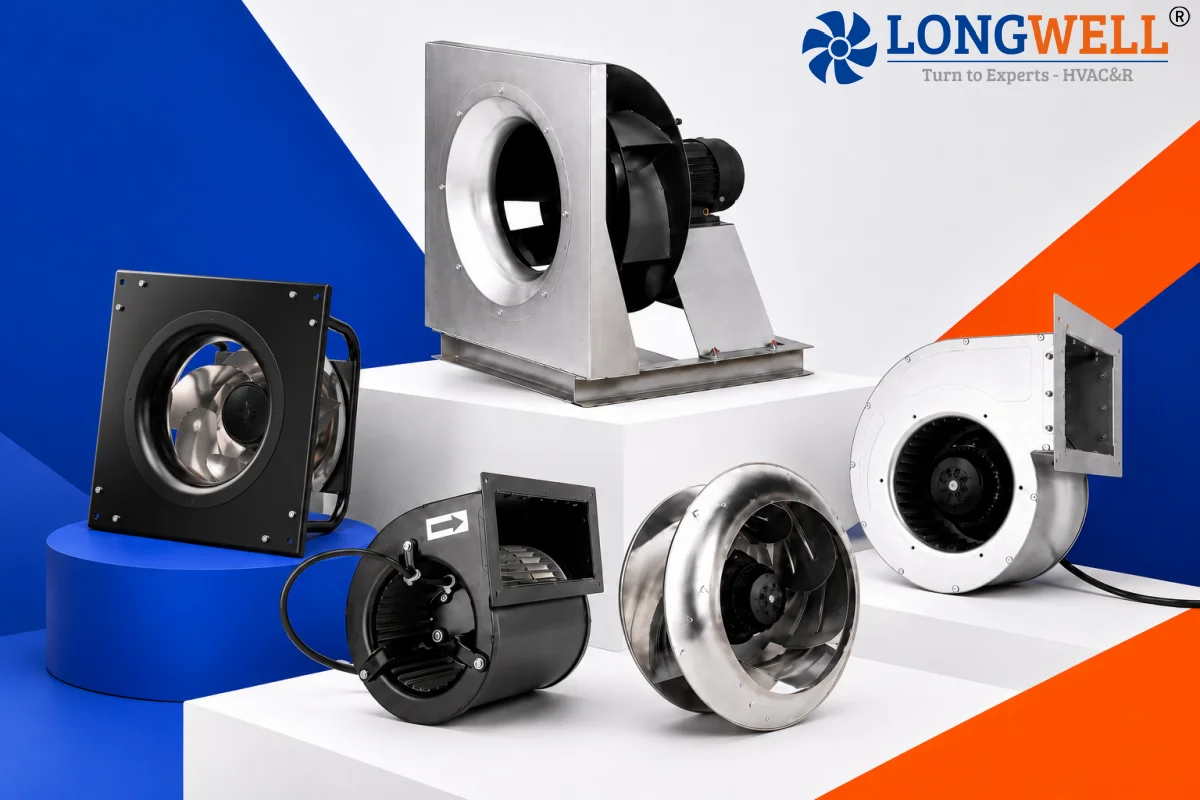
LONGWELL, offers a complete range of products from the internal Plug Fan Wall (LWBE3G) and outdoor condensation (LWAE3G) of CRAH, to cooling towers (LWAE3G large-sized arrays) and cabinet-level cooling. It can cover the entire data center cooling system and simplify the management of customers and suppliers.
FAQ
How do I size a centrifugal fan for a data center heat load?
First, calculate the total heat load (in kW) generated by the IT equipment. Then calculating required airflow (CFM). Third, calculate the total system static pressure, which includes the resistance from server chassis, heat exchangers, filters, and floor plenums. Select a fan to ensure the operating point sits within the peak efficiency zone.
What static pressure are typical for data center centrifugal fans?
The static pressure usually ranging from 200-300 Pa for centrifugal fans in CRAH, depending on the specific flow path resistance.
How much energy do centrifugal fans use in data center cooling?
The energy consumption depends on airflow, static, pressure, operating hours, and fan efficiency.
How should I control centrifugal fans with VFDs for variable data center loads?
VFDs allow fan speed to automatically adjust based on cooling demand. In data centers, VFDs are commonly integrated with temperature sensors, pressure sensors, and BMS to maintain stable airflow and temperature conditions.
What maintenance and inspection schedule is recommended for centrifugal fans in server rooms?
For data center cooling systems, monthly or quarterly routine inspections are typically recommended.
Why are centrifugal fans preferred over axial fans in CRAC and CRAH systems?
In CRAC and CRAH systems, higher static pressure and more stable airflow is required, and these precisely represent the advantages of centrifugal fans.
![[LONGWELL] Invitation (Final Call!)](https://i.longwellfans.com/wp-content/uploads/2026/03/bss_-LONGWELL-Invitation-Final-Call-_00-768x1365.jpg)