Among the various fan technologies available, centrifugal fans generate airflow through centrifugal force, drawing air into the impeller and discharging it at a 90-degree angle to the inlet. Centrifugal fans are an essential component in commercial HVAC systems, air handling units (AHUs), and heavy-duty industrial ventilation. Backward curved centrifugal fan stands out for its energy efficiency, low noise operation, and stable performance under varying conditions.
In this article, we will explain what a backward curved centrifugal fan is, how it works, and the key features that distinguish it from other fan types. We will also explore its common applications, selection considerations, and why backward curved centrifugal fans have become the preferred solution for energy-efficient HVAC and industrial ventilation systems.
What is a Backward Curved Centrifugal Fan?
A backward curved centrifugal fan is a type of centrifugal fan in which the blades curve in the opposite direction of the impeller’s rotation, with the blades tilted backward.
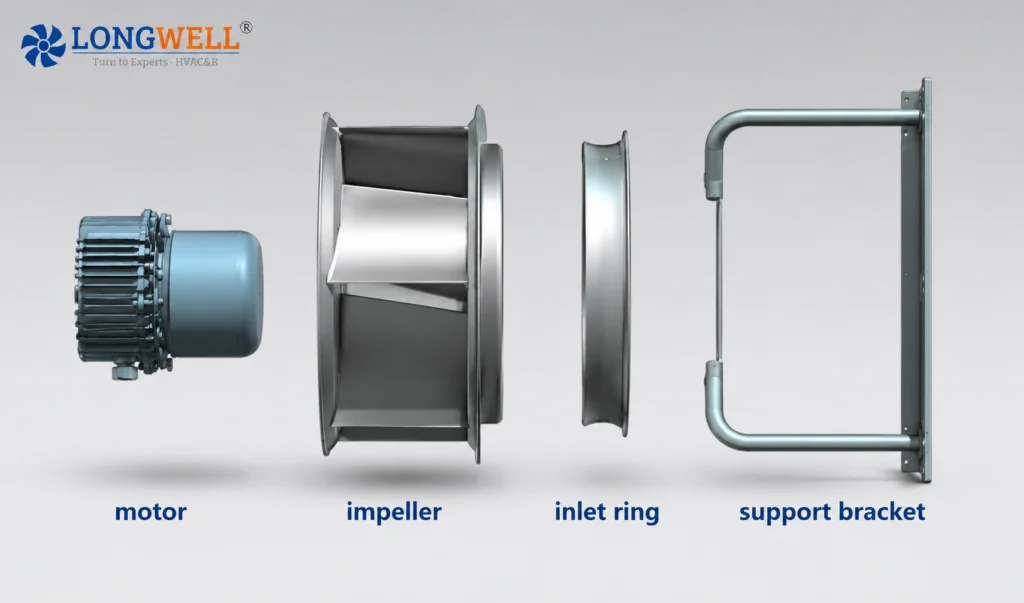
It commonly consists of four main components:
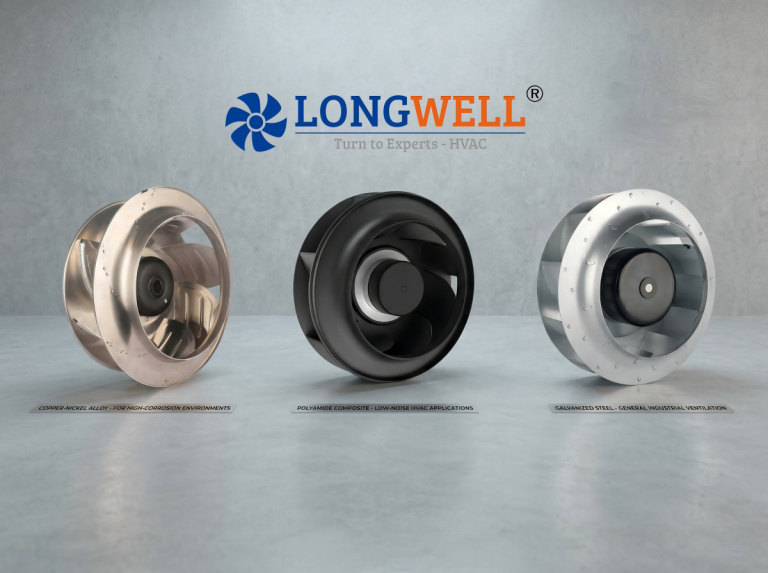
- Impeller: Depending on their size, impellers are made of plastic, galvanized steel, or aluminum alloy. Aluminum impellers can be treated with anodizing or powder coating.
- Motor: The motor serves as the power core of the entire fan system, providing the mechanical energy required to drive the impeller at high speeds. In the backward curved centrifugal fans, three different types of motor drive technologies are typically employed depending on the system’s power supply and control requirements: AC (alternating current), DC (direct current), and EC (electronically commutated).
- Inlet Ring: An inlet ring is a stationary, typically funnel-shaped flow-guiding device installed at the fan’s inlet. Structurally, it forms an extremely precise mating fit with the front ring of the rotating impeller.
- Bracket: A support bracket is not a mandatory component of the entire fan system. However, it secures the relative positions of the inlet ring, impeller, and motor before the fan leaves the factory. This makes installation easier and provides vibration isolation.
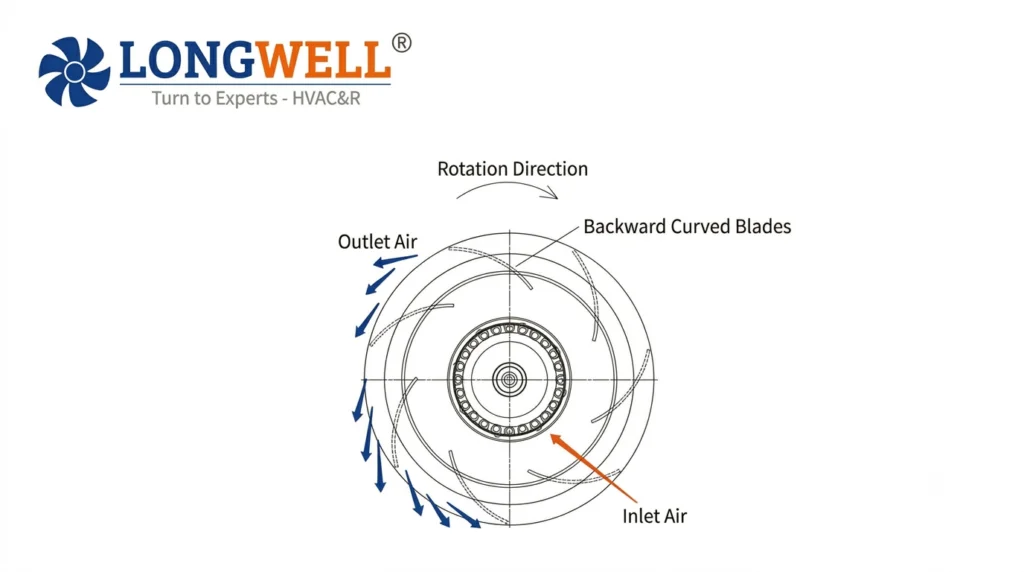
The backward curved blades on the impeller draw air in from the center and, under the action of centrifugal force, expel it along the direction of the blades, creating a high-pressure airflow. Since the airflow direction is perpendicular to the impeller’s axis, this type of fan is suitable for applications requiring the overcoming of high resistance.
Backward Curved Centrifugal Fan Working Principle
The Aerodynamics of Backward Curved Blades
The curvature of the blades is backward, matching the natural path of airflow as it moves outward. As air enters the impeller, it’s like riding a streamlined slide, flowing out extremely smoothly along the surface of the blades. This feature significantly promotes laminar flow and eliminates vortices. Without the friction caused by vortices, all electrical energy is utilized to generate airflow. This is the fundamental reason behind its high efficiency and low noise levels.
Axial Intake: How Air Enters the System
The air intake process relies on the principles of fluid dynamics: fluids flow from areas of high pressure to areas of low pressure. As the impeller rotates at high speed, the air inside the impeller is subjected to strong centrifugal forces and is flung outward toward the outer ring. This draws air away from the impeller eye, creating a localized low-pressure zone. At this point, outside air rushes straight into the fan inlet along a completely parallel direction to the motor inlet. The air maintains its forward linear inertia until it enters the impeller eye.
Energy Transfer: The Role of Centrifugal Acceleration
Centrifugal acceleration is the physical source of the work performed by the entire fan. In a backward curved design, the primary function of centrifugal acceleration is to accelerate the air entering the impeller eye outward, imparting kinetic energy to the air, which is ultimately converted into static pressure, thereby enabling air delivery and pressurization.
Radial Discharge and Velocity Generation
The most distinctive feature of backward-curved centrifugal fans is the distinct 90̊ change in airflow direction. Air enters the system axially, parallel to the motor shaft, and is then discharged at high speed in a radial direction, perpendicular to the rotor shaft. Since the gas flows from the center toward the outer circumference, the flow path between the backward curved blades naturally forms a funnel-shaped diffusion structure. During this 90̊ turn, as the passage widens, a portion of the kinetic energy is spontaneously reduced within the impeller and converted into static pressure.
Backward Curved Centrifugal Fan Characteristics
- High Efficiency: Static pressure efficiency typically exceeds 80%. When equipped with a special EC motor, which allows for precise speed control and reduces energy waste, efficiency can reach as high as 85%. The speed can also be adjusted as needed, thereby saving energy and reducing costs.
- Low Noise: Traditional backward curved fan blades in the industry achieve a noise reduction rate around 70%. According to internal Longwell testing data (2025), however, it utilizes a biomimetic blade design that increases the noise reduction rate, boosting efficiency over 5 percentage points. This results in a significant reduction in electricity costs for the same airflow output.
- Stable Performance: When airflow varies, the pressure fluctuations on the blades are minimal. Even when airflow is below or above the rated value, the impeller continues to operate efficiently, reducing operational risks for the system.
- Long Service Life: The design is robust, and the structure features self-cleaning properties. The blades exhibit extremely slow rates of physical and mechanical fatigue and wear, ensuring long-term durability. The design incorporates a built-in overload protection curve.
- Diverse sizes: Longwell offers a full range of backward-curved centrifugal fans with sizes ranging from 133 mm to 630 mm; it also offers products with impeller sizes ranging from 175 mm to 400 mm (diameter).
- Certifications: Many products have obtained CE, UL, RoHS, CCC, ETL, and other certifications.
Backward Curved vs Forward Curved Centrifugal Fans
Although the main difference between a forward curved centrifugal fan and a backward curved centrifugal fan lies in the direction of the blades’ curve, the practical differences in their application are significant. Generally, backward curved centrifugal fans are preferred in industrial and commercial tasks due to their higher static pressures, higher efficiency, and less energy. Forward-curved centrifugal fans are often selected for HVAC systems, air handling units, and cooling limited-space electronics because of their small size.
The table below provides a simplified comparison of the two fan types. For a more detailed discussion of pros and cons, efficiency characteristics, and application scenarios, see our guide on Forward Curved vs. Backward Curved Centrifugal Fans.
| Characteristics | Backward Curved Centrifugal Fan | Forward Curved Centrifugal Fan |
| Static Efficiency | Higher (75%-85%+) | Moderate (60%) |
| Noise | Lower | Higher |
| Pressure Capability | Stronger | Weaker |
| Frequency of Maintain | Lower | Higher |
| Motor Safety | Non-Overloading | Prone to Overloading |
| Energy Consumption | Lower | Higher |
| Space & Footprint | Larger Footprint | Highly Compact |
Applications of Backward Curved Centrifugal Fans
Taking the Longwell LWBE3G backward curved centrifugal fan as an example, the applications of backward curved centrifugal fans can be grouped into five main categories:
- Ventilation in Air Conditioning Systems: Continuous supply of treated air is required, and the air resistance caused by ducts, filters and heat exchangers needs to be overcome. The backward-curved centrifugal fan can maintain good operating efficiency under higher static pressure.
- Heat Pump Systems: With the promotion of the A+++ energy efficiency standard, heat pump equipment has placed higher demands on the efficiency of the fans. The backward curved centrifugal fan can provide stable airflow with lower energy consumption, while meeting the requirements for low noise operation.
- Air Handling Units (AHUs) and Fan Coil Units (FCUs): The supply air volume needs to be continuously adjusted according to the load changes to ensure the indoor air quality and comfort. The backward-curved centrifugal fan is usually used in conjunction with an EC motor to achieve precise speed control and reduce energy consumption during partial load conditions.
- Data Centers and Electronic Equipment Cooling: During operation, servers, communication equipment, and power electronic devices continuously generate a large amount of heat, which requires extremely high reliability of the cooling system. The backward-tilted centrifugal fan can provide uniform and stable air circulation and support long-term continuous operation.
- Industrial Ventilation and Air Filtration Systems: Air filters and complex piping usually cause significant system resistance, which requires the fan to continuously provide a stable air pressure. The rear-bent centrifugal fan, with its high static pressure performance and excellent energy efficiency, can maintain stable operation.
How to Choose a Fan?
Step 1: Determine the System Requirements
- Calculate the required air volume.
- Determine the air change volume or process air demand.
- Take into account the system pipe length, the number of equipment, and the air distribution requirements.
- Calculate the total system pressure.
- Define operating environmental conditions.
Step 2: Matching the Performance Curve of Fans
- Select the operating point to be near the optional efficiency point to ensure high energy efficiency, low noise and vibration, and a stable pressure point.
Step 3: Noise Assessment
- Check the noise level at the rated operating condition.
- If applied in sensitive areas, such as hospitals, libraries, or offices, consider a low-noise impeller design or silencer, or sound insulation measures.
Step 4: Life Cycle Assessment
- Give priority to efficient fans to reduce consumption.
- Evaluate the maintenance frequency and cost.
- Compare the long-term operational economics of different models.
Step 5: Final Selection and Verification
- Confirm technical parameters, performance curves, and installation requirements with the supplier.
Why Choose Longwell Backward Curved Centrifugal Fans?
With the release of ErP 2026, the energy efficiency standards for extensions have been further enhanced. Since 2026, the efficiency standard for fans will require a minimum efficiency of 64%. For OEMs or ODMs, fans are no longer merely standard components in equipment. Instead, they have become key components that directly affect the energy efficiency rating, regulatory compliance, and market competitiveness of the entire product.
In the future, backward curved centrifugal fans will play a more significant role in the fields of HVAC, heat pump, and industrial ventilation. Longwell’s EC Backward curved centrifugal fan integrates drive electronics, which have a higher efficiency and lower energy consumption compared to AC or DC motor centrifugal fans.
In a practical case, the LWBE3G backward curved centrifugal fan is used in the process exhaust and dust removal system of a battery cathode material production project. It provides stable air volume and static pressure for the dust removal equipment, meeting the ATEX-IIIC requirements, and achieving efficient and continuous industrial ventilation operation. Longwell, as a professional supplier of fan solutions, can assist enterprises in maintaining reliable and high-performance industrial operations while meeting strict energy efficiency regulations.
FAQs:
Is a backward curved centrifugal fan more efficient than a forward curved fan?
Yes, typically the backward curved centrifugal fan has a higher efficiency. The design structure of this fan enables it to have high energy efficiency.
Are backward curved centrifugal fans suitable for dusty environments?
Applicable, but a suitable design needs to be selected based on the characteristics of the dust. These fan blades have a smaller number and a wider flow channel. Compared with the forward-bent type of fan, it is less likely to accumulate dust and get clogged.
What materials are commonly used for backward curved centrifugal fan impellers?
Longwell mainly produces blades made of aluminum alloy, plastic, and galvanized sheet materials.
What is the difference between backward curved and backward inclined blades?
Both belong to the backward blades design, but the shapes of the blades are different.
The blades of the Backward Curved ones are naturally curved in an arc shape, resulting in a smoother airflow and usually higher efficiency. The blades of the Backward Inclined ones are basically straight and are installed at an angle backward.
Explore Longwell Backward Curved Centrifugal Fans
View All Backward Curved FansChoose the right backward curved centrifugal fan
Longwell manufactures 587 backward curved centrifugal fans in-house. Send airflow, static pressure and voltage — an engineer replies with a matching model, performance curve and price within one working day.