
Control Cabinet and Electrical Panel Cooling Fans
Drives, power supplies, PLCs and relays all give off heat inside closed cabinets. Electronics age quickly when they run hot, and overheating causes nuisance trips and failures. A cooling fan replaces hot cabinet air with cooler room air, or circulates air inside a sealed enclosure to remove hot spots.
LONGWELL manufactures the compact AC, DC and EC fans used by panel builders, drive and inverter makers, and enclosure manufacturers.
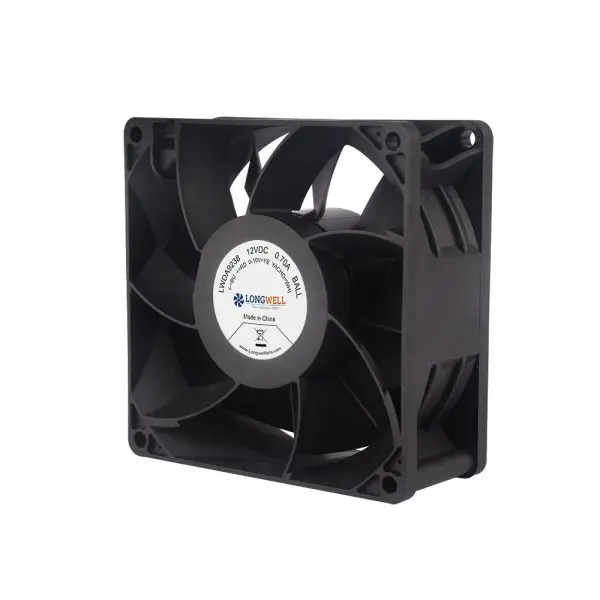
Cooling options for enclosures
| Method | When to use | Fan role |
|---|---|---|
| Filter fan + exhaust grille | Room air is cooler than the cabinet limit and reasonably clean | Axial fan pushes filtered air in; warm air leaves through an outlet grille high up |
| Internal circulation | Sealed cabinets, hot spots around drives | Small DC/EC fans mix internal air |
| Air-to-air heat exchanger or cabinet AC | Dirty or hot environments, outdoor cabinets | Fans on both air circuits of the unit |
| Direct component cooling | VFD heat sinks, power modules, motors | Dedicated drive or motor cooling fans |
How to size a cabinet fan
1. Heat load
Add up the losses (watts) of the components inside: drives, power supplies, transformers.
2. Allowed temperature rise
Take the maximum internal temperature your components allow, minus the highest room temperature.
3. Airflow
The required airflow follows from heat load ÷ (air density × specific heat × temperature rise). As a rule of thumb, required airflow (m³/h) ≈ 3.1 × heat load (W) ÷ temperature rise (K). Add margin for filter resistance and dust build-up.
4. Voltage and control
Choose AC fans (115 / 230 V) for mains-powered cabinets, or DC fans (12 / 24 / 48 V) running from the control supply, with PWM or temperature-controlled speed and alarm outputs.
5. Environment
Dust, moisture and outdoor installation call for filters, sealed fans (IP-rated options) or a closed-loop solution.
LONGWELL fans for cabinets and drives
- DC compact axial fans: frames from 25×10 mm to 92×38 mm, 5 / 12 / 24 / 48 V. Typical options: auto-restart (AS), rotation detect/alarm (RD), tachometer (FG), PWM speed control, temperature control, and IP56 sealing on selected series. UL94-V0 plastic frame and impeller, -10 to 70 °C operation (non-condensing).
- AC electronics cooling fans: mains-powered compact fans for cabinets, power supplies and appliances; the 2026 catalogue lists 170 models (LWAA series).
- EC electronics cooling fans: mains input with electronic speed control.
- VFD and motor cooling fans: 59 models (LW-BG series) for variable-frequency drives, converters and forced-ventilated motors.
Browse: compact axial fans · DC axial fans · AC axial fans
Download: AC electronics cooling fans · DC electronics cooling fans · EC electronics cooling fans · VFD and motor cooling fans
Engineering examples
Related: independent motor cooling · telecom cabinet cooling
What to include in your enquiry
- Cabinet size, heat load and maximum internal temperature
- Ambient temperature, dust and moisture conditions
- Supply voltage (AC or DC) and control/alarm signals needed
- Fan size limits or the model you use today
- Annual quantity
Send your cabinet cooling requirements →
FAQ
How do I calculate the fan size for an electrical cabinet?
Required airflow (m³/h) ≈ 3.1 × heat load (W) ÷ allowed temperature rise (K). Then add margin for filter resistance and pick a fan that delivers that airflow at the expected pressure.
Should a cabinet fan blow in or out?
Usually in, through a filter at the bottom, with an outlet grille at the top. The cabinet stays at slight positive pressure, so unfiltered dust is kept out.
AC or DC cabinet fan?
AC fans connect straight to mains. DC fans run from the 24 V control supply and offer speed control and alarm signals more easily.
Can LONGWELL replace the fan in my existing cabinet or drive?
Yes. LONGWELL can provide replacement candidates for many mainstream cabinet and drive fans. Send the frame size, voltage, airflow and connector; the final model is confirmed by duty point, mounting and a test.