Meeting Regional Ventilation Constraints
First, a customer needed a new 220v inline duct fan series for European homes. Next, the project required three specific casing diameters. We had to build 100 mm, 125 mm, and 150 mm units. Furthermore, the customer provided a firm minimum performance matrix.
For example, the 100 mm unit needed at least 187 m3/h on high speed. It also had a low-speed target of 145 m3/h. Meanwhile, the 125 mm model needed 280 m3/h on high speed. Finally, the 150 mm version required a minimum of 520 m3/h.
Consequently, electrical constraints firmly anchored this equipment in the European market. The units required exactly 220 VAC at 50 Hz. First, they needed built-in dual-speed operation. Next, the design had to include a pre-wired European standard plug.
The ambient temperature range spanned from -20°C to 50°C. Therefore, this fan operates safely in semi-conditioned spaces. Finally, local regulations demanded CE and RoHS compliance. The electrical safety testing had to meet EN 60335-1 rules.
Airflow testing followed ISO 5801 methods. We also reviewed the baseline power limits from the customer. The 100 mm fan had a strict target power limit of 33 watts. By contrast, the 125 mm model aimed for 37 watts on high speed.
Next, the 150 mm version targeted a maximum of 60 watts. Furthermore, the packaging requirements included a retail color box. The customer also requested a custom logo sticker on the housing. So, our engineering team had strict boundaries for both cost and physical design.
Engineering the 220v Inline Duct Fan Series
Evaluating Motor Options
We evaluated three different paths for this project. First, we considered standard single-speed AC motors with external voltage regulators. We rejected this idea quickly. The customer explicitly requested native dual-speed control integrated into the fan unit. By contrast, an external controller adds extra material cost. It also complicates the final wiring process for home users.
Next, we analyzed electronically commutated (EC) motors. EC technology easily manages multiple speeds. It also runs highly efficiently at partial loads. However, we discarded this option early in the review. The EC motor severely overshot the customer’s cost threshold for a standard consumer product. Therefore, we selected an AC capacitor-run motor. We designed it with specific dual windings. This choice requires a slightly heavier copper coil inside the stator. Even so, it fully satisfies the native two-speed requirement. It does this at a much lower cost than EC alternatives.
Sharing Core Components
During development, we made a major design trade-off. We looked very closely at the 100 mm and 125 mm models. Instead of designing two entirely separate motors, we shared parts. We used the exact same 40W motor core for both sizes.
Consequently, the smaller 100 mm model delivers 319 m3/h on high speed. This vastly outperforms the customer’s 187 m3/h minimum requirement. This decision cost the 100 mm unit a higher power draw. It uses 40W instead of the original 33W target.
Furthermore, we accepted this trade-off for a very practical reason. Sharing the core components slashed our tooling time. It also eliminated duplicate testing phases in the lab. Finally, the 150 mm size received a larger 80W motor.
This motor yields 556 m3/h at peak speed. Therefore, it safely clears the 520 m3/h threshold. All sizes hit the required IP44 protection class. Meanwhile, they maintain noise levels strictly at or below 38 dB(A).
We test these noise limits according to standard methods. Furthermore, we specified deep groove ball bearings for all models. This guarantees a long life expectancy in residential spaces. So, these bearings prevent premature motor failure.
Next, we balanced the impellers strictly to JB/T 9101-1999 G6.3 requirements. Proper balancing prevents annoying chatter over time. In short, the AC dual-winding strategy met every major project constraint.
Technical Specifications
| Parameter | LWDA-100(4”)S | LWDA-125(5”)S | LWDA-150(6”)S |
|---|---|---|---|
| Voltage (VAC) | 220 | 220 | 220 |
| Frequency (Hz) | 50 | 50 | 50 |
| Speed High/Low (RPM) | 2600 / 2200 | 2600 / 2200 | 2600 / 2200 |
| Input Power High/Low (W) | 40 / 32 | 40 / 32 | 80 / 70 |
| Airflow High/Low (m3/h) | 319 / 205 | 319 / 205 | 556 / 400 |
| Airflow High/Low (CFM) | 187 / 121 | 187 / 121 | 327 / 235 |
| Static Pressure High/Low (Pa) | 185 / 135 | 185 / 135 | 309 / 171 |
| Noise Level (dB(A)) | 32 | 32 | 38 |
| Operating Ambient (°C) | -20 to 50 | -20 to 50 | -20 to 50 |
| Protection Type | IP44 | IP44 | IP44 |
| Certifications | CE, FCC, RoHS, REACH | CE, FCC, RoHS, REACH | CE, FCC, RoHS, REACH |
First, the shared performance numbers for the 100 mm and 125 mm models reflect the shared motor strategy discussed earlier. Next, the static pressure and airflow rows demonstrate standard AC motor scaling. The table lists the exact input power for high and low modes. Furthermore, the noise level remains at 32 dB(A) for the smaller units. Finally, the 150 mm unit peaks at 38 dB(A) while moving much more air.
Reference: AMCA 210 covers the test method behind these figures.
Technical Documentation
longwell-wi-6930157027-spec-sheet-03.pdf
First, this document provides the complete dimensional drawings for the 100 mm unit.
longwell-wi-6930157027-spec-sheet-01.pdf
Next, engineers will find the performance curves for the 125 mm model in this official sheet.
longwell-wi-6930157027-technical-doc-02.pdf
Furthermore, this file outlines the parameters for the larger 150 mm unit.
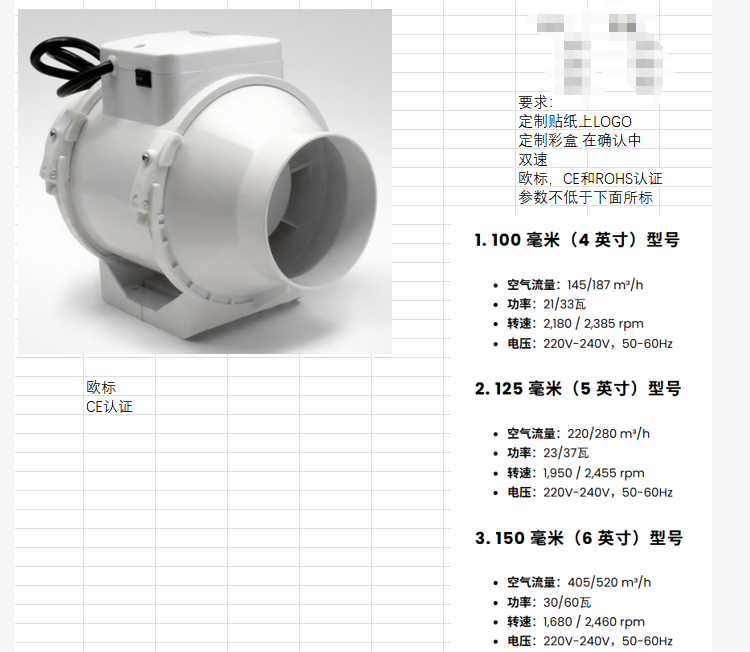
Finally, the initial customer input matrix shows the exact minimum targets we needed to surpass.
Guidelines for Specifying Duct Ventilation
If you face a similar ventilation project, consider these practical steps.
- Next, decide if you truly need independent motor designs for every diameter. Sharing a motor core across consecutive sizes reduces lead times. It also simplifies your replacement parts inventory.
- Furthermore, always specify your connector constraints early. Incorporating a pre-wired European standard plug at the factory prevents costly manual rewiring later.
- Finally, evaluate your noise ceiling carefully. Hitting 32 dB(A) on a 125 mm fan requires specific impeller balancing. You must balance the rotor to at least a G6.3 grade to avoid vibration.
Related: Duct Fans.
Frequently Asked Questions
Technical Documentation & Resources
Browse our duct fans range, the inline duct fans section, or mixed flow fans.
Have a Similar Fan Requirement?
Longwell’s engineering team delivers custom spec sheets and samples within 90 days. Since 1990, we have supplied EC fans and blowers to OEMs across HVAC, cold chain, data center, and industrial applications worldwide.
🏆 ISO 9001 / ISO 14001 / ISO 45001 | CE (TÜV) | UL/ETL | ATEX Zone 21/22 | AMCA 210-16 / ISO 5801 tested