The Thermal Problem and Strict Limits
The customer needed to cool heavy industrial gear. First, they asked for a strong 200mm 48v dc fan. They wanted a
200mm 48v dc fan. Meanwhile, this 200mm 48v dc fan had to spin at exactly 5800 RPM. This fast speed was vital to clear out internal heat. Next, the power supply gave a strict 48 VDC main rail. The safe working range was 24 to 52 VDC. Also, the physical box could not exceed 200 by 200 by 60 mm. The 200mm 48v dc fan had to fit this exact space.
But the air target was massive. The 200mm 48v dc fan had to move 1100 CFM at 50 Pa static pressure. Therefore, this made it a pure high-speed air mover. The gear works outside in harsh weather. So, it had to run from -10 to +60 degrees Celsius. Spinning a large plastic fan at 5800 RPM causes heavy stress. In practice, the mechanical load on the hub is huge.
Therefore, safety rules required strict UL 94V-0 plastics. As a result, the 200mm 48v dc fan needed a locked-rotor guard. This keeps the 200mm 48v dc fan from catching fire. Moreover, it limits heat if the blades jam for 72 hours. Finally, the whole unit had to weigh under 1050 grams. In short, this kept the metal mounts safe from breaking over time. We had to draft the specs and quote an export cost. Meanwhile, we balanced this extreme speed against a 50,000-hour life.
Engineering the 200mm 48v dc fan
A 200x60mm fan running at 5800 RPM forces tough choices. Therefore, we had to balance motor life, loud noise, and weight. First, we looked at a metal frame. In practice, the metal could handle the fast spin easily.
However, the metal frame weighed too much. As a result, it would break the customer’s mounting points during transit. Instead, we chose a dense plastic frame and blade set. Moreover, this plastic meets the UL 94V-0 safety rule.
As a result, the 200mm 48v dc fan weighs just 1050 grams but stays strong. In short, the plastic blades do not bend under the heavy air load. Next, the extreme speed drove our bearing choice. Besides, we dropped sleeve bearings right away.
They fail fast at speeds near 5800 RPM. They simply cannot run for 50,000 hours at 25 degrees Celsius. The oil inside them dries out too quickly. Therefore, we used dual ball bearings.
This choice drove up the total cost. Even so, it kept the spinning parts stable. The rotor stays balanced from -10 to +60 degrees Celsius. This stability is worth the extra cost.
Handling Noise and High Input Power
Moving 1100 CFM with a
200mm 48v dc fan makes loud noise. The chosen design runs at 81 dBA on average. We accepted this loud noise level. The customer wanted raw air flow more than quiet spaces. Slowing the 200mm 48v dc fan down would cause the main gear to overheat. Heat damage was a bigger threat than noise.
Finally, the motor draws up to 300W of power. This required a heavy-duty electrical design. We used a strict Class A insulation system. It handles 5 mA at 500VAC for one minute without a spark. Next, the high power draw needed thick wires. We chose 22 AWG UL1007 lead wires. They stretch 500mm to carry the large current safely. By contrast, thin standard wires would melt under the peak load. The heavy wires keep the voltage steady. This ensures the fan starts smoothly every time.
Technical Specifications
| Model Number | LWAD20060HX-06-00 |
| Rated Voltage | 48 VDC |
| Operating Voltage | 24 – 52 VDC |
| Input Power (Max) | 300 W |
| Speed | 5800 RPM (±10%) |
| Maximum Airflow | 1100 CFM |
| Acoustical Noise (AVG) | 81 dBA |
| Dimensions | 200 x 200 x 60 mm |
| Weight | 1050 grams |
| Operating Temperature | -10°C to +60°C |
| Life Expectancy | 50,000 Hours at 25°C (15~65% RH) |
| Insulation Type | UL: CLASS A |
| Material Standard | Plastic UL: 94V-0 |
The 5800 RPM speed and 300W input power define this unit. These numbers force the use of dual ball bearings. They also cause the 81 dBA noise needed to hit the 1100 CFM mark. Engineers must look closely at the 24 to 52 VDC range. It shows the fan can handle large voltage drops safely.
Reference: AMCA 210 covers the test method behind these figures.
Technical Documentation
Technical Specification and Dimensional Drawing
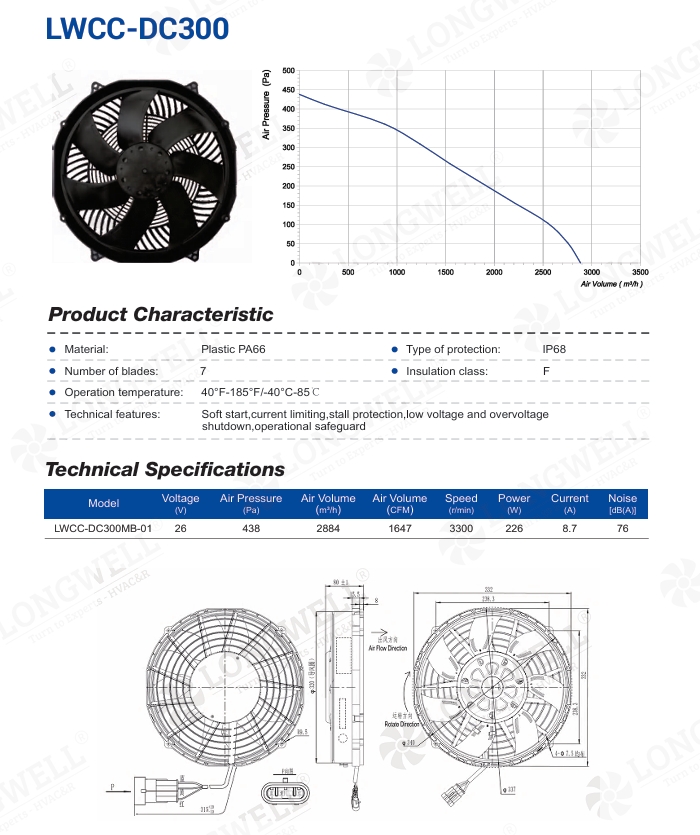
This sheet shows the performance curves and locked-rotor rules. Engineers need it to plan safe use. It lists all the test data from our lab. It also confirms the materials match the UL safety rules.
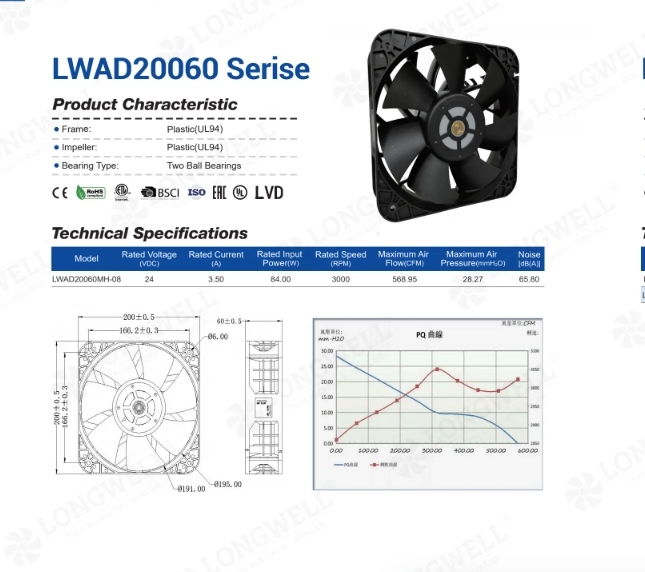
This drawing shows the exact blade shape. It details the 166.2mm hole spacing needed for exact mounting. The diagram ensures the factory drills the holes in the right places. It serves as a visual guide for the final build.
Specifying High-Speed DC Cooling Systems
Engineers must take care when they spec a
200mm 48v dc fan. Standard rules often fail near 6000 RPM. You must check every limit before you buy.
- Check the mounting strength: Fast speeds create heavy shaking. First, make sure your metal box can hold a 1050-gram mass. It must not rattle at 5800 RPM. A weak mount will crack over time.
- Check the power supply: A fan drawing 300W needs a lot of power. So, make sure the main supply can handle the startup spike. This stops the main voltage rail from dropping. A stable power supply keeps the fan running smoothly.
- Accept the loud noise: Pushing 1100 CFM through a 200mm hole makes more than 80 dBA of noise. Therefore, check if the area needs to be quiet before you set the air target. Do not expect a silent fan at this speed.
Related: Axial Fans.
Frequently Asked Questions
Technical Documentation & Resources
Browse our axial fans range, the AC axial fans section, or EC axial fans.
Have a Similar Fan Requirement?
Longwell’s engineering team delivers custom spec sheets and samples within 90 days. Since 1990, we have supplied EC fans and blowers to OEMs across HVAC, cold chain, data center, and industrial applications worldwide.
Browse Related Products:
🏆 ISO 9001 / ISO 14001 / ISO 45001 | CE (TÜV) | UL/ETL | ATEX Zone 21/22 | AMCA 210-16 / ISO 5801 tested