Enclosure Cooling Targets
First, the customer sent us a tough technical brief. They needed an exact 24V cross flow fan. This blower had to cool a tight space. Next, the whole unit had to fit inside a 355 mm box.
Furthermore, the housing could not be wider than 70 by 70 mm. Also, they asked for exactly 180 m³/h of airflow. So, we had to hit this mark at a strict speed of 2400 RPM. Meanwhile, the power limits were very tight.
The machine ran on a 24V direct current setup. Therefore, the motor could only draw 0.45A. The main board also needed to change speeds based on heat. Consequently, we had to add a 0-10V speed control input.
We placed this control signal on a white wire. Then, the system needed a clear tachometer output. Instead, we added a frequency generator (FG) signal on a yellow wire. Finally, the finished unit had to meet GB/T 13933 safety rules. We test our fans to AMCA 210-16 methods.
Engineering the 24V Cross Flow Fan
Building this 180 m³/h fan took careful choices. First, we looked at the core motor options.
Selecting the Motor
We thought about using an AC motor. However, an AC motor lacks 0-10V speed control. Furthermore, it would draw far too much power. Instead, we chose a brushless DC motor.
This motor has a built-in control board. Therefore, it handles the 24V power easily. It draws exactly 0.45A under a full load. Next, we checked the fan blade size.
We could have used a small 40 mm rotor. However, spinning a 40 mm rotor fast makes too much noise. So, we rejected the small size completely. Instead, we used a 50 mm diameter impeller. This larger part pushes enough air at just 2400 RPM.
Building the Metal Rotor
First, we picked the right hard materials. The 24V cross flow fan needs a 280 mm impeller. Plastic parts this long will bend over time. Therefore, we chose a strong aluminum impeller.
It has exactly 25 blades to move the air. Next, the side plates use solid iron. Meanwhile, the air inlet plates use rigid aluminum. Every choice has a direct cost.
First, metal parts weigh more than cheap plastic. Furthermore, dual ball bearings cost more than plain sleeve bearings. Even so, this trade-off made perfect sense. The heavy metal stops the fan from bending.
Next, the ball bearings ensure a long life. In short, the LWCD-50290MN-09 model hits the 180 m³/h mark perfectly. It also fits the strict 355 mm space.
Technical Specifications
| Parameter | Value |
|---|---|
| Model Number | LWCD-50290MN-09 |
| Operating Voltage | 24 VDC |
| Maximum Current | 0.45 A |
| Rated Speed | 2400 RPM |
| Air Volume | 180 m³/h |
| Total Length | 355 mm |
| Mounting Hole Distance | 317 mm / 307 mm |
| Impeller Dimensions | ø 50 x 280 mm |
| Blade Count | 25 |
| Bearing Type | Ball bearing |
| Shaft Material | Steel (ø 3 mm) |
| Side Plate Material | Iron |
| Impeller Material | Aluminum |
| Control Signal | 0-10V (White Wire) |
| Tachometer Output | FG (Yellow Wire) |
These simple numbers tell us how the system works. First, the 0-10V control wire manages the speed. Next, the FG wire tracks the fan speed. Therefore, the main board can watch and change the cooling power easily.
Reference: AMCA 210 covers the test method behind these figures.
Technical Documentation
First, you can view the drawing here:
LWCD-50290MN-09 Dimensional Drawing. This PDF shows the exact mounting holes. Mechanical engineers need this exact data. Next, the label photo shows the ratings: 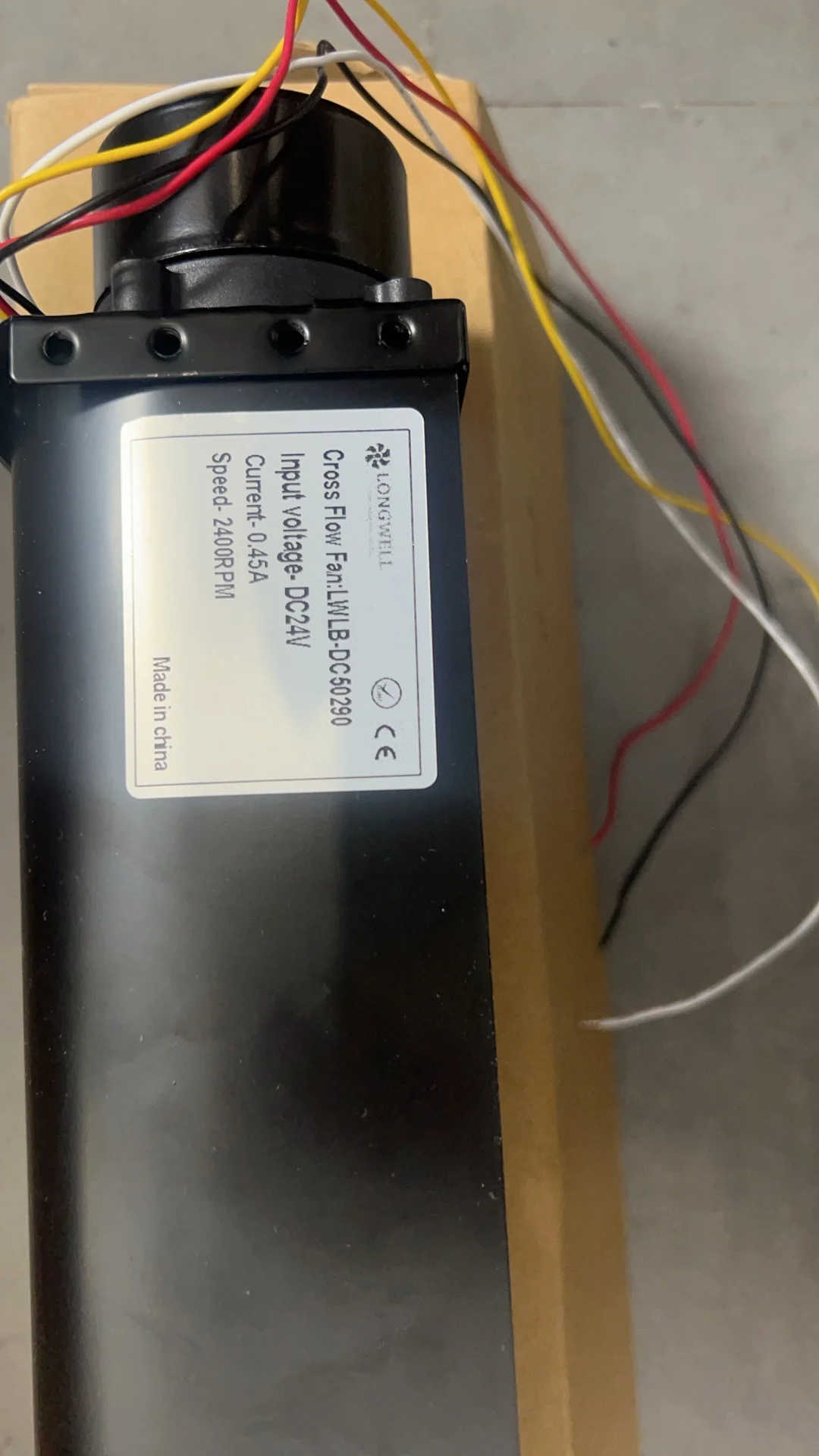 . Finally, workers use this picture to check parts against the order.
Rules for Equipment Cooling
Using a 24V cross flow fan takes real care. If you face a similar cooling problem, follow these rules:
- First, measure the true depth of your space. Cross flow blowers need clear room on the intake side. If you block the inlet, your airflow drops fast.
- Next, check your power limits. A system that jumps above 24V can ruin sensitive parts. Always verify your power board before you order a fan.
- Furthermore, pick your motor control early. Changing from a simple PWM signal to a 0-10V wire later causes big trouble. It forces a complete motor board change. Therefore, lock down your outputs early.
- Finally, look at your metal needs. Longwell makes these impellers in our own shop. We can use rigid aluminum for long parts. Metal stops the fan from bending over time.
Related: Cross Flow Fans.
Technical Questions
Q: How does a 0-10V control wire interact with the 24V cross flow fan motor?
A: The white wire takes an analog signal from the main board. At 0V, the fan stops completely. At 10V, it hits the top speed of 2400 RPM. Consequently, the machine can change cooling power based on heat sensors.
Q: Why specify an aluminum impeller over plastic for a 280 mm length?
A: Plastic parts can warp when they reach 280 mm long. Heat inside the box makes this bending worse. Therefore, we use an aluminum ø 50 x 280 mm impeller. This metal choice adds a little weight. However, it keeps bearing shake very low.
Q: What specific function does the FG wire serve on this blower?
A: The yellow FG wire sends a quick pulse back to the host. Next, the main board reads these pulses. It checks if the fan is spinning at 2400 RPM. If the speed drops, the system triggers a heat alarm.
Technical Documentation & Resources

Browse our cross-flow fans range, the AC cross-flow fans section, or cross-flow impellers.
Have a Similar Fan Requirement?
Longwell’s engineering team delivers custom spec sheets and samples within 90 days. Since 1990, we have supplied EC fans and blowers to OEMs across HVAC, cold chain, data center, and industrial applications worldwide.
Browse Related Products:
🏆 ISO 9001 / ISO 14001 / ISO 45001 | CE (TÜV) | UL/ETL | ATEX Zone 21/22 | AMCA 210-16 / ISO 5801 tested