Adapting Equipment for Global Power Standards
Machine builders often use one base design. So they face clashing power needs when selling abroad. Recently, a client asked us about a 300mm AC axial fan. They gave us a tough task. They needed a custom
300mm AC axial fan for two distinct power grids. First, they asked for a 440V 60Hz three-phase unit. This was for heavy factory sites. Next, they needed a 110V 60Hz single-phase fan. They use this version for other regional markets.
Both fans had to fit a 370mm square plate hole. The max depth was 80mm. Also, the fans had to move more than 2100 m3/h of air. Meanwhile, the noise limit was strict at 62 dB(A). The client installs these units outdoors. Because of this, the fans must start and run from -30C up to +60C. Therefore, we chose Class F insulation and IP54 protection. Finally, the 300mm AC axial fan had to pass CE safety rules like EN 60335-1. We test all air performance to AMCA 210-16 methods.
Engineering the 300mm AC Axial Fan Stator
We looked at a few paths to meet these rules. For instance, we thought about using an EC motor. EC motors accept a wide voltage range. We rejected this idea quickly.
The electronic parts added a materially higher cost. Plus, the client used simple contactor relays. Thus, adding EC control would force them to rebuild their control panels. Instead, our team designed two distinct AC stators.
These stators drive the exact same impeller. The base unit used a 5-blade cold-rolled sheet metal rotor. We kept this part. Reusing the rotor keeps the proven air flow profile.
In addition, cold-rolled sheet blades need precise factory balancing. They must pass JB/T 9101-1999 G6.3 rules. By keeping the rotor, we cut out new tooling and balancing work.
Managing the Power Consumption Trade-off
This choice brought a clear trade-off. Single-phase 110V motors are less efficient than three-phase 440V motors of the same size. Consequently, the 110V unit draws 0.96A. It uses 105W to spin at 1510 RPM.
By contrast, the 440V unit draws only 0.2A. It consumes just 80W and runs at 1550 RPM. Ultimately, the 110V setup carries a 25W penalty. It makes more internal heat.
Even so, we accepted this flaw. It let both fans use the exact same mounting plate. Therefore, the client paid for zero new sheet metal tooling. In the end, the two fans give almost the exact same air output.
The 440V fan moves 2112 m3/h. Meanwhile, the 110V fan moves 2142 m3/h.
Technical Specifications
| Parameter | LWAA4D300S-5MEB-36-00 | LWAA4E300S-5MEB-37-00 |
|---|---|---|
| Nominal Voltage | 440 VAC | 110 VAC |
| Voltage Range | 396~484 VAC | 92~138 VAC |
| Frequency | 60 Hz | 60 Hz |
| Speed | 1550 ±5% RPM | 1510 ±5% RPM |
| Current | 0.2 A | 0.96 A |
| Power Input | 80 W | 105 W |
| Air Flow (Max) | 2112 m3/h (1242 CFM) | 2142 m3/h (1260 CFM) |
| Noise Level | 62 dB(A) | 62 dB(A) |
| Ambient Temperature | -30C to 60C | -30C to 60C |
| Insulation Class | Class F | Class F |
| Protection Type | IP54 | IP54 |
| Work System | S1 (Continuous) | S1 (Continuous) |
| Life Expectancy (L10) | 30,000 Hours at 40C | 30,000 Hours at 40C |
The input power rows show the main gap between the two designs. In contrast, the fixed 370mm size and 62 dB(A) noise rows prove the mechanical fit stayed unchanged.
Reference: IEC 60529 covers the test method behind these figures.
Technical Documentation
View 440V 60Hz Fan Specs
This sheet shows the three-phase wiring and part sizes.
View 110V 60Hz Fan Specs
Engineers need this file to check the higher single-phase current draw.
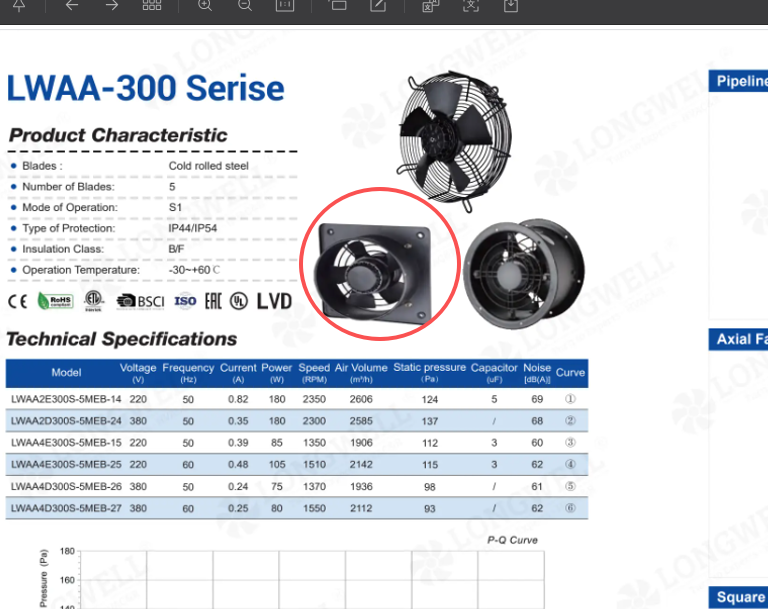
The client sent this picture to lock in the square plate frame before we began.
Planning for Dual Voltage Needs
Engineers often face power clashes when shipping units abroad. Therefore, you should check these traits before you order parts:
- First, find out the real phase power at the end site. Single-phase motors lose more energy as heat than three-phase motors.
- Next, check the max amp limit on your relays. Lower voltages always draw more current to do the same work.
- Also, ensure a larger motor winding will not hit parts inside your chassis.
- Finally, keep your blade shape the same across all models. We make our own impellers in-house. Because of this, we can swap stators easily while keeping the air flow steady.
Related: Axial Fans.
Common Questions About Custom Fans
Q: Why does the 110V version of this 300mm AC axial fan need 105W? A: Single-phase 110V motors need a different winding style than 440V three-phase ones. Consequently, they lose more power to wire resistance. The 300mm AC axial fan must spin the 5-blade impeller near 1500 RPM.
To do this while keeping the 62 dB(A) noise limit, the 110V unit draws more current. This adds a 25W penalty. Q: How does a -30C rating change the bearing choice? A: Normal grease freezes or gets too thick below -20C.
Therefore, reaching -30C requires custom synthetic oils. We use sealed deep groove ball bearings. They spin freely in harsh cold. This ensures the 30,000-hour L10 life span stays true.
Q: Does the new voltage change the acoustic noise? A: Fan noise comes from blade shape and speed. First, both models share the exact same cold-rolled steel blades. Next, their speeds are very close.
They run at 1510 RPM and 1550 RPM. Because of this, both fans emit exactly 62 dB(A). In short, the electrical shift does not ruin the sound profile.
Technical Documentation & Resources
Browse our axial fans range, the AC axial fans section, or EC axial fans.
Have a Similar Fan Requirement?
Longwell’s engineering team delivers custom spec sheets and samples within 90 days. Since 1990, we have supplied EC fans and blowers to OEMs across HVAC, cold chain, data center, and industrial applications worldwide.
Browse Related Products:
🏆 ISO 9001 / ISO 14001 / ISO 45001 | CE (TÜV) | UL/ETL | ATEX Zone 21/22 | AMCA 210-16 / ISO 5801 tested