Meeting Constraints for an Outdoor Telecom Cabinet
A customer needed a cooling fan for a packed outdoor telecom cabinet. First, the 24V DC centrifugal fan had to run on internal battery power. So, we supplied a 24V DC centrifugal fan. Next, the battery rack left little space.
The allowed depth was under 100 mm. Meanwhile, the max height was under 190 mm. Even so, the cabinet had a high heat load. Therefore, the system needed 360 m3/h of airflow.
At the same time, it faced a high static pressure of 340 Pa. In practice, dense cable routing and filters caused this pressure. Meanwhile, the site faced harsh weather. Meanwhile, winter lows dropped to -25C.
Summer peaks reached +60C. Finally, the customer wanted active speed control. This saves power during low loads. Therefore, the 24V DC centrifugal fan needed an IP44 rating to block dust and water.
We had to meet EN 60335-1 and ISO 5801-1997 testing methods. In practice, the noise limit was 65 dB(A). Therefore, we reviewed these strict limits to pick the best fan design.
Selecting the Right 24V DC Centrifugal Fan Architecture
We looked at axial fans first. However, we quickly rejected them. Axial fans move free air well. By contrast, they stall against the 340 Pa static pressure here.
Next, we checked a backward-curved fan. As a result, these fans need large side clearances to build pressure. The strict 99.5 mm depth limit made this impossible. We could not fit one without blocking the air path.
Instead, we chose a forward-curved fan design. A forward-curved 24V DC centrifugal fan builds high pressure at lower speeds. Furthermore, it fits snugly in a tight scroll housing. We put the motor and PA66 plastic impeller in a custom 188 mm casing. So, we pushed the air right to the heat sinks.
Engineering Trade-Offs and Costs
Every design choice carries a cost. First, we picked a plastic PA66 impeller. We rejected a welded aluminum wheel. Consequently, we lost a little peak aerodynamic efficiency.
The motor must use 95 W to reach the target airflow. Next, a tight scroll casing raises the noise level. Therefore, the unit hits exactly 65 dB(A) at its top speed of 2400 RPM. We also had to pick the right bearings.
To keep the depth under 100 mm, we used deep groove ball bearings. The heavy 2.5 kg assembly rests on these parts. The cost is a shorter lifespan. It has an L10 life of 20,000 hours at 40C.
In short, the user must plan for maintenance every few years. To offset the power draw, we added smart speed control. The motor takes a PWM signal or a 0-10VDC input. Finally, the main system slows the fan when the air gets colder. The final model, LWFD3G120-072SM-01, met all targets.
Technical Specifications
| Parameter | Value |
|---|---|
| Model Number | LWFD3G120-072SM-01 |
| Rated Voltage | 24 VDC |
| Voltage Range | 16 to 28 VDC |
| Input Power | 95 W |
| Rated Current | 3.95 A |
| Speed | 2400 RPM |
| Maximum Airflow | 360 m3/h (212 CFM) |
| Maximum Static Pressure | 340 Pa |
| Noise Level (LpAin) | 65 dB(A) |
| Operating Temperature | -25C to +60C |
| Protection Class | IP44 |
| Insulation Class | Class B |
| Weight | 2.5 kg |
| Balance Grade | G6.3 (per JB/T 9101-1999) |
| Certifications | CE, RoHS, REACH |
The wide 16 to 28 VDC voltage range is the most vital row here. Battery charging cycles push voltages up. A strict 24V limit would trip the safety cutoff. By contrast, this motor runs safely at 28V. Furthermore, the -25C lower limit dictates a special bearing grease.
Reference: AMCA 210 covers the test method behind these figures.
Technical Documentation
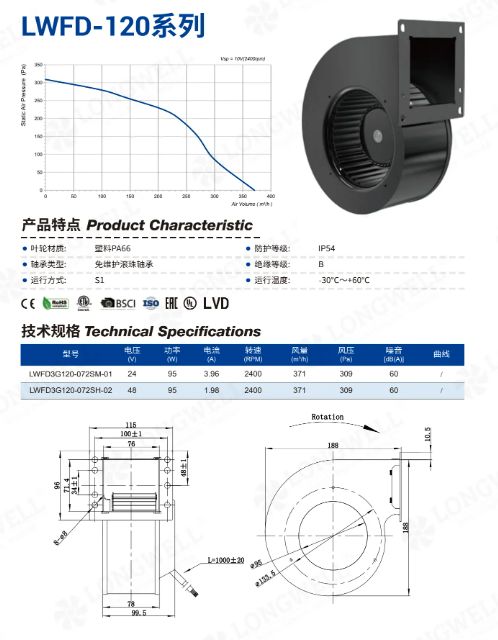
This catalog page shows the P-Q curves and key sizes. Mechanical engineers need these dimensions for basic CAD layouts.
LWFD3G120-072SM-01 Technical Data Sheet
This technical sheet gives wiring diagrams and safety limits. System builders use it for safe wiring and final testing.
Lessons for Enclosure Cooling Projects
If you must cool a tight cabinet, space limits dictate your fan choice. Keep these rules in mind:
- Measure the real pressure drop: Dense cables and filters block air. A fan rated for a large free airflow might fail here. Instead, pick your fan based on the real system pressure curve.
- Check cold weather limits: Standard plastics break easily below -20C. First, verify that your plastic impeller and bearing grease handle the lowest expected winter temperatures.
- Plan for voltage spikes: A 24V battery bank rarely stays at exactly 24V. So, give your fan maker the exact upper and lower voltage limits. This keeps the fan running safely during battery charging cycles.
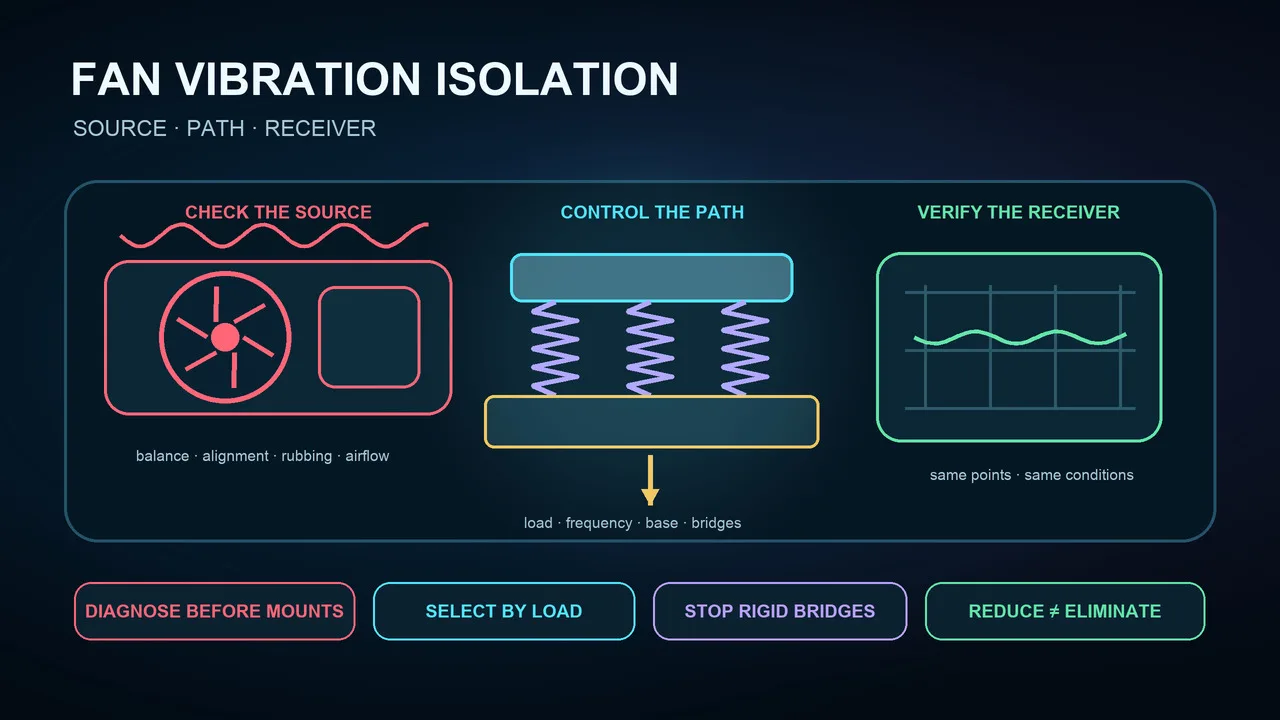
- Control final vibrations: We make our own PA66 plastic impellers. Therefore, we balance the final rotor assembly to a strict G6.3 standard. This stops bad vibrations from shaking your telecom cabinet.
Related: Centrifugal Fans.
Frequently Asked Questions
Technical Documentation & Resources
Browse our centrifugal fans range, the backward-curved fans section, or forward-curved fans.
Have a Similar Fan Requirement?
Longwell’s engineering team delivers custom spec sheets and samples within 90 days. Since 1990, we have supplied EC fans and blowers to OEMs across HVAC, cold chain, data center, and industrial applications worldwide.
Browse Related Products:
🏆 ISO 9001 / ISO 14001 / ISO 45001 | CE (TÜV) | UL/ETL | ATEX Zone 21/22 | AMCA 210-16 / ISO 5801 tested