The industrial air curtain Door Barrier Problem
We received an order for a large industrial air curtain. The customer runs a massive warehouse. The warehouse stores sensitive cold chain goods. Therefore, maintaining the indoor temperature is critical.
A standard plastic strip curtain was not enough. Forklifts drive through the opening constantly. Consequently, a physical barrier slows down the work. So, the customer needed an invisible air barrier.
First, they wanted to block dust and dirt from coming inside. Next, they needed to keep their conditioned air indoors. The opening was two meters wide. Therefore, they requested a 2000 mm long machine.
We reviewed the numbers. We selected our LWAC-BG4520S-01 model. It is a very heavy unit. It weighs 69 kg.
Furthermore, it moves a massive amount of air. It pushes 9,400 m³/h at a wind speed of 25 m/s. The power supply was 380V at 50Hz. So, the fan draws 3300 watts of input power.
We build these units to strict rules. First, they must pass IEC/EN 60335 safety checks. Next, we test all airflow data to AMCA 210-16 methods. However, the customer had one strict demand.
They wanted the machine to run automatically. They planned to use a small magnetic switch on the door. Next, they wanted to wire this tiny switch right into the 380V power line. Finally, this choice ruined the project.
Why Magnetic Switches Melt Under 3.3 kW Loads
We studied their electrical plan carefully. Wiring an industrial air curtain directly to a door switch is dangerous. The LWAC-BG4520S-01 requires 3300 watts. First, this is a massive inductive load.
The motors spin up very fast to hit that 25 m/s air speed. Consequently, they pull a huge spike of inrush current from the 380V line. By contrast, a normal magnetic door switch is weak. Manufacturers build it to handle tiny control signals.
Typically, it handles less than 24 volts and 1 amp. So, wiring a 3300 W load through it is a terrible idea. The high current would jump across the tiny metal gap inside the switch. First, it would melt the contacts instantly.
Next, it would weld the switch closed. Finally, it creates a massive fire hazard. Therefore, we rejected their direct wiring plan.
Safe Relay Control Designs
We told the customer to change their electrical panel. We designed a safe split circuit for them. First, the weak magnetic switch would run on a safe 24V loop. Next, that low-voltage loop would trigger a large industrial contactor.
Finally, the big contactor relay would handle the heavy 380V power. This is the only safe way to switch a 3.3 kW fan. Instead, the customer refused this new design. They lacked physical space in their main electrical box.
Furthermore, buying the heavy relays cost too much money. They could not fit a step-down transformer for the 24V loop. We also suggested adding an optical sensor. An optical sensor sends a clean digital signal to the control board.
However, the customer only had basic magnetic reed switches. They refused to upgrade their door hardware. Furthermore, they did not want to run new low-voltage wires across the wide bay door. Instead, they demanded a simple plug-and-play solution.
Unfortunately, you cannot plug a heavy load directly into a fragile sensor. So, they rejected the safe control panel plan.
The Cost of Poor Electrical Planning
We tried to find a third option. First, we looked at using a smaller fan. A smaller motor draws less power. So, a tiny fan might not melt the switch.
However, a small fan pushes less air. It cannot reach the 25 m/s speed needed for a large opening. It would not seal a 2000 mm door. Therefore, it would fail to stop the dust.
In short, the project hit a dead end. The magnetic switch could not survive 3.3 kW. Meanwhile, the customer refused to add a relay panel. Consequently, we terminated the project entirely.
The failure cost the customer weeks of lost planning time. Even so, stopping the project prevented a dangerous electrical fire.
Technical Specifications
The project files show the exact working parameters. First, they highlight the high power draw. Next, they confirm the physical size.
| Parameter | Value |
|---|---|
| Model | LWAC-BG4520S-01 |
| Machine Size | 2000 x 352 x 306 mm |
| Rated Voltage | 380 VAC |
| Frequency | 50 Hz |
| Input Power | 3300 W |
| Wind Speed | 25 m/s |
| Air Volume | 9400 m³/h |
| Weight | 69 kg |
The 3300 W input power row caused the industrial air curtain failure. First, the 25 m/s wind speed creates a perfect dust barrier. However, that high speed requires massive energy. Consequently, you cannot use cheap magnetic sensors to switch the machine on and off. Therefore, the power load dictates the entire control design.
Reference: IEC 60529 covers the test method behind these figures.
Technical Documentation
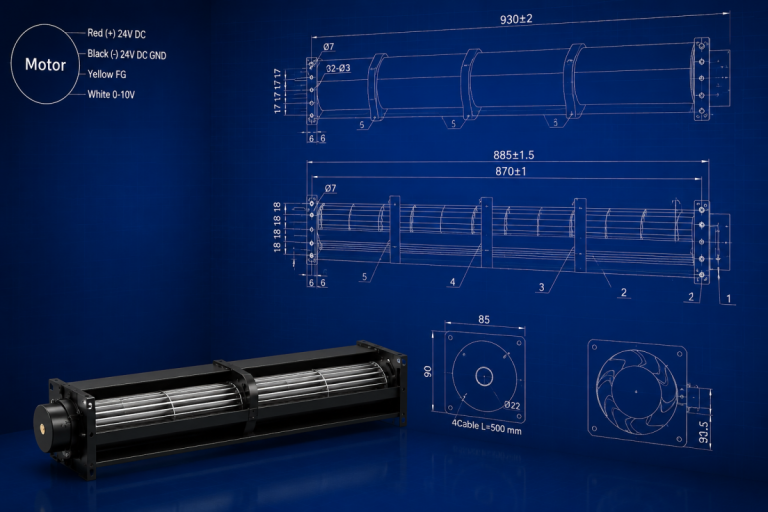
We provide the exact approved files below. First, engineers need them to verify sizes. Next, electricians use them to plan relays.
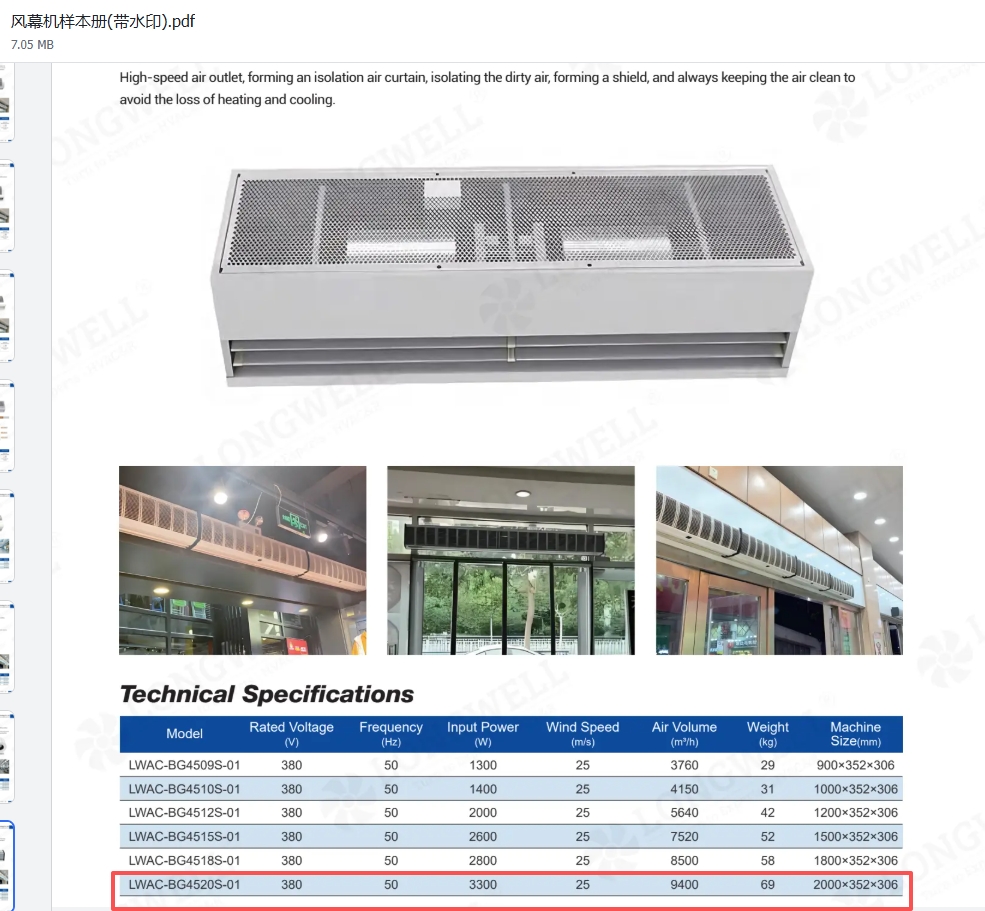
This catalog chart proves the 3.3 kW power limit.
Download LWAC-BG4520S-01 Engineering Drawing
Electricians need this file to plan the correct 380V contactors.
How to Wire High-Power Door Automation
If you need to automate an industrial air curtain, follow these rules. First, never wire a high-voltage motor directly to a tiny door switch. Next, plan your electrical panel before you buy the machine.
- First, calculate the massive startup current of your chosen fan. Large fans pull huge electrical spikes when they spin up.
- Next, separate your system into two isolated loops. Your weak door switch must run on a safe 24V line.
- Furthermore, ensure your main breaker box has empty space. You must install large industrial relays to handle the 380V power.
- Finally, if you need fast CE safety testing, our local TUV NORD Notified Body setup shortens the wait time considerably.
- By contrast, if you use an optical sensor, check the voltage rating. Even optical sensors require a relay board to handle heavy 380V motors.
In short, match your relays to your motor power. Instead, many buyers skip this step and ruin their equipment.
Related: Commercial Fan & Blower.
Wiring Safety Questions
Technical Documentation & Resources
Browse our axial fans range, the AC axial fans section, or EC axial fans.
Have a Similar Fan Requirement?
Longwell’s engineering team delivers custom spec sheets and samples within 90 days. Since 1990, we have supplied EC fans and blowers to OEMs across HVAC, cold chain, data center, and industrial applications worldwide.
Browse Related Products:
🏆 ISO 9001 / ISO 14001 / ISO 45001 | CE (TÜV) | UL/ETL | ATEX Zone 21/22 | AMCA 210-16 / ISO 5801 tested