Chassis Size Limits for Outdoor Cooling
A customer in the outdoor HVAC field needed a strong cooling fan. First, they asked for our standard LWAE3G450SS-5PKW-12 unit. However, putting this 450mm EC axial fan into their metal box was hard. The normal PKW model has a thick metal ring bracket. This large ring did not fit their space. It hit their inside rails.
Next, the unit had to move 7622 m3/h of air at 1400 RPM. Also, the noise limit was 75 dB(A). The power rail was a normal 230VAC single-phase line. Even so, the local power grid changed a lot. Therefore, the motor had to run well between 198 and 277 VAC at 50/60 Hz. Meanwhile, the control setup needed modern links. Specifically, the customer needed 0-10VDC, PWM, and RS485 Modbus RTU inputs.
Finally, the 450mm EC axial fan had to meet strict global rules. The design needed air tests to ISO 5801-1997 methods. Electrical safety had to pass EN 60335-1 rules. In short, we had to remove the big housing. But we still had to keep the unit safe.
Engineering the 450mm EC Axial Fan Grille Change
We looked at a few ways to fix the size problem. First, we thought about changing the customer’s metal box. We said no to this idea. Tooling changes for their sheet metal take too long. Next, we thought about sending a bare motor and PA6+30%GF blade. We rejected this idea too. It fails the EN 60335-1 safety rules. Running a fast blade at 1400 RPM with no guard is not safe.
A New Grille and IP Rating
Instead, we used a standard wire basket grille. We took off the big metal wall ring. This change created the final LWAE3G450SS-5PEW-18-00 model. Consequently, the 450mm EC axial fan now fit their tight space. The customer bolted it right to their 522mm mount circle.
Furthermore, we improved the water seals during this work. The old 5PKW-12 model had an IP44 rating. We changed the motor casing to reach IP55. This choice cost a bit more. But it cost much less than a fully potted motor. Also, it keeps water out very well. The 450mm EC axial fan faces bad weather outside. Therefore, we used ThermoFlex rules so it runs from -25 C to 60 C.
Better Motor Controls
Finally, we added our SmartEC control board. This part gave the system an RS485 link. So, the customer’s PLC can read fan speed from a 5 Pulse/R signal. The PLC changes the speed as needed. We traded a slightly longer lead time for this custom grille and IP55 upgrade. By contrast, European brands take many months to do this. However, the final 450mm EC axial fan fit perfectly. It uses 380 W of power at 1.7 A. It spins up in under 30 seconds with a soft start.
Technical Specifications
| Parameter | Value |
|---|---|
| Airflow (Max) | 7622 m3/h (4486 CFM) |
| Speed | 1400 RPM |
| Input Power (Max) | 380 W |
| Nominal Voltage | 230 VAC |
| Voltage Range | 198~277 VAC |
| Frequency | 50/60 Hz |
| Current (Max) | 1.7 A |
| Noise Level | 75 dB(A) |
| Ambient Temperature | -25 C to 60 C |
| Protection Type | IP 55 |
| Insulation Class | Class F |
| Control Inputs | 0~10VDC / PWM / RS485 |
| Soft Start Time | under 30 seconds |
| Life Expectancy | 40,000 Hours (L10 at 40 C) |
| Impeller Material | PA6+30%GF |
| Certifications | CE, RoHS, REACH |
In short, the IP55 rating and Class F parts matter most here. They keep the fan safe from outside rain and heat. Also, these specs mean the fan runs safely across the wide 198 to 277 VAC range.
Reference: IEC 60529 covers the test method behind these figures.
Technical Documentation
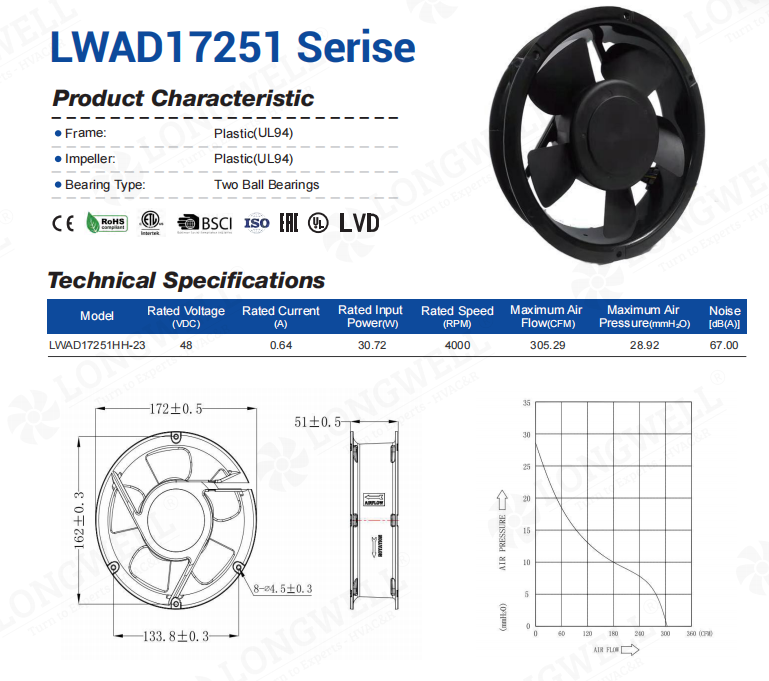
Old Specification Sheet. First, this file shows the old fan data before we took off the bracket.
 . Next, this picture shows how we cut the big metal ring to fit.
New Engineering Drawing. Finally, this PDF gives the final sizes and the new IP55 data.
Fitting an Axial Fan in Tight Spaces
- First, check your box size against the full fan depth. A 450mm EC axial fan needs more than 500mm of free space for wires and bolts.
- Next, remember that losing a wall ring changes the air path. You must build a curved inlet on your machine. Consequently, this guides the air and stops pressure drops.
- Furthermore, look at how much rain will hit the motor. Taking off a big cover exposes the motor body. Therefore, you must upgrade to IP55 if the unit lives outside.
- Finally, Longwell tests fan flow to AMCA 210-16 rules in our lab. We can quickly test if a new wire grille hurts the air speed.
Related: Axial Fans.
Engineering FAQ
Q: Why does the fan run safely between 198 and 277 VAC when rated for 230 VAC?
A: The smart drive board has active power control. It reads the power drops and changes the current pull. Therefore, it holds the 1400 RPM speed steady across the whole 198 to 277 VAC range.
Q: How do you meet the 75 dB(A) noise limit without the wall ring?
A: Noise gets worse when fast air hits flat metal edges. First, we swapped the wide metal bracket for a thin wire grille. This step stops bad air loops. In short, it keeps the sound under the 75 dB(A) mark.
Q: What happens if the RS485 wire breaks while running?
A: The motor checks the control wires all the time. If the 450mm EC axial fan drops the Modbus RTU link, it goes into a safe mode. Instead of shutting down hard, it slows down safely until the PLC fixes the link.
Technical Documentation & Resources
Browse our axial fans range, the AC axial fans section, or EC axial fans.
Have a Similar Fan Requirement?
Longwell’s engineering team delivers custom spec sheets and samples within 90 days. Since 1990, we have supplied EC fans and blowers to OEMs across HVAC, cold chain, data center, and industrial applications worldwide.
Browse Related Products:
🏆 ISO 9001 / ISO 14001 / ISO 45001 | CE (TÜV) | UL/ETL | ATEX Zone 21/22 | AMCA 210-16 / ISO 5801 tested