Defining the Space Cooling Requirement
The customer asked us to build new industrial floor fans. First, they needed strong fans to cool big spaces. These spaces include farm sheds and large storage rooms. Such huge rooms do not have air conditioning.
Summer heat makes the air very stale. Thus, proper air movement is vital for worker health. So, the fans must push air all day long. Meanwhile, the client gave us exact sizes to match.
They asked for 24-inch, 30-inch, and 36-inch fan models. Next, the main limits involved power and tough bodies. The fans run on standard 220V wall power. Busy workers drive carts around these units.
Therefore, the fans need thick metal shells. We also had to watch the noise levels. Loud fans hurt clear talk between workers. Also, fast blades make too much wind noise.
We tested early models using AMCA 210-16 methods. This testing showed us the exact air flow for each size. Finally, the fans must pass safe use tests. They need to meet the IEC/EN 60335 standard for safe gear.
This strict rule keeps workers safe near the spinning parts. Moreover, outdoor dirt and dust get into the fan motors. Because of this, the design must handle rough use without failing. We had to fix the blade design to meet this strict safety rule.
Engineering the Industrial Floor Fans
We looked at many ideas to build these industrial floor fans. First, we checked different blade materials. We wanted long life and low noise.
Choosing the Best Fan Blades
We said no to cheap plastic blades. Plastic bends too much in hot spaces. In a 40C factory, plastic blades lose their shape fast. A bent blade shakes the whole fan body.
Instead, we picked strong aluminum blades. We used a three-blade design for all the fans. This light metal needs less power to start spinning. Consequently, the motor draws less current when you turn it on.
The aluminum parts cost more money to make. However, the three-blade shape cuts through the air smoothly. This setup yields high air output with less drag. Also, lighter blades save wear on the motor bearings. Therefore, the fan runs much longer before it needs repair.
Selecting Pure Copper Motors
Next, we focused on the heavy motors. We rejected standard mixed-metal wires. Cheap metal wires break down under heavy daily loads. Instead, we chose pure copper wire for the motor cores.
Pure copper costs a lot more money up front. Furthermore, it adds heavy physical weight to the fan unit. But copper stays much cooler during hard work. Thus, the motor will not burn out after running all day long.
Less heat means a longer life for the whole machine. Then, we had to hold this heavy motor safely. We mounted the fans on thick steel base tubes. The strong tubes hold the motor steady at all times. Finally, we added solid rubber wheels so users can move them fast.
Matching Size and Speed
Finally, we matched the fan size with the right spin speed. The big 36-inch fan spins at just 1,050 RPM. It uses 350W of electric power. By contrast, the small 24-inch fan spins faster at 1,300 RPM.
It only needs 180W of power. We keep the big blades spinning slowly on purpose. Slower speeds stop the blade tips from howling loud. Fast blades chop the air and create terrible noise.
Therefore, the large fan moves a massive 17,400 m³/h of air quietly. We accepted the heavier total weight to get this quiet power. In short, careful speed control solves the biggest noise problems.
Technical Specifications
| Model Number | Airflow (m³/h) | Speed (RPM) | Power (W) | Voltage (V) | Dimensions (mm) |
|---|---|---|---|---|---|
| LWA-600(24″) SM-05 | 11,400 | 1,300 | 180 | 220 | 775 × 280 × 770 |
| LWA-750(30″) SM-05 | 13,200 | 1,200 | 250 | 220 | 815 × 280 × 810 |
| LWA-900(36″) SM-02 | 17,400 | 1,050 | 350 | 220 | 900 × 280 × 920 |
The air flow row shows the massive volume these big fans move every hour. Meanwhile, the power row proves that the larger units do not waste electricity. A 350W draw is very low for such huge air output. The speed values highlight our focus on noise control. Finally, the exact dimensions help buyers map out clear floor spaces for safe daily use. Floor managers must know these sizes to keep aisles clear for rolling carts.
Reference: IEC 60529 covers the test method behind these figures.
Technical Documentation
Drawing for the 36-inch industrial floor fans. This main sheet shows the large 900 mm width and the 350W power draw for space planning. Engineers use this specific sheet to check the exact floor footprint.
Drawing for the 30-inch model. Shop buyers check this file to see the 1,200 RPM motor speed limit. The drawing also shows the full metal cage guard details.
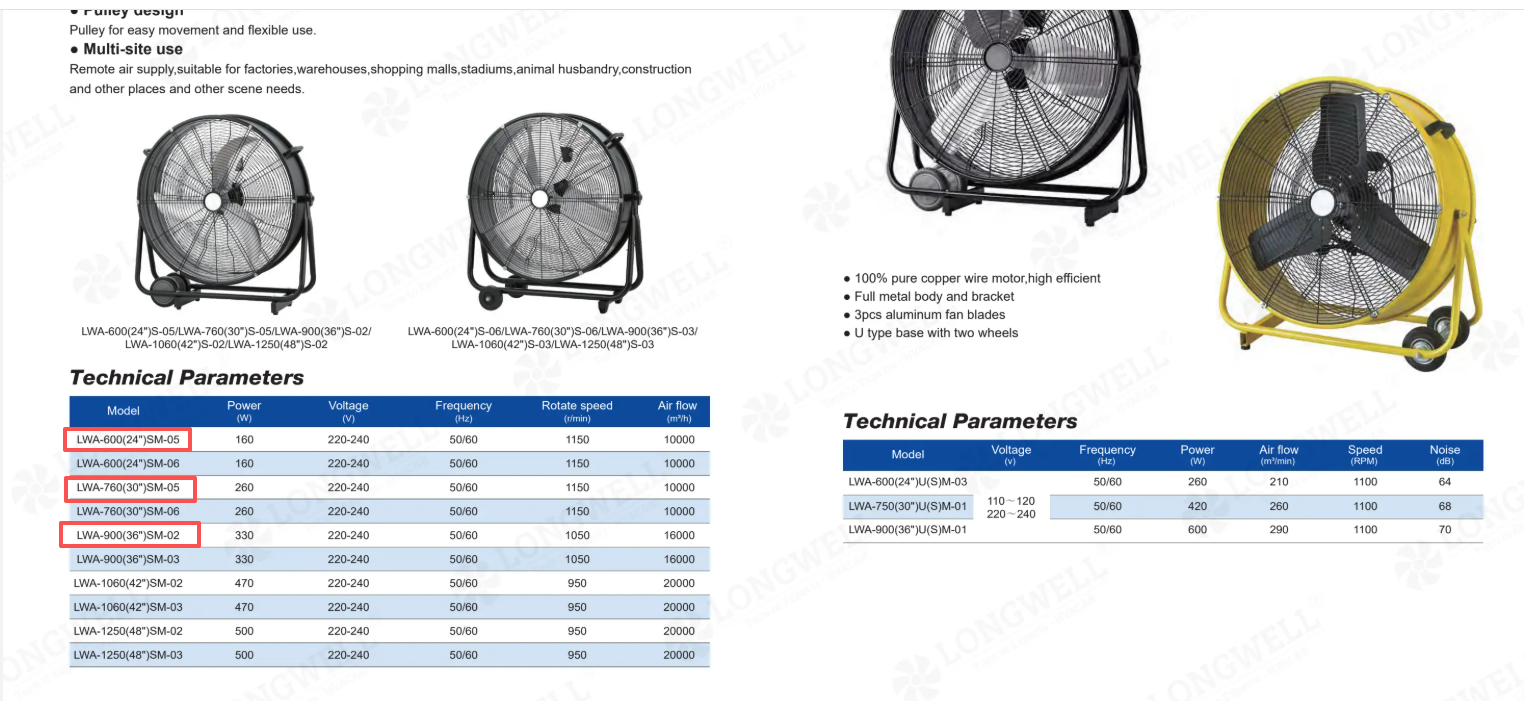
The catalog image lists all product sizes and highlights the heavy metal body details. Buyers can see the pure copper wire feature clearly listed here.
Drawing for the 24-inch unit. Engineers use this file to verify the shorter 770 mm height for tight rooms. It proves the smallest model still uses the strong U-type bracket base.
Buying the Right Cooling Equipment
Buyers looking for industrial floor fans must check a few key facts before ordering. First, always measure the real space between your shop racks. A fan that does not fit your aisles is completely useless.
- Count the full air volume of your big room, not just the flat floor space. Then, pick fans that can replace that air fast enough.
- Measure the real gaps in your walking paths. Wide metal brackets might block a busy cart aisle if you buy the biggest model.
- Ask for pure copper wires if the fans will run all day. Cheap wires burn out fast when the shift gets hot.
- Check the exact power plugs on your site walls. A heavy fan needs the right voltage or the motor will quickly fail.
Since we build our own fan blades, we can change the blade pitch to hit your exact noise limits. Also, early testing helps avoid bad surprises later. We test our samples under real factory loads. In short, matching the motor to the real room saves money over time.
Related: Commercial Fans and Blowers.
Technical Documentation & Resources
Browse our axial fans range, the AC axial fans section, or EC axial fans.
Have a Similar Fan Requirement?
Longwell’s engineering team delivers custom spec sheets and samples within 90 days. Since 1990, we have supplied EC fans and blowers to OEMs across HVAC, cold chain, data center, and industrial applications worldwide.
Browse Related Products:
🏆 ISO 9001 / ISO 14001 / ISO 45001 | CE (TÜV) | UL/ETL | ATEX Zone 21/22 | AMCA 210-16 / ISO 5801 tested