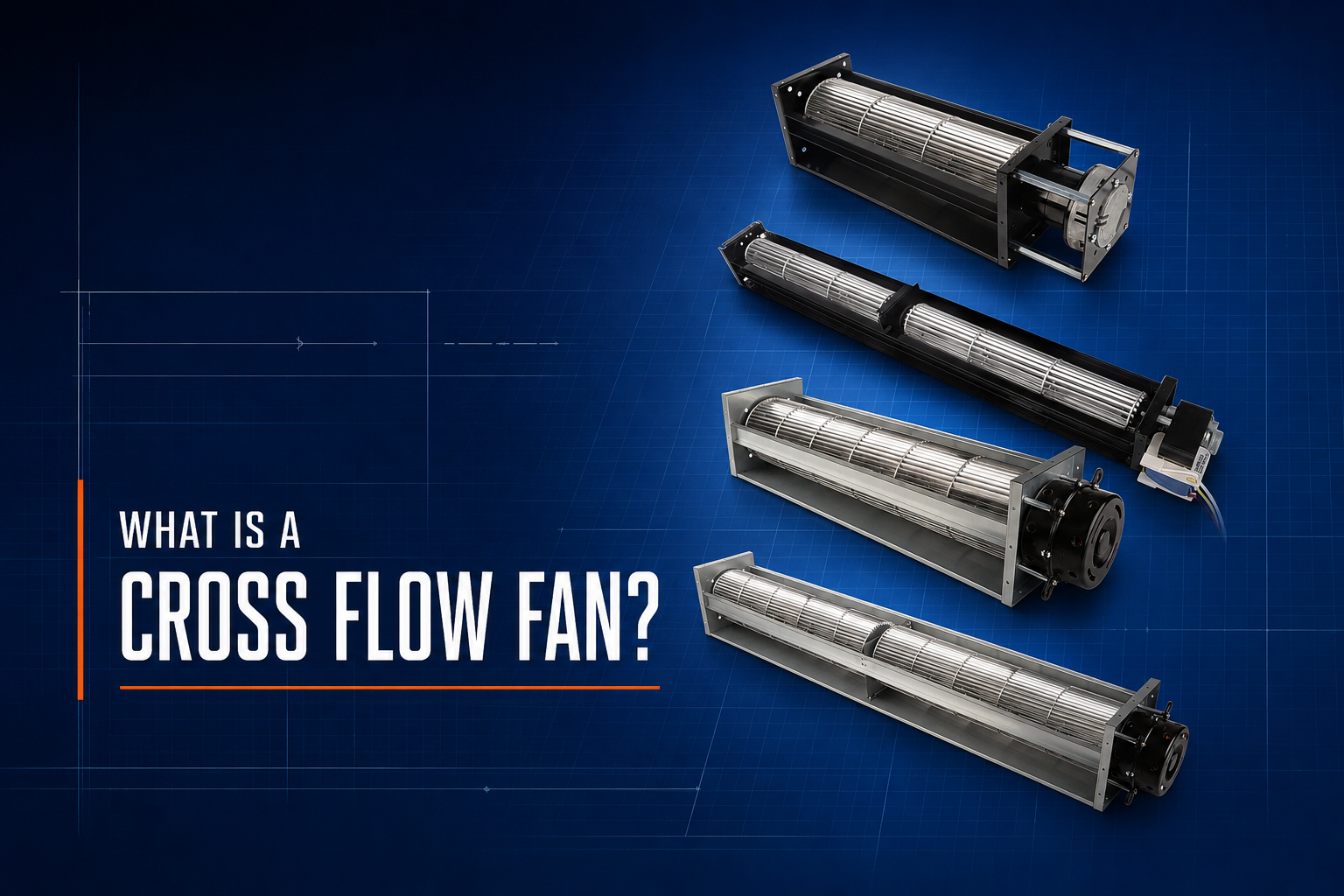
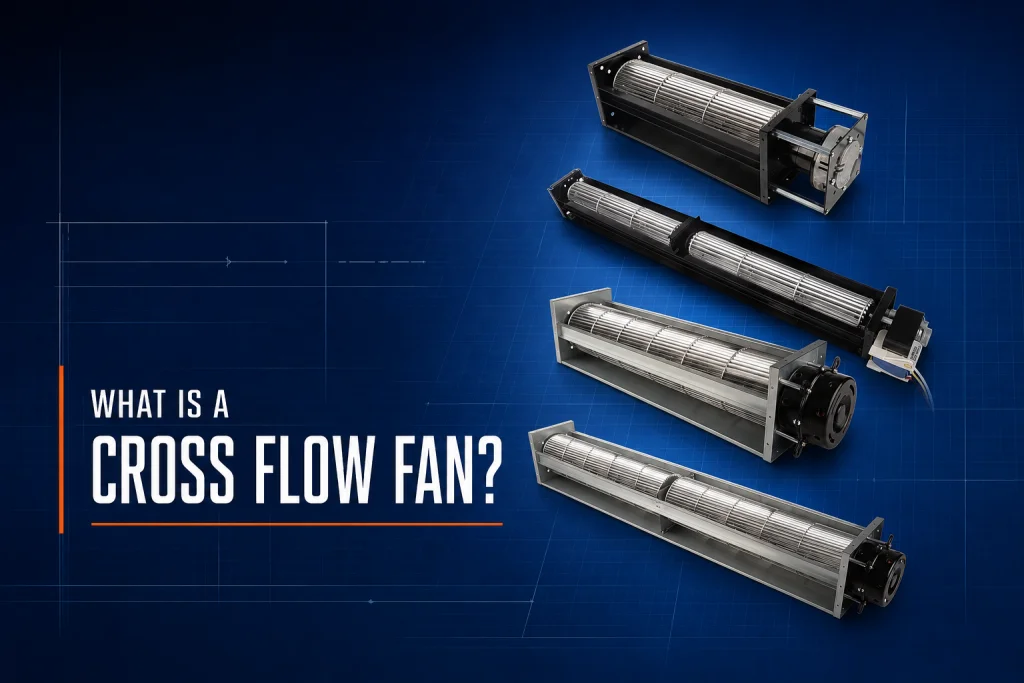
A cross flow fan is a type of blower designed to provide a wide and uniform airflow distribution. Unlike conventional fans that focus on concentrated airflow output or high-pressure performance, cross flow fans provide a long and consistent air stream across the entire impeller length. These features make them widely used in space-limited cooling applications and uniform airflow conditions, including air curtains, HVAC indoor units, electronic enclosures, and commercial equipment. This blog will introduce how a cross flow fan works, its advantages and disadvantages, and compare the cross flow fan with other fan types. We will also explore efficient cross flow fan applications and LONGWELL solutions.
What is a Cross Flow Fan Structured?
Main Components
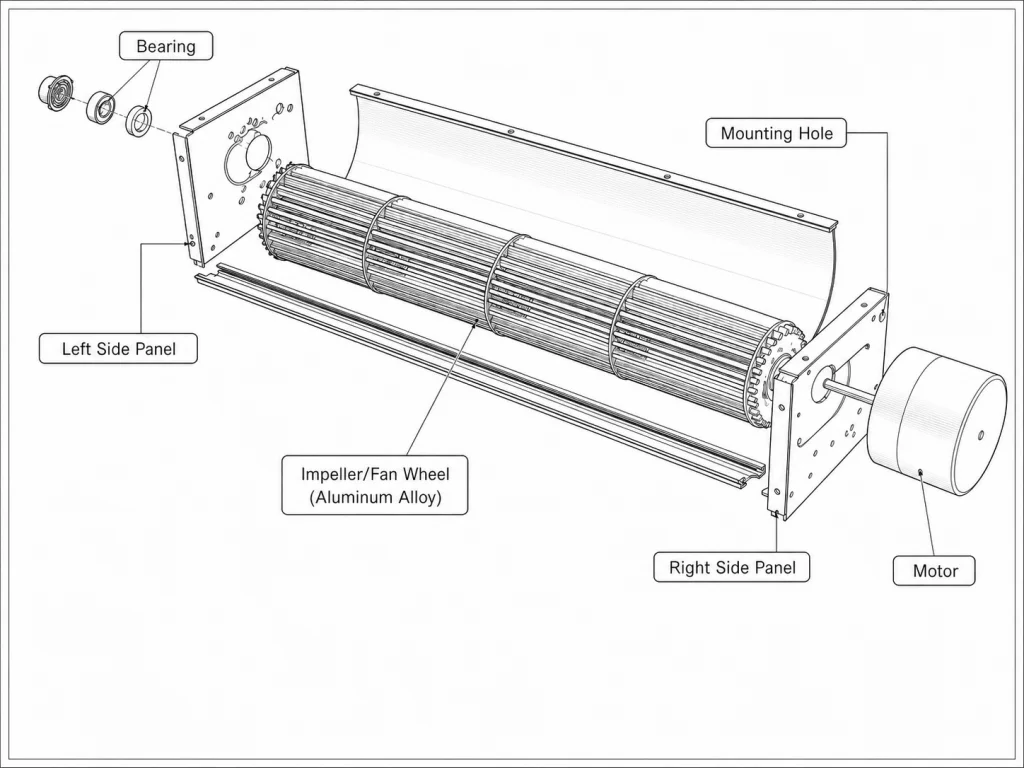
The cross-flow fan consists of several main components, which work together to achieve high efficiency:
- The impeller is the core of a cross flow fan. It features a long, multi-bladed cylinder.
- The motor is the power part of a cross flow fan. It is generally classified into three types: AC, DC, and EC motors.
- The housing works as the airflow guidance and encloses the impeller.
- A bearing support the impeller’s rotation.
The materials for cross flow fan include metal and plastic. Whether to choose is decided according to the practical applications.
Structure
The cross flow fan has a unique cylindrical impeller. The multiple blades are arranged along the cylindrical impeller. This unique design allows the cross flow fan to move air in a wide and uniform pattern. The impeller can deliver airflow across its entire length consistently.
The cross-flow fan is also known as a tangential fan. The air exits the impeller in a direction approximately parallel to the tangent of the rotating cylinder. It also allows air to pass through the impeller from one side to the other, creating a longer and more evenly distributed airflow stream. The installation direction can be either horizontal or vertical.
Cross Flow Fan Working Principle
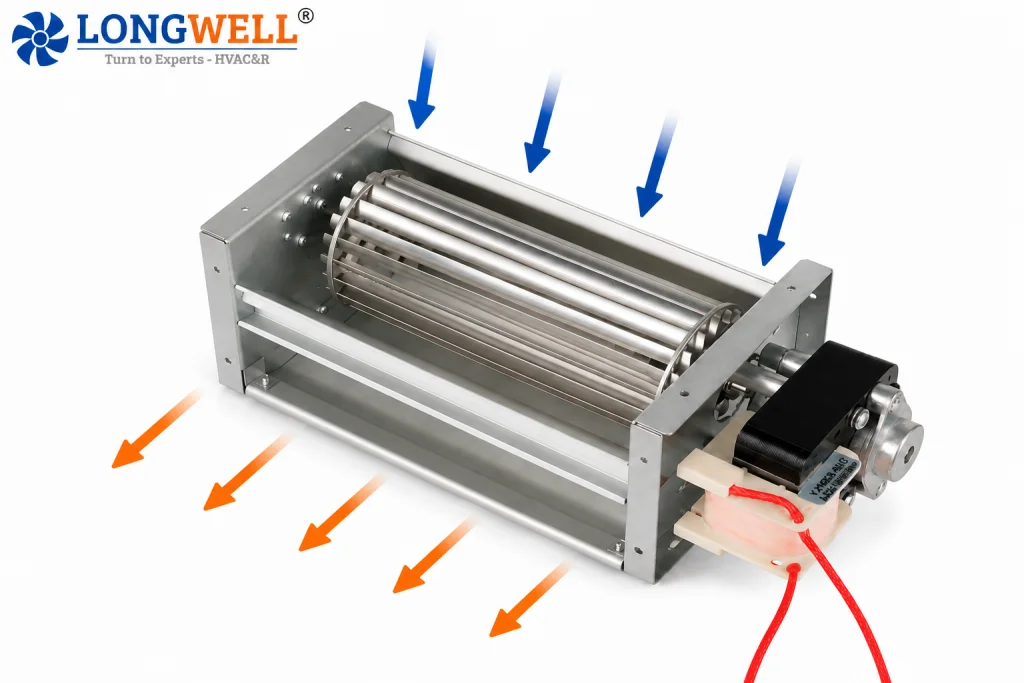
The unique operating principle of a cross flow fan is that the airflow passes through the fan’s impeller twice. During operation, air enters the rotating cylindrical impeller from the outer circumference in a radial direction. As the blades rotate, the airflow is carried through the inner region of the impeller and gains additional kinetic energy. After passing through the impeller, the air leaves from the opposite side in a radial direction with a tangential velocity component. This creates a wide and uniform airflow pattern along the entire length of the cross flow fan.
This unique airflow path allows the air to enter the impeller. The direction of airflow leaving the impeller can be designed at a specific tangential angle. Compared with conventional fans, the cross flow fan generates a wider and more uniform airflow distribution along the entire length of the impeller.
Cross Flow Fan: Pros and Cons
Uniform Airflow
The cross flow fan can deliver uniform air distribution across the entire outlet. The length of the impeller is not limited. The customer can tailor the impeller length according to their project’s requirements. As a result, the airflow can reach a long distance.
This characteristic makes cross flow fans particularly suitable for applications where consistent airflow coverage is required. They are usually used in air curtains, HVAC indoor units, and electronic enclosure cooling.
High-Precise Air Guidance
The unique structure of a cross flow fan enables precise control of airflow direction. By changing the housing and impeller design, manufacturers can adjust the airflow direction to meet specific application requirements. This adjustable design allows a cross flow fan to provide targeted air delivery.
Quiet Operation
The impeller of a cross flow fan is relatively large. When the same airflow volume is required, the larger impeller can rotate at a lower speed, which reduces the pneumatic noise. Besides, the long cylindrical impeller distributes airflow across a wider outlet area. The cross flow fan impeller has multiple blades, which can cut the airflow smoothly and reduce turbulence. As a result, cross flow fans can provide precise airflow with relatively low noise levels.
Compact Design
The slim cylindrical impeller structure provides cross flow fans with a compact design advantage. Conventional fans require a larger volute to guide airflow and generate static pressure. The cross flow fans use a linear airflow path that allows installation in space-constrained applications. Manufacturers can also customize the impeller length and housing dimensions to match different equipment layouts. The extended impeller length provides wide airflow coverage without increasing the fans’ impeller size.
Limited Static Pressure
The airflow path and impeller design limit its ability to generate higher static pressure. When installed in systems with high resistance, such as long ductwork or filters with significant pressure drops, a cross flow fan may not maintain the required airflow performance. Therefore, application requirements should be evaluated carefully before selection.
Lower Efficiency
When air passes through the rotating impeller, it will interact with the internal vortex. Although it improves airflow uniformity, it increases energy conversion losses. Compared to other fans, the cross flow fan has a lower power conversion rate. Under certain operating conditions, cross flow fans may consume more power to deliver the same airflow. The efficiency difference becomes more noticeable in continuous working conditions.
Cross Flow Fan vs Other Fan Types
Cross Flow Fan vs Axial Fan
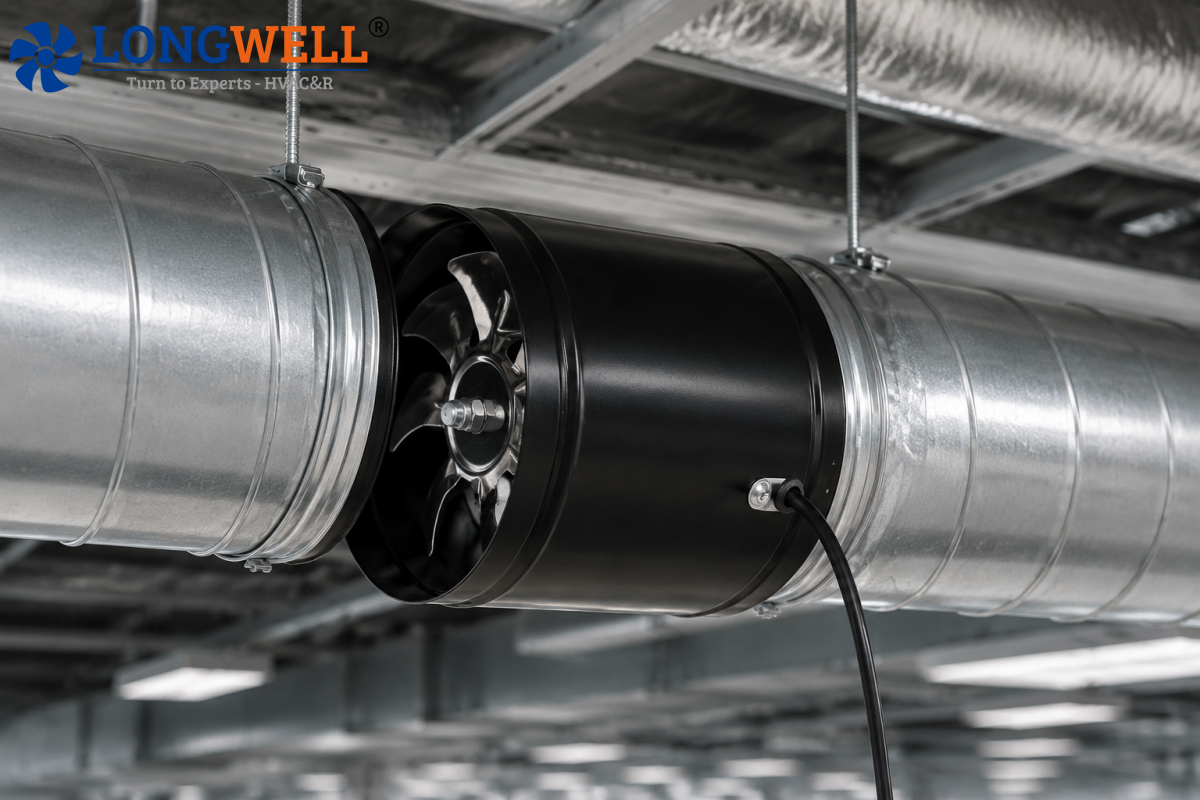
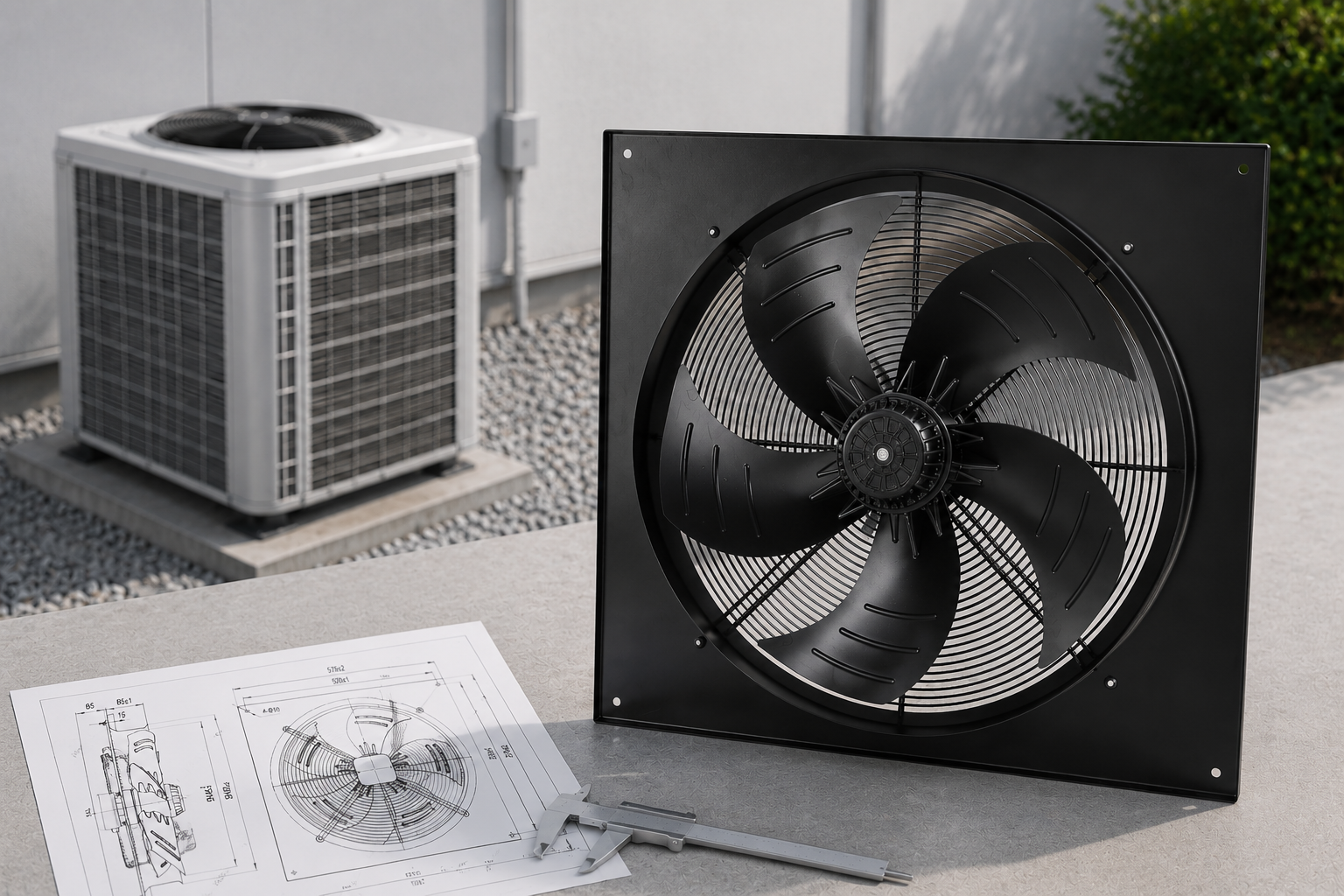
An axial fan moves air in a linear way, which is parallel to the fan’s motor shaft. Its blade design allows it to generate a large airflow volume with relatively low power consumption. The main difference lies in airflow distribution. When the impeller rotates, the pressure difference draws air through the shaft and produces a concentrated airflow jet. The cross flow fans provide broader airflow coverage across the entire impeller length.
Cross Flow Fan vs Centrifugal Fan
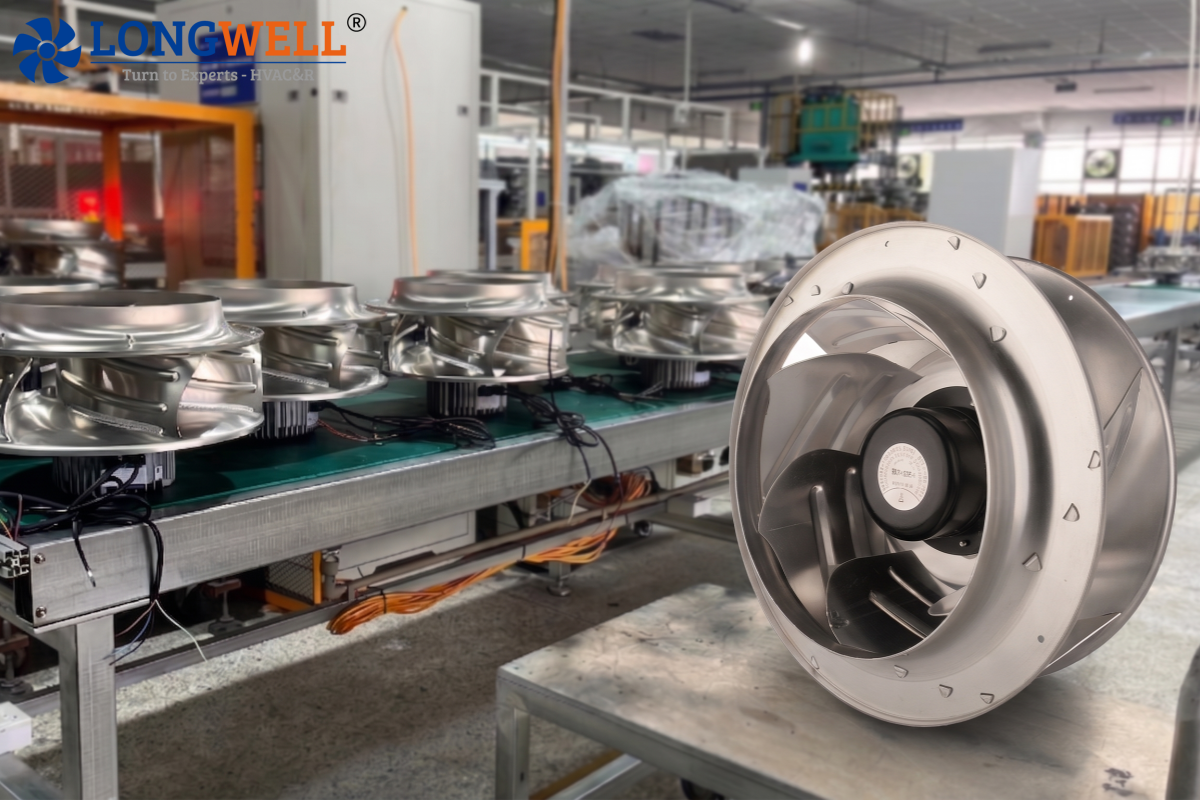
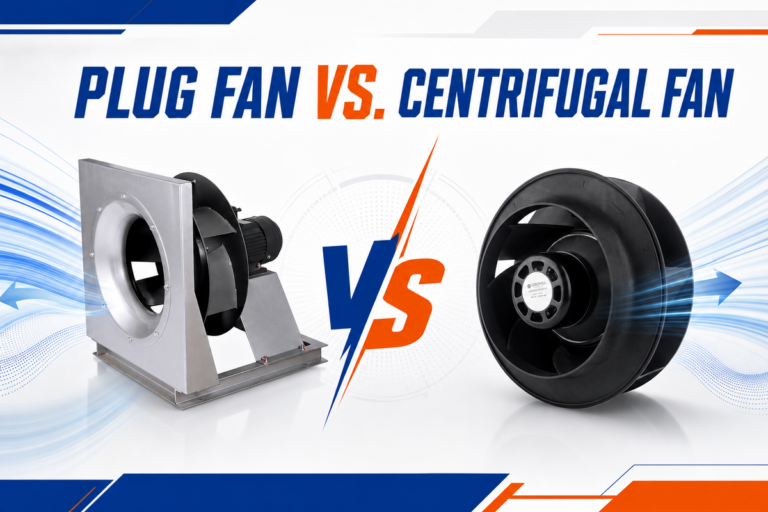
Both cross flow fans and centrifugal fans use rotating impellers to generate airflow, but their internal airflow paths are different. Centrifugal fans accelerate air and use a volute to generate static pressure. This allows centrifugal fans to overcome higher system resistance and operate effectively in duct systems. Cross flow fans rely on a tangential airflow mechanism created by the cylindrical impeller and internal vortex. It provides lower pressure capability compared with many centrifugal fan designs.
Choosing the Right Fan
Selecting the suitable fan depends on several parameters. Calculate the airflow required and static pressure to draw the system resistance curve and find out where the operating point is. Before choosing the fan type, remember that no single fan type can provide the best performance in every application. Selecting the right fan depends on the airflow requirements, system resistance, installation limitations, and operating environment. The following table provides a comparison summary among cross flow fan, axial fan, and centrifugal fan.
| Cross Flow Fan | Axial Fan | Centrifugal Fan | |
| Airflow Direction | Tangential airflow | Parallel to shaft | Radial airflow |
| Airflow Volume | Medium | Higher | Higher |
| Static Pressure | Low to Medium | Lower | Higher |
| Noise Level | Lower | Medium | Depends |
Applications of Cross Flow Fan
Industrial and Commercial Use
Cross flow fans feature a low noise level with uniform airflow output, which is designed for noise-sensitive applications. They are commonly used in air curtains, HVAC indoor units, display equipment, and commercial appliances. The long impeller design allows airflow to be evenly distributed across the entire outlet length, reducing uneven air zones and improving user comfort.
Data Center Cooling
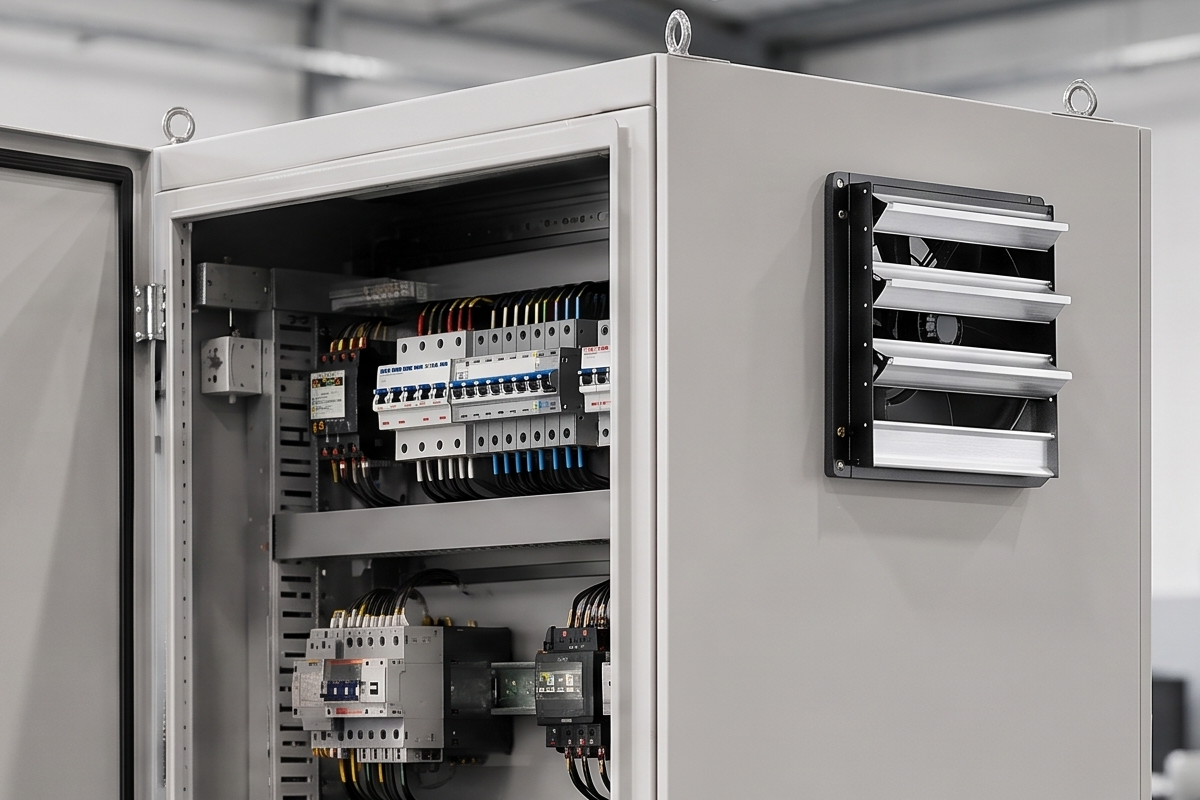
For small-scale electronic cooling applications, cross flow fans provide a compact solution. In electronics cabinets, high-density components can create localized heat accumulation. A cross flow fan provides a long and uniform airflow to help distribute cooling air across the cabinet. Its slim cylindrical structure allows it to be integrated into a narrow cabinet.
LONGWELL Cross Flow Fan Solutions
LONGWELL Engineering Case
LONGWELL’s engineering cases show how impeller operation adapts to real-world needs. In a film set application, the team modified a standard AC cross flow fan to provide dual-speed operation. This allowed the user to switch between two airflow modes, creating different wind effects without changing the fan’s core structure. In another case, a DC cross flow fan for air curtains included an integrated controller for speed monitoring. This solution improved system feedback and met strict safety standards.
LONGWELL Cross Flow Fan Models
LONGWELL produces AC/DC/EC cross flow fans for different airflow requirements, ranging from 27m³/h to 3700m³/h. The impeller diameters typically range from 30mm up to 150mm and lengths from 90mm up to 1400mm. LONGWELL AC cross flow fans have rated voltages ranging from 110v-120v, and 220v-240v suitable for multiple international markets. The DV models are workable in 12V, 24V, and 48V.
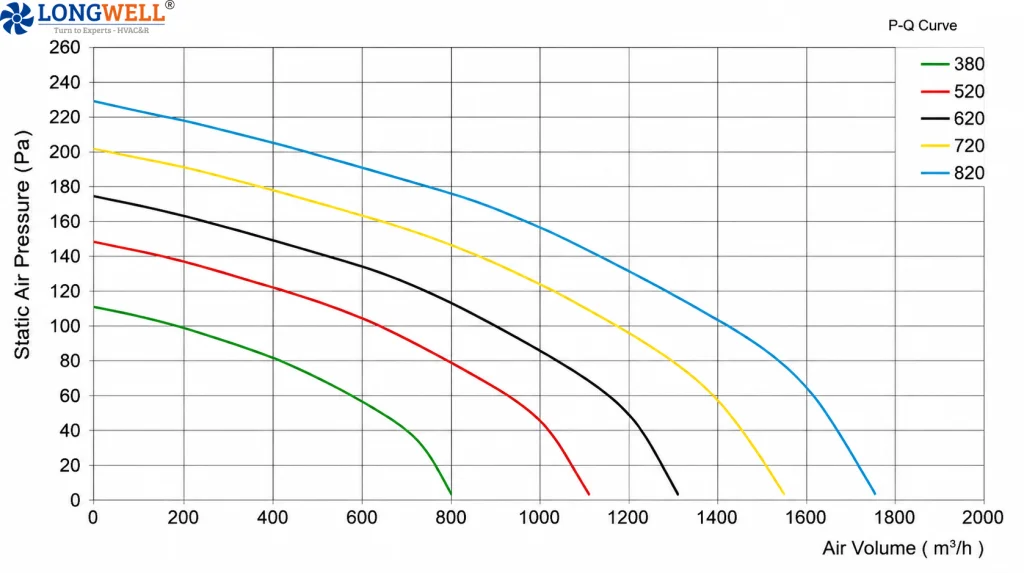
The following is the P-Q curve of the LWCE-100 series. The impeller diameter of the cross-flow fan in this series is 100mm, and the length ranges from 380mm to 820mm.
Apart from these standard models, LONGWELL excels in providing custom-tailored solutions. The dimensions, airflow output, operating voltages, and other parameters can be adjusted to fit requirements.
FAQs
What is the main advantage of a cross flow fan?
A cross flow fan has a long impeller that can move a large amount of air. It can provide high volume and uniform airflow.
Are cross flow fans energy efficient?
The cross flow fan is not the most energy-efficient one. Compared to centrifugal fans, the cross flow fans have lower energy efficiency.
Can LONGWELL cross flow fans operate in extreme temperatures?
Most standard LONGWELL cross flow fans operate between -25°C and +60°C. LONGWELL provides custom service to expand the working temperature range.
What certifications do LONGWELL cross flow fans meet?
LONGWELL can provide ISO 9001 / ISO 14001 / ISO 45001, CE (TÜV), UL/ETL, ATEX Zone 21/22, AMCA 210-16 / ISO 5801-tested certifications.