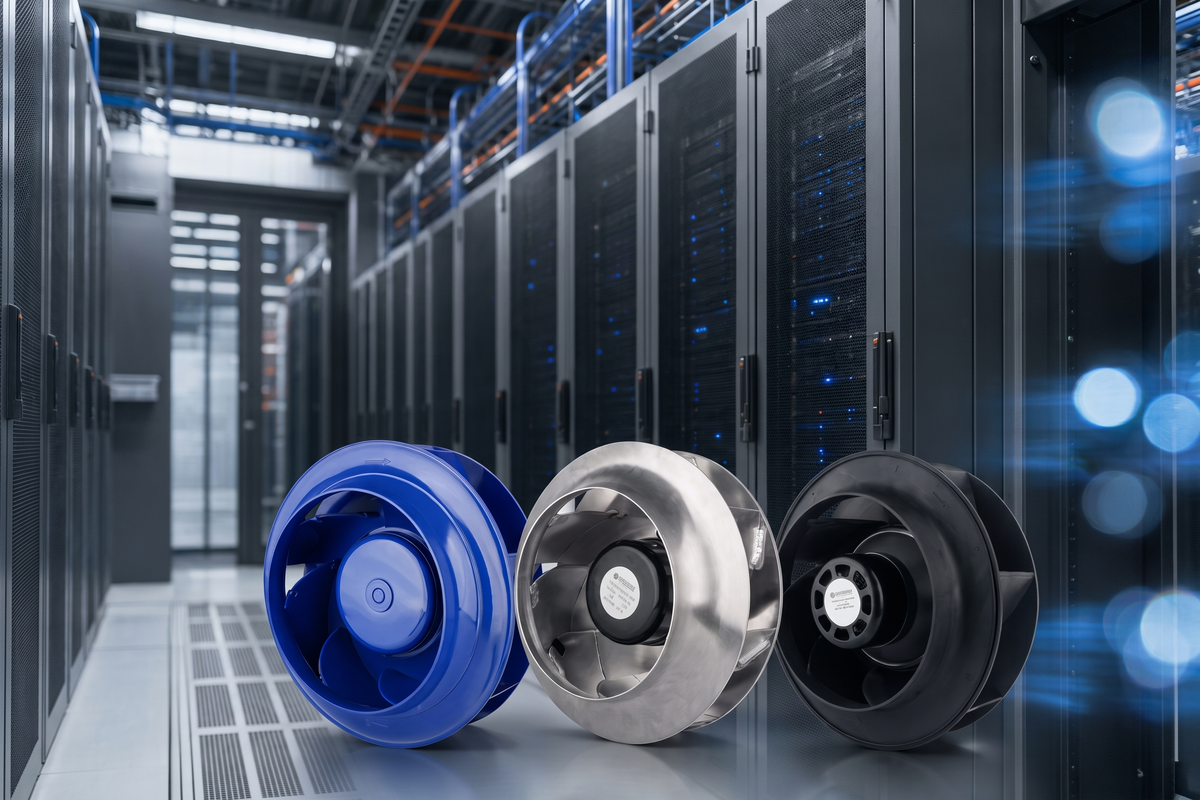
Today’s procurement engineer isn’t just selecting an EC backward-curved centrifugal fan for a new data center cooling system – they’re making a decision that will influence energy performance for years to come. With AI and high-performance compute workloads driving facility power densities past 50kW per rack and cooling now accounting for 30–40% of a data center’s total electricity consumption, the fan selection on a CRAH unit or a hyperscale fan wall directly shapes the facility’s PUE and long-term operating costs.
This guide is the practical engineering reference for evaluating and selecting EC backward-curved fans in data center environments. It focuses on the five fan diameter ranges mostly commonly used in modern data center cooling systems – 280 mm, 355 mm, 450 mm, 560 mm, and 630 mm – and explains where each size is typically deployed, the performance requirement it serves, and the factors that determine the best fit for a given architecture. The guide also explores the impact of fan efficiency on overall cooling energy consumption, helping engineers and procurement teams understand the trade-offs behind each selection.
The PUE Math Behind Data Center Fan Optimization
Before comparing fan sizes, airflow requirements, or cooling architectures, it’s important to understand why fan selection matters in the first place. For many procurement and facility engineers, the financial impact of fan efficiency is far greater than expected.
In modern data centers, Power Usage Effectiveness (PUE) remains the benchmark for measuring energy efficiency. The Uptime Institute’s industry-average PUE sits around 1.6; hyperscale facilities operating with free-cooling strategies and elevated supply air temperatures achieve 1.1 to 1.2. The 0.4 to 0.5 difference represents pure overhead – power consumed by the cooling system, lighting, UPS losses, and other facility loads. Of that overhead, cooling alone typically accounts for 30 to 40 percent of total facility electricity consumption.
| Total facility power | = 1,000 kW × 1.5 | = 1,500 kW |
| Cooling overhead | = 0.4 × Total | = 600 kW |
| Fan share of cooling | = 15–25% (typical) | = 90–150 kW |
| Annual savings | = 36 kW × 8,760 h × $0.12/kWh |
| = $37,843 / year / MW | |
| 10-year savings | = $378,432 / MW |
| For a 10 MW colocation | = $3.78M lifetime |
This is before factoring in reduced HVAC equipment sizing, reduced backup generator capacity requirements, and the carbon-credit value increasingly meaningful in regulated jurisdictions.
The fan selection decision is one of three or four facility-level decisions where the engineering team can move PUE by 0.05 or more. That is worth taking seriously.
The math has implications for procurement priorities. When a procurement team evaluates EC fan vendors and treats unit price as the primary criterion, they routinely select fans that cost 5–10% less but consume 15–30% more power at duty point. Over a 10-year deployment, the wrong selection costs 30–60 times the unit price difference.
The right question is not “what is the cheapest fan that meets spec” but “what is the lowest-total-cost-of-ownership fan across the deployment lifecycle.” Validated case data, comparative test reports, and field deployment references matter more here than in any other HVAC fan application.
Fan Sizes for Five Data Center Cooling Architectures
Selecting the right EC fan starts with understanding the cooling architecture. Different data center designs create different airflow, pressure, redundancy, and efficiency requirements, which directly influence the fan diameter and performance range needed.
Before comparing manufacturers or model numbers, engineers should identify the cooling strategy being deployed. In most cases, the architecture itself narrows the fan selection to a specific size segment.
| Data Center Architecture | Fan Diameter | Description | LONGWELL Recommended SKU |
| CRAH / CRAC — Raised Floor | 280–355 mm | Computer Room Air Handler (chilled water coil) or CRAC (DX) units placed at row ends or perimeter. Most-deployed legacy architecture, still common in Tier II and III facilities. | LWBE3G280-092PS-03
LWBE3G355-138PT-05 |
| In-Row Cooling | 250–355 mm | Cooling units placed between server racks within hot/cold aisle containment. Higher heat density support (up to ~40kW/rack), shorter air paths, lower pressure requirements. | LWBE3G250 / LWBE3G280 series |
| Hot Aisle Containment Exhaust | 400–560 mm | Dedicated exhaust fans handling high-temperature return air through filter banks and ducted returns. High static pressure requirement, often 1500+ Pa. | LWBE3G450-188PT-09
(validated: 30% energy reduction) |
| Modular Fan Wall (FanGrid) | 450–630 mm | Multi-fan parallel arrays providing N+1 redundancy. Industry standard for hyperscale and large colocation (STULZ CyberWall, etc.), 6+ fans per air handler. | LWBE3G560-188PT-01 (560mm)
LWBE3G630-188PT-04 (630mm) |
| Hyperscale Precision Cooling — 1MW-class | 630 mm | Latest generation chilled-water precision cooling units up to 1 MW. 630mm backward-curved EC fans are the de facto industry standard — Airedale SmartCool ONE and similar products. | LWBE3G630-188PT-04
(21,950 m³/h, 1,597 Pa, 5,600W) |
| Rear-Door Heat Exchanger | 200–280 mm | Passive or active rear-door cooling at rack level, supporting up to 75kW/rack. Compact, low-static design with high airflow at relatively low pressure. | LWBE3G220 / LWBE3G280
(low-pressure variants) |
CRAH and CRAC Units – 280 mm to 355 mm EC Fan
The 280 mm to 355 mm EC centrifugal fan range remains the backbone of data center cooling and is the most commonly deployed fan size segment in CRAH (Computer Room Air Handler) and CRAC (Computer Room Air Conditioner) systems worldwide.
A typical CRAH unit supporting 50 – 100 kW of IT load will often utilize two to four fans within this size range, depending on factors such as cooling capacity, coil design, airflow requirements, and redundancy strategy. These systems are found across enterprise data centers, colocation facilities, and many Tier II and Tier III environments, making this fan category one of the highest-volume segments in the industry.
The single most important specification beyond airflow and pressure is power efficiency at the actual operating duty point. Most CRAH units operate at 60–80% of nameplate capacity for most of their life — meaning the fan curve at this part-load condition matters more than peak performance. EC backward-curved fans hold efficiency well across this part-load range, which is the primary reason they have displaced forward-curved alternatives in this segment over the past decade.
CRAH WORKHORSE
LWBE3G280-092PS-03
280mm · 230V single-phase · IP55 · F-class insulation
CRAH 25-80kW CRAC Standard In-Row Cooling
| Airflow | 2,009 m³/h | Static Pressure | 803 Pa |
| Input Power | 225 W | Speed | 2,650 RPM |
| vs ebm R3G280 | 47% lower W | Lead Time | 15–30 days |
WHY THIS SKU
47% lower power consumption (225W vs 425W) and 34% higher static pressure capability. Direct mounting compatibility means dimensional drop-in replacement in existing CRAH/CRAC housings is possible. Major retrofit opportunity for facilities running legacy units approaching end of service life.
MID-LARGE CRAH
LWBE3G355-138PT-05
355mm · 380V three-phase · IP55 · F-class insulation
CRAH 100-200kW Large CRAC Pre-Fan-Wall
| Airflow | 7,045 m³/h | Static Pressure | 830 Pa |
| Input Power | 1,700 W | Speed | 2,200 RPM |
| vs ebm R3G355 | +96% airflow | Lead Time | 15–30 days |
WHY THIS SKU
The 355mm segment is the transition point between traditional CRAH and modern fan wall architecture. LWBE3G355-138PT-05 is suitable for upgrading older CRAH units to handle increased IT density without unit replacement.
THE CRAH/CRAC RETROFIT OPPORTUNITY
Most data centers built between 2010 and 2018 deployed AC-induction fans in CRAH/CRAC units that are now approaching end-of-life replacement. The cooling capacity of these units is typically still adequate for current IT loads, but the fan section consumes 2–3× the power of a current-generation EC equivalent. Fan-section retrofit (replacing fan modules without replacing the chilled water coil or unit casing) recovers most of the energy savings of a full unit replacement at 20–30% of the cost.
For facilities running 50–100 CRAH units of this vintage, fan-only retrofit is one of the highest-IRR capital decisions available in 2026.
Hot Aisle Containment Exhaust – 450 mm High-static EC Fan
Hot aisle and cold aisle containment systems have become standard practice in colocation and enterprise data centers since approximately 2015. They improve cooling effectiveness by preventing hot return air from mixing with cold supply air, allowing both supply temperatures and CRAH return-air setpoints to be raised – directly improving cooling efficiency.
The fan requirement in containment exhaust applications differs from standard CRAH in two ways. First, the static pressure requirement is substantially higher — total static pressure requirements of 1,500–2,500 Pa. Second, the operating temperature range is wider — hot aisle return temperatures of 35–45°C are common, with peak temperatures during overload conditions reaching 55°C.
VALIDATED 30% ENERGY RETROFIT
LWBE3G450-188PT-09
450mm · 380V three-phase · IP55 · F-class · Soft-start
Hot Aisle Exhaust High-Static AHU Filter Bank Fan
| Airflow | 8,660 m³/h | Static Pressure | >2,000 Pa |
| Input Power | 2,500 W | Speed | 2,100 RPM |
| Control | 0-10V / PWM / MODBUS | Protection | OC / OT / LR / soft-start |
WHY THIS SKU
A European HVAC OEM deployed this exact SKU in 2024 for an industrial AHU application matching the duty point of high-static hot-aisle exhaust (8,660 m³/h at >2,000 Pa). Comparative measurement showed a 30% reduction in fan-section energy consumption. The SKU now sits in the OEM’s standard product range — the same engineering characteristics translate directly to data center hot aisle containment exhaust applications.
Modular Fan Wall and Large Precision Cooling – 560 mm to 630 mm
The single largest shift in data center cooling architecture since 2018 has been the displacement of single large-fan precision cooling units by modular fan walls — multi-fan parallel arrays of 6 to 12 individual EC fans per air handler. STULZ CyberWall, Vertiv Liebert PCW, and Airedale SmartCool families all use this architecture for hyperscale and large colocation applications.
The drivers are operational rather than aerodynamic. Modular fan walls provide three advantages:
- N+1 redundancy with low overhead — losing one fan in a 12-fan wall causes 8.3% capacity loss rather than 100%
- Part-load efficiency — at 50% load, six fans at 90% duty are more efficient than twelve fans at 50% duty
- Simpler maintenance — individual fans can be hot-swapped without taking the unit offline, eliminating planned downtime
FAN WALL GOLDEN MATCH
LWBE3G560-188PT-01
560mm · 380V three-phase · IP55 · F-class · MODBUS
Modular Fan Wall Large Precision Cooling Hyperscale AHU
| Airflow | 16,039 m³/h | Static Pressure | 1,166 Pa |
| Input Power | 3,300 W | Speed | 1,700 RPM |
| vs ebm R3G560 | alternative | Lead Time | 15–30 days |
WHY THIS SKU
Identical airflow within 0.2%, slightly lower static pressure (1,166 vs 1,300 Pa), 6% lower input power. The cleanest dimensional and performance match in LONGWELL’s cross-reference database. For new fan wall builds and retrofits of existing 560mm-segment units, this is the lowest-friction substitution available, with documented dimensional compatibility for direct replacement in existing scroll housings.
HYPERSCALE STANDARD
LWBE3G630-188PT-04
630mm · 380V three-phase · IP55 · F-class · MODBUS
Hyperscale Precision Cooling 1MW-Class Units Large Fan Wall
| Airflow | 21,950 m³/h | Static Pressure | 1,597 Pa |
| Input Power | 5,600 W | Speed | 1,200 RPM |
| vs ebm R3G630 | +5% airflow | Lead Time | 15–30 days |
WHY THIS SKU
630mm has emerged as the de facto industry standard for hyperscale-grade precision cooling units, used by Airedale SmartCool ONE (35kW to 1MW, 104 model variants) and STULZ CyberWall (6-fan modular wall). LWBE3G630-188PT-04 delivers full IP55 / F-class construction and MODBUS speed control for fan-wall integration.
Hyperscale 1MW-class precision cooling – 630 mm EC Fan
For the largest capacity-per-unit precision cooling applications — single units serving 500 kW to 1 MW of IT load — the engineering envelope narrows to a single fan size choice: 630mm backward-curved EC. The reason is constraint-driven rather than preference-driven.
At this capacity, the airflow requirement is in the range of 60,000–120,000 m³/h per unit. 630mm sits at the sweet spot where each individual fan delivers 20,000–22,000 m³/h at appropriate static pressure (1,500–2,000 Pa), allowing 4–6 fans per unit to deliver hyperscale-class capacity with operationally manageable N+1 redundancy.
THE 630mm CONSOLIDATION ACROSS PRECISION COOLING BRANDS
Airedale’s SmartCool ONE family — designed for colocation and hyperscale facilities with capacity from 35 kW to 1 MW — standardizes on 630mm backward-curved EC fans across 104 model variants and 36 case sizes. STULZ, Vertiv, and other premium precision cooling brands have similarly converged on 560mm and 630mm as the two production sizes for new hyperscale-grade products.
For procurement engineers specifying fans for OEM integration, qualification effort directed at 630mm SKUs has the broadest cross-application return.
AC vs EC Fan Walls: Why Data Centers Choose EC Technology
The shift from AC-induction fan walls to EC fan walls in data center applications since approximately 2015 has been driven less by energy efficiency than by operational considerations. The three that matter most:
- Soft-Start for Fast Recovery: After a power outage, data centers must restore cooling systems as quickly and safely as possible. In fan wall systems using AC induction motors, multiple fans can draw high inrush current simultaneously during startup, placing stress on electrical infrastructure and potentially triggering upstream protection devices. For a fan wall with 8–12 AC-induction fans, the simultaneous inrush can trip upstream protection devices. EC fans with soft-start ramping eliminate this entirely – the fan wall can be restarted in seconds rather than minutes.
- Integrated Variable-Speed Control: Traditional AC fan systems typically require a dedicated Variable Frequency Drive (VFD) for each fan to enable speed control. In large fan wall installations, this increases system complexity, installation costs, maintenance requirements, and potential points of failure. EC fans integrate speed-control electronics directly into the motor, eliminating the need for external VFDs in most applications. This simplifies commissioning, reduces component count, and enables straightforward integration with building management systems (BMS) through standard 0–10 V, PWM, or Modbus control signals.
- Intelligent Protection and Safer Failure Modes: Motor protection is another area where EC technology offers significant advantages. When an AC-induction fan fails, the failure mode is typically locked-rotor – the motor continues drawing high current while mechanically stalled, often damaging stator windings and creating thermal hazards. EC fans with integrated protection detect locked-rotor conditions in milliseconds and self-isolate. When an abnormal event is detected, the fan automatically limits operation or shuts down, helping prevent equipment damage and supporting overall system reliability.
For data center applications, the case for EC over AC fan technology is not primarily about energy efficiency — it is about operational resilience. Energy savings is the bonus, not the driver.
How to Validate an EC Fan Selection Before Final Specification?
For data center applications, the right validation path depends on facility criticality and procurement standards:
For colocation tenant deployments (most common)
Request engineering samples of the candidate SKU. LONGWELL ships samples within 1–3 days from Yuyao. Mount in a test rig matching the target duty point and measure airflow, static pressure, and input power at three points: design, +10%, -10%.
For hyperscale and enterprise (Tier III/IV)
Request comparative test data. For each cross-reference pair in serial production, LONGWELL maintains side-by-side aerodynamic and acoustic test reports against the original ebm-papst, Ziehl-Abegg, or Nicotra Gebhardt part. Available under NDA to qualifying procurement teams.
For mission-critical buildouts
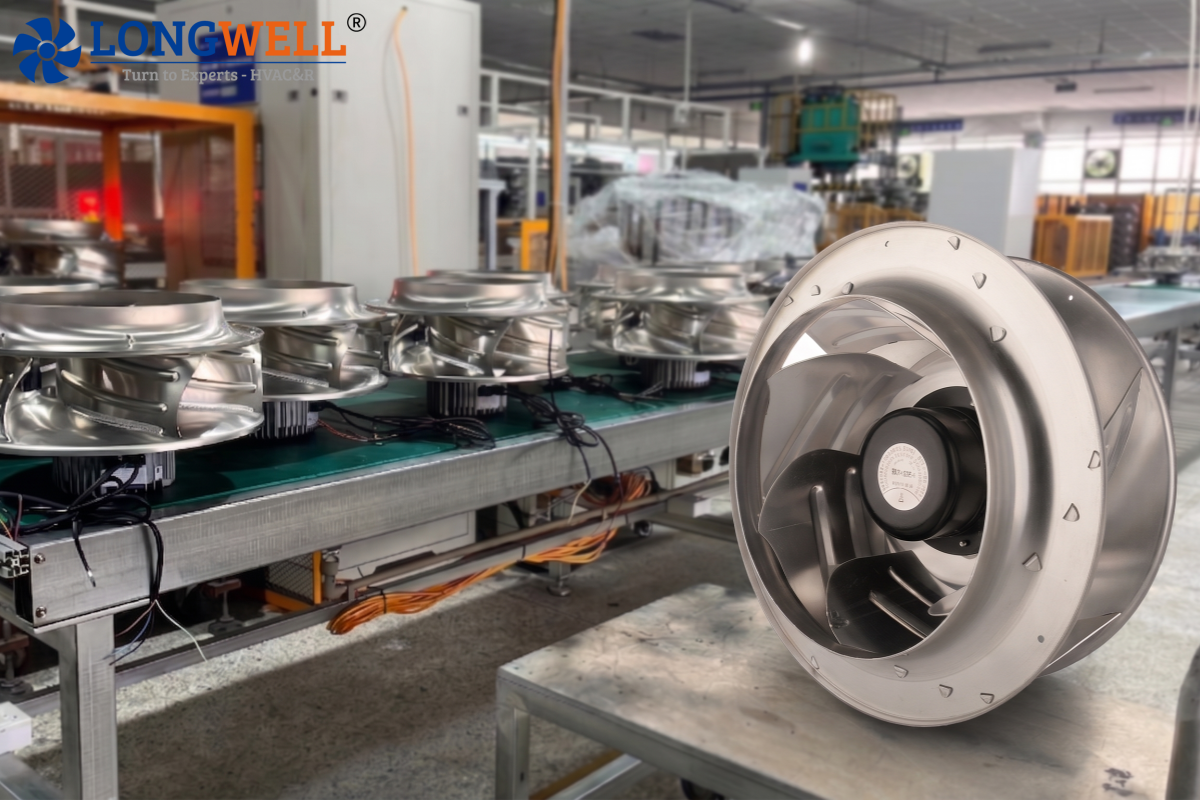
Request a factory technical visit. The Yuyao facility hosts approximately 40–60 customer technical visits per year. The EC backward-curved cell, the dedicated rail transit production area, and the application engineering laboratory are open to qualified visitors under NDA.
Evaluating an EC fan for a data center cooling application?
Engineering samples in 1–3 days. Application-specific selection consultation with response within one business day. Cross-reference database covering ebm-papst R3G/K3G, Nicotra Gebhardt, Ziehl-Abegg ZAplus, and Rosenberg series available on request.
Request Selection Consultation: sales@longwellfans.com
Frequently Asked Questions
What size EC fan is used in data center CRAH and CRAC units?
Data center CRAH and CRAC units typically use EC backward-curved centrifugal fans in the 280mm to 450mm diameter range, with 280–355mm most common for standard 25–80 kW units and 400–450mm for larger 100–200 kW units. The LONGWELL LWBE3G280-092PS-03 (280mm, 2,009 m³/h, 803 Pa, 225W) and LWBE3G355-138PT-05 (355mm, 7,045 m³/h, 830 Pa, 1,700W) are the most-deployed SKUs in this segment, offering 47–50% lower power consumption versus equivalent ebm-papst R3G specifications.
What is the best 600mm or 630mm EC fan for data center fan wall applications?
For data center fan wall (modular multi-fan parallel) and hyperscale air handling applications, the LONGWELL LWBE3G560-188PT-01 (560mm, 16,039 m³/h, 1,166 Pa, 3,300W) and LWBE3G630-188PT-04 (630mm, 21,950 m³/h, 1,597 Pa, 5,600W) are designed for this segment. Major precision cooling brands including Airedale SmartCool ONE and STULZ CyberWall use 630mm backward-curved EC fans in their hyperscale product lines — making the 630mm size the de facto standard for new hyperscale-grade air handling systems.
How much does fan selection affect data center PUE?
In a typical 1 MW IT load data center with PUE 1.5–1.6, cooling represents 30–40% of total electricity consumption, with fans contributing 15–25% of cooling power (60–150 kW continuous). A 30% reduction in fan power through EC fan optimization translates to 18–45 kW continuous savings — approximately $19,000–$47,000 per MW per year at $0.12/kWh, or $190,000–$470,000 over a 10-year deployment cycle per MW. For a 10 MW hyperscale facility, fan optimization can deliver $1.9M–$4.7M in lifetime energy savings.
Why are EC backward-curved fans preferred over forward-curved in data center cooling?
EC backward-curved centrifugal fans deliver three advantages: (1) Higher static efficiency at duty point — backward-curved fans achieve 65–75% peak static efficiency vs 50–60% for forward-curved; (2) Better off-design behavior — they maintain efficiency across a wider duty point range, important for variable IT load; (3) Lower acoustic signature at design point. The cost premium is typically recovered within 18–24 months through energy savings.
What redundancy configuration should data center fan walls use?
Tier III facilities typically deploy N+1 fan redundancy (one spare fan per fan wall). Tier IV deploys 2N redundancy with two completely independent fan wall systems. Most modern fan wall designs use 6–12 individual fans per unit, allowing N+1 to be achieved with 8–12% capacity reserve. EC fans simplify this by allowing soft-start and intelligent speed-up of remaining fans when one fails, maintaining cooling continuity within seconds.
How quickly can LONGWELL deliver 600mm or 630mm EC fans for data center projects?
Engineering samples of LWBE3G560-188PT-01 and LWBE3G630-188PT-04 ship within 1–3 days from the Yuyao production facility. Standard production orders typically deliver in 15–30 days against the 12–20 weeks typical for equivalent ebm-papst R3G560/R3G630 specifications. For data center buildout schedules where commissioning dates are fixed, the lead time differential is often the deciding qualification factor independent of price.
Does LONGWELL provide MODBUS speed control for fan wall integration?
Yes. LONGWELL LWBE3G series EC fans support 0–10V analog, PWM, and MODBUS RTU speed control as standard. MODBUS RTU integration allows individual fan speed monitoring, fault diagnostics (over-current, over-temperature, locked-rotor, soft-start status), and coordinated speed control across the fan wall through a single RS-485 bus. The protocol implementation is compatible with Siemens Desigo, Schneider StruxureWare, and Honeywell ComfortPoint BMS platforms.
ebm-papst and all other trademarks mentioned in this post are the property of their respective owners. LONGWELL is an independent manufacturer and is not affiliated with, endorsed by, or sponsored by any of these groups. Any references to third-party trademarks are used solely for identification and comparison purposes.