
Garage and Shed Ventilation Fans
Garages and sheds trap heat in summer and collect fumes, dust and damp the rest of the year: car exhaust, paint and solvent smells, sawdust, fuel, fertiliser, lawn-mower fumes. Without ventilation they become uncomfortable to work in, and stored tools, timber and textiles suffer. An exhaust fan, with an inlet on the opposite side, solves most of these problems.
LONGWELL supplies plastic wall exhaust fans, metal sidewall fans and solar-powered fans for garages, home workshops, sheds and storage buildings, through distributors, installers and brands.
Pick the right fan
| Building | Recommended fan | Why |
|---|---|---|
| Single or double home garage | Plastic wall exhaust fan, 8–12 in | Simple wall or window installation on a standard socket |
| Garage workshop, auto repair bay | Metal sidewall exhaust fan, 400–600 mm | Higher airflow for fumes, dust and heat |
| Shed or storage unit without power | Solar roof or wall fan | No wiring; runs when the sun heats the building |
| Large storage building, farm shed | Metal sidewall fans, 600–900 mm, or several solar fans | Covers bigger volumes |
How to ventilate a garage or shed
1. Exhaust high, inlet low
Fit the fan high on one wall and an inlet vent low on the opposite wall. Hot air and many fumes rise, and the cross-flow sweeps the whole space.
2. Size by volume
Multiply length × width × height, then by the air changes per hour you want. Workshops with fumes need more air changes than storage.
3. Keep car fumes out of the house
For an attached garage, keep the garage slightly negative with exhaust, and seal doors and gaps to the house.
4. Flammable vapours
If you store fuel or spray solvents in quantity, standard fans may not be suitable. Ask about explosion-proof options and follow local fire codes.
5. Weather and insects
Choose fans with shutters, rain deflectors and insect screens for outside walls.
LONGWELL fans for garages and sheds
- Plastic wall and window exhaust fans: 6, 8, 10 and 12 in, round or square, 110 V or 220 V, 50/60 Hz, typical power 25–40 W.
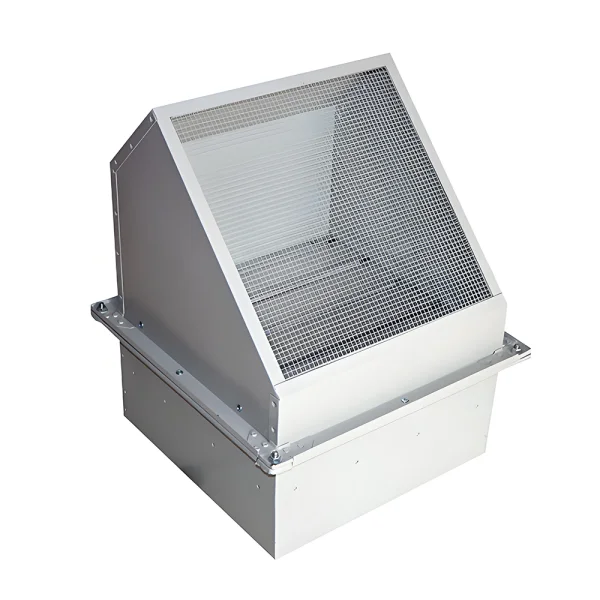
- Metal sidewall exhaust fans (LWWEXD series): 400–900 mm with rain deflector and insect screen. Example: LWWEXD-500D4-01, 380 V 50 Hz, 370 W, 7,800 m³/h. Corrosion-resistant versions on request.
- Solar fans: LW-SPF-320 (320 mm, 1,500–2,500 m³/h, 15 V DC panel) and LW-SPF-600 (600 mm, 6,000–7,000 m³/h, 36 V DC panel); automatic shut-off below about 25 °C.
Browse: plastic wall exhaust fans · metal wall exhaust fans · solar fans
Download: solar ventilator brochure · Related: welding fume capture
What to include in your enquiry
- Building type and size; attached or detached
- Use: parking, workshop, storage, painting
- Power available (voltage) or solar
- Wall or roof mounting; opening size
- Quantity and branding
Ask about garage and shed fans →
FAQ
What size exhaust fan does a garage need?
Calculate the garage volume and multiply by the air changes per hour you want. For a workshop with fumes, aim higher than for parking or storage. Then choose a fan that delivers that airflow.
Where should a garage exhaust fan go?
High on one wall, with an inlet vent low on the opposite wall, away from the door to the house.
Do solar shed fans work?
Yes, for heat and stale air on sunny days. They run when the shed heats up most and need no wiring.
Can I use a bathroom fan in a garage?
A plastic wall exhaust fan suits small, dry garages. For dust, fumes or larger spaces, a metal sidewall fan is more robust.