
Fans for Aircraft Hangars, Airports, Stations and Large Halls
Very large buildings, such as aircraft hangars, airport terminals, railway stations, exhibition centres and sports arenas, are hard to keep comfortable. Warm air rises to high ceilings, cold air pools at floor level in winter, and in summer people at ground level feel stagnant, warm air. HVLS (high-volume, low-speed) ceiling fans move a huge column of air gently down and across the floor, while exhaust fans remove heat and fumes.
LONGWELL supplies HVLS ceiling fans and sidewall exhaust fans for these spaces, through contractors and distributors.
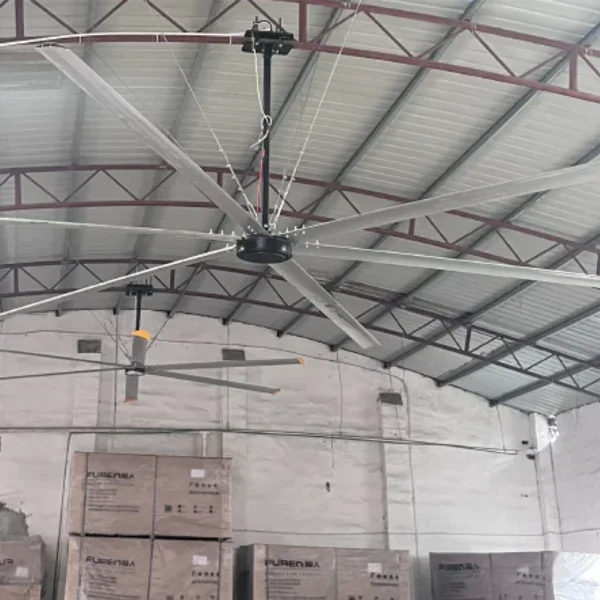
What large-space fans do
- Summer comfort: steady air movement over people at floor level.
- Winter destratification: running slowly, HVLS fans push warm ceiling air back down, which helps the heating system keep the floor warm.
- Air exchange: sidewall and roof exhaust fans remove hot air, engine fumes and odours, with fresh air coming in through doors or louvres.
- Drying and condensation control on floors and aircraft or equipment surfaces.
Planning HVLS fans in tall buildings
1. Clearances
Check the height of aircraft tails, cranes, signage, lights, sprinklers and smoke detectors. Leave clearance above and below the blades and around obstructions.
2. Coverage and layout
Divide the floor area by the rated coverage of the chosen diameter, then adjust for obstructions and door positions. In hangars, fans are often placed away from the aircraft parking footprint.
3. Structure and mounting
HVLS fans hang from the roof structure. A structural engineer should confirm the mounting point and the loads.
4. Integration with fire systems
Many sites require large fans to stop when the fire alarm activates, so they do not disturb sprinkler or smoke-detection performance. Follow local fire codes.
5. Power supply
Specify 220 V single-phase or 380 V three-phase and the control method.
LONGWELL HVLS ceiling fans (LW-ECCF series)
| Model | Diameter | Blades | Power | Max speed | Rated coverage |
|---|---|---|---|---|---|
| LW-ECCF-4.2 | 4.2 m / 13.8 ft | 6 | 0.75 kW | 75 r/min | 500–900 m² |
| LW-ECCF-5.2 | 5.2 m / 17 ft | 6 | 1.1 kW | 65 r/min | 700–1,000 m² |
| LW-ECCF-6.2 | 6.2 m / 20.3 ft | 6 | 1.3 kW | 63 r/min | 800–1,100 m² |
| LW-ECCF-7.3 | 7.3 m / 24 ft | 6 | 1.6 kW | 55 r/min | 900–1,200 m² |
Permanent-magnet motor, aluminium-alloy blades, 220 V or 380 V. Smaller 2.6 m and 3.2 m models are also available. Coverage depends on height and obstructions; values from LONGWELL product data.
Exhaust and supply fans
- LWWEXD sidewall fans: 400–900 mm with rain deflector and insect screen; supply-air versions available.
- LWAF35-11 axial fans: 13+ frame sizes from 293 mm to 1,140 mm, up to 61,000 m³/h, for ducted or wall-mounted exhaust.
Browse: HVLS ceiling fans · sidewall exhaust fans · industrial axial fans
Download: HVLS brochure · PM direct-drive HVLS
Related: warehouse cooling · high-bay destratification
What to include in your enquiry
- Building type, floor plan and ceiling height
- Obstructions (aircraft tails, cranes, lights, sprinklers)
- Heating and ventilation already installed
- Power supply and fire-alarm interface
- Installation country
Plan fans for your large space →
FAQ
Do HVLS fans work in aircraft hangars?
Yes. They move air across large floor areas for comfort in summer and push warm air down in winter. Layout must respect aircraft clearances.
How many HVLS fans does a hangar need?
Divide the floor area by the rated coverage of the chosen size and adjust for obstructions. LONGWELL’s 7.3 m model is rated for 900–1,200 m².
Can HVLS fans reduce heating costs?
By mixing warm ceiling air back down to the floor, they can help the heating system work more effectively. The result depends on the building and heating system.
Do large fans need to stop during a fire alarm?
Many codes require it. Plan an interlock with the fire alarm system as local rules require.