
Warehouse and Workshop Cooling Fans
Large buildings are hard to air-condition. Roofs absorb heat, doors stay open for trucks, and warm air settles around people and stock. Moving air works in two ways: air passing over the body makes staff feel cooler, and exhaust fans push hot air out and draw fresh air in. Most sites need both.
LONGWELL supplies the full set: HVLS ceiling fans for open floor areas, mobile drum fans and wall fans for workstations, and sidewall exhaust fans for air exchange.
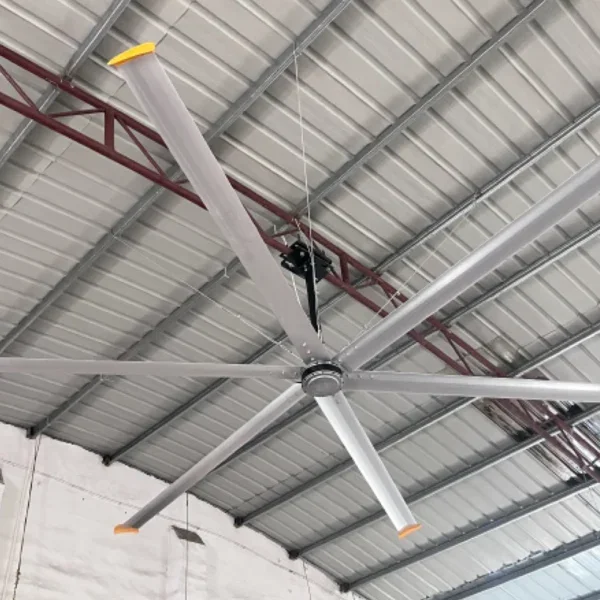
Which fan for which part of the building?
| Need | Fan type | Where it works best |
|---|---|---|
| Gentle air movement over a large open floor | HVLS ceiling fan (large diameter, low speed) | Warehouses, distribution centres, factories, gyms, farms with high ceilings |
| Strong airflow at a workstation or dock | Mobile drum fan / industrial floor fan | Workshops, loading docks, assembly lines, garages |
| Floor kept clear, fixed coverage | Industrial wall-mounted fan (fixed or oscillating) | Workshops, kitchens, aisles, small factories |
| Remove hot air, bring in fresh air | Sidewall exhaust fan | Any building with hot roofs or process heat |
| Extra cooling in dry heat | Misting fan | Semi-open docks, outdoor yards; see misting fans |
How to plan warehouse cooling
1. Start with exhaust
Remove heat first. Sidewall or roof exhaust fans high in the building, with inlets low on the opposite side, flush out the hottest air.
2. Cover open floors with HVLS fans
A single large ceiling fan moves a big column of air at low speed and covers a wide area, with less clutter than many small fans. Check ceiling height, obstructions (racking, cranes, lights, sprinklers) and the mounting structure before choosing a diameter.
3. Add spot cooling where people work
Drum fans and wall fans give direct airflow at docks, workbenches and lines. Mobile units can follow the work.
4. Specify power supply and controls
State voltage (110 V, 220 V or 380 V), frequency and whether you need speed control or a remote.
HVLS industrial ceiling fans (LW-ECCF series)
| Model | Diameter | Blades | Power | Max speed | Rated coverage |
|---|---|---|---|---|---|
| LW-ECCF-2.6 | 2.6 m / 8.5 ft | 5 | 0.52 kW | 125 r/min | up to 600 m² |
| LW-ECCF-3.2 | 3.2 m / 10.5 ft | 5 | 0.52 kW | 120 r/min | 200–650 m² |
| LW-ECCF-4.2 | 4.2 m / 13.8 ft | 6 | 0.75 kW | 75 r/min | 500–900 m² |
| LW-ECCF-5.2 | 5.2 m / 17 ft | 6 | 1.1 kW | 65 r/min | 700–1,000 m² |
| LW-ECCF-6.2 | 6.2 m / 20.3 ft | 6 | 1.3 kW | 63 r/min | 800–1,100 m² |
| LW-ECCF-7.3 | 7.3 m / 24 ft | 6 | 1.6 kW | 55 r/min | 900–1,200 m² |
Permanent-magnet motor, aluminium-alloy blades, 220 V or 380 V. Coverage depends on ceiling height, layout and obstructions; values from LONGWELL product data.
Drum fans, wall fans and exhaust fans
- Mobile drum fans: 26, 30, 34, 42 and 48 in blade sizes, 220–240 V. For example, LWA-660 (26 in) 450 W, 12,000 m³/h; LWA-760 (30 in) 650 W, 18,000 m³/h; LWA-860 (34 in, permanent-magnet motor) 500 W, 22,000 m³/h, with a rated air throw of 30–35 m.
- Industrial wall and stand fans: 18–30 in, fixed or oscillating, 110 V, 220 V or 380 V versions.
- Sidewall exhaust fans (LWWEXD series): square wall fans from 400 mm to 900 mm with rain deflector and insect screen. Example: LWWEXD-500D4-01, 380 V 50 Hz, 370 W, 7,800 m³/h. Supply-air and corrosion-resistant versions are available on request.
Browse: industrial ceiling fans · drum / floor fans · industrial wall fans · wall exhaust fans
Download: HVLS ceiling fan brochure · PM direct-drive HVLS · drum fan brochure
Related: high-bay destratification
What to include in your enquiry
- Building size, ceiling height and main obstructions (racking, cranes)
- Areas where people work and doors that stay open
- Heat sources (roof, ovens, machines)
- Voltage, phase, frequency; control needs
- Quantity and delivery country
Get a warehouse cooling proposal →
FAQ
What is the best fan for a warehouse?
For open floor areas with high ceilings, an HVLS ceiling fan. For docks and workstations, drum or wall fans. Combine them with sidewall or roof exhaust fans to remove hot air.
How many HVLS fans does a warehouse need?
Divide the floor area by the rated coverage of the chosen diameter, then adjust for racking, ceiling height and obstructions. LONGWELL’s 7.3 m model is rated for 900–1,200 m².
Drum fan or HVLS fan?
A drum fan gives strong, directed airflow to a small area and can be moved. An HVLS fan gives gentle airflow over a large area from the ceiling.
Do fans cool a warehouse?
Fans make people feel cooler by moving air over the skin. Exhaust fans lower building temperature by replacing hot air with outdoor air. They do not cool air below outdoor temperature; misting fans add evaporative cooling in dry climates.