
Gym and Sports Hall Fans
Exercise turns food into heat. A full gym or training hall produces a lot of body heat and moisture, and many gyms (warehouse units, garage gyms, sports halls) have little or no air conditioning. Fans help in two ways: moving air over members helps sweat evaporate so they stay comfortable, and exhaust ventilation removes heat, humidity and odour from the building.
LONGWELL supplies HVLS ceiling fans, oscillating wall fans, drum fans and exhaust fans for gym operators, fitness-equipment distributors and sports-facility contractors.
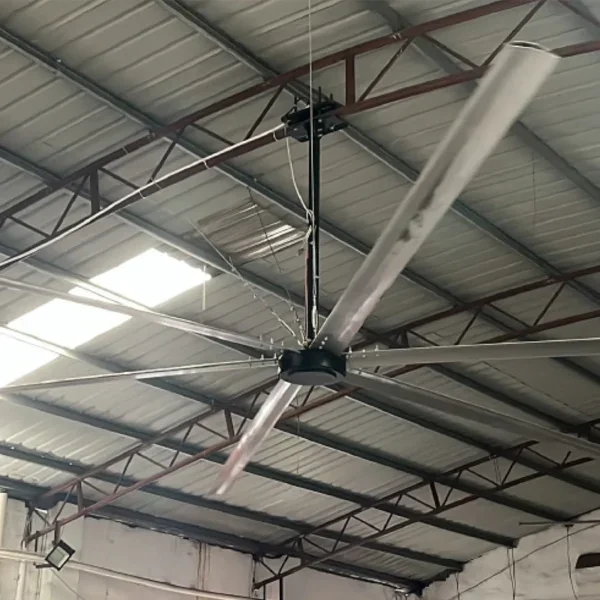
Fan options by space
| Space | Best fit | Notes |
|---|---|---|
| Large training floor, sports hall (high ceiling) | HVLS ceiling fan | Even, gentle airflow over a wide area; no floor space used |
| Weights area, functional-training zones | Oscillating wall fans, 24–30 in | Targeted airflow; out of the way of equipment |
| Garage gym, small studio | Drum fan or 18–26 in wall/stand fan | High airflow for the price; can be moved |
| Spin and HIIT studios | Wall fans aimed across the room plus exhaust | High heat load in a small room |
| Changing rooms and showers | Ducted exhaust with EC inline fans | Removes humidity and odour |
Planning tips
1. Ventilate first
Circulating fans make people feel cooler but do not remove heat or moisture. Add exhaust fans high in the building and openings or supply air low down.
2. Check ceiling height and obstructions
HVLS fans need clear height above rigs, basketball hoops, lights and sprinklers. Measure before choosing a diameter.
3. Keep noise down
Coaches and classes need to be heard. Large, slow fans and several smaller fans at medium speed are quieter than a few fans at full speed.
4. Safety
Mount wall fans out of reach, keep guards closed, and keep cables clear of training areas.
LONGWELL fans for gyms
- HVLS ceiling fans (LW-ECCF series): 2.6–7.3 m diameter, 5 or 6 aluminium-alloy blades, permanent-magnet motor, 0.52–1.6 kW, 220 V or 380 V. Rated coverage from up to 600 m² (2.6 m model) to 900–1,200 m² (7.3 m model). Remote-control versions are listed.
- Oscillating wall and stand fans: 18–30 in, pure copper motor with fuse, 3 speeds, metal grille; 110 V, 120 V or 220–240 V.
- Drum fans: 26–48 in mobile fans, e.g. 30 in, 650 W, 18,000 m³/h.
- Exhaust: LWWEXD sidewall exhaust fans (400–900 mm) for the hall; LWDE EC inline fans (100–315 mm, IP54) for changing rooms.
Browse: HVLS ceiling fans · wall and stand fans · drum fans · wall exhaust fans
Download: HVLS brochure · Related: warehouse cooling · high-bay destratification
What to include in your enquiry
- Gym type, floor area and ceiling height
- Training zones and obstructions (rigs, hoops, lights)
- Existing ventilation or air conditioning
- Voltage, phase; noise expectations
- Quantity and installation country
FAQ
What are the best fans for a gym?
For large, high-ceiling training floors, HVLS ceiling fans. For zones and smaller rooms, oscillating wall fans. Add exhaust ventilation to remove heat and humidity.
How big should an HVLS fan be for a gym?
It depends on floor area, ceiling height and obstructions. As a guide, LONGWELL’s 4.2 m model is rated for 500–900 m² and the 7.3 m model for 900–1,200 m².
What fan is best for a garage gym?
A 24–30 in drum fan or a wall-mounted oscillating fan, with the garage door or a window open for fresh air.
Do gym fans need special wiring?
Large HVLS fans are usually wired to a fixed supply (220 V or 380 V) by an electrician. Wall and drum fans plug into standard sockets for their voltage.