
Aeration Blowers for Aquaculture and Ponds
Fish and shrimp need dissolved oxygen. In dense ponds, tanks and hatcheries, natural oxygen transfer is not enough, especially on hot nights. An aeration blower pushes air through pipes to diffusers (air stones, tubes or discs) at the bottom of the water. The rising bubbles add oxygen and keep the water moving.
LONGWELL supplies two blower families for aeration: regenerative (ring / side-channel) blowers for low to medium pressure, and Roots blowers for higher pressures and larger systems.
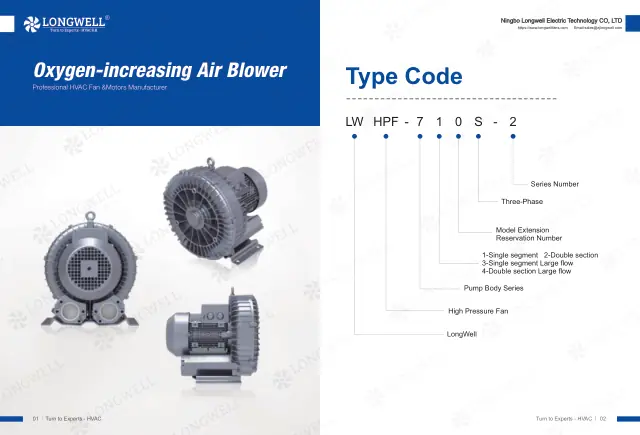
Regenerative or Roots blower?
| Regenerative (ring / side-channel) blower | Roots (positive-displacement) blower | |
|---|---|---|
| Pressure range | Low to medium; suits shallow ponds, tanks and hatcheries | Higher; suits deep ponds, long pipe runs, many diffusers |
| Design | Compact, direct-drive, few wearing parts | Robust; usually belt or direct drive with silencers |
| Typical users | Hatcheries, RAS tanks, garden and koi ponds, small farms | Large fish and shrimp farms, wastewater treatment |
| Other uses | Vacuum, conveying, packaging and printing machinery | Pneumatic conveying |
How to size an aeration blower
1. Air volume
Start from the oxygen demand: the stocking density and species, the water volume and temperature. Diffuser makers usually give an airflow per diffuser; multiply by the number of diffusers.
2. Pressure
The blower must overcome the water depth above the diffusers (about 10 kPa per metre of water) plus losses in the pipes, valves and diffusers. Deeper water needs more pressure.
3. Duty and redundancy
Aeration often runs 24/7, and a stopped blower can cost a crop overnight. Plan a standby blower and alarms for critical systems.
4. Site conditions
Give the voltage, phase and frequency, and protect the blower from rain, heat and flooding. Fit inlet filters and silencers where needed.
LONGWELL aeration blower range
- AC single-stage regenerative blowers (LWHPF series): 18 models from LWHPF-710S to LWHPF-790S. Mains-powered, for pressure or vacuum duty in aeration, conveying, packaging and printing.
- Roots blowers (LWSR and LWC series): 36 models from LWSR-50 to LWSR-350 plus the LWC range, for aeration and pneumatic conveying. The catalogue includes selection tables, performance curves, drawings, wiring diagrams and noise data.
Download: regenerative blower catalogue · Roots blower catalogue
Related: wastewater diffused aeration · compost aeration
What to include in your enquiry
- Application: fish, shrimp, hatchery, garden pond, wastewater
- Water depth at the diffusers and number/type of diffusers
- Required airflow, or pond area and stocking details
- Voltage, phase, frequency; continuous duty
- Quantity; need for a standby unit
Get an aeration blower selection →
FAQ
What is a ring blower used for in aquaculture?
It supplies low-pressure air to diffusers in ponds and tanks, adding dissolved oxygen for fish and shrimp.
How much pressure does an aeration blower need?
Roughly 10 kPa for every metre of water above the diffusers, plus pipe and diffuser losses.
Ring blower or Roots blower for a fish farm?
Ring blowers suit shallow ponds and smaller systems; Roots blowers suit deeper water, long pipe networks and large farms.
Can the same blower create vacuum?
Regenerative blowers can run in pressure or vacuum duty, which is why they are also used for conveying and packaging machinery.