Industrial fans play an important role in HVAC systems, warehouses, data centers, cold chain facilities, battery energy storage systems, and various industrial ventilation projects. Two primary fan drive mechanisms are direct drive fans and belt drive fans. Choosing between these technologies can significantly impact energy efficiency, maintenance requirements, operating costs, and reliability.
In this guide, LONGWELL breaks down the differences between direct drive and belt drive fans, compares their performance, and how to choose between them for different industrial applications.
What is Direct Drive Fan?
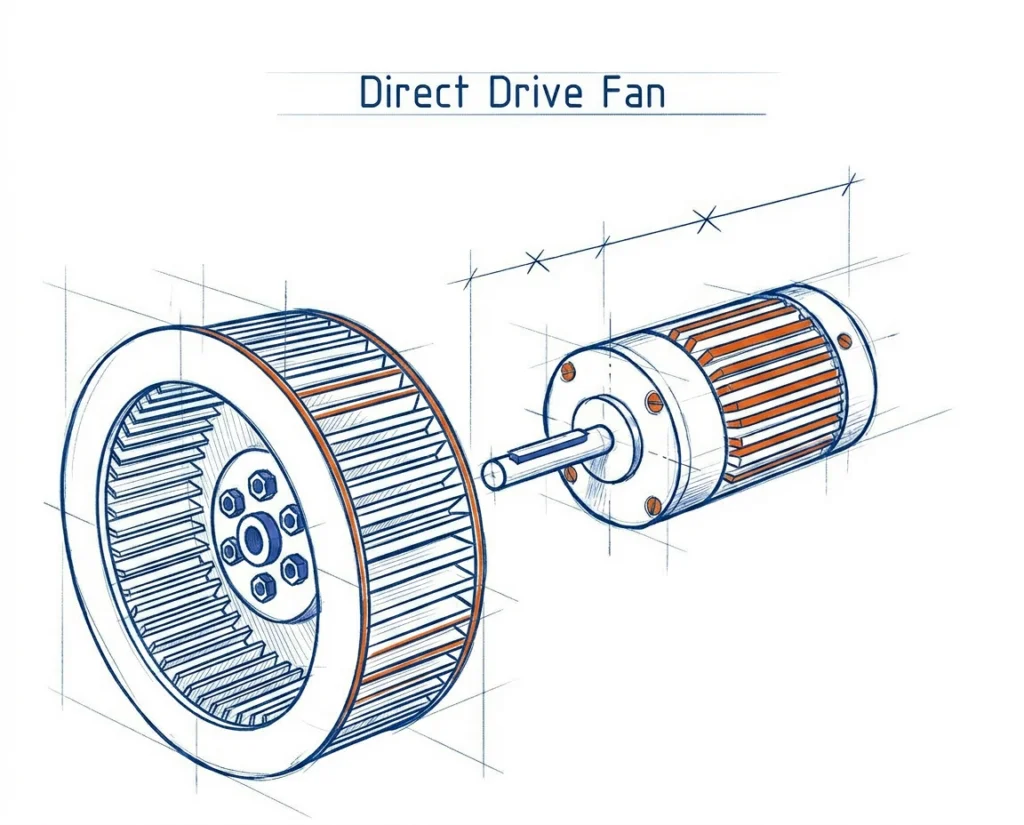
A direct drive fan connects the fan impeller directly to the motor shaft without any belt or intermediate transmission components. So the motor and fan share a single rotating assembly and the fan speed also means the motor speed. For direct drive fans, the speed control is often achieved electronically via the motor controller, usually EC motors. Direct drive fans have increasingly become the default choice in modern HVAC and industrial ventilation systems, especially where energy efficiency and low maintenance are priorities.
What is Belt Drive Fan?
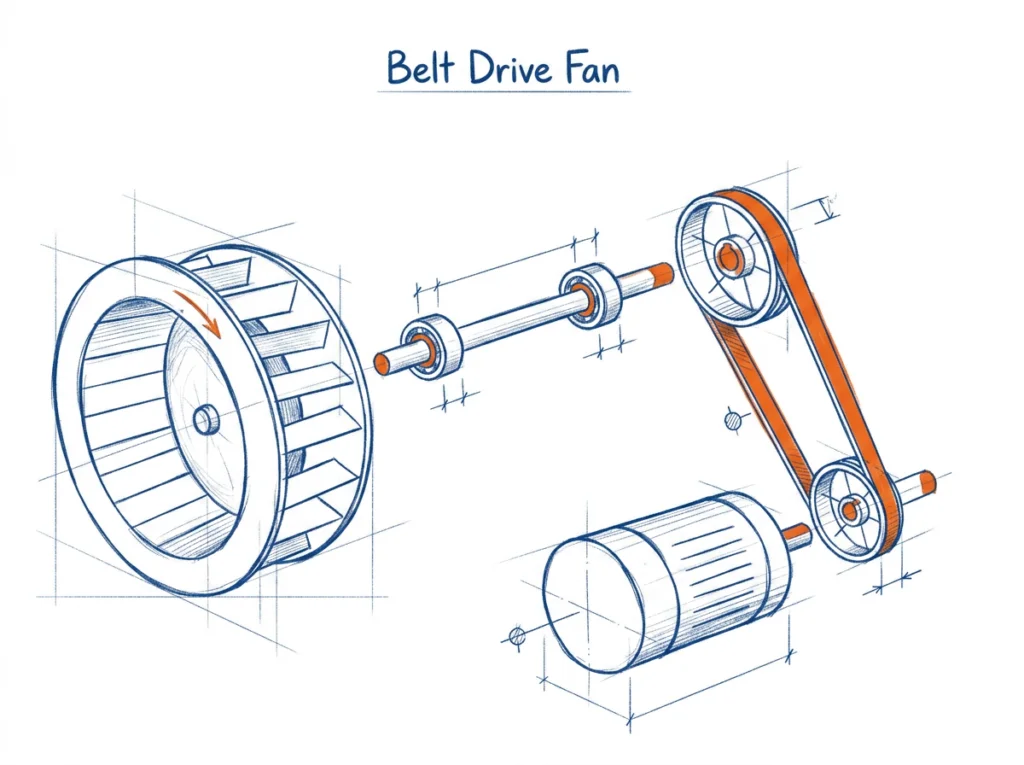
A belt drive fan transfers power from the motor to the fan impeller using belts and pulleys. In this design, the motor is mounted separately from the fan assembly. The motor shaft drives a smaller pulley, which rotates a larger pulley on the fan shaft via one or more belts.
This configuration allows for mechanical speed reduction, enabling the motor to operate at its most efficient RPM while the fan runs at the desired speed. The speed of belt drive fans can be easily adjusted by changing the sizes of the pulleys, providing flexibility for different airflow requirements. Belt drive fans are commonly used in high static pressure applications where adjustable speed and high torque are required.
Direct Drive vs Belt Drive Fan: Key Differences
Selecting the right fan type is critical for industrial and commercial projects, impacting energy efficiency, maintenance requirements, and long-term operational costs. Understanding the differences between direct drive fans and belt drive fans can help engineers and facility managers make informed decisions for HVAC systems, manufacturing processes, and other industrial applications.
Efficiency
Direct-driven fans are designed with the impeller mounted directly on the motor shaft, eliminating the need for additional transmission components. This direct connection ensures that all the motor’s energy can be efficiently transferred to the fan, and minimal power loss and optimal airflow performance can be achieved.
Belt drive fans use a belt and pulley system to transfer power from the motor to the fan shaft, and it can cause energy losses due to belt friction and slippage. Energy losses can range from 15-20% for smaller motors to 3-5% for larger motors. This makes belt drive fans slightly less efficient compared to direct drive systems.
Reliability
Direct drive fans are generally considered more reliable because they contain fewer mechanical components than belt drive systems. Direct drive fans have fewer wear points and fewer opportunities for mechanical failure, and this simplified design helps reduce downtime and ensures consistent airflow performance. Modern direct drive fans, particularly those equipped with EC motors, can provide consistent performance over long operating periods. A reputable fan manufacturer should carefully optimize the motor, impeller, control system, and overall airflow design to ensure long-term durability, efficiency, and performance.
Belt drive fans can provide reliable performance when properly maintained. However, the additional transmission components, including belts, pulleys, bearings, and shafts, may introduce potential failure points compared to direct drive designs. Over time, belt stretching, wear, slippage, or pulley misalignment, and bearing degradation can negatively impact fan performance and efficiency. Without regular inspections, these issues may lead to increased vibration, reduced airflow, and unexpected system downtime. Regular maintenance is therefore essential to maintain optimal reliability and extend the service life of belt drive fans.
Maintenance
Direct drive fans feature a simpler, more compact design, which translates into minimal mainimal maintenance requirements. With no belts, pulleys, or additional transmission components, there’s no need for belt adjustments or replacement. So, compared to belt drive fans, direct drive fans require less maintenance.
Belt drive fans, by contrast, have more mechanical components that operate under friction and tension, which require ongoing maintenance to ensure optimal performance. Common maintenance includes: inspecting and replacing worn belts, adjusting belt tension, checking pulley tension, lubricating bearings, and monitoring vibration.
Noise Level
Direct drive fans have no belt squeal and fewer moving parts, so they generally operate more quietly because they eliminate belt-related noise sources such as slippage, vibration, and pulley movement. The direct connection between the motor and impeller results in smoother operation and reduced mechanical noise. This makes direct drive fans particularly suitable for applications where low noise levels are important.
Belt drive fans may generate additional noise due to belt movement and pulley rotation caused by belt wear or improper tension, and potential vibration at certain speeds.
Motor Protection
In direct drive fans, the fan motor is often in the airstream, which may expose itself to the surrounding air conditions. This means the motor must be carefully selected and rated to withstand the specific operating environment with extreme temperature and many contaminants. Proper motor selection and protection are critical for ensuring long-term reliability.
Belt drive fans usually allow the motor to be mounted separately from the airstream, which can reduce exposure to heat, dust, or moisture. This separation can simplify motor protection requirements. However, belt drive motors need routine checks to ensure that they remain properly aligned, lubricated, and free from stress caused by the belt and pulley system.
Direct Drive vs. Belt Drive Fan Comparison Chart
| Factor | Direct Drive Fan | Belt Drive Fan |
| Energy Efficiency | Higher – no belt transmission losses, especially with EC motors | Lower – belt friction causes 3–5% transmission loss |
| Maintenance | Minimal | Requires regular maintenance |
| Noise Level | Lower | Higher |
| Initial Cost | Higher, but lower TCO over life | Lower |
| Motor Protection | Must be rated for the operating environment | Easier to protect |
| Reliability | Excellent | Good with proper maintenance |
Direct Drive vs Belt Drive Centrifugal Fans
Centrifugal fans are widely used across industrial and commercial applications, including dust collection systems, equipment cooling, air pollution control, HVAC systems, and general ventilation. When selecting a centrifugal fan, one of the most important design considerations is the drive mechanism: direct-driven or belt-driven type.
Understanding the differences between direct drive and belt-driven centrifugal fans can help engineers, OEMs, HVAC contractors, and facility managers choose the most suitable fan solution for their specific ventilation requirements.
Direct Drive Centrifugal Fan
What Is a Direct Drive Centrifugal Fan?
A direct drive centrifugal fan mounts the backward-curved or forward-curved impeller directly onto the EC, DC, or AC motor shaft. The combination of direct connection simplifies the overall structure of the centrifugal fan, reducing the mechanical complexity and minimizing energy losses.
Advantages of Direct Drive Centrifugal Fan
- Higher energy efficiency: System efficiency gains of 15 – 30% over equivalent belt-drive centrifugal fans.
- Improved reliability: Minimal wear and potential failure point
- No belt maintenance: No downtime for tensioning or replacement
Considerations for Direct Drive Centrifugal Fan
Because the motor is often located within the airflow path, it must be properly rated for the operating environment. Factors such as temperature, humidity, dust, and corrosive contaminants should be considered when selecting the motor.
Belt Drive Centrifugal Fan
What is a Belt Drive Centrifugal Fan?
A belt drive centrifugal fan uses a separately mounted motor driving the impeller shaft through belts and pulleys. Belt drive fans have been widely used in industrial ventilation systems for decades due to their versatility and adaptability.
Advantages of Belt Drive Centrifugal Fan
- Flexible speed adjustment: By changing pulley sizes, fan speed can be adjusted without replacing the motor.
Ideal for large-scale and challenging applications: Belt drive centrifugal fans are well-suited for large air handling systems and demanding environments. They can handle high-temperature air, corrosive gases, or air containing dust and particulates, making them a reliable choice for industrial ventilation, pollution control, and heavy-duty HVAC projects.
Consideration for Belt Drive Centrifugal Fan
The additional mechanical components introduce energy losses through belt friction and slippage. Depending on the application, efficiency losses can range from 3–20%. So regular maintenance is essential for belt-driven centrifugal fans to keep long-term reliability.
The Game Changer: EC Motor Technology in Direct Drive Fans
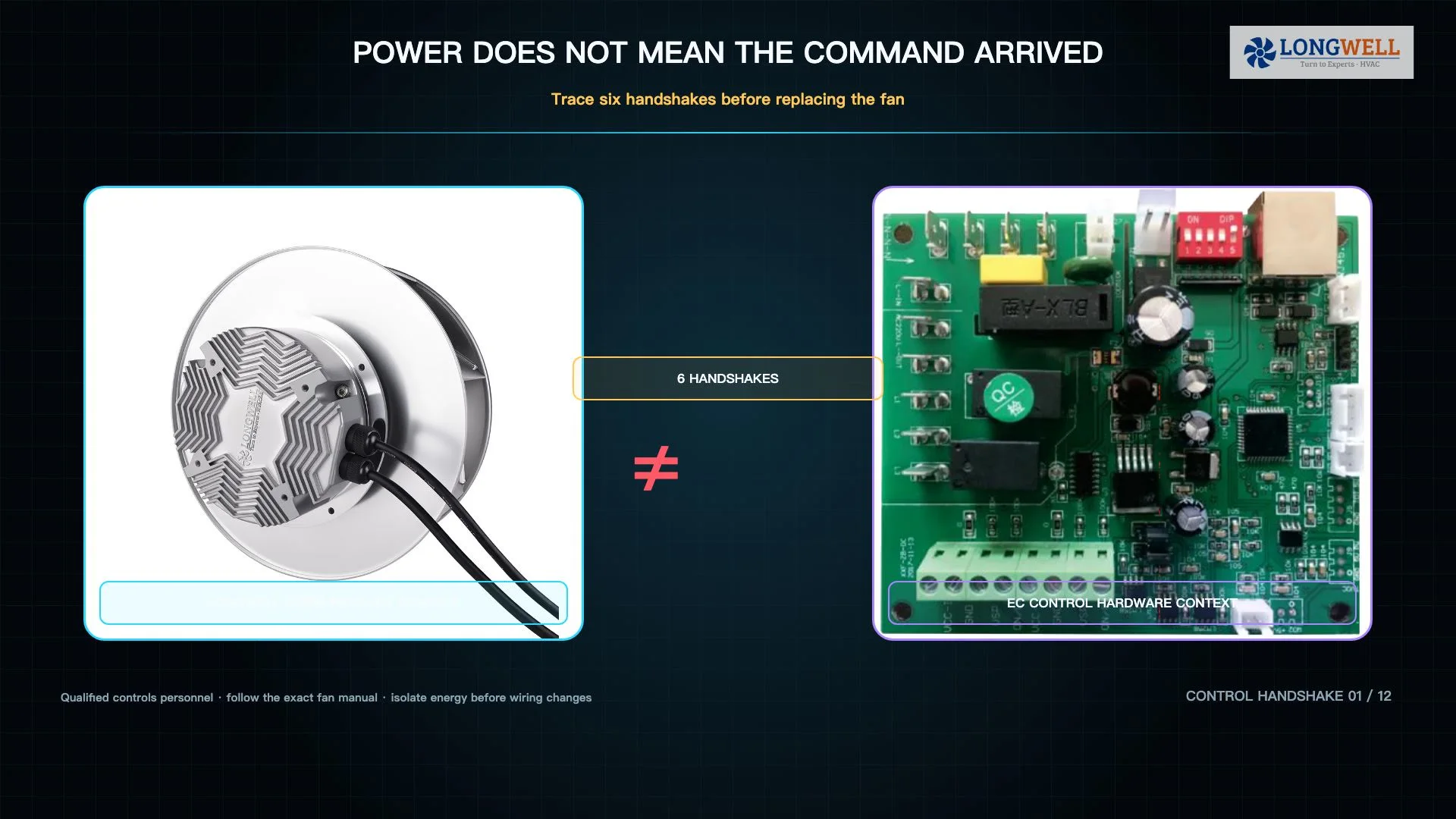
Before EC motors, direct drive fans were often limited to smaller applications because AC induction motors couldn’t deliver the efficiency and speed control that belt-drive setups offered at large scale. EC motors combine the best of AC and DC motor worlds: a permanent-magnet rotor with built-in electronic commutation (no brushes), delivering high efficiency of 85% to 92%, 0-100% infinitely variable speed via 0-10V or Modbus digital control, and built-in protection.
LONGWELL Direct Drive Fan Solutions & Belt Drive Fan Solutions
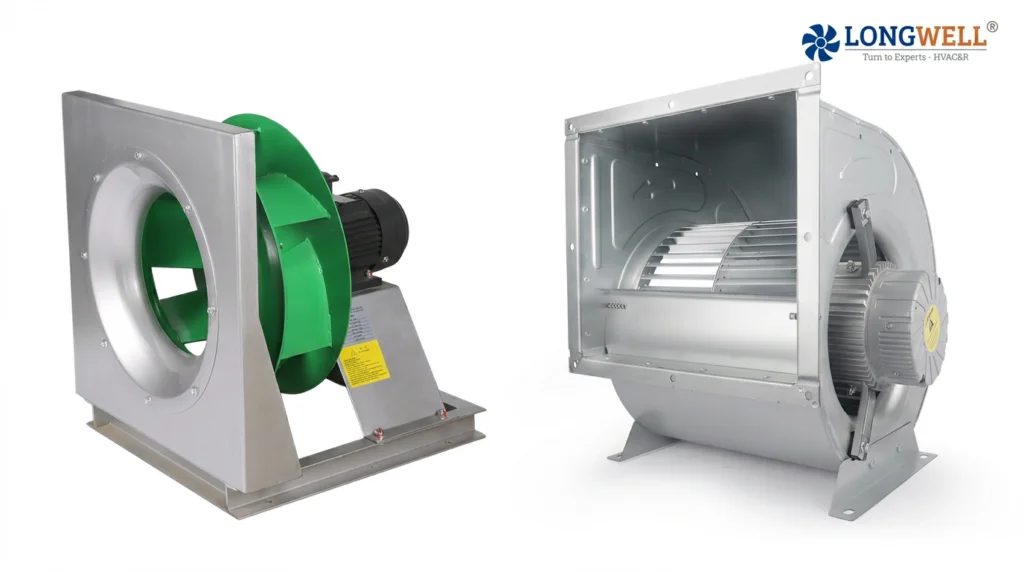
Direct Drive Fan Solution: The motor is directly coupled to the impeller with no intermediate transmission components. Representative LONGWELL product series include DD / DDM / REM / TEM / RLM. These fans use EC motors with system efficiency of 85–92% (IE4+), starting current ≤ 1.5× rated, zero belt transmission loss, compact structure, and low maintenance cost (no belt replacement required). They also deliver lower noise levels thanks to optimized aerodynamic design. Ideal for new-build projects and intelligent control scenarios such as data centers and heat pump systems.
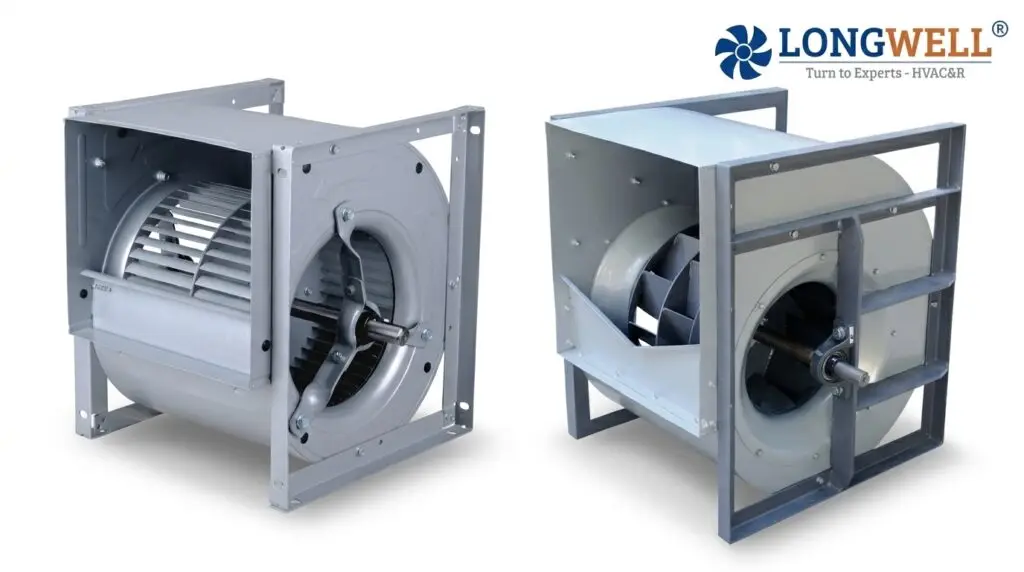
Belt Drive Fan: Power is transmitted via a pulley-and-belt assembly. Representative LONGWELL product series include RDH / ADH. These fans use AC motors with efficiency of 65–75% (IE2–IE3), starting current 6–8× rated, and 8–10% transmission loss from the belt drive. The structure requires reserved space for belt maintenance, resulting in higher maintenance costs (average 48 belt replacements per year). Noise levels are higher due to belt vibration. Suited for retrofit projects with existing VFD systems and heavy-duty industrial applications such as dust extraction systems and large-scale AHUs.
FAQs
Which is better, direct drive or belt drive fan?
The choice depends on your application requirements. Direct drive fans offer higher energy efficiency, lower maintenance, quieter operation, and greater reliability due to fewer moving parts. Belt drive fans provide flexibility in speed adjustment and are better suited for large-scale systems or challenging environments.
Are direct drive fans quieter than belt drive fans?
Yes. Direct drive fans typically operate more quietly because they eliminate belt slippage and additional mechanical vibration associated with pulley-driven systems.
How does a dusty or humid environment affect the choice?
In environments with dust, moisture, or corrosive particles, belt drive fans may be advantageous since the motor can be mounted outside the airstream, reducing exposure. Direct drive fans can also be used in these conditions, but the motor must be properly rated and protected against contaminants, humidity, and temperature extremes.
Can I convert a belt drive fan to direct drive?
In most cases, yes — this is called a fan retrofit or fan upgrade. The existing fan housing and mounting can often be reused while replacing the belt-drive motor and pulley assembly with a direct drive EC plug fan. If you have any needs, contact LONGWELL directly for various fan solutions.
Choose the right centrifugal fan
Longwell manufactures 956 centrifugal fans in-house. Send airflow, static pressure and voltage — an engineer replies with a matching model, performance curve and price within one working day.