Squeezing Air Through a Tight Industrial Space
A customer needed a new blower for a tight industrial thermal unit. First, they required a 140mm EC centrifugal fan. Next, the internal space was extremely small. Therefore, the fan had to produce very high pressure.
The unit works outside in freezing winter weather. Consequently, it must survive a strict -30 Celsius lower limit. Furthermore, standard plastics become brittle and crack in this extreme cold. So, the fan needed strong metal materials.
The equipment runs on a 230 VAC supply. Therefore, the motor needed to accept this direct power without external converters. Finally, local site rules enforce strict noise limits. The sound must stay strictly under 75 dB(A).
We had to meet strict electrical safety standards too. First, the electrical parts required ETL certification to UL 507. Next, they needed CE marks for EN 60335-1. The internal system impedance was very high.
The fan had to move 494 m3/h of air. Meanwhile, it faced exactly 845 Pa of static resistance. So, normal axial fans would simply stall and fail here. Therefore, the engineering team had to find a specific aerodynamic design.
We test all airflow to AMCA 210-16 methods. In short, this ensures the published data matches the real output perfectly. The physical envelope allowed no extra room for errors. First, the maximum diameter could not exceed 140mm.
Next, the total height was capped at exactly 72mm. Consequently, replacing the unit later in the field would be very hard. Therefore, the bearing life had to reach 40,000 hours. Finally, the customer needed IP55 protection against heavy rain and dust.
Engineering the High-Pressure Wheel
We looked at several ways to solve this airflow problem. First, we tested a backward-curved wheel. However, this type cannot make 845 Pa at 140mm without spinning very fast. Consequently, the high speed causes too much noise.
The acoustic output would easily pass the 75 dB(A) limit. Instead, we chose a forward-curved impeller. This blade geometry grabs air much harder. Therefore, it builds high pressure at lower speeds.
Trade-offs for the 140mm EC Centrifugal Fan
Every design choice forces a real penalty. First, forward-curved blades are heavy. So, we picked galvanized steel instead of standard plastic. Furthermore, the steel adds overall mass to the fan.
The metal easily handles the physical stress of pushing 494 m3/h. Meanwhile, the steel resists freezing outdoor temperatures perfectly. Next, forward-curved wheels draw maximum power at low pressure. Therefore, a sudden drop in pressure could burn out the motor.
So, we added our SmartEC control logic. This system actively limits the electrical current. Finally, it caps the maximum draw at exactly 0.85 amps.
Final Output and Costs
The final unit spins at exactly 2060 RPM. First, this speed safely reaches the 845 Pa target. Next, we built the motor to Insulation Class B. Furthermore, we sealed the housing to IP55 standards.
However, this choice came with real costs. The fan makes exactly 74 dB(A) of noise. Therefore, it leaves almost no acoustic margin for error. Next, the smart drive costs more than a simple AC motor.
Even so, this 140mm EC centrifugal fan completely solved the spatial bottleneck. Finally, the metal construction guarantees a long life in cold weather. The motor uses 115 W of input power. Meanwhile, the speed control accepts a 0-10VDC signal.
Therefore, the system can slow down when cooling demand drops. In short, this saves energy during winter months.
Technical Specifications
| Parameter | Value |
|---|---|
| Model | LWFE3G140-072NS-02 |
| Nominal Voltage | 230 VAC |
| Voltage Range | 176~264 VAC |
| Frequency | 50/60 Hz |
| Speed | 2060 RPM |
| Current | 0.85 A |
| Power Input | 115 W |
| Max Airflow | 494 m3/h |
| Max Static Pressure | 845 Pa |
| Noise Level | 74 dB(A) |
| Operating Temperature | -30°C to +60°C |
| Protection Type | IP55 |
| Insulation Class | Class B |
| Speed Control | 0~10VDC / PWM |
| Bearing Life Expectancy | 40,000 Hours |
| Material | Galvanized sheet steel |
| Certification | CE, ETL |
The table shows the exact test results for the 140mm EC centrifugal fan. First, the static pressure reaches an impressive 845 Pa. Next, the maximum airflow hits 494 m3/h. Therefore, these exact numbers define the main cooling capability. Meanwhile, the low temperature limit sits at -30 Celsius. So, the fan needs special bearing grease to prevent freezing. Next, the IP55 rating blocks harmful dust and water. Furthermore, the motor draws exactly 0.85 amps at full load. Finally, the 40,000-hour bearing life ensures years of continuous operation.
Reference: AMCA 210 covers the test method behind these figures.
Technical Documentation

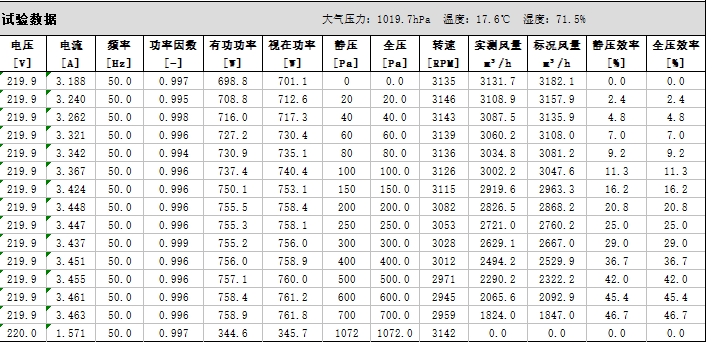
This image shows the pressure and airflow curve for the 140mm EC centrifugal fan. First, engineers need this graph to verify the safe working limits. Next, it maps the exact performance across different system resistance levels. Therefore, buyers can confirm the fan will not stall in their equipment.
Download the Engineering Specification
This PDF file holds all the exact physical dimensions. Furthermore, it contains the strict wiring diagram for the electric motor. Finally, system integrators need this document to plan their electrical connections.
How to Specify Compact High-Pressure Fans
If you need a 140mm EC centrifugal fan, check your system carefully.
- First, measure the true pressure drop. Dense filters and tight spaces block air constantly. Consequently, fans often stall if the pressure is too high. Therefore, exact measurements prevent unexpected cooling failures.
- Next, specify your exact control voltage clearly. The motor needs clear electrical instructions to function properly. Therefore, tell the factory what should happen below 1.0 VDC. Finally, decide if the motor should stop or run slowly.
- By contrast, do not ignore the acoustic noise limit. Small fans pushing hard make much more sound. So, use a physically larger fan if you have the space. Instead, a larger fan runs slower and quieter.
- We make our own impellers directly in house. Therefore, we can change the bearing grease for extreme cold weather. Next, tell your supplier your exact outdoor temperature range. Finally, this ensures the fan starts safely during winter.
Related: Centrifugal Fans.
Common Engineering Questions
Technical Documentation & Resources
Browse our centrifugal fans range, the backward-curved fans section, or forward-curved fans.
Have a Similar Fan Requirement?
Longwell’s engineering team delivers custom spec sheets and samples within 90 days. Since 1990, we have supplied EC fans and blowers to OEMs across HVAC, cold chain, data center, and industrial applications worldwide.
Browse Related Products:
🏆 ISO 9001 / ISO 14001 / ISO 45001 | CE (TÜV) | UL/ETL | ATEX Zone 21/22 | AMCA 210-16 / ISO 5801 tested