Engineering a 110V Explosion Proof Axial Fan for Extreme Heat
A US buyer contacted us with a tough technical request. They needed a new 24-inch ventilation unit for an industrial plant. First, they required a strict 110V power supply. This is a very unusual voltage for a large industrial fan. Most large fans use three-phase 380V power. Next, the target environment was highly dangerous. Therefore, they needed an explosion proof axial fan. This explosion proof axial fan had to meet strict US safety rules. It also had to pass UL 507 safety standards. We also test all our fan performance to AMCA 210-16 methods.
Furthermore, the temperature limits were severe. The explosion proof axial fan had to run safely between -30°C and +80°C. Consequently, the -30°C limit told us the fan would sit outdoors in winter. Meanwhile, the +80°C upper limit meant the fan would handle intense process heat. The customer also set a strict airflow goal. They wanted 6900 CFM of free air. Finally, they shared their standard 24-inch mounting limits. We took these hard numbers and started our review. We matched their list against our standard 600 mm products. However, our standard parts could not meet all these rules at once.
Choosing a Custom Motor Over Standard Parts
Our engineering team looked at a few different options. First, we checked our standard LWEA600S(T)M-076E model. However, we rejected this standard unit right away. The off-the-shelf fan uses a 220/380V power supply. Next, we thought about using an external step-down transformer. Instead, we dropped that idea too. A transformer adds a serious electrical ignition risk in a hazardous zone. Therefore, we chose to build a custom 110V motor for the 600 mm frame.
Custom Motor Trade-Offs
This decision forced us to make hard trade-offs. First, a 110V single-phase motor draws huge current to make power. Consequently, we had to use much thicker copper wire. This heavy wire filled the stator slots. It also added a lot of mass to the explosion proof axial fan. Furthermore, the extreme heat forced a second big change. Our proprietary ThermoFlex design easily handles the cold -30°C start. Even so, the +80°C upper limit was a problem. Therefore, we added Class F insulation and special high-heat grease to the bearings.
Every custom choice has a real cost. First, the thicker copper raised the overall weight and cost materially. Second, the new electrical design added lead time. Standard samples leave our stock in 1-3 days. By contrast, this custom work pushed the job into a 90-day NPI cycle.
Final Performance Numbers
Finally, we finished the LWEA600UM-076E model. This custom explosion proof axial fan runs safely on a 110V rail. It turns at 1450 RPM. It pushes 9500 m3/h of air. The buyer originally asked for 6900 CFM. Our 9500 m3/h result equals roughly 5591 CFM. Why did we accept this lower number? The heavy flameproof housing and thick steel guards add high static pressure. Consequently, you cannot get free-air CFM through a restrictive guard. The fan delivers exactly what the actual system needs.
Technical Specifications
| Model Number | LWEA600UM-076E |
| Air Volume | 9500 m3/h (approx. 5591 CFM) |
| Requested Airflow | 6900 CFM |
| Speed | 1450 RPM |
| Voltage | 110V |
| Input Power | 3700 W |
| Duct Inner Diameter | 560 mm |
| Mounting Hole Spacing | 490 mm x 490 mm |
| Operating Temperature | -30°C to +80°C |
The voltage and power numbers show the real challenge here. A 110V supply drawing 3700 W pulls nearly 34 amps of current. Therefore, the custom thick copper stator is the most vital part of this unit. Furthermore, the 1450 RPM speed keeps the heavy cast-aluminum blades quiet. By contrast, faster speeds would break the strict noise limits. Finally, the 490 mm mounting spacing fits perfectly into standard industrial ducts.
Reference: AMCA 210 covers the test method behind these figures.
Technical Documentation
longwell-lwea600s-technical-doc-01.pdf. First, this file shows the full catalog data for our standard series. It helps buyers check standard footprint sizes.
longwell-lwea600s-technical-doc-02.pdf. Next, this drawing maps the custom 110V LWEA600UM-076E dimensions. Engineers need this sheet to plan the physical install.
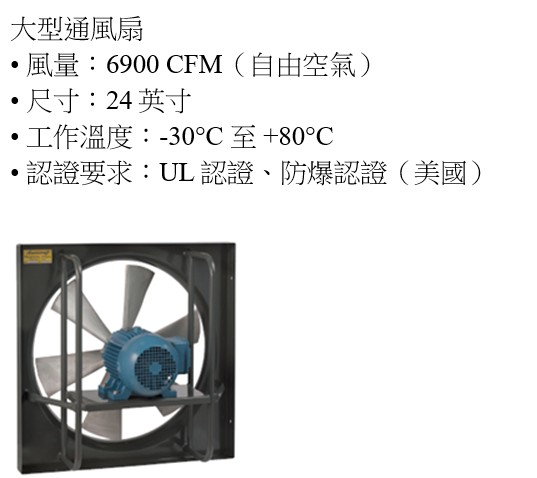
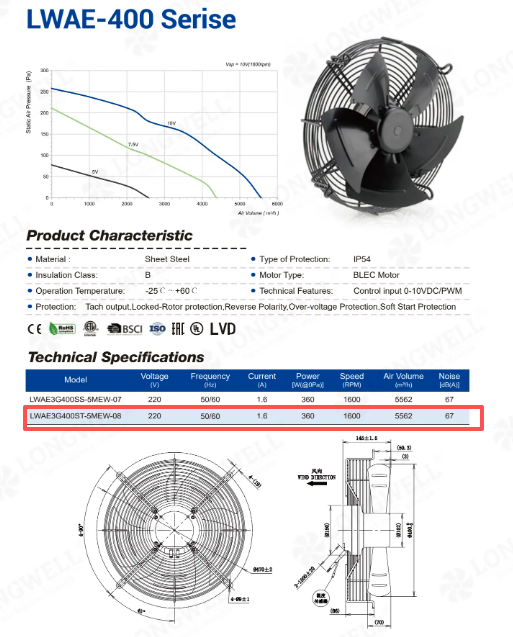
Finally, this image is the exact 24-inch spec sheet sent by the customer.
How to Specify a Fan for Extreme Heat
Buying fans for extreme heat and hazardous zones is hard. You must collect exact data before you ask for a quote.
- First, measure the real voltage drop at your site. A long wire run lowers the voltage before it hits the fan. Consequently, the motor will pull more amps and run hotter than normal.
- Next, check if your +80°C limit applies to the room air or the hot gas inside the pipe. This fact changes the exact bearing grease we pick.
- Furthermore, do not expect high free-air numbers after you add safety guards. A thick steel guard always blocks airflow and adds static pressure.
- Finally, tell us your exact chemical zone right away. We can finish a custom NPI in just 90 days. Even so, we need to know the chemical risks on day one to pick the right metal casting.
Related: Exhaust Fans.
Technical Documentation & Resources
Browse our axial fans range, the AC axial fans section, or EC axial fans.
Have a Similar Fan Requirement?
Longwell’s engineering team delivers custom spec sheets and samples within 90 days. Since 1990, we have supplied EC fans and blowers to OEMs across HVAC, cold chain, data center, and industrial applications worldwide.
Browse Related Products:
🏆 ISO 9001 / ISO 14001 / ISO 45001 | CE (TÜV) | UL/ETL | ATEX Zone 21/22 | AMCA 210-16 / ISO 5801 tested