Requirements for an Australian Cooling System
The customer builds heavy equipment that needs a hydraulic radiator cooling fan for export. First, they ship units to Australia and New Zealand. The machine uses a large heat exchanger. In service the fluid gets very hot during heavy work.
Therefore, the system needs a strong hydraulic radiator cooling fan. The space limit was very strict. The shroud requires an exact 250 mm impeller diameter. Furthermore, the power supply must match local grids.
They specified a three-phase 400 to 415 V supply at 50 Hz. Next, the motor had to spin fast. The dense fins block airflow. So, the hydraulic radiator cooling fan speed had to exceed 2200 RPM.
The original request asked for a 65°C maximum ambient limit. Compliance was another big challenge. Furthermore, exporting requires SAA and RCM approvals. Meanwhile, the fan needed mandatory CE certification.
The customer had to meet these rules quickly. Consequently, we could not spend months designing a custom motor. Instead, we had to match the exact voltage and diameter using proven parts. In short, the project demanded high speed, grid compatibility, and fast compliance.
First, we test performance to AMCA 210-16 methods. This testing confirms the pressure drop across the radiator fins. Next, the hydraulic radiator cooling fan must pass strict safety checks. It must meet standard EN 60335-1 safety guidelines.
Furthermore, the overall machine must pass ISO 5801 performance standards. Therefore, every specification carried heavy weight. By contrast, ignoring any single rule would fail the export inspection. Finally, the customer needed an immediate solution.
Engineering the Hydraulic Radiator Cooling Fan
Matching the 415 V Grid
First, we tackled the high voltage limit. The Australian grid runs at 415 V. Designing a custom winding takes time. Instead, we used our standard 380 V three-phase AC fan motor.
This motor handles a tested voltage range from 342 to 418 VAC. Consequently, it perfectly covers the 415 V target for this hydraulic radiator cooling fan. We rejected a custom build because it would add delays. Furthermore, using an off-the-shelf motor meant a materially lower cost. The customer got a proven motor fast.
Airflow and Noise Trade-offs
Next, we looked at the speed constraint. The dense radiator required high pressure. So, the fan had to spin above 2200 RPM. We chose a five-blade, cold-rolled sheet steel impeller.
This setup hits 2530 RPM. Furthermore, it moves 1627 m³/h of air. However, fast metal blades are loud. The hydraulic radiator cooling fan generates 66 dB(A) of noise.
We could add more blades to drop the noise. Even so, more blades increase the motor current. The control circuit only allowed 0.35 A. Therefore, we accepted the 66 dB(A) noise level to stay under the power limit. In short, airflow won over quiet operation.
Lowering the Thermal Target
Finally, we reviewed the 65°C temperature request. High heat ruins bearing grease. Running a standard motor at 65°C reduces its lifespan. Instead, we proposed a 60°C maximum limit.
The motor uses Class F insulation. It handles internal heat well. Meanwhile, the maintenance-free deep groove ball bearings need cooler air to survive. Capping the ambient air at 60°C protects these bearings.
Consequently, the fan guarantees a 30,000-hour L10 lifespan. We rejected the 65°C target because reliability matters more. The customer accepted this trade-off. By contrast, a heavier bearing would have delayed the project.
The final unit holds CE certification. Therefore, it supports their SAA and RCM approvals perfectly.
Technical Specifications
| Nominal Voltage | 380 VAC |
| Voltage Range | 342~418 VAC |
| Frequency | 50 Hz |
| Speed | 2530 rpm |
| Current | 0.35 A |
| Power Input | 100 W |
| Air Flow (Max) | 1627 m³/h (957 CFM) |
| Noise Level | 66 dB(A) |
| Max Ambient Temp | 60 °C |
| Min Ambient Temp | -30 °C |
| Insulation Class | Class F |
| Protection Type | IP54 |
| Work System | S1 (Continuous) |
| Bearing Type | Maintenance-free deep groove ball bearings |
| Life Expectancy | 30,000 Hours (L10) at 40°C |
| Certifications | CE, RoHS, Reach |
The 342 to 418 VAC voltage range guarantees safe operation on the target grid. Furthermore, the 2530 RPM speed ensures enough pressure for the radiator.
Reference: AMCA 210 covers the test method behind these figures.
Technical Documentation
longwell-lwaa2d250s-5meb-31-technical-doc-01.pdf
First, electrical engineers use this datasheet to verify the current ratings and dimensions.
longwell-lwaa2d250s-5meb-31-technical-doc-02.pdf
Next, the installation team needs this secondary file for structural limits and wiring diagrams.
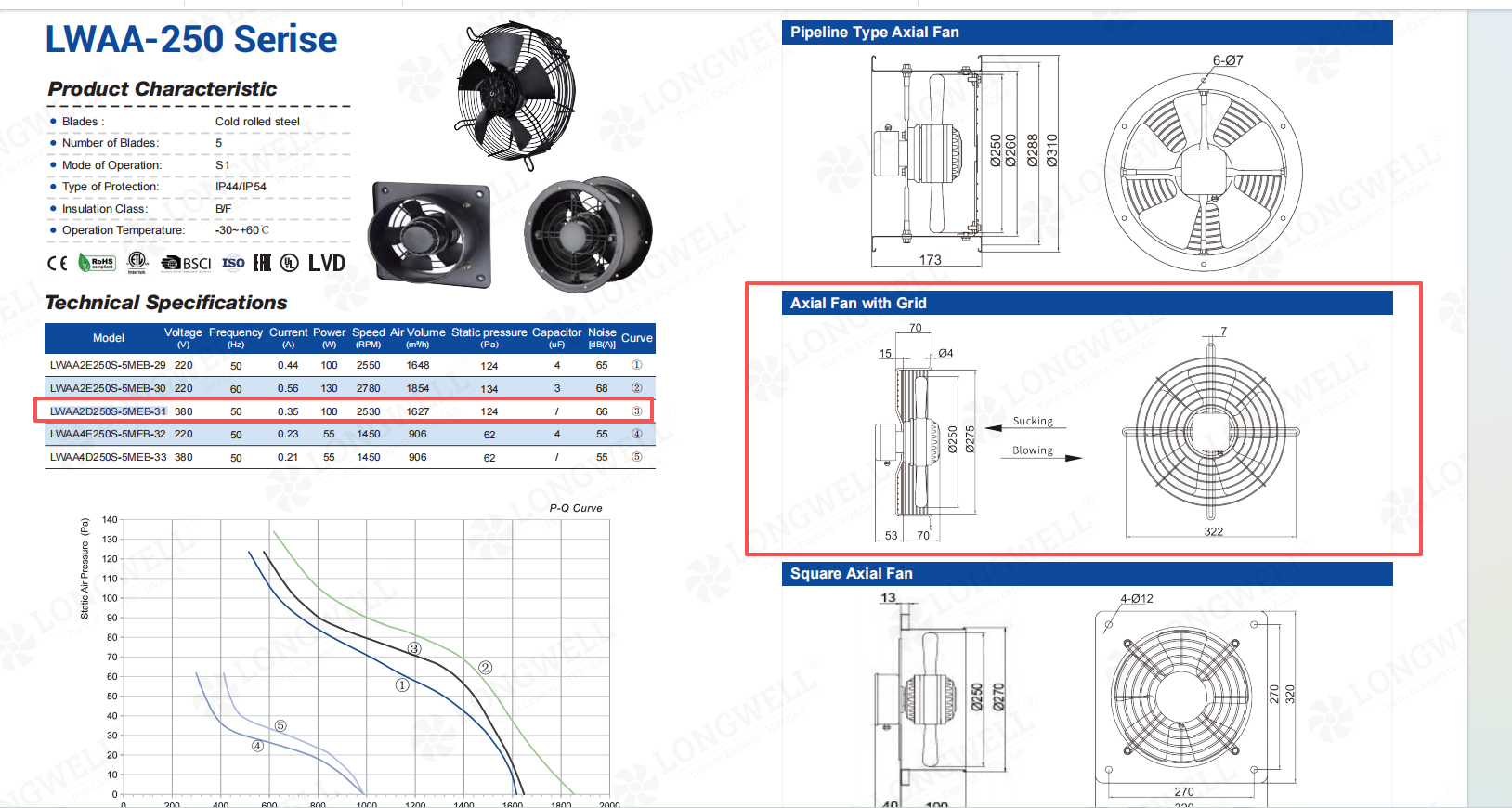
Finally, system integrators read this P-Q performance curve to match the static pressure capability to the heat exchanger.
Specifying a Fan for Heavy Equipment
If you need a hydraulic radiator cooling fan, focus on actual limits before choosing parts.
- Measure the real static pressure: First, understand that radiator fins create massive airflow blocks. Free-air CFM numbers drop sharply once you mount the fan. Therefore, provide the exact Pascal rating of your shroud.
- Verify your grid voltage tolerance: Next, check the real operating range. A 415 V grid does not always need a custom 415 V motor. Standard 380 V three-phase units often run safely up to 418 V. Consequently, you save time and skip custom engineering fees.
- Trade maximum temperature for longer life: Finally, respect the bearing limits. Pushing standard bearings to 65°C ruins the internal grease. Dropping your requirement to 60°C protects the parts. Instead, you secure a 30,000-hour lifespan without buying heavier bearings.
- Check your notified body requirements early: Furthermore, compliance takes time. We hold existing CE certifications from our local TUV NORD Notified Body. Consequently, using a pre-certified fan speeds up your final machine approval considerably.
Related: Axial Fans.
Engineering Questions
Technical Documentation & Resources
Browse our axial fans range, the AC axial fans section, or EC axial fans.
Have a Similar Fan Requirement?
Longwell’s engineering team delivers custom spec sheets and samples within 90 days. Since 1990, we have supplied EC fans and blowers to OEMs across HVAC, cold chain, data center, and industrial applications worldwide.
Browse Related Products:
🏆 ISO 9001 / ISO 14001 / ISO 45001 | CE (TÜV) | UL/ETL | ATEX Zone 21/22 | AMCA 210-16 / ISO 5801 tested