Requirements for an 8-Inch High-Speed Metal Exhaust Fan
A customer asked us to build a high-speed metal exhaust fan for a tight factory space. The new fan had to fit the old spot exactly. First, the open hole size was very strict. The square front panel could not pass 250 mm.
Next, the four bolt holes required a 205 mm spacing. This exact spacing allowed a fast drop-in fit. Furthermore, the rear parts faced strict space limits. The back tube goes deep into a wall duct.
That rear fan tube measured exactly 188 mm across. Meanwhile, the depth of the whole fan could not pass 158 mm. If the high-speed metal exhaust fan was deeper, it would hit the wall behind it. Even so, the site used a 220V power grid running at 50 Hz.
The customer provided a picture of their old fan. That old fan claimed a huge air volume of 1140 m3/h. It also ran at 2400 RPM using just 40 W. However, those old numbers only happen in empty open air.
Real factory ducts push back with high air pressure. Therefore, we knew the old design would fail under real pressure. So, the engineers set to work on a new plan. Finally, this new plan became model LWAA2E200S-7MKB-50.
Engineering the High-Speed Metal Exhaust Fan
We had to choose the best materials for this high-speed metal exhaust fan. First, we looked at three different ways to build the high-speed metal exhaust fan wheel. We thought about a standard plastic fan wheel. Plastic parts weigh very little and cost less to cast.
Furthermore, they put almost no stress on the motor bearings. However, we rejected plastic very fast. Factory air gets extremely hot during long shifts. Consequently, plastic fan blades warp over time.
When blades warp, the spinning fan shakes badly. In short, that shaking breaks the motor early. Instead, we picked a full metal frame. We designed a solid 7-blade metal fan wheel.
The thick metal fights heavy heat perfectly. Next, it does not bend under high air pressure. By contrast, this metal wheel added a lot of heavy weight. Heavy metal blades demand a stronger motor.
They also increased the raw metal cost. Even so, the customer wanted a fan that would never break. Therefore, we accepted the higher metal cost. Finally, the heavy metal choice gave the fan a long life.
Matching the Motor to the Metal Blades
Next, we solved the power problem. The old fan used a weak 40 W motor spinning at 2400 RPM. A 40 W motor cannot spin a heavy metal wheel against duct pressure. If you try, the motor slows down and gets hot.
Therefore, we upgraded the whole motor block. We picked a strong 45 W motor base. Furthermore, we wrapped the inner parts with pure copper wire. Pure copper carries power much better than cheap aluminum.
Copper also stays much cooler when the fan runs all day long. Next, we changed the motor speed. We lowered the target speed from 2400 RPM down to 2200 RPM. A slower speed might seem bad at first glance.
However, a slower and stronger motor pushes more real air. We test fan output to exact AMCA 210-16 rules. In short, the final tests proved our engineering idea. The new 45 W motor moves a steady 650 m3/h of air. It does this easily through the tight 188 mm rear duct.
Meeting Strict Safety Rules
Finally, the customer needed to sell their machines in North America. This meant the fan required strict ETL safety marks. ETL rules are very tough on wire heat limits. First, the inner wires must never melt.
So, we added thick safety wrap to the power lines. Next, we gave the fan exactly 250 mm of bare wire leads. This length lets the factory workers connect the fan safely. They do not have to stretch the short wires.
Furthermore, the pure copper motor helped us pass the ETL tests. A hot motor fails safety checks very quickly. By contrast, our 45 W copper design stays well below the heat limit. Even so, the copper added more money to the price.
The shipping weight also went up slightly. However, these trade-offs resulted in a totally safe unit. The LWAA2E200S-7MKB-50 matches the 250 mm panel size perfectly. It bolts right into the existing 205 mm holes. In short, it is a perfect and safe drop-in part.
Technical Specifications
This table shows the exact numbers for the new fan design. We pulled these facts straight from the official engineering file.
| Parameter | Value |
|---|---|
| Model Number | LWAA2E200S-7MKB-50 |
| Voltage | 220 V |
| Frequency | 50 Hz |
| Air Volume | 650 m3/h |
| Input Power | 45 W |
| Speed | 2200 RPM |
| Dimensions (Panel) | 250 x 250 mm |
| Hole Spacing | 205 x 205 mm |
| Duct Diameter | 188 mm |
| Depth | 158 mm |
| Line Length | 250 mm (without plug) |
| Color | Black |
These rows show the exact physical size and power limits. The 45 W power draw tells engineers how to size their breakers. Meanwhile, the 205 mm hole spacing proves the unit will fit the wall perfectly. Finally, the 188 mm duct size ensures smooth air flow into the pipe.
Reference: IEC 60529 covers the test method behind these figures.
Technical Documentation
Engineering File for LWAA2E200S-7MKB-50
This PDF document shows every detail of the fan body. Engineers can use this file to see the 250 mm square panel. It also shows the strict 158 mm depth limit.
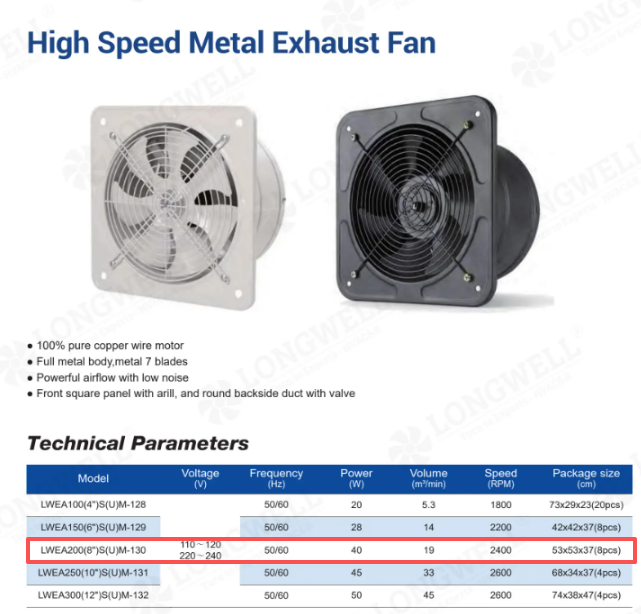
This image file shows the customer’s very first request. It lists the old 2400 RPM target that we later changed to build a safer system.
How to Source an Industrial Axial Fan
If you are looking for a high-speed metal exhaust fan, read these tips. Buying the wrong fan can cause your machines to overheat. Follow these simple steps to get a safe, working fan on the first try.
- First, measure your true duct opening. Do not just look at the big front square panel. The rear fan tube must fit inside your wall pipe. Our fan has a 188 mm tube to fit a common 8-inch pipe.
- Next, ignore open-air volume numbers. Many cheap fans boast huge free-air scores. But your factory duct will block that air. Instead, ask the fan maker how much air flows under pressure.
- Then, check your exact power grid. A fan wound for both 50 Hz and 60 Hz often runs poorly. A dedicated 50 Hz motor saves power. We made this fan run purely on a 220 V, 50 Hz line.
- Finally, tell the maker about your safety rules early. ETL or UL 507 rules change how we build the fan. We must use better wires, like our 250 mm bare leads. Knowing this rule up front saves weeks of design time.
Related: Exhaust Fans.
Common Questions About This Project
Technical Documentation & Resources
Browse our duct fans range, the inline duct fans section, or mixed flow fans.
Have a Similar Fan Requirement?
Longwell’s engineering team delivers custom spec sheets and samples within 90 days. Since 1990, we have supplied EC fans and blowers to OEMs across HVAC, cold chain, data center, and industrial applications worldwide.
Browse Related Products:
🏆 ISO 9001 / ISO 14001 / ISO 45001 | CE (TÜV) | UL/ETL | ATEX Zone 21/22 | AMCA 210-16 / ISO 5801 tested