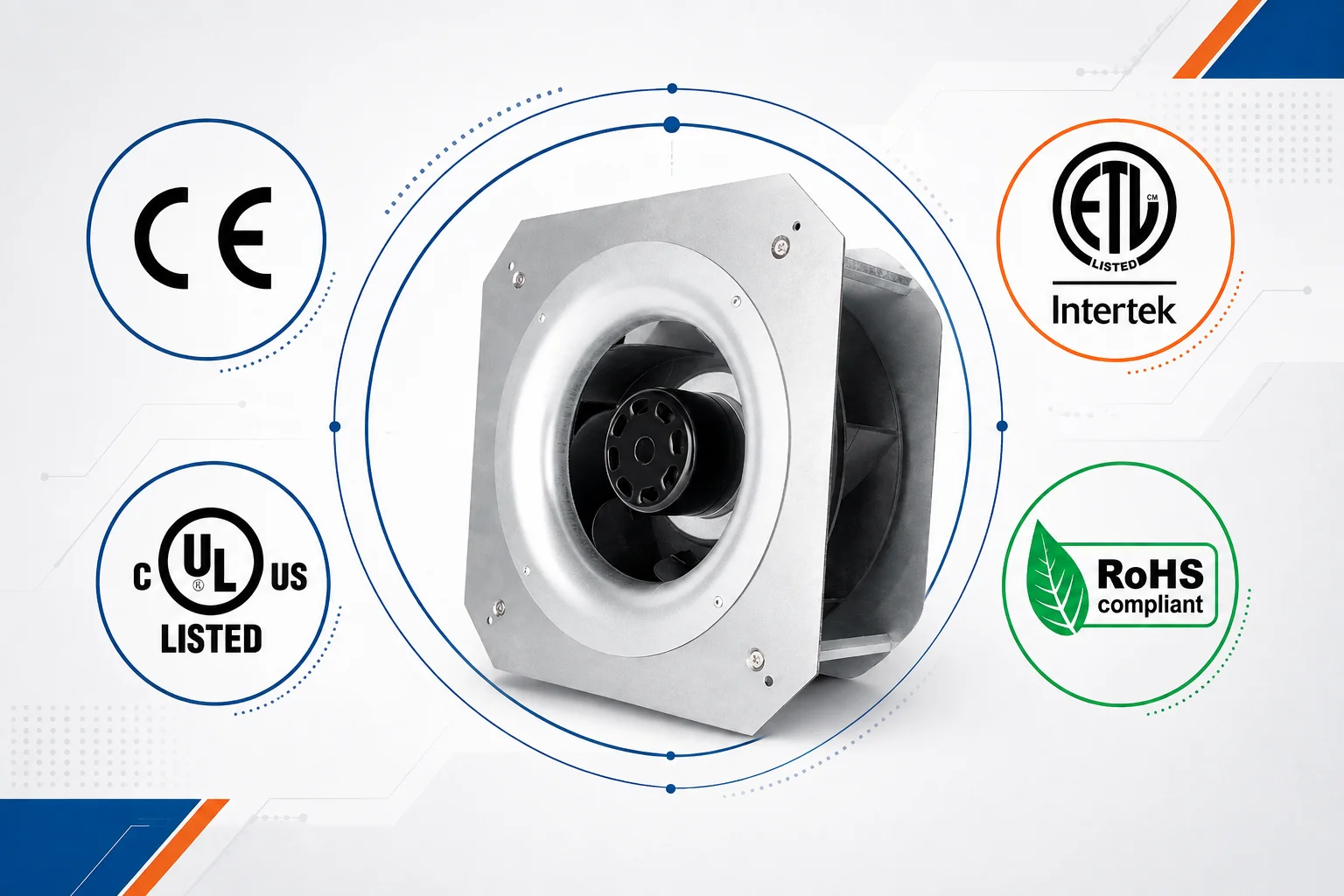
Performance specifications like airflow, static pressure, and noise level tell you whether a ventilation fan is capable of operating in the specific environment. But fan certifications tell you whether that fan is permitted to be sold or operated in your target market. CE, UL, ETL, and RoHS are commonly seen in ventilation fan technical documents, but they do not represent the same type of requirement. Some focus on product safety and conformity, while others address electrical standards or restricted substances. This guide explains what CE, UL, ETL, and RoHS mean in the industry of ventilation fans, how they differ, and the benefits of purchasing certified ventilation fans for importers, distributors, and project contractors.
Industry Certification
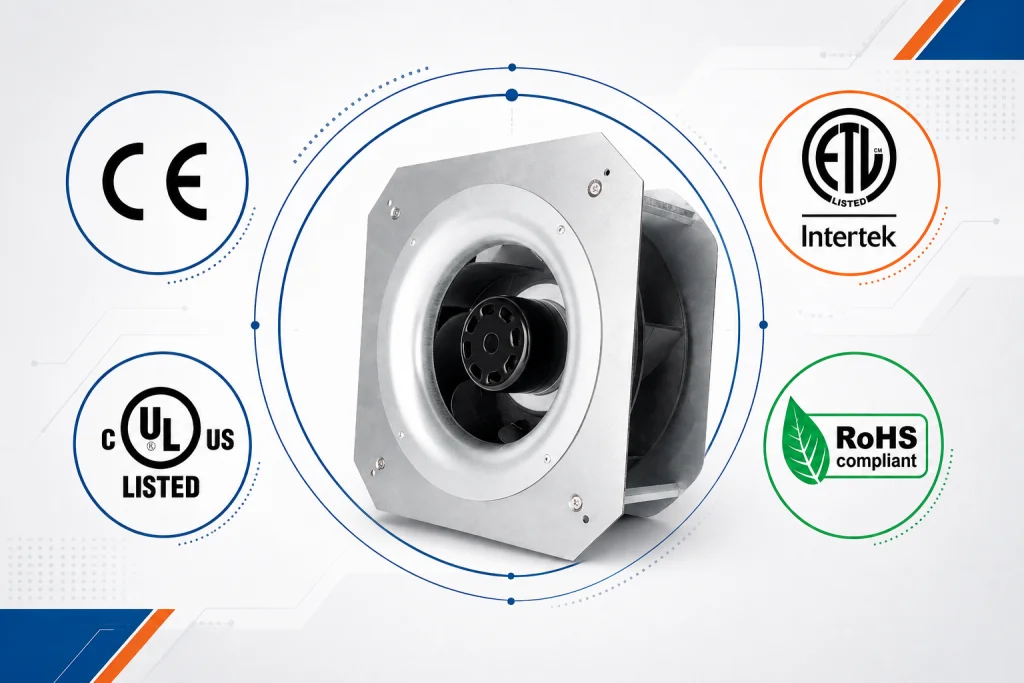
Ventilation fans’ certification covers more than performance. Compliance may involve electrical safety, motor insulation, electromagnetic compatibility, and material restrictions. A fan sold as a complete product may also face different certification requirements when served as a component integrated into HVAC systems. The commonly used certifications have different purposes. CE relates to compliance with applicable EU requirements. UL and ETL are used for product safety evaluation in North America. RoHS focuses on restricting hazardous substances in electrical and electronic equipment (EEE).
What is CE Mark on Products?
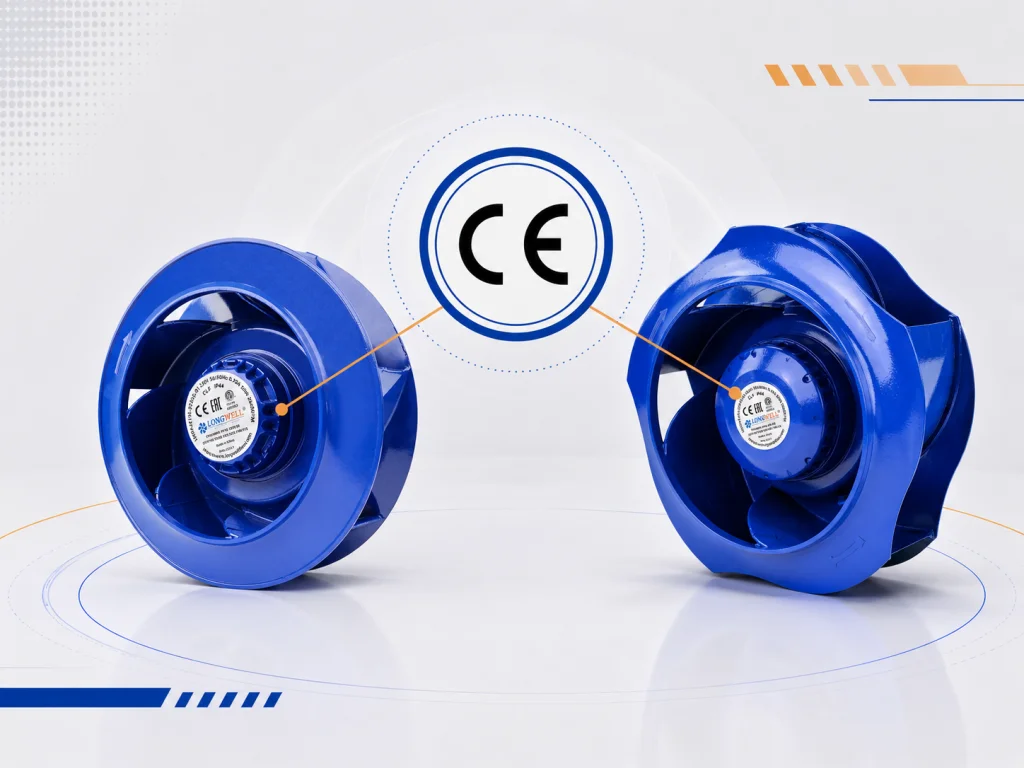
The CE mark is a conformity marking used on certain products sold in the European Economic Area (EEA). CE marking is mandatory only for product categories covered by specific harmonized EU legislation. By replacing the CE mark on the ventilation fans, the manufacturer declares that their products meet all applicable EU requirements.
CE marking should not be understood as a product approval issued by the EU or as a conventional third-party certification. In most cases, the manufacturer is responsible for identifying the applicable EU requirements, carrying out the required conformity assessment, preparing technical documentation, and issuing an EU Declaration of Conformity. A Notified Body is involved only where the applicable legislation requires third-party assessment.
For ventilation fan manufacturers and OEM buyers, a CE mark indicates that the product has been assessed against the EU requirements applicable to that particular fan and configuration.
CE Mark Countries
The CE Mark is mandatory for the 27 EU Member States, as well as Iceland, Liechtenstein, and Norway. The requirement applies based on where the product is sold, so ventilation fans produced outside Europe may still need CE marking before entering the EEA market.
Outside the EEA, the situation varies. Turkey has implemented many EU CE-marking requirements and requires the mark for many covered product categories. Switzerland is not part of the EEA but accepts CE marking for certain products under its own regulatory framework. Therefore, OEM buyers should confirm the specific requirements of the destination country rather than assuming that one CE mark provides automatic market access worldwide. After Brexit, the UK introduced its own certification mark, UKCA (UK Certification and Assessment). It replaced the CE mark used in the UK regions. However, in UK, the CE marking is still recognized indefinitely for many products.
UL Certified Meaning
Underwriters Laboratories, also known as UL, is the agency for electronic safety and certification worldwide. UL certification indicates that a ventilation fan has been evaluated against applicable safety standards. It is generally voluntary and widely used in the US electrical product market.
Product certification confirms that the tested product meets the requirements of the relevant standard, helping demonstrate compliance and reduce safety risks. For electrical products like ventilation fans, UL standards primarily address fire and electric shock hazards.
UL Listing vs UL Recognition vs UL Classified
UL uses different certification designations depending on ventilation fans’ applications and the scope of evaluation. For ventilation fan buyers, the key question is to know which UL designation applies, which standard it was evaluated against, and the certification scope.
UL certification can also take different forms depending on how the product is used. UL Listing generally applies to an end product, while UL Recognition is intended for components that will be incorporated into a larger product or system. UL Classified means UL has evaluated a product only for certain properties, hazards, applications, or specified conditions rather than for its complete end-use. Buyers should therefore check the exact classification scope.
ETL Certification Definition
An ETL certification means Intertek has tested and certified the product to the applicable safety standards for the US and Canadian markets. These evaluations typically address risks such as electric shock, overheating, and fire associated with motors, wiring, and other electrical components. The ETL mark is also be seen ad cETLus mark. When ‘c’ indicates certification for Canada, and ‘us’ indicates certification for the United States. For the OEM targeting North America, buyers should check not only for the ETL mark but also the certified model, applicable standard, and market scope.
ETL vs UL
ETL and UL both provide third-party product safety certification for the North American market. The main difference between them is the certification organization and mark. Intertek can evaluate products against applicable UL, ANSI, or CSA. This means that the ETL-certified ventilation fans can be tested according to the same safety standards as the UL-certified products. UL also notes that products may be certified by a third-party organization using UL Standards for safety. Generally, ETL and UL are regarded as being completely equivalent in terms of certification.
RoHS Compliance Certificate
RoHS limits the use of certain hazardous substances like lead and mercury in electrical and electronic equipment entering the EU. The materials used in motors, control boards, wiring, connectors, or solder will be checked. The core requirement is based on Directive 2011/65/EU, with Directive (EU) 2015/863 adding four phthalates to the restricted-substance list.
RoHS is also connected with the CE mark. RoHS requirements are one of the conditions under which the CE marking must be indicated on certain products. However, a CE marking alone does not automatically mean proof of RoHS compliance.
RoHS vs REACH
RoHS and REACH both regulate hazardous substances in the EU. However, their scope and compliance requirements are different. RoHS focuses on electrical and electronic equipment. REACH is much broader and applies to chemical substances used across nearly all types of products placed on the EU market.
A ventilation fan may need to satisfy both RoHS for EEE and REACH for substances requirements. When preparing a ventilation fan for the EU market, these two compliance requirements should be reviewed separately.
CE vs UL vs ETL vs RoHS: What Is the Difference?
| Difference | CE | UL | ETL | RoHS |
| What It Is | EU conformity marking | Third-party product safety certification by UL Solutions | Third-party product safety certification by Intertek | Hazardous substance compliance requirement |
| Main Market | EU / EEA | U.S. and Canada | U.S. and Canada | EU, with similar requirements adopted in other markets |
| Main Purpose | Shows conformity with applicable EU legislation | Evaluates product safety against applicable standards | Evaluates product safety against applicable standards | Restricts hazardous substances in electrical and electronic equipment |
| Main Focus | May include electrical safety, EMC, environmental and other applicable requirements | Electrical, fire, mechanical and other safety risks | Electrical, fire, mechanical and other safety risks | Materials and restricted substances |
For ventilation fan buyers, the main differences between these certifications are their purpose, target market, assessment method, and compliance scope. A ventilation fan includes more than an impeller and housing. Its motor, wiring, insulation system, controller, PCB, connectors, cables, and other electrical or material components may all fall within the scope of different safety or environmental requirements.
Ventilation fans used in HVAC units, AHUs, heat pumps, and electrical cabinets have different integration requirements and destination markets. For example, an EC centrifugal fan intended for an AHU in Europe may need to satisfy applicable CE mark requirements as well as RoHS restrictions. The same fan platform supplied for a North American HVAC project may instead require a UL or ETL certification appropriate to its intended use. If the ventilation fan is supplied only as an OEM component, the relevant certification type and integration requirements may also differ.
Benefits of Choosing Certificated Ventilation Fans
Electrical Safety Verification
When integrated into the system, the ventilation may need to operate for thousands of hours under loads. Safety certifications of UL and ETL provide independent evaluation against applicable standards, covering relevant electrical and fire-related risks. This gives additional evidence that the fan’s electrical design has been assessed for its intended use.
Lower OEM Integration Risk
For OEM projects, the fan is often only one component of a larger AHU, heat pump, air purifier, or industrial ventilation system. Using a fan with suitable certification documentation can make it easier for engineers to confirm whether the motor, wiring, voltage, and product configuration match the compliance requirements of the final equipment.
Better Traceability
Certification records, test reports, declarations, wiring diagrams, and product specifications give a clearer basis for compliance review. They can also help purchasing and engineering teams verify the exact fan configuration before production or installation.
LONGWELL – Ventilation Fan Certification Support for OEM Projects
LONGWELL maintains certification and compliance documentation for ventilation fans supplied to European and North American projects. Buyers can review LONGWELL certifications and declarations for CE marking, ETL Listed certification, RoHS compliance, REACH, and other applicable product requirements.
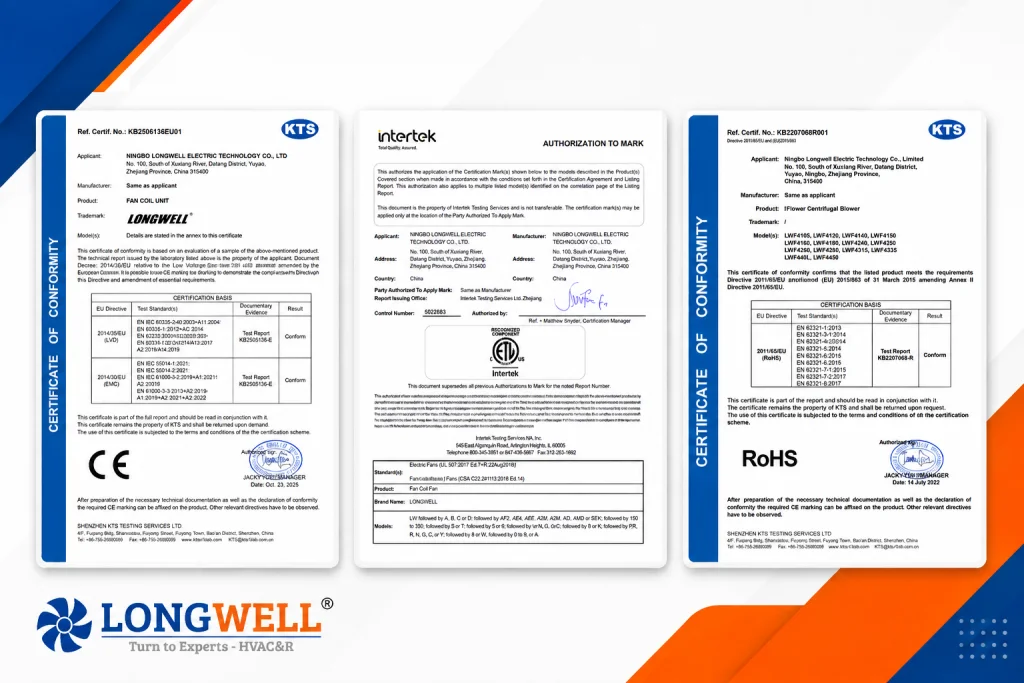
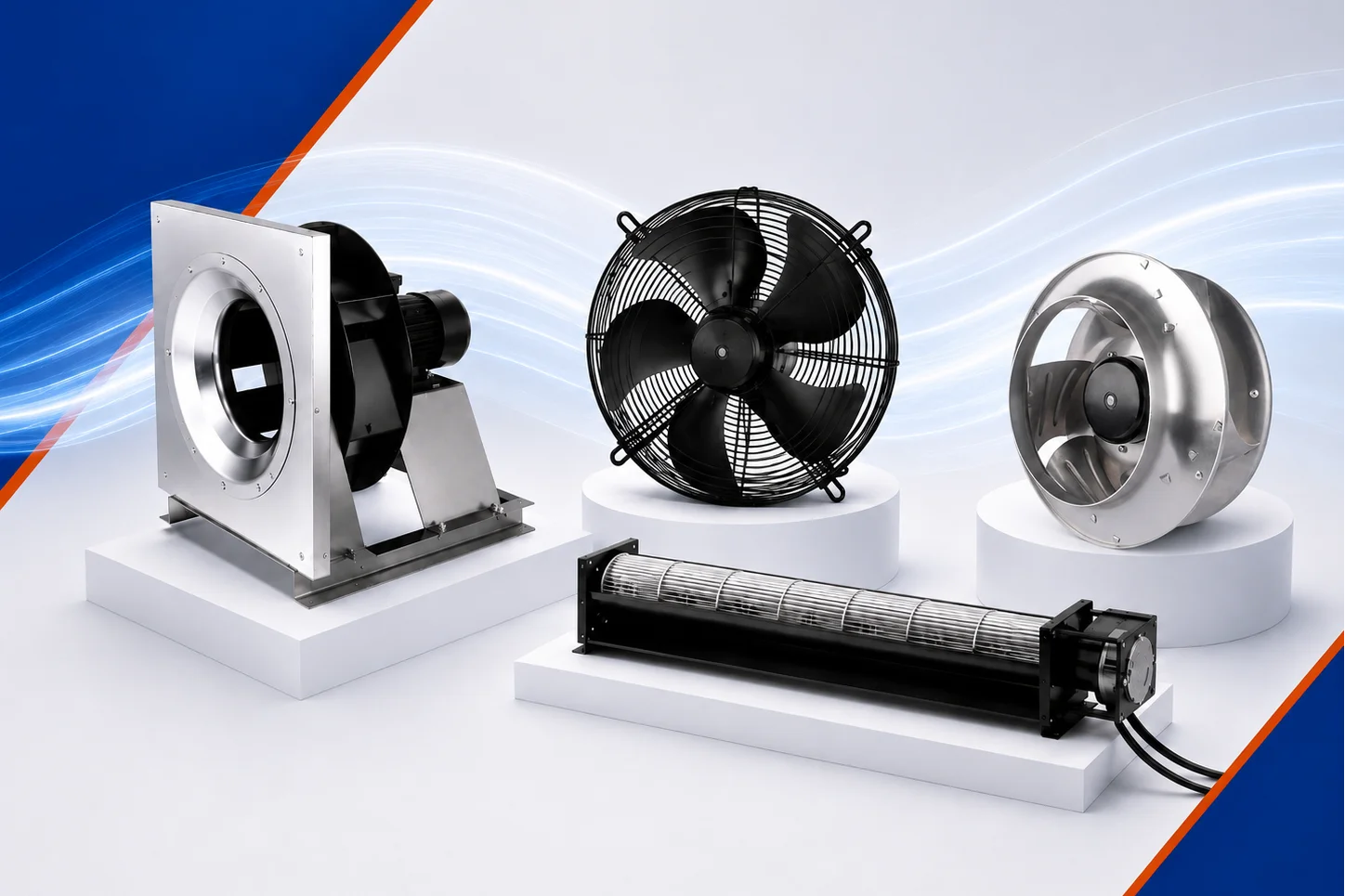
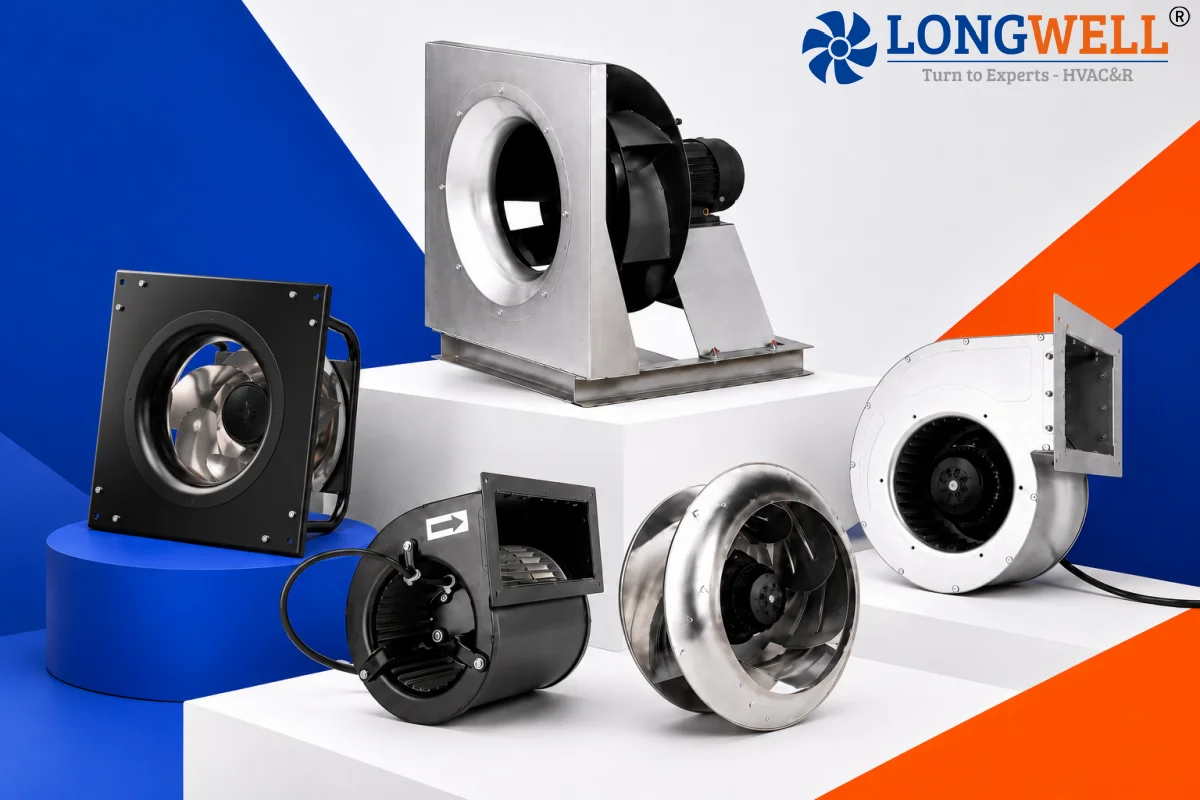
For the North American market, LONGWELL’s fan range is ETL certified by Intertek and tested according to UL 507 standards. The certification scope includes EC and AC backward-curved fans, cross-flow fans, centrifugal blowers, axial fans, duct fans, motorized impellers, customized HVAC fans, and ventilation modules.
For projects that require a specific certification or market configuration, contact LONGWELL with the target market, fan type, electrical specification, and application requirements so the appropriate ventilation fan solution can be evaluated.
FAQ
Are CE and RoHS mandatory for ventilation fans sold in the EU?
Yes. CE marking is mandatory only for products covered by EU rules that require it. RoHS applies to electrical and electronic equipment within its scope unless a specific exclusion or exemption applies.
Which is better, ETL or UL certification?
There is no clear comparison result. UL LLC and Intertek are both OSHA-recognized Nationally Recognized Testing Laboratories in the United States. Each can certify products within its recognized scope against applicable product safety standards.
Does CE marking prove RoHS compliance?
No. Not by the CE mark alone. For electrical and electronic equipment that falls within the RoHS Directive, RoHS compliance forms part of the EU conformity requirements and is associated with CE marking.