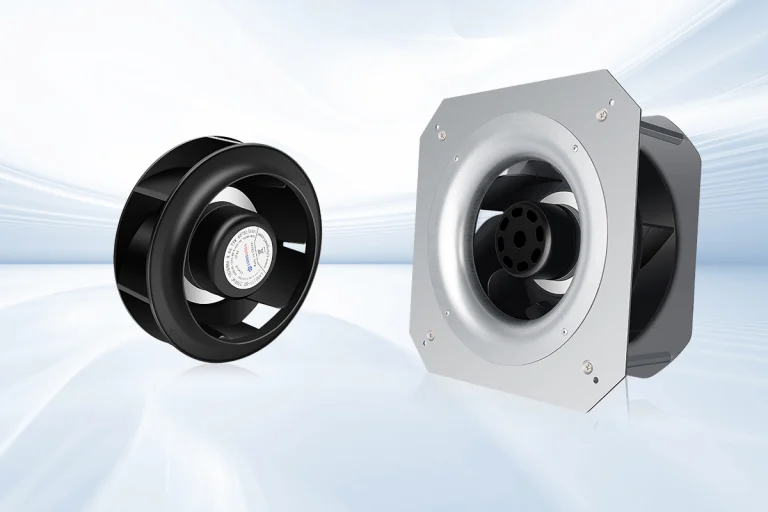
In HVAC and industrial ventilation systems, centrifugal fans are widely used. The impeller, as the core component of centrifugal fans, plays a critical role in determining the performance efficiency. The slight differences among blades on the impeller will influence key factors such as airflow volume, static pressure capability, noise level, and energy efficiency. In this blog, we separate the centrifugal fans according to their blade geometry and blade construction. We also introduce the impeller design influences and LONGWELL main centrifugal fan specs.
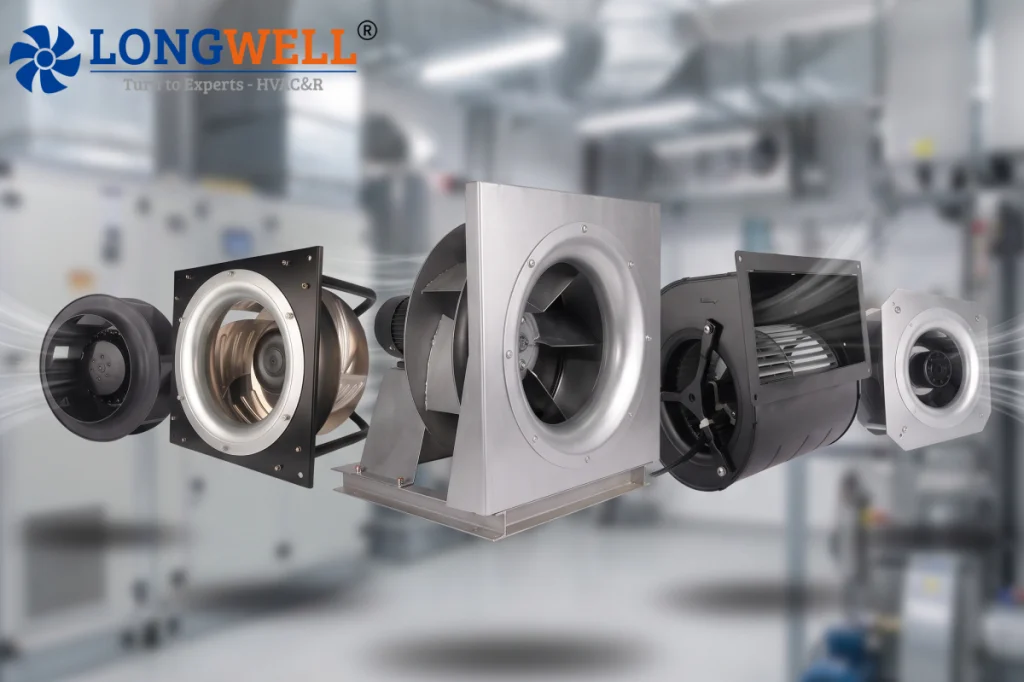
What is a Centrifugal Fan?
A centrifugal fan draws the air through the impeller and discharges it at 90 degrees. The impeller converts mechanical energy from the motor into airflow energy, increasing both air velocity and static pressure. Engineers usually choose to use centrifugal fan when high static pressure applications are required.
The key components of a centrifugal fan are: motor, impeller, housing, air inlet, and air outlet. Among them, the impeller can determine the centrifugal fan’s performance characteristics. For a more comprehensive centrifugal fan guide, please refer to our blog: What Are Centrifugal Fans? A Complete Beginner’s Guide.
Blade Geometry
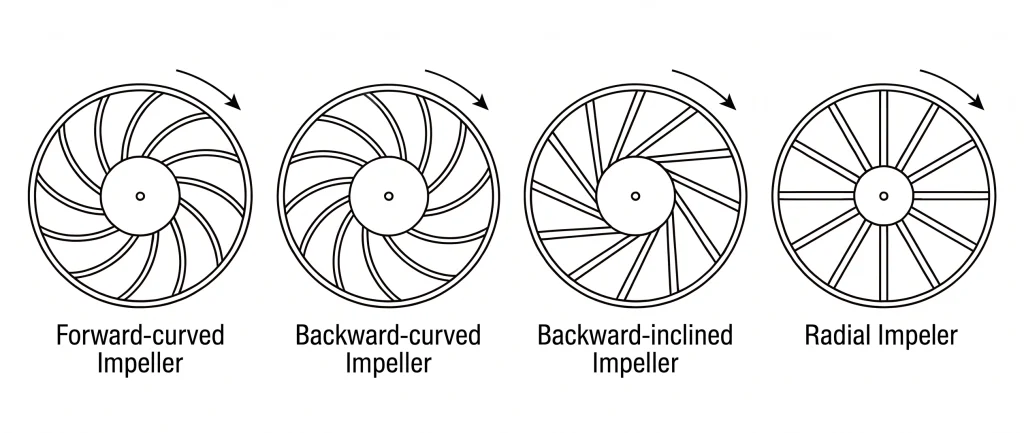
The performance and application of a centrifugal fan are fundamentally dictated by the geometry of its blades. The blade shape determines how the air is accelerated and the resulting static pressure characteristics. According to the classification of blade geometry, there are four types.
Forward-curved Impeller
Forward-curved blades are designed with blade tips curved in the direction of impeller rotation.
This geometry allows the impeller to move a large volume of air at relatively low rotational speeds. They are typically used in low-static pressure, high-airflow applications, providing a compact solution for moving large volumes of air. It is well-suited in HVAC, AHU, and compact data center heat dissipation.
Backward-curved Impeller
Backward-curved blades are curved opposite to the direction of impeller rotation. This design reduces airflow turbulence, allowing the fan to operate with lower energy consumption. The major advantage of backward-curved impellers is their non-overloading power characteristic. It means that the motor will not overload as airflow resistance suddenly decreases. This type is suitable for ventilation systems.
Backward-inclined Impeller
The main difference between backward-inclined blades and backward-curved blades is that the blades of backward-inclined blades are flat. The backward-inclined impellers are improved in durability and are usually used for commercial HVAC and industrial exhaust systems.
Radial Impeller
The blades are straight and perpendicular to the axis. Radial blades extend outward from the impeller hub in a radial direction. The airflow exists along the radial direction. Because of their straight-blade construction, they are the most suitable type for handling high dust or sticky air streams. Their blades are less prone to buildup of materials. Although radial blade impellers generally have lower efficiency, they are preferred in applications that place more emphasis on durability and reliability.
Key Features
| Types | Efficiency | Pressure Capability | Typical Application |
| Forward Curved | Medium | Low–Medium | HVAC, AHU, ventilation, compact systems |
| Backward Curved | High | Medium–High | HVAC air handling systems, ventilation, energy-efficient applications |
| Backward Inclined | High | Medium–High | Commercial HVAC, industrial dust collection and exhaust system |
| Radial | Medium | High | Industrial applications |
Blade Construction
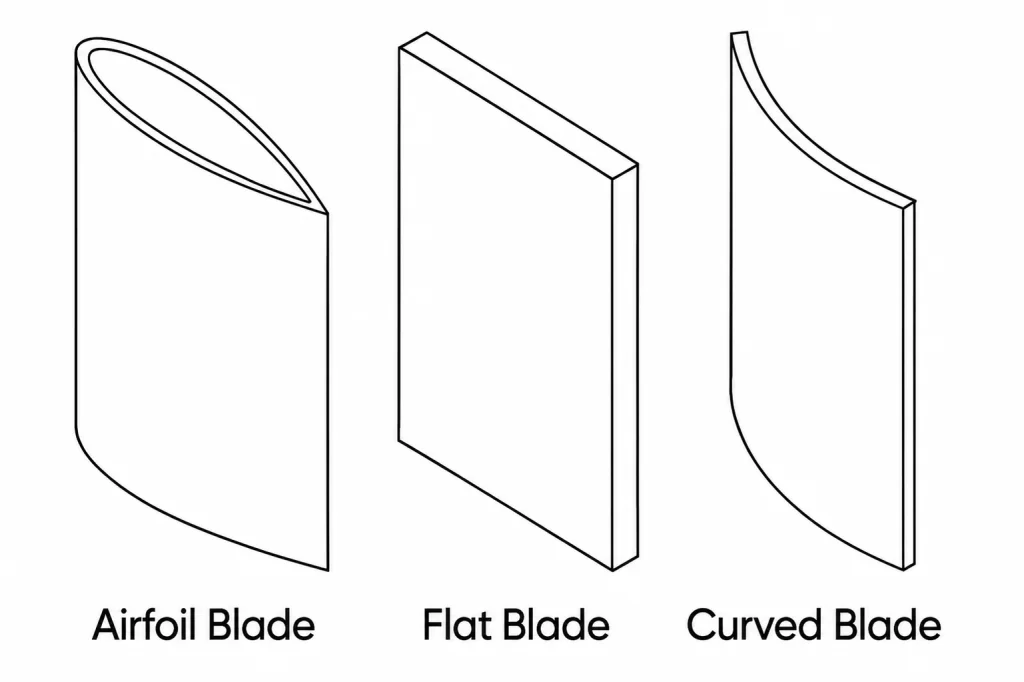
The blade construction of a centrifugal fan significantly affects fans’ operating efficiency and noise generation. Based on blade cross-sectional design and structural shape, centrifugal fan impellers can generally be classified into three types: airfoil blades, flat blades, and curved blades.
Airfoil Blade Impeller
This type of centrifugal fan adopts a backward-curved blade structure. The cross-section of the airfoil blade is similar to an aircraft wing. Compared to a single solid plate of common backward-curved blades, the airfoil blades have a hollow shape. This kind of blade is a more aerodynamic improvement. They allow air to flow along the blade shape, significantly reducing turbulence. As a result, the airfoil blade will generate a lower noise level.
Flat Blade Impeller
Flat blades use a simple and straight plate design. This construction is easier to manufacture and more economical. Compared to airfoil impellers, they have lower efficiency and higher turbulence. However, in industrial applications, the cost-effectiveness and stability are priorities. The flat blade impellers are more suitable for dealing with heavy-dust airflow. Their straightforward design allows them to withstand high mechanical stress without compromising the structural integrity of the impeller.
Curved Blade Impeller
These blades feature a single-thickness curved profile. They are a form of lies between flat blades and airfoil blades. Depending on the curvature direction, curved blades can be classified as forward-curved or backward-curved configurations. The curved blades help guide the air stream more effectively than a flat surface. This feature leads to better performance and higher efficiency than flat blade impellers. They offer a balance between performance and durability, making them a better choice for ventilation applications.
Key Features
| Types | Efficiency | Manufacture Cost | Typical Application |
| Airfoil Blade Impeller | Higher | Higher | High-efficiency HVAC, AHU |
| Flat Blade Impeller | Medium | Lower | Industrial ventilation |
| Curved Blade Impeller | Medium-High | Medium | General ventilation |
How Impeller Design Affects Centrifugal Fan Performance
Airflow Volume
The geometry of the impeller blades directly affects the air volume a centrifugal fan can move. Blade angle and curvature influence how effectively the impeller transfers motor energy to the airflow.
Forward-curved impellers typically generate higher airflow within a compact design. They are generally more suitable for low- to medium-pressure applications.
Backward-curved impellers are designed to provide a stronger and more controlled airflow path, making them suitable for applications that require stable airflow performance.
Static Pressure Capability
The static pressure generation determines the centrifugal fan’s effectiveness against the system resistance.
The forward-curved design increases air velocity, but lose more kinetic energy as turbulence. However, the backward-curved and backward-inclined impellers are widely used in higher static pressure applications. It is because their blade geometry enables airflow leaves the impeller with lower velocity but higher pressure recovery. Compared with forward-curved designs, backward-curved impellers typically provide a more stable pressure curve.
Noise Level
The mechanical sound is mainly caused by the interaction between the blade and airflow. Turbulent airflow, unstable flow separation, and excessive blade can increase noise levels.
A smooth blade design, such as airfoil blades, reduces turbulence, resulting in quieter operation. Furthermore, when a fan operates near its Best Efficiency Point, aerodynamic losses are minimized. This helps reduce noise generation while improving energy efficiency and system performance.
Energy Efficiency
The centrifugal fan’s overall energy efficiency mostly depends on the impeller design. An efficient blade design and proper blade quantity reduce airflow losses caused by turbulence and friction losses.
Airfoil blades are designed similar to the shape of an aircraft wing that allows air to pass through the impeller more smoothly. By reducing turbulence, flow separation, and aerodynamic losses, this design improves energy conversion efficiency. These factors enable centrifugal fans to deliver higher performance with lower power consumption. Due to these characteristics, backward-curved airfoil impellers are commonly used for HVAC and industrial ventilation systems that require high efficiency.
Select LONGWELL Centrifugal Fans for Your Application
LONGWELL centrifugal fan series features strong power, high static pressure, and long durability. They are suitable for long-distance or high-resistance environments. Their high efficiency and low maintenance requirements have made them the leading position in the industry. LONGWELL has several centrifugal fan series, all the fans can be equipped with AC/DC/EC motor.
Backward-curved Centrifugal Fan: LWBE Series
Backward-curved centrifugal fan is one of LONGWELL’s key products. This series uses a bio-mimetic blade profile, which improves the fans’ efficiency. They include the impeller diameter parameter from 133mm to 450mm. The key feature of this series is the higher efficiency. The highest air volume can reach to 8652m³/h with 1391Pa static pressure.
Forward-curved Centrifugal Fan: LWFE Series
This model covers impeller diameters ranging from 108mm to 355mm. The air pressure can reach 1102Pa, which is a double-inlet forward-curved centrifugal fan. It can generate 8799m³/h airflow. For a single-inlet forward- curved centrifugal fan, the generated air flow is 1759m³/h with 422Pa air pressure.
Airfoil Impeller Centrifugal Fan: RLM series
RLM series uses backward-curved airfoil blades. As they are non-volute centrifugal fans, they are more suitable for higher efficiency and lower noise applications. Among other types of centrifugal fans, they can keep the noise level lower with efficient airflow. From the LONGWELL cases, they are commonly used in AHU, CRAH, and RTU.
LONGWELL is a powerful technical research and development team that provides tailored service. Our technical team will conduct a detailed analysis of the fan selection based on the customer’s requirements and specific application scenarios. They will take into account factors such as airflow rate, pressure demand, noise control, and energy consumption optimization to ensure the most suitable solution.
FAQs
How does the design of the blades affect the centrifugal fan performance?
The blade angle and curvature determine the effectiveness of the impeller. For instance, the backward-curved impeller can provide higher efficiency and more stable performance. The forward-curved centrifugal fan is designed to deliver high airflow in compact applications.
What are the advantages of using backward-curved blades?
The important advantage of a backward-curved centrifugal fan is its non-overloading characteristic. The power consumption will not significantly increase as airflow increases. Their blade geometry allows the impeller to convert motor power into airflow more effectively, reducing aerodynamic losses during operation.
What kind of material is best for a centrifugal fan impeller?
The best material for a centrifugal fan depends on the system requirements. Commonly used materials are metal and plastic. For industrial use, thick-walled carbon steel or high-strength stainless steel are common materials. Plastic centrifugal fans are often used in small ventilation equipment.
Are backward-curved centrifugal fans more efficient?
A backward-curved centrifugal fan has a commonly higher efficiency. However, whether to use this type of fan needs a comprehensive assessment. The wrong use of a fan will bring a relatively low efficiency.