
Portable and Confined-Space Ventilation Fans
Manholes, tanks, vaults, ship holds, tunnels under construction and crawl spaces can hold stale air, fumes, vapours or too little oxygen. A portable ventilation fan with flexible ducting pushes fresh air into the space or pulls contaminated air out, before and during work. The same fans clear welding fumes, dry out wet areas and cool hot work zones on construction sites.
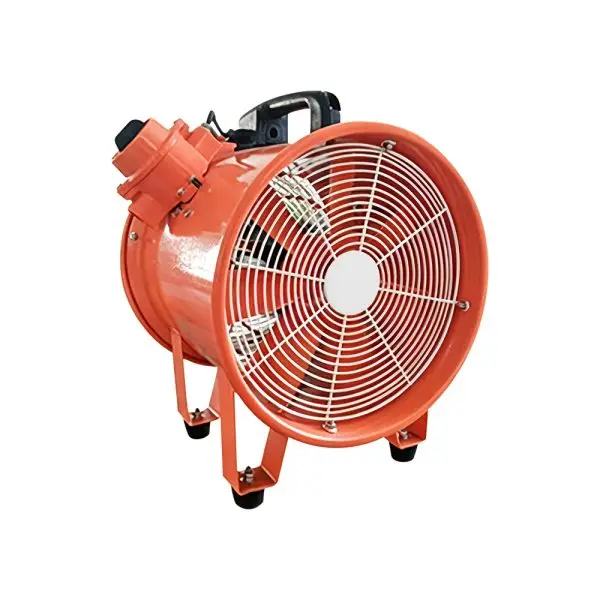
LONGWELL’s LWSFP portable axial fans are carried by one person, run from a standard supply, and connect to flexible duct. The LWSFP-EX version is built for areas where flammable vapours may be present.
Supply or exhaust?
| Mode | How it works | Use when |
|---|---|---|
| Supply (blowing) | Fan outside, duct runs into the space, fresh air pushed to the work point | Providing breathing air to workers; diluting contaminants throughout the space |
| Exhaust (extraction) | Duct pulls air from the contamination source to outside | Removing welding fumes, solvent vapours or dust at the source |
| Push-pull | One fan supplies, another extracts | Long tanks, tunnels and large holds |
How to size a portable ventilation fan
1. Space volume and air changes
Estimate the space volume and the air changes per hour required by your site procedure. The fan must deliver that airflow through the duct you will use.
2. Duct length and bends
Every metre of flexible duct and every bend reduces airflow. For long runs, choose a model with higher static pressure, keep ducts as straight as possible and avoid kinks.
3. Place the intake in clean air
Keep the supply fan’s intake away from engine exhausts, generators and the space’s own exhaust.
4. Flammable atmospheres
If flammable gases or vapours may be present, use an explosion-proof fan that matches the site’s hazardous-area requirement.
LWSFP portable axial fans
| Model | Blade diameter | Duct inner diameter | Airflow | Static pressure | Speed | Power |
|---|---|---|---|---|---|---|
| LWSFP-2A | 190 mm | 210 mm | 1,500–2,100 m³/h | 250–420 Pa | 2,800 r/min | 0.15 kW |
| LWSFP-2.5A | 240 mm | 261 mm | 2,700–3,300 m³/h | 300–450 Pa | 2,800 r/min | 0.25 kW |
| LWSFP-3A | 290 mm | 306 mm | 3,300–3,720 m³/h | 350–500 Pa | 2,800 r/min | 0.37 kW |
| LWSFP-3.5A | 340 mm | 364 mm | 4,840–5,840 m³/h | 550–600 Pa | 2,800 r/min | 0.55 kW |
| LWSFP-4A | 390 mm | 406 mm | 5,860–6,840 m³/h | 750–800 Pa | 2,800 r/min | 0.90 kW |
| LWSFP-5A | 490 mm | 507 mm | 6,800–10,000 m³/h | 185–200 Pa | 1,450 r/min | 0.75 kW |
50/60 Hz. All-copper motor, seven cast aluminium-alloy blades, thickened steel casing, carry handle and rubber anti-vibration feet. The explosion-proof LWSFP-EX has the same sizes and adds an explosion-proof switch and motor. For larger open sites, LONGWELL also offers mobile industrial axial blowers and drum fans.
Product pages: LWSFP portable fan · LWSFP-EX explosion-proof portable fan · Browse: industrial axial blowers
Where these fans are used
- Sewer manholes, utility vaults and cable pits
- Storage tanks, silos and ship holds during cleaning, inspection and painting
- Tunnels and basements under construction
- Welding and grinding in enclosed areas
- Drying and airing after water damage
- Emergency and maintenance crews’ equipment fleets
What to include in your enquiry
- Type and size of space; supply, exhaust or both
- Duct length and diameter you plan to use
- Whether flammable vapours may be present
- Voltage, frequency, plug type
- Quantity; duct and accessories needed
Ask about portable ventilation →
FAQ
How do I ventilate a confined space?
Supply fresh air with a portable fan and flexible duct, or extract contaminated air at its source, and keep ventilating while people are inside. Test the atmosphere and follow your site’s confined-space entry procedure.
How much does duct length reduce airflow?
It depends on duct diameter, length and bends. Longer and narrower ducts lose more. Choose a fan with enough static pressure for the duct you will use; the LWSFP-4A, for example, is rated at 750–800 Pa.
Do I need an explosion-proof portable fan?
If flammable gases or vapours may be present, yes. Use the LWSFP-EX or another fan that meets the site’s hazardous-area requirement.
What duct size fits the LWSFP fans?
The duct inner diameter ranges from 210 mm (LWSFP-2A) to 507 mm (LWSFP-5A).