Cooling an Outdoor Cabinet Under Harsh Weather
The customer needed an IP55 cross flow fan for a large outdoor electronics cabinet. First, the system required a flat sheet of air across an 820 mm wide heat sink. The physical space inside the metal box was very tight. The total length could not pass 938 mm.
Also, the mounting profile had to fit within a strict 140 mm depth. Furthermore, the cabinet lives outdoors year-round. Therefore, the fan faced huge swings in local weather. It had to turn on reliably at a freezing -25°C.
At the other extreme, it had to run safely in 60°C summer heat. Meanwhile, the cabinet interior suffered from heavy morning moisture. When the sun came up, cold metal parts pulled water from the air. Wet metal surfaces meant a standard motor would fail right away.
So, the engineers demanded an IP55 cross flow fan to stop water damage. Next, the team set very hard air flow limits. The system needed an exact air volume of 1735 m3/h (1020 CFM). It had to push this air against a strong 229 Pa static pressure.
Even so, the fan noise could not pass 61 dB(A) at a one-meter distance. Finally, the local grid power was unstable. The fan took a 230 VAC input, but the true voltage swung widely. Consequently, the motor had to accept 184 to 276 VAC without failing. In short, this project required strict testing to AMCA 210-16 methods and UL 507 safety rules.
Choosing the Right Impeller and Drive System
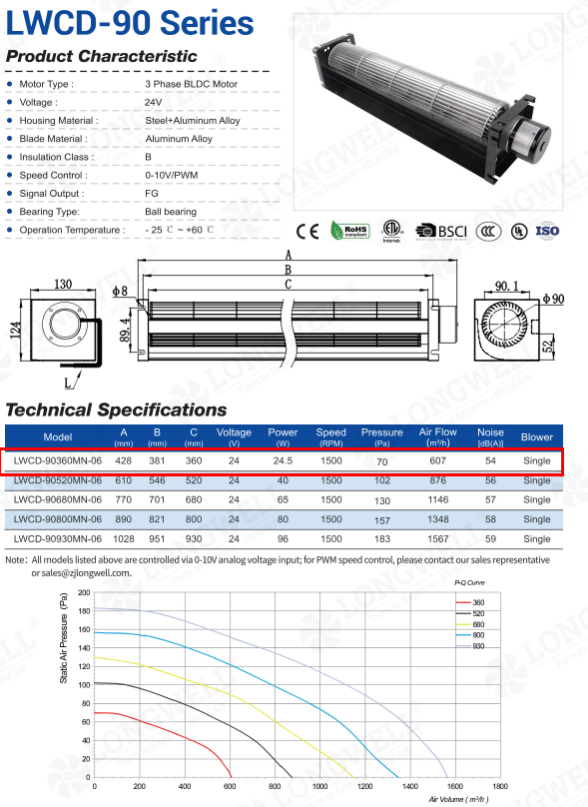
When engineers cool wide panels, they face a choice. They can use a row of small axial fans or one long impeller. First, we looked at placing several 120 mm axial fans in a row. However, round fans leave blank spaces between their blades.
These dead spots let heat build up on the metal coil. Instead, we chose an 820 mm long aluminum impeller. This design creates one smooth sheet of cold air.
Upgrading the IP55 Cross Flow Fan Motor
Next, we had to pick the motor type for this IP55 cross flow fan. A basic AC motor costs less up front. Even so, basic AC motors only run at one fast speed. They waste power on cold nights when the cabinet needs less air.
Therefore, we used our SmartEC motor technology. This drive system accepts a 0-10V signal from the main cabinet computer. Consequently, the fan drops its 1500 RPM speed when the outdoor air gets cold. This smart control keeps the sound waves well below the strict 61 dB(A) limit most of the time.
The Real Trade-offs of Water Protection
Furthermore, we had to solve the water problem. Standard EC motors breathe ambient air to stay cool inside. By contrast, pulling damp air into this outdoor motor would cause a fatal short circuit. So, we filled the entire motor stator with thick epoxy resin.
This potting process created a fully sealed IP55 cross flow fan. However, this choice caused a new engineering problem. The hard resin traps natural heat inside the copper coils. Thus, the sealed motor runs much hotter than a normal open motor.
Therefore, we applied our ThermoFlex design rules to offset the heat. We added high-grade ball bearings that survive high temperatures. Finally, every design choice has a real cost. The heavy resin added extra weight to the final product.
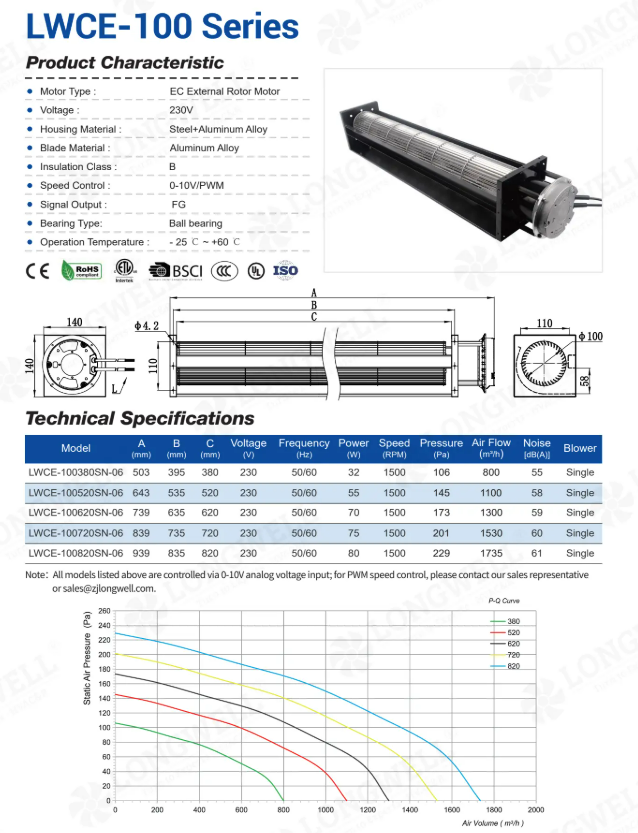
Standard indoor units offer a materially lower cost. In short, the final LWCE-100820SN-06-11 model met the 229 Pa pressure target while surviving the wet, hot outdoor conditions.
Technical Specifications
| Model | LWCE-100820SN-06-11 |
| Voltage | 230 VAC |
| Voltage Range | 184-276 VAC |
| Frequency | 50/60 Hz |
| Speed | 1500 RPM |
| Airflow | 1735 m³/h (1020 CFM) |
| Max Static Pressure | 229 Pa |
| Noise Level | 61 dB(A) |
| Operating Temperature | -25°C to +60°C |
| Rotation | CCW |
| IP Rating | IP55 (Potted Motor) |
| Impeller Material | Aluminum |
| Frame Material | Cold-rolled steel |
| Bearing Type | Ball bearing |
| Lifespan (L10) | 30,000 hours at 25°C (30%-90% RH) |
| Certification | CE |
First, the table above lists the exact numbers verified in our test lab. Next, the wide 184-276 VAC voltage range protects the IP55 cross flow fan from poor local power grids. Finally, the extreme temperature limits ensure the unit survives cold winters and hot summers.
Reference: AMCA 210 covers the test method behind these figures.
Technical Documentation
First, mechanical engineers can open the PDF below to check the exact 938 mm frame length and wiring map. Next, the curve image maps the exact air output of this IP55 cross flow fan across different pressure loads.
Download LWCE-100820SN-06-11 Technical Specification
How to Specify Parts for Outdoor Heat Exchangers
If you must cool a wide panel in harsh weather, follow these practical steps. Good planning saves time and stops early field failures.
- First, measure the exact active width of your cooling coil. Consequently, you can match your impeller length directly to that number. This simple step stops air from leaking around the empty edges.
- Next, record the real voltage swings at your final site. Outdoor cabinets rarely get a perfect power supply. So, asking for a wide voltage range stops random system crashes.
- Furthermore, remember that water protection adds heat. When you seal a motor stator with thick resin, the internal copper gets hot. Therefore, you must check that the supplier tested the sealed bearings at your highest expected air temperature.
- Finally, give your supplier one strict working point. Tell them you need exactly 1735 m3/h at 229 Pa. Because we build both the aluminum impellers and the smart motors in our Ningbo factory, we can tune the copper windings to hit your exact target.
Related: Cross Flow Fans.
Frequently Asked Questions
Technical Documentation & Resources
Browse our cross-flow fans range, the AC cross-flow fans section, or cross-flow impellers.
Have a Similar Fan Requirement?
Longwell’s engineering team delivers custom spec sheets and samples within 90 days. Since 1990, we have supplied EC fans and blowers to OEMs across HVAC, cold chain, data center, and industrial applications worldwide.
Browse Related Products:
🏆 ISO 9001 / ISO 14001 / ISO 45001 | CE (TÜV) | UL/ETL | ATEX Zone 21/22 | AMCA 210-16 / ISO 5801 tested