The Application and Hard Constraints
We received a request to quieten a battery cooling system built around a 48V DC centrifugal fan. The customer used an older sheet-aluminum fan. Its model number was LWBD3G310-092NH-02. This legacy fan pushed 2266 m³/h of air.
Also, it worked against 391 Pa of static pressure. First, the customer needed a direct 48V DC centrifugal fan replacement. The new unit had to fit the exact same physical space. Next, the system required precise speed control.
We had to use 0-10V or PWM signals. These signals link directly to their thermal management boards. However, we found a major flaw in their old design. The old fan was far too loud.
At its peak speed, it hit 72 dB(A). Consequently, the noise was too high for tight server corridors. It also caused problems in battery storage containers. Furthermore, when you stack many fans, the total noise grows quickly.
Next, the customer had strict testing rules. They needed a fan tested to AMCA 210-16 standards. They also required ISO 5801 testing to prove the airflow curves. Finally, the project had clear temperature limits.
The 48V DC centrifugal fan must run safely from -25°C up to 60°C. This wide range tells us the unit sits outdoors. Therefore, the main goal was clear. We had to cut the noise levels. At the same time, we could not lose any air power.
Overcoming Noise in a 48V DC Centrifugal Fan
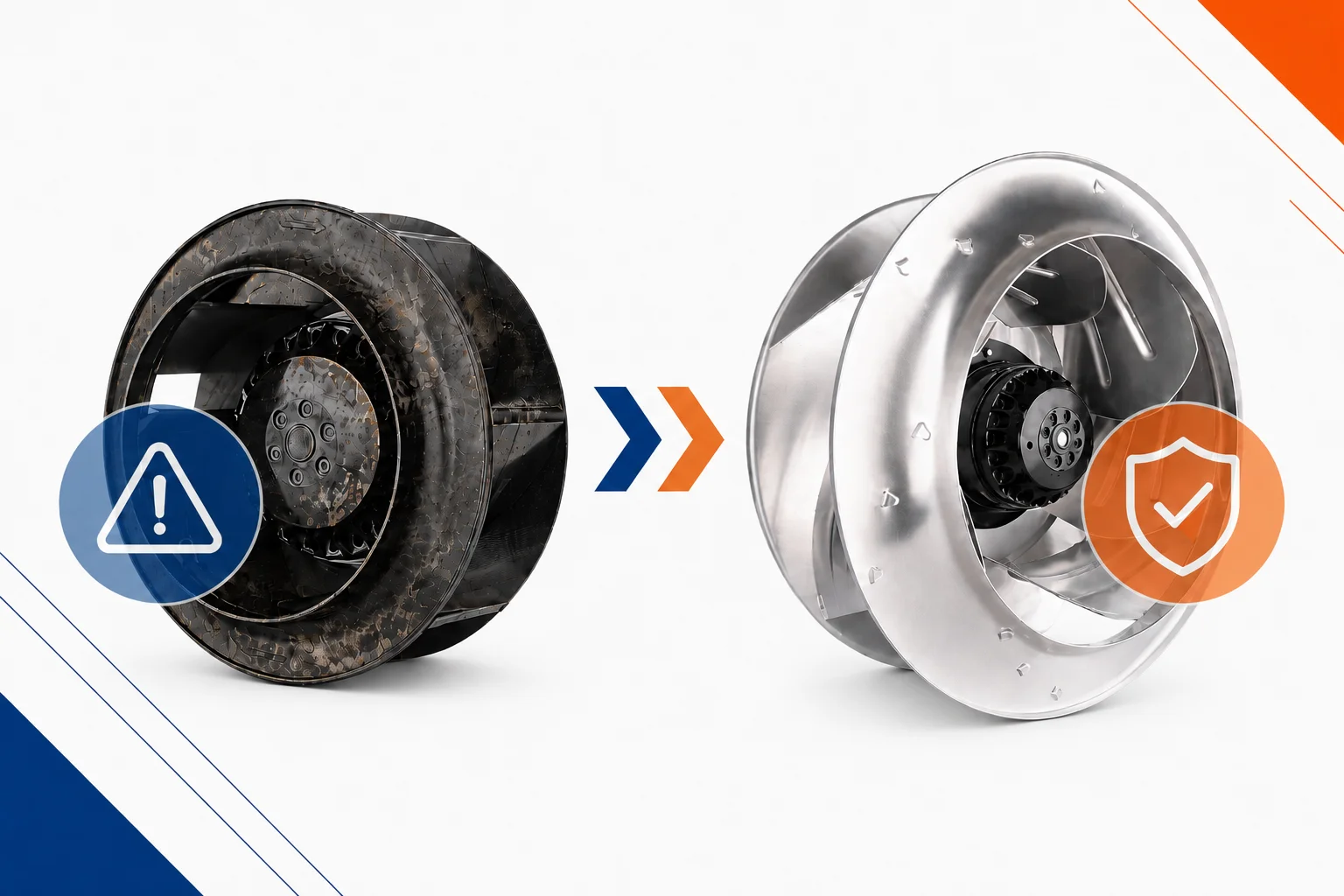
We looked at several ways to fix the noise issue. First, we thought about keeping the old sheet-aluminum blade design. This choice would save weight. However, thin metal blades bend under high pressure.
This bending causes the air to swirl in bad ways. As a result, the 48V DC centrifugal fan shakes and makes loud noises. Therefore, we rejected the cheap sheet metal idea entirely.
Upgrading the Impeller Material
Instead, we moved to our LWBD3G310-102PH-18-00 platform. This model uses a thick cast aluminum alloy impeller. The thicker metal is much stiffer. By using this stiff material, we stopped the blades from bending.
Consequently, the loud vibration went away. Then, the noise level dropped fast. The new unit records exactly 66 dB(A) at top speed. This change gave the customer a massive 6 dB(A) drop in noise. Thus, they were very happy to leave the old 72 dB(A) rating behind.
The Cost of Quieter Performance
Of course, every choice has a cost. First, the new aluminum alloy impeller is much heavier. It needs more force to start spinning. Next, it needs more power to hold its 1930 RPM top speed.
So, we had to pair the new 48V DC centrifugal fan impeller with a larger motor. This choice pushed the power draw up. The old fan used 120W. Now, the new design draws 216W.
Furthermore, the fan gained a lot of mass. The new assembly weighs 4.2 kg. By contrast, the old model weighed only 2.7 kg. Even so, the stronger motor delivers better air pressure.
The maximum airflow now reaches 2695 m³/h. Additionally, the maximum static pressure hits 566 Pa. Finally, we added our SmartEC control board. The board reads the incoming 0-10V or PWM signal.
Thus, the fan only pulls the full 216W when heat loads peak. During normal shifts, the fan slows down. This saves power and cuts noise even more. Ultimately, the final unit mounts on a custom 440mm square bracket.
Technical Specifications
| Parameter | Value |
|---|---|
| Airflow (Max) | 2695 m³/h / 1585 CFM |
| Static Pressure (Max) | 566 Pa |
| Input Power | 216 W |
| Speed | 1930 RPM |
| Nominal Voltage | 48 VDC |
| Voltage Range | 36~57 VDC |
| Current | 4.5 A |
| Noise Level (LpA) | 66 dB(A) |
| Operating Temperature | -25°C to 60°C |
| Weight | 4.2 kg |
| Insulation Class | Class B |
| Protection Type | IP44 |
The lower noise row is the most important detail here. It proves the stiff alloy blades work better than thin metal. Consequently, the higher power input and weight rows show the real cost. You must accept a heavier 48V DC centrifugal fan to get a quiet system. Furthermore, the higher static pressure limit gives the cooling system more headroom. Therefore, the trade-off makes perfect sense for this telecom project.
Reference: AMCA 210 covers the test method behind these figures.
Technical Documentation
System engineers need this specification sheet to check the exact electrical draws and thermal limits.
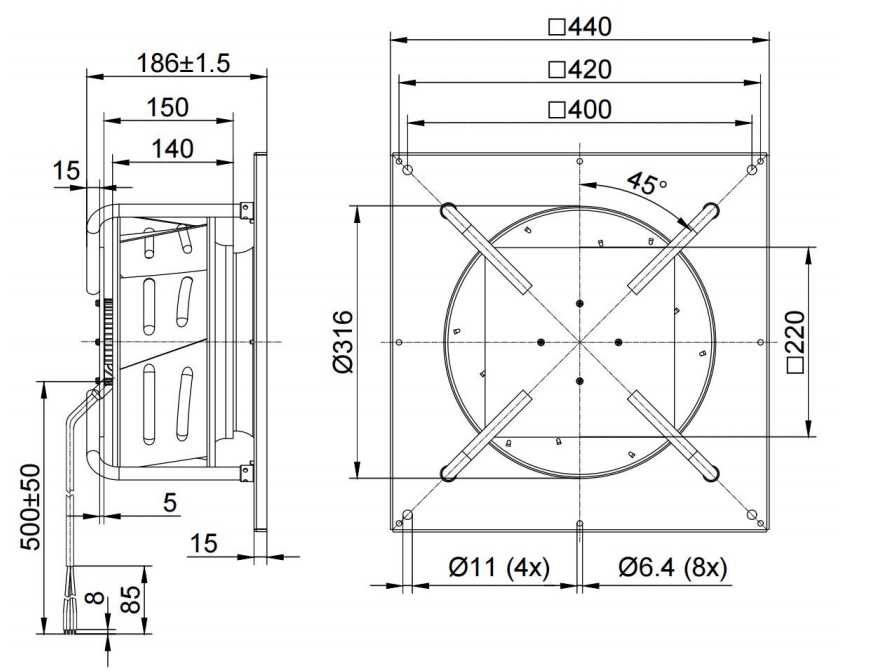
Mechanical designers must review this drawing to verify the 440mm square bracket mounting holes.
Specifying an Equipment Cooling Fan
If your project faces strict noise and pressure limits, you must plan carefully. Review these specific steps before you order parts:
- First, measure your true system resistance. Thin metal blades often fail when air pressure gets too high. Therefore, you must use rigid alloy blades to keep the noise down.
- Next, check your physical weight limits. A quiet 48V DC centrifugal fan needs a thick metal core. Consequently, this adds extra mass to your cabinet doors or frames. You must make sure your hinges can hold the extra weight.
- Then, map out your full power supply range. Batteries never put out exactly 48 volts all day. Therefore, your motor must run safely during power dips. Our motors handle swings from 36V up to 57V without stalling.
- Finally, share your exact mounting layout with your supplier right away. A custom square bracket saves you hours of assembly time. We build panels like the 440mm plate in this project directly on our factory floor. Thus, this cuts out extra steps.
In short, finding your hard limits early makes the quoting phase much faster.
Related: Centrifugal Fans.
Frequently Asked Questions
Technical Documentation & Resources
Browse our centrifugal fans range, the backward-curved fans section, or forward-curved fans.
Have a Similar Fan Requirement?
Longwell’s engineering team delivers custom spec sheets and samples within 90 days. Since 1990, we have supplied EC fans and blowers to OEMs across HVAC, cold chain, data center, and industrial applications worldwide.
Browse Related Products:
🏆 ISO 9001 / ISO 14001 / ISO 45001 | CE (TÜV) | UL/ETL | ATEX Zone 21/22 | AMCA 210-16 / ISO 5801 tested