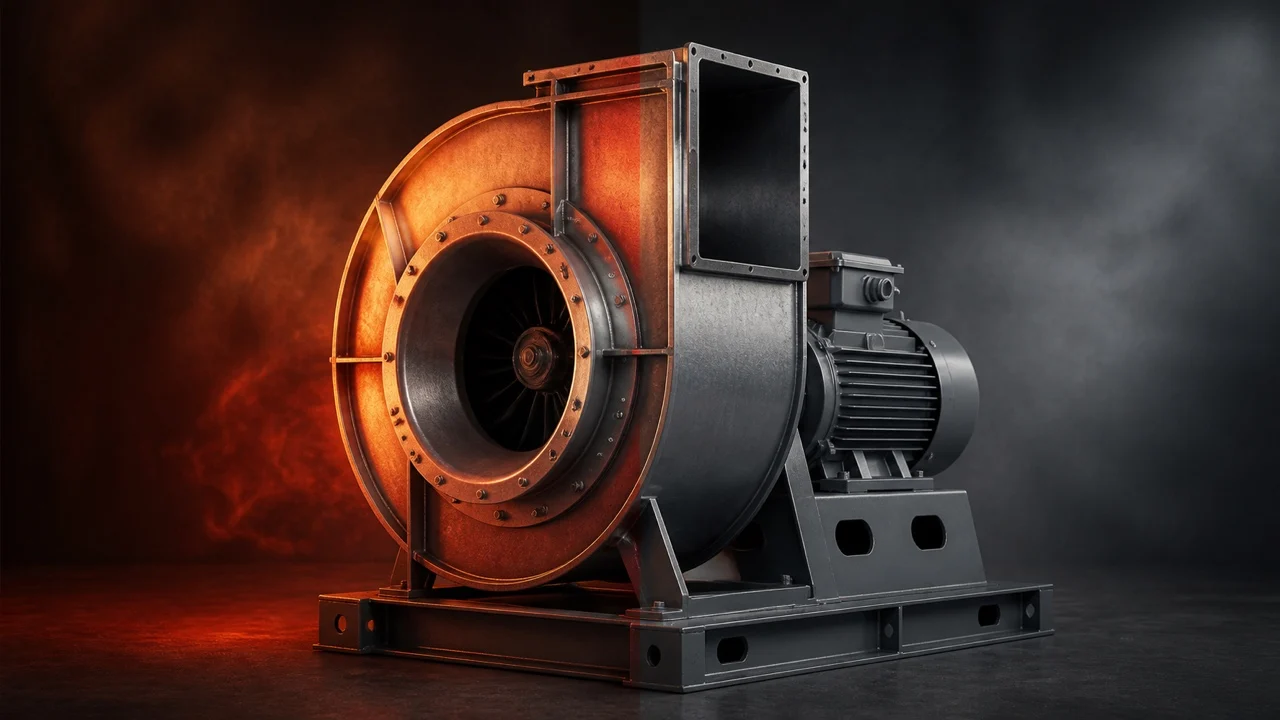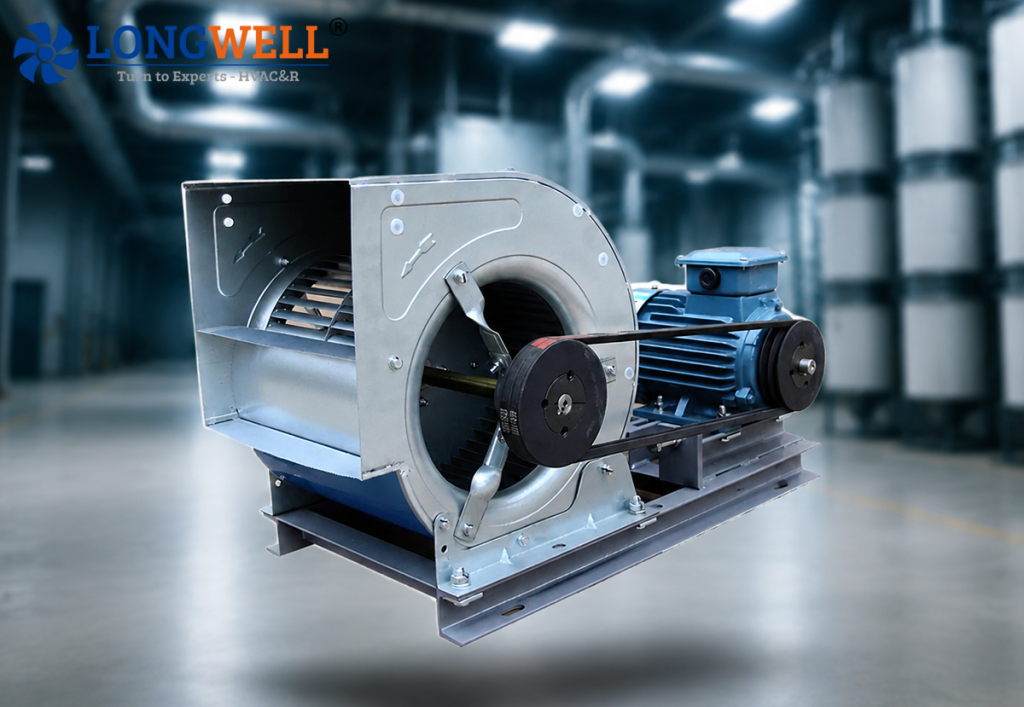
In industrial environments where reliable air movement and high static pressure are critical, industrial centrifugal blowers play a vital role. Unlike standard ventilation fans, industrial centrifugal blowers are engineered to generate the pressure required to move air through ductwork, filters, heat exchangers, dust collectors, and other high-resistance systems.
This comprehensive guide explains everything you need to know about industrial centrifugal blowers. We’ll explore the different blower types, their operating principles, key industrial applications, and the advantages they offer over other ventilation solutions. The article aims to help you choose a blower that delivers maximum efficiency, long-term reliability, and the lowest total cost of ownership for your industrial system.
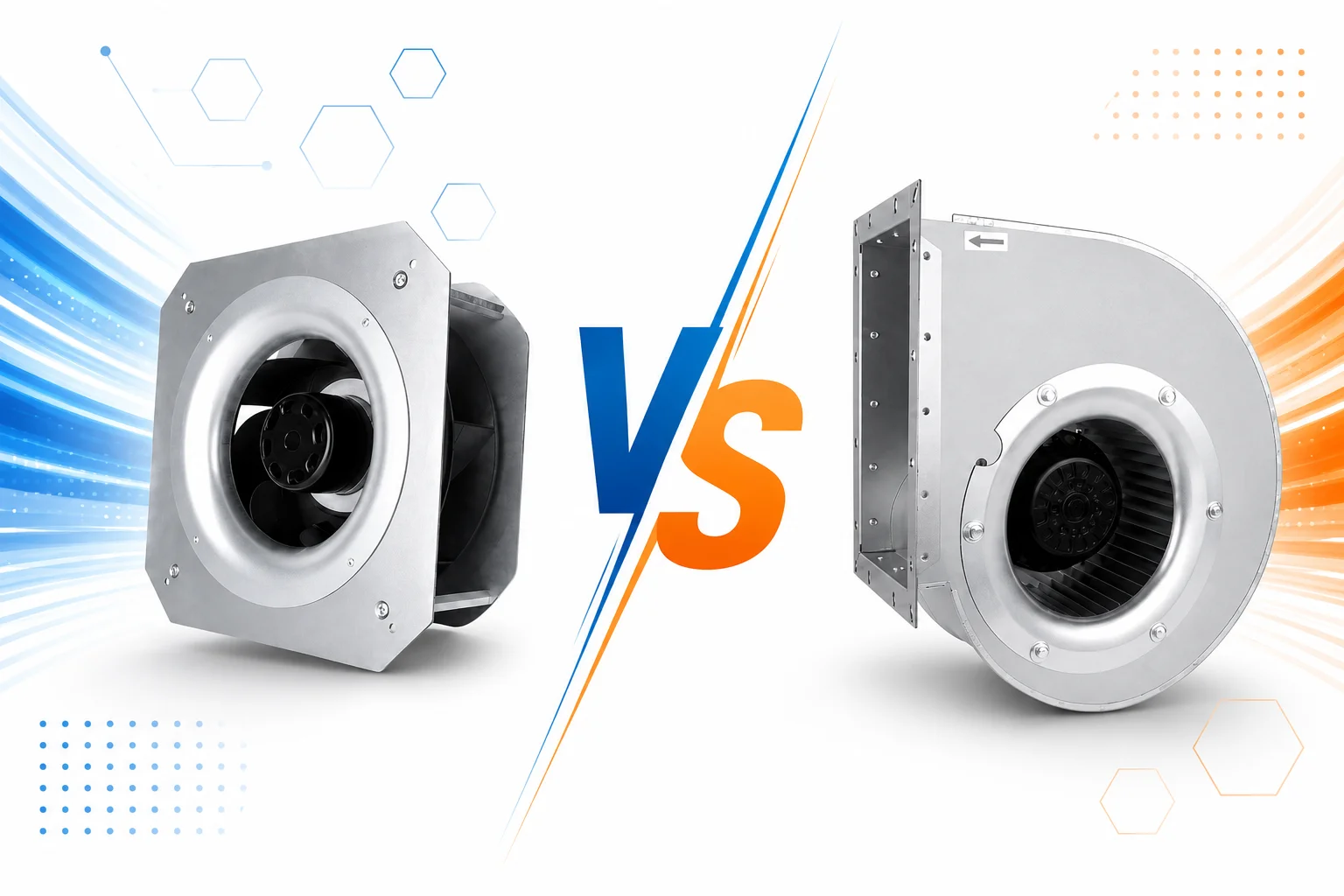
Industrial Centrifugal Blower vs. Centrifugal Fan: What’s the Difference?
In ventilation and air conveying systems, the differences between the use of centrifugal blowers and centrifugal fans are not significant. However, their performance will be significantly different when in industrial use. IIndustrial centrifugal blowers are built for jobs that demand higher static pressure, greater system resistance handling, and more robust operating performance.
- Static Pressure Capability: Industrial Centrifugal fans are used for higher static pressure condition. They need to generate high and stable pressure airflow through the systems. When centrifugal fans are typically designed for low- to medium-pressure ventilation systems.
- Construction and Durability: Standard centrifugal fans are typically used in situations where the operating conditions are relatively low. Due to industrial requirements, centrifugal blowers are equipped with heavier housings and more solid impellers. Some models have special designs to withstand high temperatures and particles in the air.
Types of Industrial Centrifugal Blowers
Forward-Curved Centrifugal Blowers
The blades of forward-curved centrifugal fans are curved in the direction of rotation. It can generate a large volume of air at a relatively low rotational speed. However, the limitations are also obvious. In applications with high static pressure, due to its relatively weak structural strength, it is prone to causing a significant increase in motor power when overloaded.
Backward-Curved Centrifugal Blowers
The blades of the backward-curved impeller have their tips facing in the opposite direction to the rotation direction. This blower has an extremely high static efficiency. Its non-overload feature ensures that when the air volume increases and the pressure decreases, the power consumption of the motor decreases. It performs stably in high-pressure systems with significant fluctuations in operating conditions.
Radial Centrifugal Blowers
The blades are in a highly rigid straight line shape. This design of the impeller structure is the most stable, capable of withstanding extremely high centrifugal force and generating extremely high static pressure. Moreover, it has strong impact resistance and is not prone to dust accumulation or scaling. Durability is a major feature of this blower.
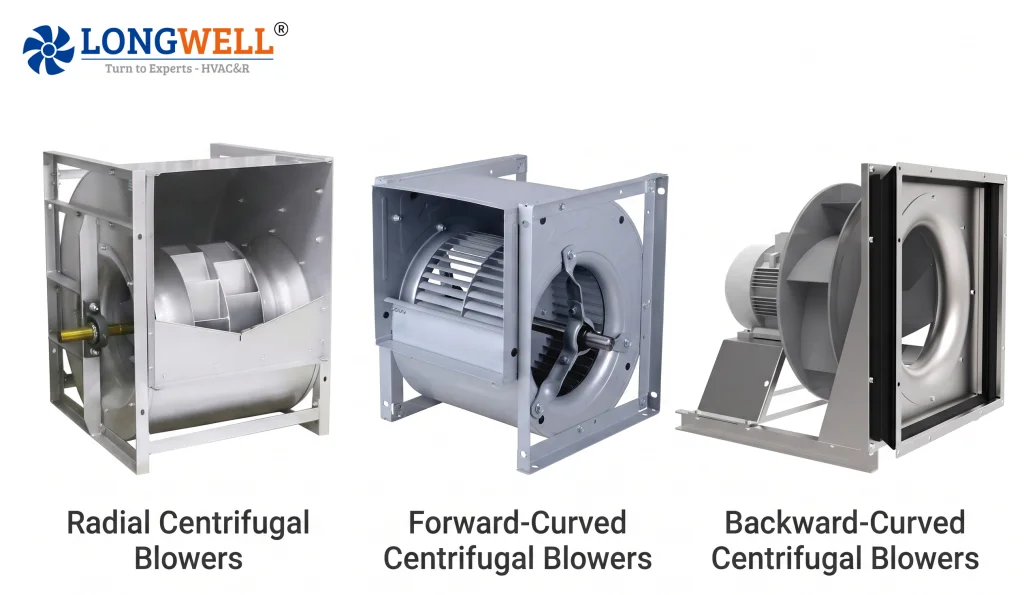
| Blower Types | High Static Pressure Performance | Efficiency | Dust Handling | Best Application |
| Forward-Curved Blower | Lower | Moderate | Lower | Clean air, low-resistance system |
| Backward-Curved Blower | Higher | Higher | Moderate | Clean or slightly dusty, stable high pressure |
| Radial Centrifugal Blower | Higher | Moderate | Higher | High dust, impurity-containing materials, extreme high pressure |
Why Industrial Centrifugal Blowers are Ideal for High Static Pressure Systems?
Higher Static Pressure Generation
In industrial applications, if the pressure in the blower cannot provide sufficient static pressure, even if the air volume is high, it is impossible to transport the air to the end of the system. Therefore, the industrial centrifugal blowers are specifically designed for this purpose.
- Impeller: The impeller is the core component of accelerating airflow. In industrial centrifugal blowers, the impeller is typically designed with blade geometries. As the impeller rotates, air is drawn into the center of the impeller and accelerated outward by centrifugal force. This process significantly increasing its velocity. The high-velocity airflow provides the foundation for generating the static pressure required to overcome system resistance.
- Volute: The function of the volute is to convert kinetic energy into static pressure. In general, industrial volutes typically feature a gradually increasing cross-section of the flow channel, which effectively suppresses internal turbulence and secondary flow back.
The rotational speed range designed for industrial centrifugal blowers is usually higher than that of ordinary fans, thereby achieving a higher pressure coefficient. It is because they need to overcome complex airflow paths such as coil pipes, filters, and long ducts.
Reliable Performance in High Resistance Systems
The P-Q Curve of industrial centrifugal blowers is designed extremely steeply. This means that when the system resistance increases, the blower can generate a stronger pressure reserve within itself, resulting in a very small decrease in the corresponding air volume. This is very important for industries that require a constant airflow. The blower can keep a stable air volume output when there is a sudden change in the front-end duct.
Most industrial centrifugal blowers come with automation or VFD controls, so they can dynamically change speed depend on real-time feedback. This ensures that the pressure of the dust collection system remains at the optimal operating condition.
Greater Industrial Operating Conditions Adaptability
The industrial centrifugal blower’s volute can be matched with different materials, such as galvanized plate, high-strength aluminum alloy, steel, and etc. Materials are tailored for specific operation demands. These units are designed with robust ingress protection to maintain reliable performance. The blowers can provide IP44, IP55, or higher ratings protection, ensuring the internal electrical components are effectively shielded from dust ingress and moisture.
High-Static-Pressure Applications of Industrial Centrifugal Blower
Industrial Dust Collection and Filtration
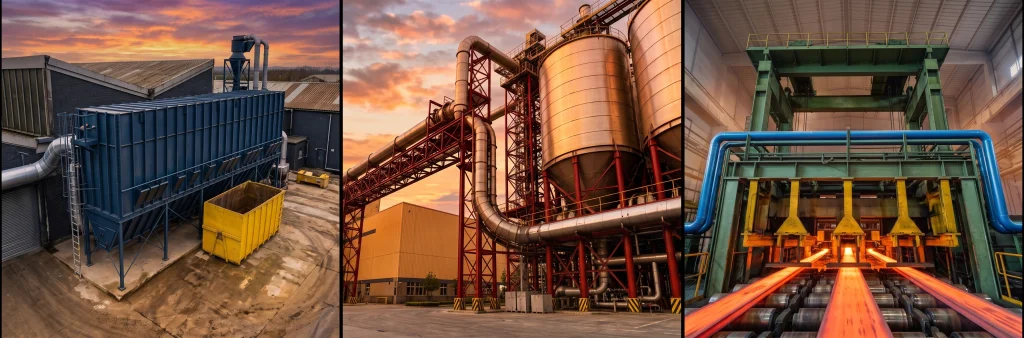
Industrial dust collection and filtration systems usually consist of numerous components, which cause significant pressure loss along the airflow path. Additionally, as dust accumulates on the filtration medium, the system resistance increase. Industrial centrifugal blowers can provide the static pressure to maintain a stable airflow. They can provide stable filtration performance to meet the air quality requirements of the workplace.
Pneumatic Conveying Systems
In pneumatic conveying systems, air is used to propel particles, powders or wood chips for long-distance transportation within the pipes. During the transportation process, the centrifugal blower must overcome the friction losses caused by the long conveying line and the moving materials. This creates a high-pressure working environment, which requires a stable airflow and reliable pressure generation.
Industrial Combustion and Furnace Systems
In high-temperature industrial ovens, kilns, and boilers, precise air-to-fuel ratios are critical for efficiency and emission control. The airflow usually needs to pass through multiple systems and devices that increase additional resistance. Industrial centrifugal blowers can generate the required pressure to ensure a stable and controlled airflow. Moreover, the relatively more robust structure also enables the blower to operate stably under high-temperature conditions.
How to Choose a LONGWELL Industrial Centrifugal Blower?
1. Application Requirement
Defining the system application and its resistance:
- HVAC systems → EC/DC backward curved centrifugal blower
- Industrial dust collection → RDH series
- High-volume ventilation systems → ADH series
2. Performance Parameter
- Long-term operating costs can be considerably lowered with an efficient type.
- An appropriate rotational speed lowers wear and improves efficiency.
- Low-noise designs should be considered as a priority when installing in noise-sensitive regions.
- Match the necessary static pressure and air volume with blower types:
EC/DC Backward-Curved Centrifugal Blowers: 400–2,100 Pa | 200–24,000 m³/h
RDH series: 1,500-2,500 Pa | 4,500-50,000 m³/h
ADH series: 8,000–60,000 m³/h | ≤ 1,000 Pa
3. Environmental Adaptation
- Operating environment temperature range and humidity conditions.
- Check special environmental requirements (anti-corrosion, explosion-proof, etc.).
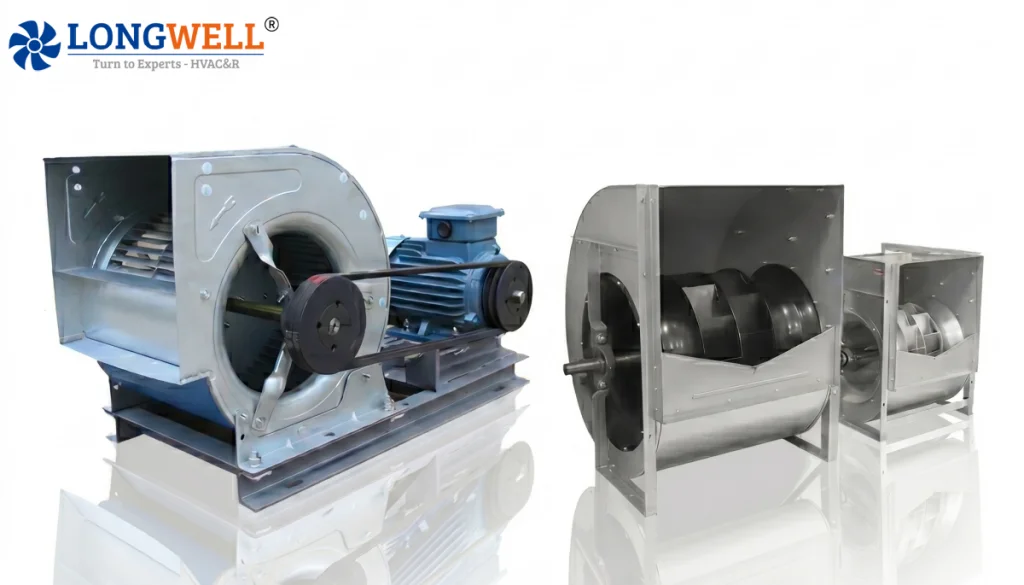
Taking the RDH series as an example, this series is specifically designed for high-resistance environments such as downstream dust removal. The RDH series features 11 backward-inclined steel impellers and undergoes G1.0 industrial-level dynamic balancing and wear-resistant coating treatment to adapt to harsh dust conditions. The five mainstream sizes range from 400 to 630 millimeters and are certified to comply with ATEX Zone 22 as the standard.
4. Installation Condition
- Reserve available installation space and method (horizontal/vertical).
- Consider Air intake/exhaust direction.
When faced with compact structure with high static pressure requirement, choose EC backward curved centrifugal blowers. When deal with dust collection systems with a large housing installation, turn to RDH series.
5. Economic Considerations
- Trade-off between initial investment and life cycle cost.
- Pay attention to the warranty policy.
Although choosing EC blowers will take a high initial cost, their energy-saving performance significantly reduces long-term operating expenses.
6. Maintenance Service
- Make sure the required maintenance frequency and quality certification.
Depending on the processing scale of different systems, you can refer to the following selection matrix for a preliminary assessment:
| Industrial Condition | Airflow (m³/h) | Pressure (Pa) | Recommended |
| AHU, RTU, Data Center Cooling, etc. | 200-24000 | 400-2100 | EC/DC/AC Backward-curved Centrifugal Blower |
| Mid-size Dust Collection | 4,500-12,000 | 1,500-1,800 | RDH-355 / 400 |
| Large Dust Collection | 13,500-25,000 | 1,800-2,200 | RDH-500 / 560 |
| Extra-large Dust Collection | 25,000-50,000 | 2,000-2,500 | RDH-630 / 710 / 900 |
| Mid-size Workshop Air Volume Generation | 8,000-20,000 | 400-700 Pa | ADH-630 / 710 |
| Large Workshop Air Volume Generation | 20,000-40,000 | 500-800 Pa | ADH-900 / 1000 |
| Extra-large Air Volume Generation | 40,000-60,000 | ≤ 1,000 Pa | ADH-1120 / 1250 |
Longwell Industrial Centrifugal Blower Solutions
In complex industrial projects, it is common to need to purchase blowers of different specifications from multiple suppliers, which results in lengthy project integration time and difficulties in compliance certification. By standardizing the 4-stage integrated fan solution, Longwell has modular integrated the fan technologies required for each stage. This enables Longwell to offer an One Product Portfolio that can meet the specific compliance and performance requirements of different industries. It provides customized integration solutions for six vertical sectors including BESS, semiconductors, food processing, metal processing, pharmaceuticals, and chemical coating. Compared with multi-vendor procurement, complete machine integration can save 40% to 60% of the time.
FAQs
What is an industrial centrifugal blower used for?
When a industrial system need high static pressure, the centrifugal blowers are the ideal choice. Their typical uses are moving air, particles or dust.
What is the power consumption of an industrial centrifugal blower?
Its depends on the features of the centrifugal blower. Different types of blowers have the different parameters. The main factors includes: airflow, pressure, efficiency, motor size, and operating hours.
How to choose a centrifugal blower size?
Calculating the total system resistance is the first step. Then, matching the equipment’s P-Q curve to the system’s pressure and airflow requirements.
What are precautions for installing an industrial centrifugal blower?
All the blowers should be installed on a stable base. Make sure components meet the environment protection rating. If use blower to handle combustible dust, turn to choose centrifugal blowers with ATEX certification.
What kind of maintenance does a centrifugal blower need?
Common maintenance routine focus on the electronic components. Cleaning the impeller, checking bearings, monitoring vibration, and verifying motor performance.