Why Do Wall-Mounted Air Conditioners Prefer Cross-Flow Fans? Principles & Comfort Parameters
When evaluating the performance of a split wall-mounted air conditioner, consumers often focus on compressor capacity or the overall Annual Performance Factor (APF). However, the core component that determines the actual indoor comfort—whether the airflow feels gentle and operates silently—is the cross-flow fan (also known as a tangential fan) hidden behind the indoor unit’s louvers.
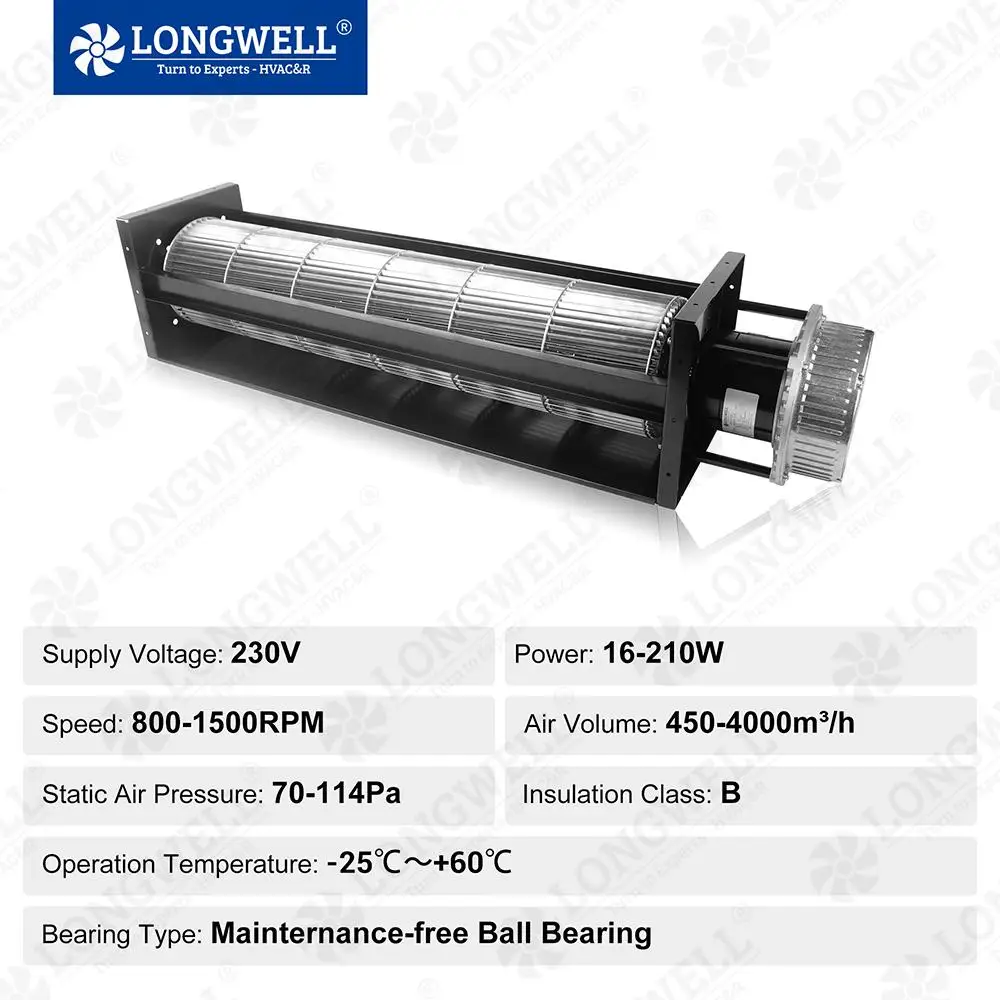
Why do major HVAC brands universally abandon traditional axial or centrifugal fans in favor of cross-flow fans for wall-mounted indoor units? LONGWELL breaks down the technical logic from the perspectives of fluid dynamics and indoor thermal comfort.
The Ultimate in Space Utilization: Making Room for Heat Exchange
The design trend for modern wall-mounted air conditioners leans heavily toward minimalism and ultra-thin profiles. The internal space of an indoor unit is highly restricted, consisting primarily of the evaporator (heat exchanger) and the blower assembly.
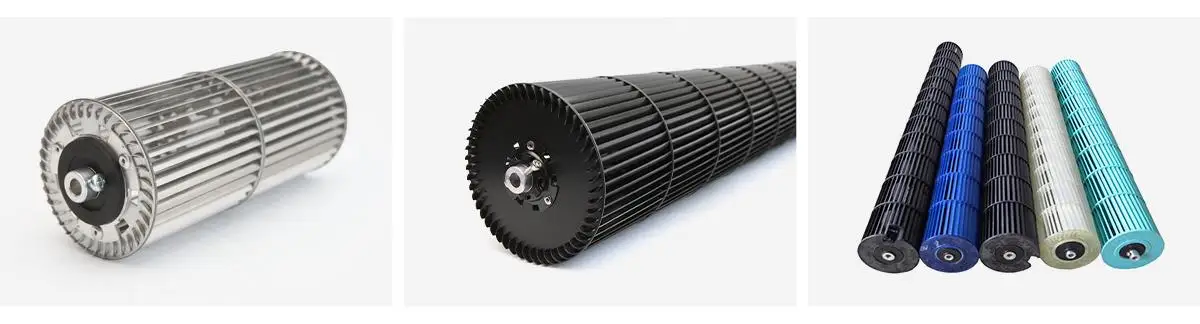
Cross-flow fans feature an elongated, cylindrical impeller design. Standard diameters usually range from 90mm to 120mm, while lengths can stretch from 600mm to 1000mm, perfectly matching the width of the AC indoor unit. This structure allows air to flow transversely into one side of the impeller and exit from the other.
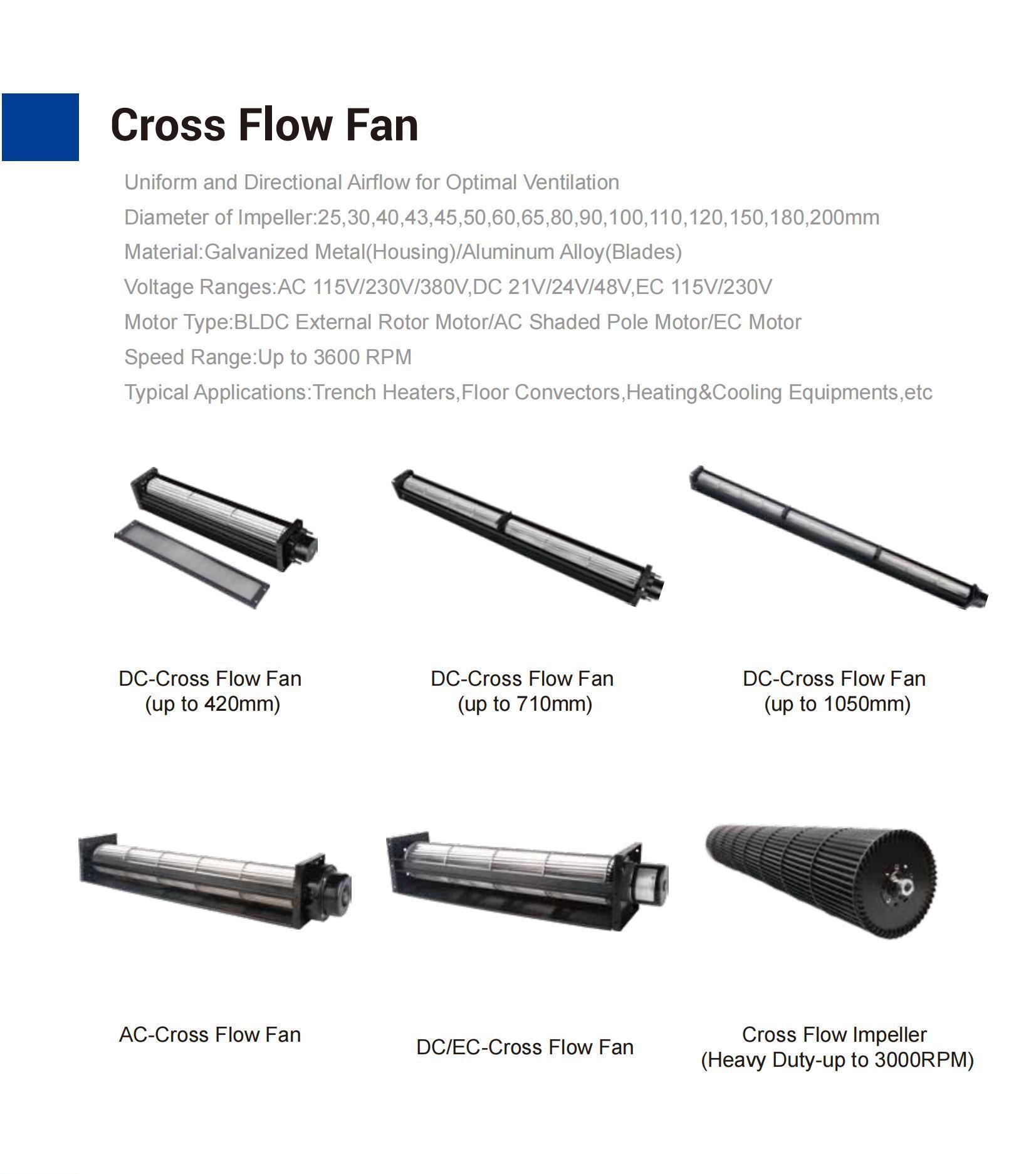
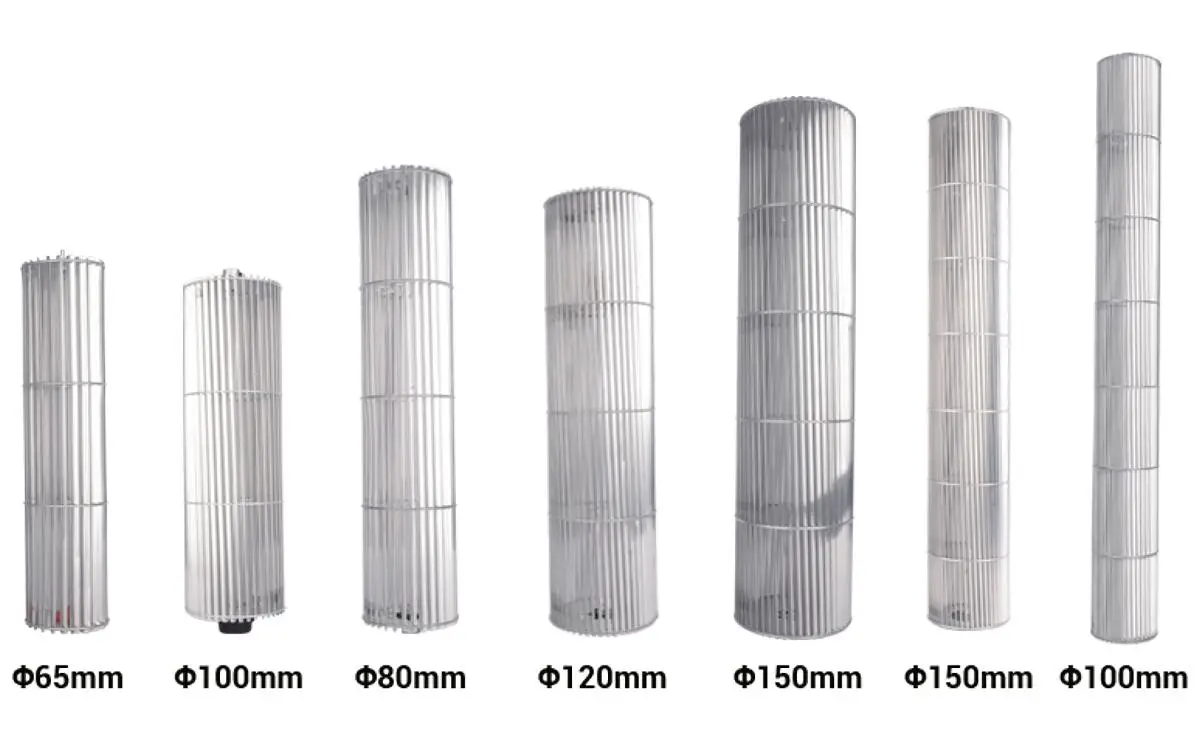
· Structural Advantage: The slender shape not only minimizes the thickness of the indoor unit but, more importantly, frees up significant surface area for the front-mounted evaporator. A larger evaporator area directly translates to higher heat exchange efficiency, which is the physical foundation for accelerating cooling and heating speeds.
Ergonomic Airflow Parameters
The ultimate goal of an air conditioning system is to create a microclimate that meets human physiological needs. International standards clearly define indoor air distribution, and the characteristics of cross-flow fans perfectly align with these parameters:
1. Eliminating “Direct Cold Drafts”: High Volume with Micro-Velocity
The human body, when at rest, is highly sensitive to wind speed. When indoor air velocity exceeds 0.5 m/s, it easily creates an uncomfortable, piercing “draft sensation.”
A major advantage of the cross-flow fan is its ability to deliver a large circulation volume of hundreds of cubic meters per hour (m³/h) while dispersing the airflow through a wide outlet cross-section. This “waterfall-style” airflow trajectory ensures that the terminal wind speed reaching the human activity zone is precisely controlled at a draft-free 0.3 m/s.
2. Uniform Thermal Distribution: Controlling Temperature Variance
Single-point air delivery (like traditional desk fans) leads to severe indoor temperature stratification. Because the cross-flow fan’s outlet is as long as the unit itself, it forms a complete “wall of air.” During heating mode, this broad air delivery effectively pushes warm air down to the floor, ensuring the vertical temperature difference (between head and ankles) is kept within 2℃ to 3℃, significantly enhancing winter heating comfort.

Overcoming Acoustic Challenges: Sleep-Level Silence
Bedrooms are the primary application scenario for wall-mounted ACs, making noise control a critical competitive factor for manufacturers.
Compared to the turbulent airflow of axial fans, the internal air movement of a cross-flow fan is much smoother. By optimizing the blade angles (often using non-equidistant, staggered designs) and the volute air duct, high-quality cross-flow fans effectively slice through the air, minimizing vortex noise.
· Noise Reduction Parameters: In low-speed or “sleep mode,” an AC equipped with a high-performance cross-flow fan can drop indoor noise levels down to 20 dB(A) to 25 dB(A). This sound pressure level is roughly equivalent to rustling leaves, perfectly meeting the acoustic requirements for deep human sleep.
LONGWELL: The Manufacturer of High-Reliability Cross-Flow Fans
In practical operation, if a nearly one-meter-long cylindrical impeller experiences even minor deformation or mass imbalance while rotating at high speeds, it will trigger severe vibrations and low-frequency noise, instantly ruining the user experience of a premium air conditioner.
As a professional fan manufacturing brand, Ningbo Longwell Electric Technology Co., Ltd. (LONGWELL) maintains a rigorous quality control system for the R&D and production of cross-flow fans:
1. High-Precision Dynamic Balancing: All our cross-flow impellers undergo micro-gram level dynamic balance calibration before leaving the factory. This ensures absolute stability at extremely high RPMs, eliminating mechanical resonance at the source.
2. Weather-Resistant Material Engineering: We utilize high-strength modified engineering plastics (such as glass-fiber reinforced materials), granting the blades outstanding creep resistance. They will not become brittle or deform, even under prolonged exposure to 70℃ heating conditions or freezing, frosting environments.
3. Customized Flow Field Matching: LONGWELL’s engineering team can conduct CFD (Computational Fluid Dynamics) simulations based on the specific static pressure and duct structure of a client’s AC system, providing the most perfectly matched blade profile and motor solution.
Conclusion
A cross-flow fan is far more than a simple ventilation accessory; it is the crystallization of precision engineering that balances space, airflow feel, and acoustics. If you are looking for reliable airflow solutions for your next generation of HVAC equipment, or need to learn more about our custom manufacturing services, please visit www.longwellfans.com. LONGWELL is ready to provide you with comprehensive technical support.



![[{“text”:”LONGWELL’s High-Efficiency EC/DC\n”,”type”:”text”},{“text”:”Cross-Flow Fans and Energy-Saving\n”,”type”:”text”},{“text”:”Solutions Lead HVAC Innovation”,”type”:”text”}]](https://i.longwellfans.com/wp-content/uploads/2026/03/bss_-text-LONGWELL-s-High-Efficiency-EC_00-768x511.jpg)