The Fan Revolution: Unlocking the Core Technology and Aerodynamic Principles of High-Efficiency Centrifugal Fans
Welcome to the first part of our High-Efficiency Ventilation Series. Here, we will explore the profound changes taking place in the world of industrial fans.
Chapter 1: Introduction: A Paradigm Shift in Industrial Fan Technology
1.1 Leaving the Old Era Behind: Why a Single Performance Metric is No Longer Reliable
In the past, selecting an industrial fan seemed simple: check a product catalog, find a model that meets your airflow and pressure requirements, and place an order. However, in an era of increasingly strict energy regulations and rising operational costs, this traditional method, based on a single performance metric, is outdated and can be extremely costly.
We are experiencing a fundamental shift. The true measure of a fan’s performance is no longer its standalone capability under ideal test conditions but its actual effectiveness as an essential component within a complex, interconnected system. This transition to high-efficiency fans is driven by technological advancements, economic pressures, and a growing sense of environmental responsibility.
This guide aims to provide you with a new perspective, helping you master the necessary principles, technologies, and best practices to make smarter, more forward-thinking decisions. The ultimate goal is to optimize both performance and long-term value.
1.2 “From Wire to Air”: Viewing the Fan as a Complete System
The core function of a fan is to move air and overcome the resistance generated by the entire system, including ducts, filters, elbows, and all other components. Therefore, the efficiency of this process depends not only on the fan itself but is also profoundly influenced by the efficiency of the motor, the precision of the controls, and the quality of the installation.
To assess performance accurately, we must adopt a holistic “Wire-to-Air” perspective, evaluating the entire energy conversion chain from the electrical power input to the final delivery of air. This holistic view emphasizes the critical importance of adopting standardized, system-level metrics, such as the Fan Energy Index (FEI), which has become the new industry benchmark.
Viewing the fan as a system means we are not just choosing a device that meets current airflow needs but a comprehensive solution that provides excellent energy savings and operational reliability throughout its entire lifecycle.
Chapter 2: Understanding the Language of Air: Unveiling the Core Principles of Fan Performance
To master fan selection, you must first understand the fundamental physics of its operation—airflow and pressure. Precisely distinguishing between different types of pressure is key to avoiding costly design errors.
2.1 Static Pressure vs. Total Pressure: A Critical Difference That Determines Success
Imagine pushing a shopping cart down a crowded hallway. You need to apply continuous force to overcome the friction from the crowd and the walls. This “continuous push” is analogous to Static Pressure (Ps).
Static Pressure (Ps) is a measure of the potential energy a fan needs to overcome system resistance (such as duct friction, filters, elbows, etc.). Essentially, it’s the pressure required for the fan to do the “work” of moving air. It is the most direct and crucial metric for evaluating a fan’s ability to operate in a real-world ducted environment.
Now, imagine your shopping cart is also rolling forward quickly. The energy of its motion is Dynamic Pressure (Pd).
Dynamic Pressure (Pd) is the kinetic energy of the moving air itself, generated by its velocity.
Total Pressure (Pt) is the sum of static pressure and dynamic pressure (Pt=Ps+Pd).
Why is this distinction so important?
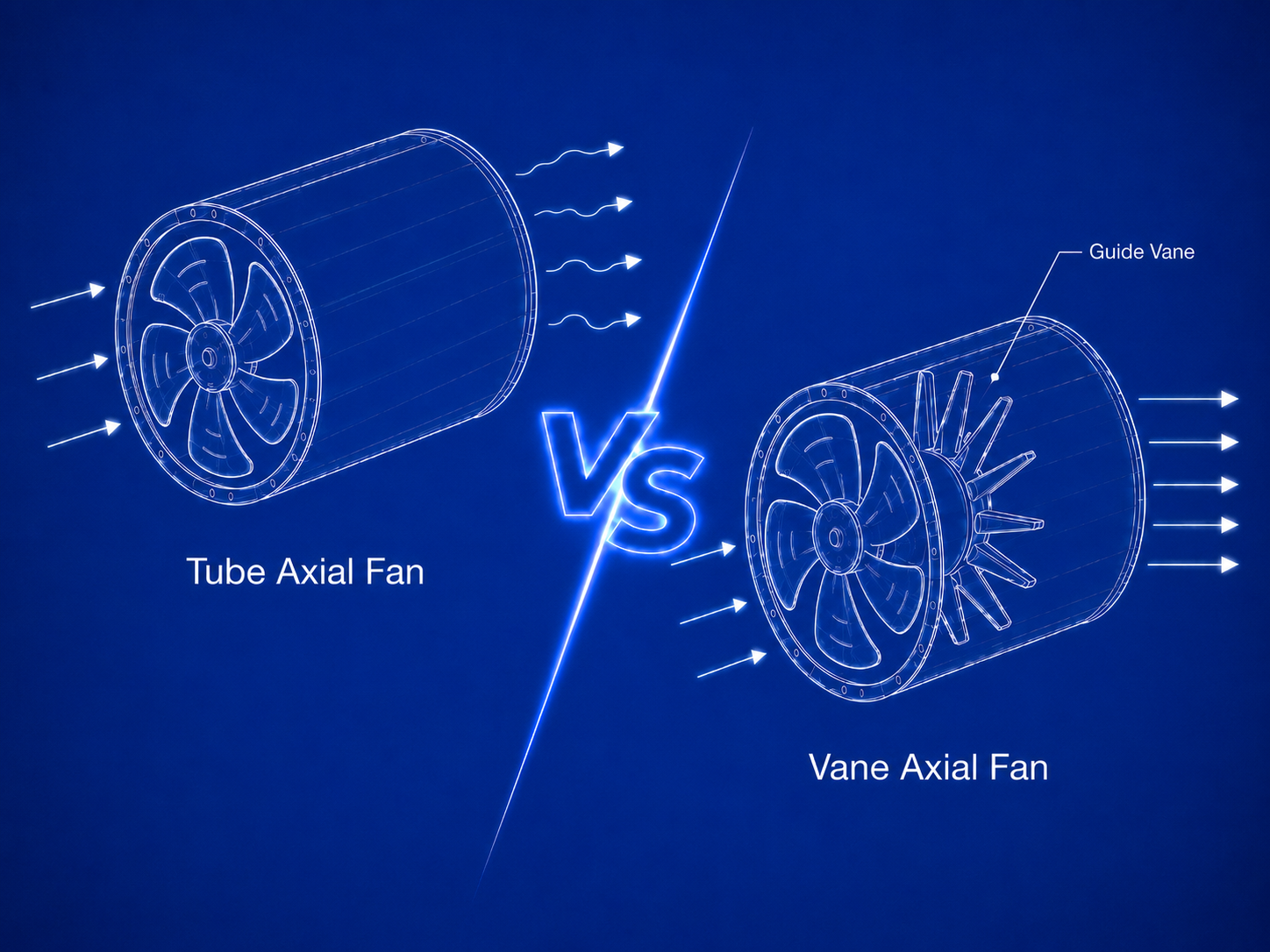
Because relying solely on total pressure for fan selection can be highly misleading. Dynamic pressure only represents the speed of the air, not the fan’s ability to overcome system resistance. A common mistake occurs when comparing axial fans and centrifugal fans. Axial fans often generate very high dynamic pressure, and if judged by total pressure, they might appear more “efficient” than centrifugal fans.
However, in actual applications that require overcoming duct resistance, what truly matters is static pressure. Centrifugal fans are generally superior at generating static pressure. If you mistakenly compare an axial fan based on its total pressure efficiency with a centrifugal fan based on its static pressure efficiency, you create a “misleading efficiency illusion.”
The Key Takeaway: In all ducted applications, you must use static pressure as the core comparison metric. This is the only way to ensure an accurate and fair evaluation.
2.2 The Heart of the Fan: How Impellers Use Fluid Dynamics to Create Powerful Airflow
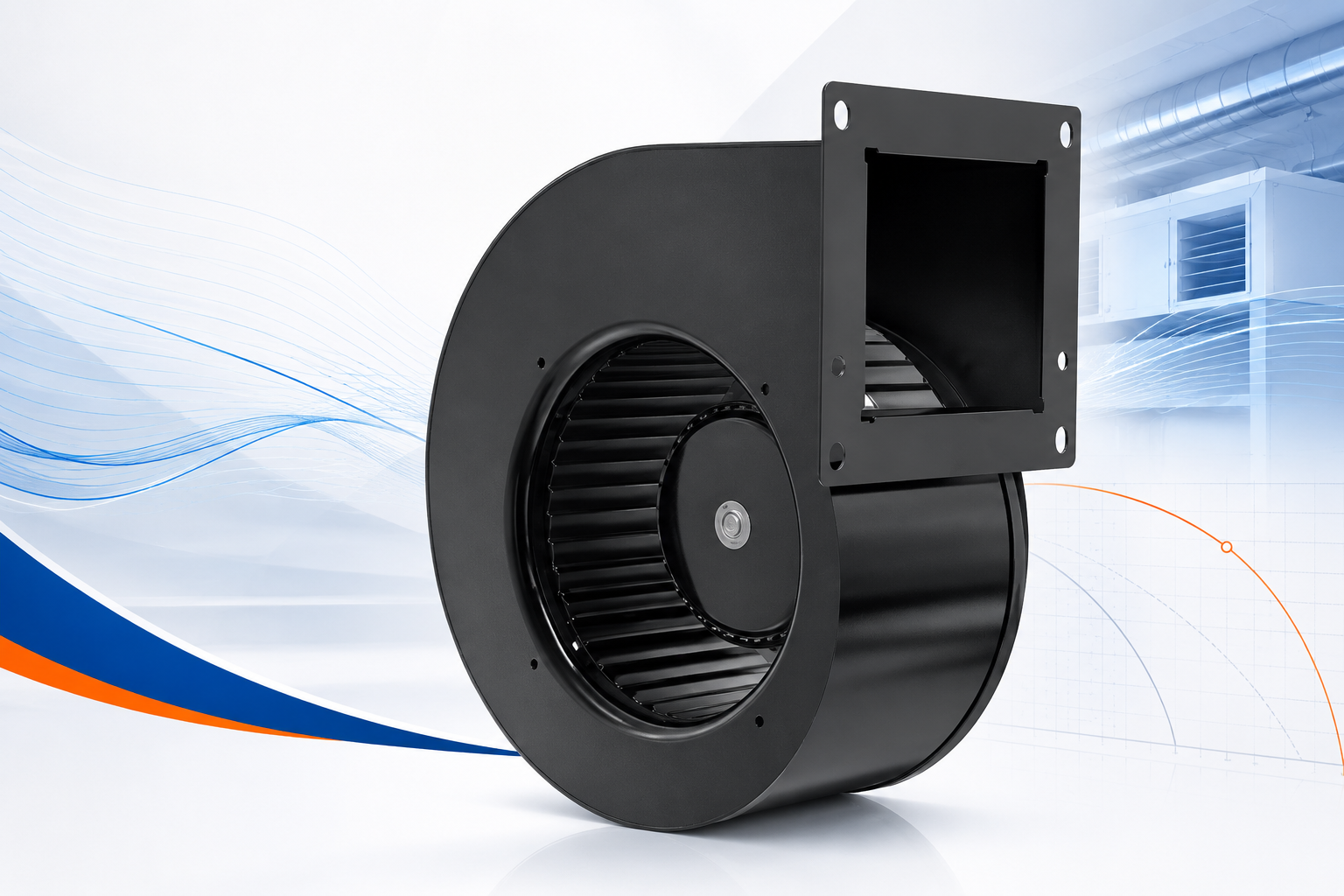
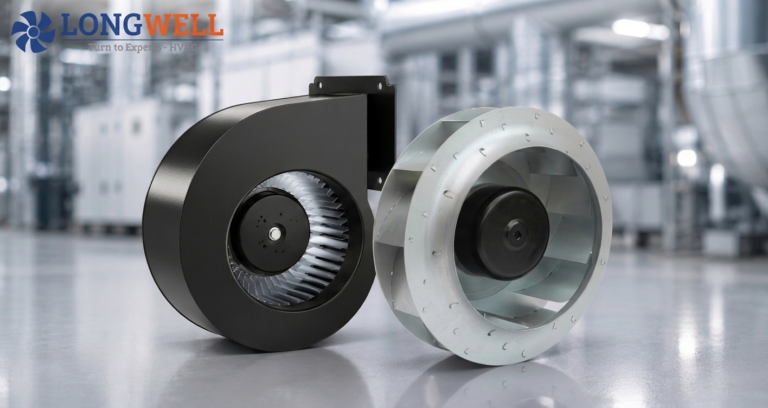
The core of a centrifugal fan is the impeller—a precisely engineered rotating component that transfers mechanical energy from the motor to the air, thereby increasing its velocity and pressure. The impeller’s design is not arbitrary; it strictly follows the fundamental principles of fluid dynamics and energy transfer, most notably the Bernoulli equation and the Euler turbomachinery equation.
Simply put, these physical principles directly link the impeller’s geometry and rotational speed to the resulting airflow and pressure. Engineers optimize the following key design parameters to maximize the fan’s efficiency and performance:
· Impeller Diameter: A larger diameter generally produces higher pressure and airflow, but energy consumption increases. This is a trade-off between performance and cost.
· Blade Angle: Both inlet and outlet angles are crucial for ensuring smooth airflow entry and exit, minimizing energy loss and turbulence.
· Number and Shape of Blades: More blades can increase efficiency but add to manufacturing complexity. The curvature of the blades is also adjusted for specific applications to guide airflow more effectively.
· Material Selection: Impeller materials must withstand the mechanical stresses of high-speed rotation and resist corrosion and abrasion to ensure long-term durability and operational balance.
Chapter 3: The Shape of Performance: A Head-to-Head Comparison of Forward-Curved, Backward-Curved, and Airfoil Impellers
The performance characteristics of a centrifugal fan are largely determined by the design of its “heart”—the impeller blades. Different blade shapes are suited for vastly different operating conditions. Understanding their pros and cons is fundamental to making the right choice.
3.1 Forward-Curved (FC) Fans
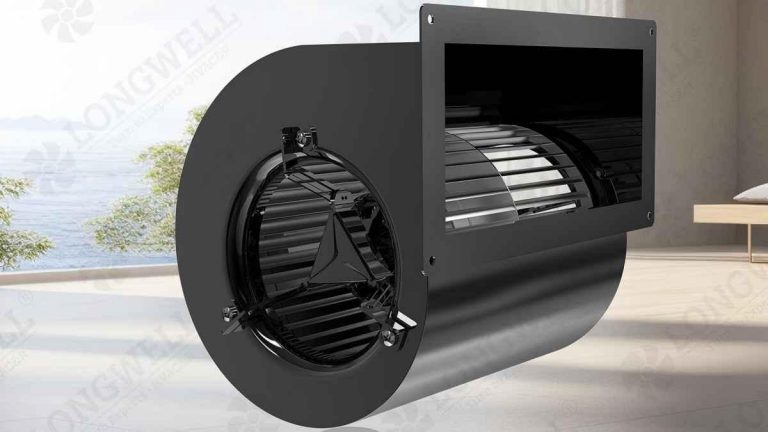
Characteristics: Blades curve in the direction of rotation. They have a compact appearance and are often called “squirrel cage” fans.
Pros:
· Compact Structure: Can move a large volume of air in a small space at relatively low speeds.
· Cost-Effective: Typically have the lowest initial investment.
· Lower Noise: Relatively quiet when operating in low-pressure environments.
Cons:
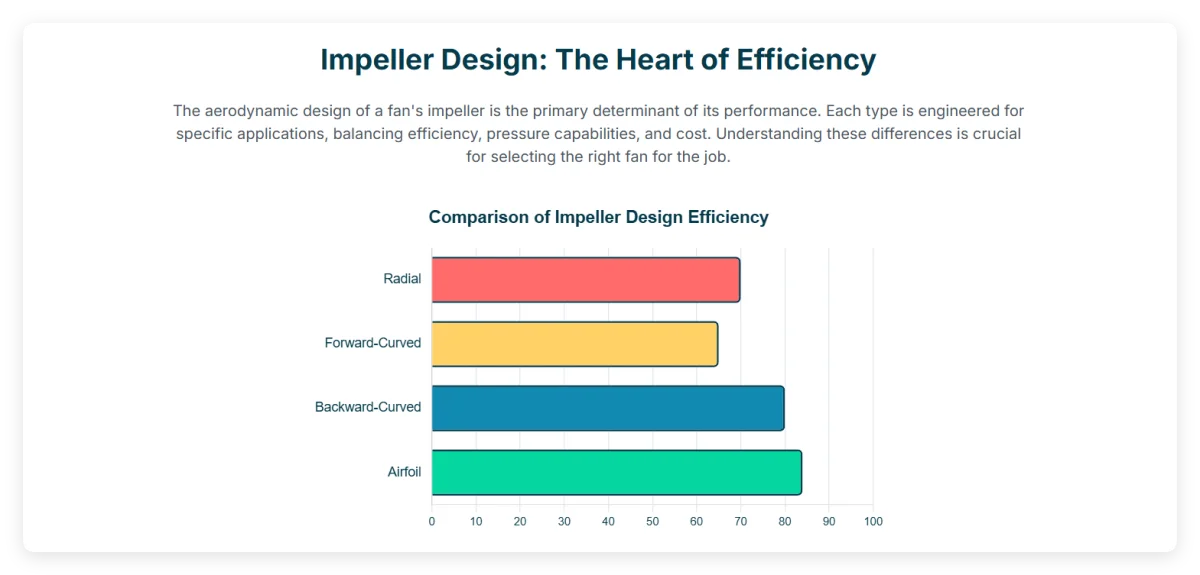
· Lower Efficiency: Static pressure efficiency is typically only up to 65%.
· Prone to Dust Buildup: The curved blades can easily trap and accumulate dust and debris, leading to performance degradation and imbalance.
Best Application Scenarios: Low-pressure, high-airflow, clean-air environments like residential furnaces, fan coil units, etc. Not suitable for handling dirty or greasy air.
3.2 Backward-Curved (BC) Fans
Characteristics: Blades curve away from the direction of rotation. This is one of the most common designs in industrial applications.
Pros:
· Higher Efficiency: Static pressure efficiency can reach up to 80%, providing significant energy savings.
· Handles Higher Pressure: Can effectively combat higher system resistance.
· Non-Overloading Power Curve: This is a crucial feature. It means that even if system resistance unexpectedly decreases (e.g., a filter is removed), the motor’s power consumption will not exceed its rated capacity, protecting the motor from damage.
Cons:
· Larger Size: Typically larger than forward-curved fans.
· Potential for Noise: Although some sources claim they are quieter, high-airflow models can generate more noise. However, this can be effectively mitigated through optimized design (e.g., using larger-diameter impellers at lower speeds).
Best Application Scenarios: General HVAC, exhaust systems, and industrial processes that handle clean or slightly dusty air.
3.3 Airfoil Fans
Characteristics: The ultimate evolution of the backward-curved design, with blade cross-sections shaped like an airplane wing.
Pros:
· Peak Efficiency: Static pressure efficiency can reach an impressive 84%, making them the most efficient of all centrifugal fans.
· Lowest Noise: The airfoil design creates a very smooth, uniform airflow, significantly reducing operational noise.
· Shares BC Advantages: Also has a non-overloading horsepower curve.
Cons:
· Requires Very Clean Air: Any particulate matter can damage the delicate blade surfaces and compromise their aerodynamic performance.
· Higher Initial Cost: Complex manufacturing processes lead to a larger upfront investment.
Best Application Scenarios: Large-scale HVAC systems, industrial clean-air systems, and environments with extreme demands for energy efficiency and low noise, such as hospitals, theaters, and laboratories.
3.4 Radial Blade Fans
Characteristics: Simple and robust design, with blades extending straight out from the central hub.
Pros:
· Extremely Sturdy and Durable: Can handle high-pressure, high-temperature, and even corrosive or abrasive particle-laden airstreams.
· Self-Cleaning Feature: The straight blades do not easily accumulate debris, making them ideal for handling dirty air.
Cons:
· Lower Efficiency: Static pressure efficiency is typically around 70%.
· Higher Noise: The simple design results in higher operational noise.
Best Application Scenarios: Material conveying, dust collection, and other harsh industrial environments.
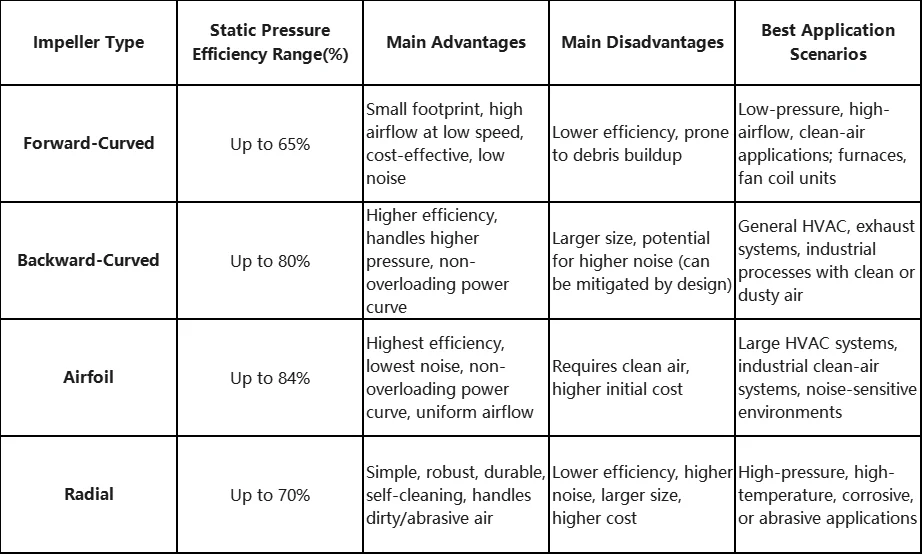
3.5 Comprehensive Comparison: At a Glance
To help you understand more intuitively, the table below summarizes the key characteristics of the four main impeller types:
Part 1 Summary
In this article, we explored the profound changes happening in the industrial fan industry and established the importance of a system-based evaluation approach. We delved into static pressure as the core metric for measuring a fan’s true performance and compared the unique advantages and suitable applications of four major centrifugal fan impeller designs.
Mastering this foundational knowledge is the first step toward building a high-efficiency ventilation system.
In the next part, we will move into an even more exciting area: exploring the game-changing EC motor technology and variable speed control strategies, and diving deep into the authoritative Fan Energy Index (FEI). We’ll see how these advanced technologies can bring unprecedented energy savings and return on investment to your facility.
What’s the biggest challenge you face in your ventilation systems? Is it energy consumption, noise, or maintenance issues?

Please share your experiences in the comments below! If you found this article valuable, please follow us and share it with your colleagues. Stay tuned for Part 2 of this series!