Industrial Blowers vs Fans: Key Differences and When to Use Each
On any facility manager or procurement officer’s equipment list, “fan” and “blower” are easily the two most confused terms.
It happens all the time. A company spends a significant portion of its Q1 budget on a massive, high-CFM (Cubic Feet per Minute) industrial fan, expecting it to clear heavy welding smoke through a long exhaust duct. Once installed? The smoke barely moves, the air stays thick, and the brand-new fan motor starts running dangerously hot. Or, conversely, a facility tries to cool down a massive, open-air warehouse using directed blowers, only to find that the air dissipates uselessly while consuming an absurd amount of electricity.
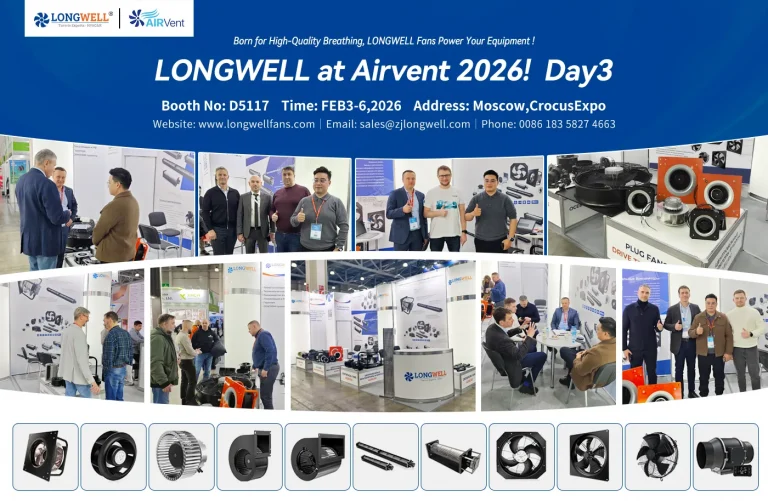
Earlier this year, at the overseas mechanical and electrical refrigeration exhibition,, the LONGWELL engineering team noticed this exact pain point crossing every language barrier. Why do so many smart facility managers pick the wrong equipment? It almost always boils down to a misunderstanding of the eternal battle between “Volume” and “Static Pressure.”
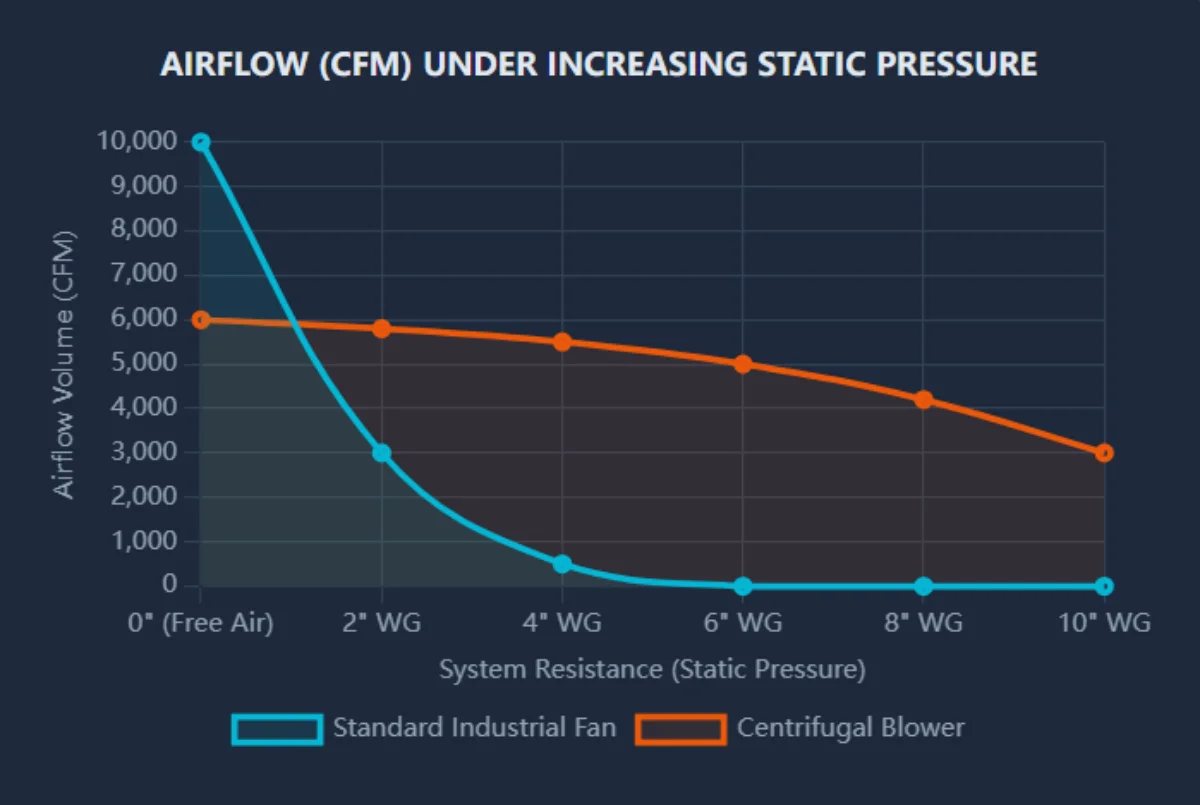
While people toss the words fan and blower around interchangeably in casual conversation, in the world of industrial manufacturing and HVAC engineering, they represent entirely different mechanical principles. Choosing the wrong device isn’t just a minor inconvenience. It leads to burned-out motors, skyrocketing energy bills, and—when dealing with toxic exhaust—severe safety hazards.
Let’s skip the complex fluid dynamics equations and break down the core differences in plain, practical English. Whether you are designing a brand-new production floor or looking to upgrade your ventilation efficiency this spring, here is everything you need to know to spend your equipment budget exactly where it belongs.
The Core Difference: Are You Moving Air, or Pushing It?
To understand the difference, you only need to look at how these two machines handle air and the obstacles in front of them.
Industrial Fans: The High-Volume Movers
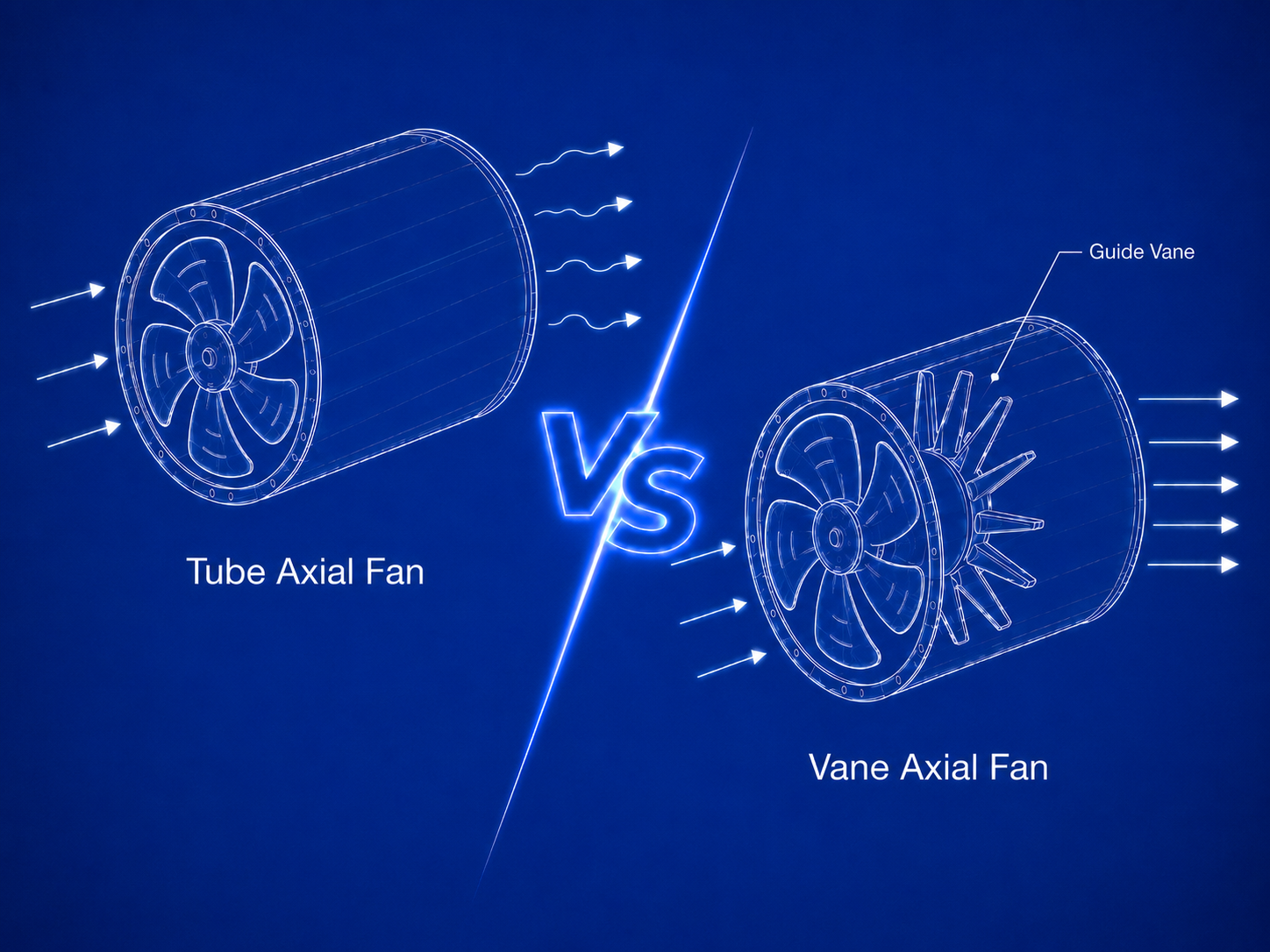
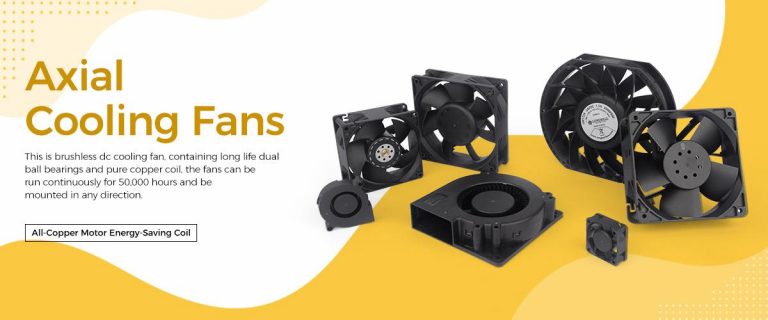
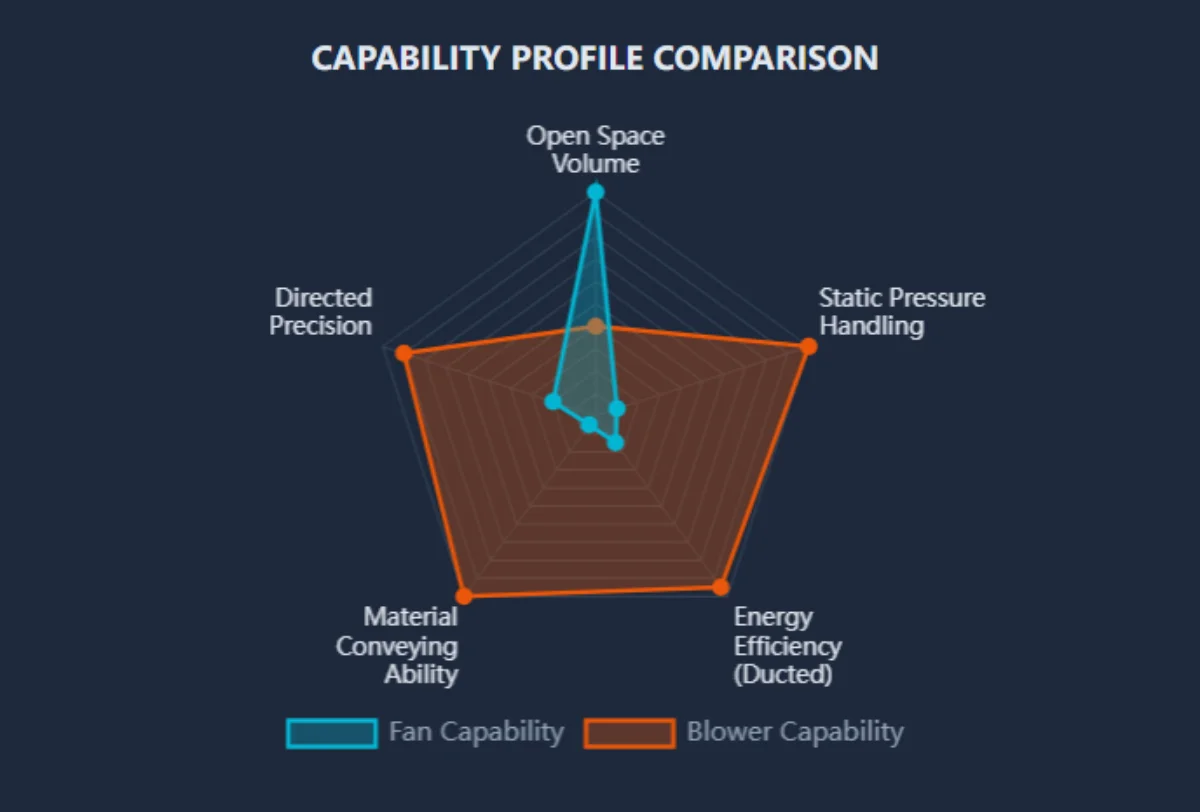
The primary job of an industrial fan (like a standard axial fan or large overhead unit) is simple: High Volume, Low Pressure.
Think of a fan’s blades like the propeller of an airplane. They slice through the air, grabbing massive amounts of it and moving it from one side of the room to the other. Their core mission is to circulate air across a wide, open space to create a cooling effect or maintain general air freshness.
The Fatal Flaw: Extreme Sensitivity to Resistance. An industrial fan is like a worker who can carry a massive pile of feathers across an empty parking lot, but trips the moment you ask them to walk through a narrow hallway. In an open environment, fans are spectacular. But the second you ask a fan to push air through a long, twisting duct, or force it through a dense HEPA filter (what engineers call “system resistance” or “static pressure”), the airflow stalls. The air simply bounces back, and the motor overheats because it’s basically holding its breath.
Industrial Blowers: The High-Pressure Powerhouses
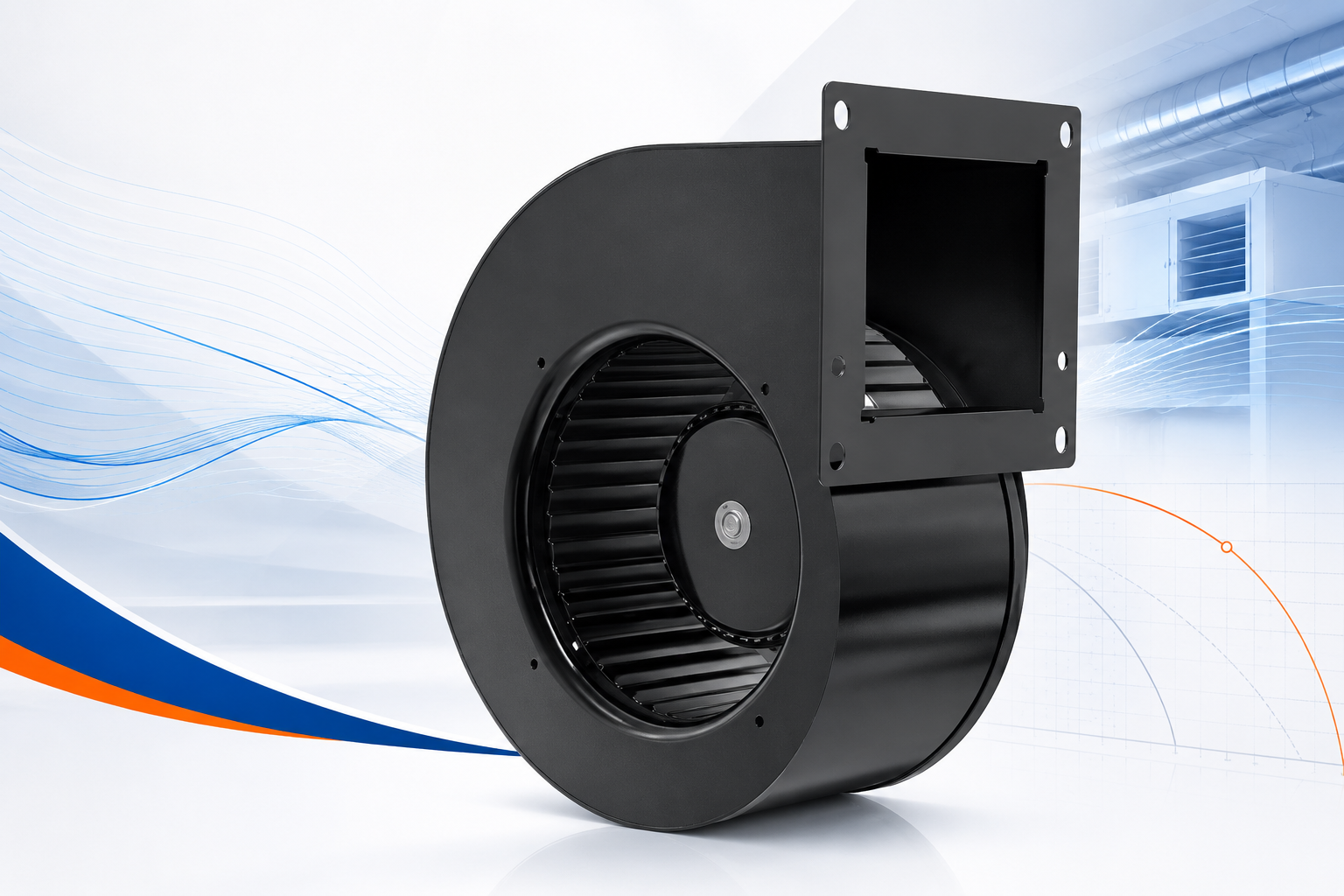
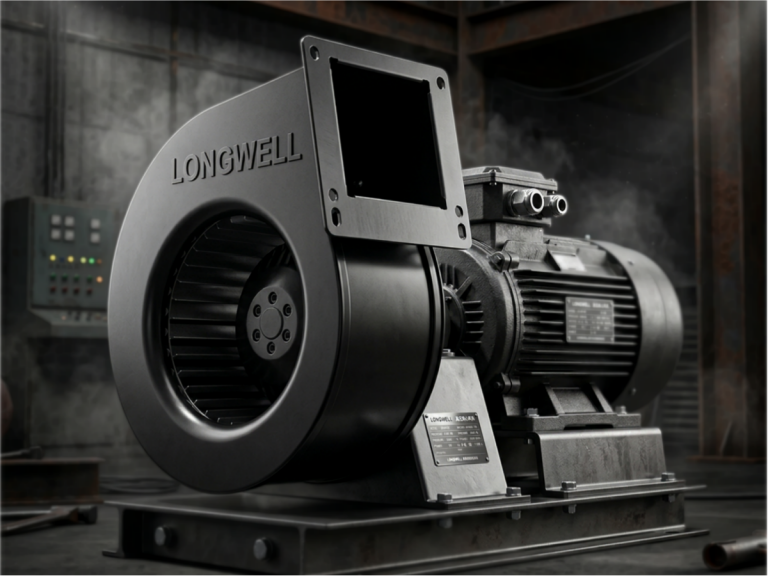
An industrial blower (such as a centrifugal blower), on the other hand, operates on a completely different philosophy: High Pressure, Directed Airflow.
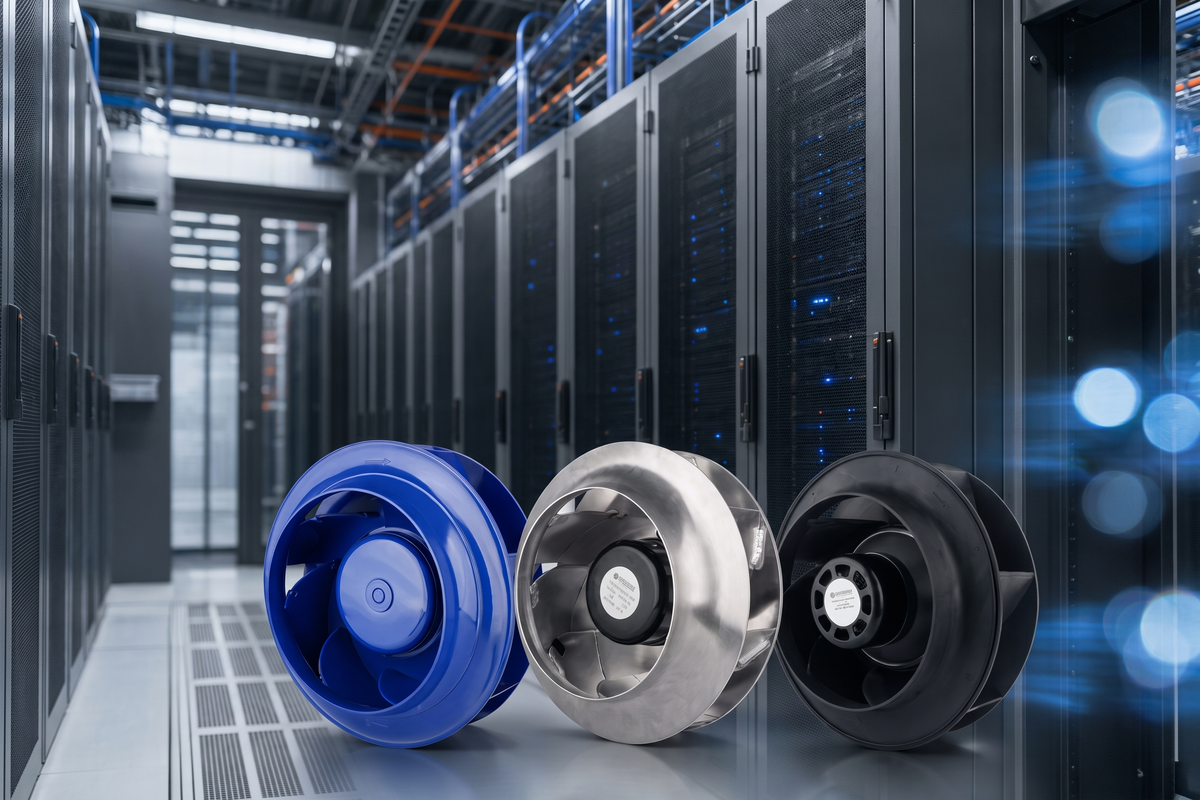
Instead of exposed propeller blades, a blower houses an impeller—a rotating component that looks somewhat like a heavy-duty hamster wheel. When the motor spins, air is pulled into the center of the housing. Centrifugal force then violently throws that air outward against the casing, squeezing and compressing it before shooting it out at a specific angle (usually 90 degrees) through a focused exhaust port.
The Core Advantage: Unstoppable Penetration. Blowers do not care about covering a wide area. They only care about pushing air through things. Even if you connect a blower to 50 feet of winding ductwork, heavy dust collectors, or tight combustion chambers, the blower generates enough static pressure to force the air through the system relentlessly. Think of it as a high-pressure water nozzle: focused, forceful, and unstoppable.
Matching the Equipment to the Application: What Does Your Facility Actually Need?
Now that we understand the mechanics, how does this translate to your procurement sheet? The golden rule is to ask yourself one question: Does my ventilation system have resistance?
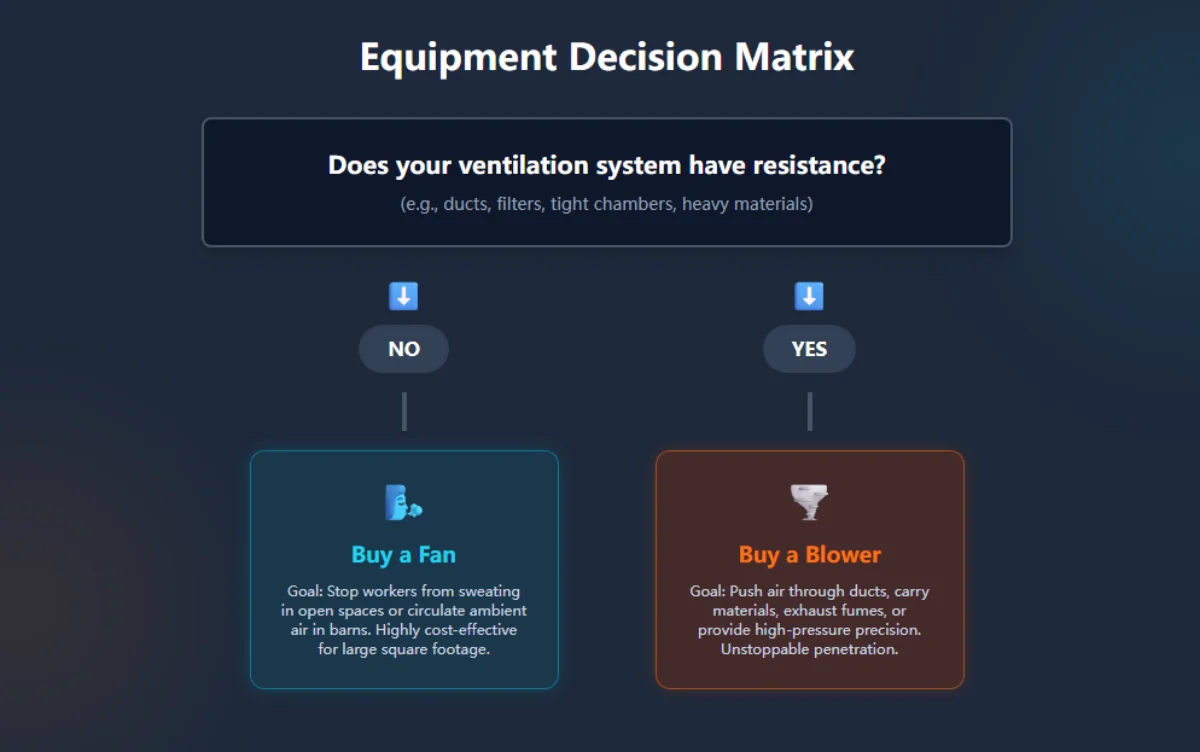
When should you blindly buy a fan? If your only goal is to stop workers from sweating in a 50,000-square-foot machine shop during the summer, or you need to keep ambient air circulating in a semi-open agricultural barn—buy an industrial fan. They are highly cost-effective, energy-efficient for large spaces, and cover massive square footage effortlessly.
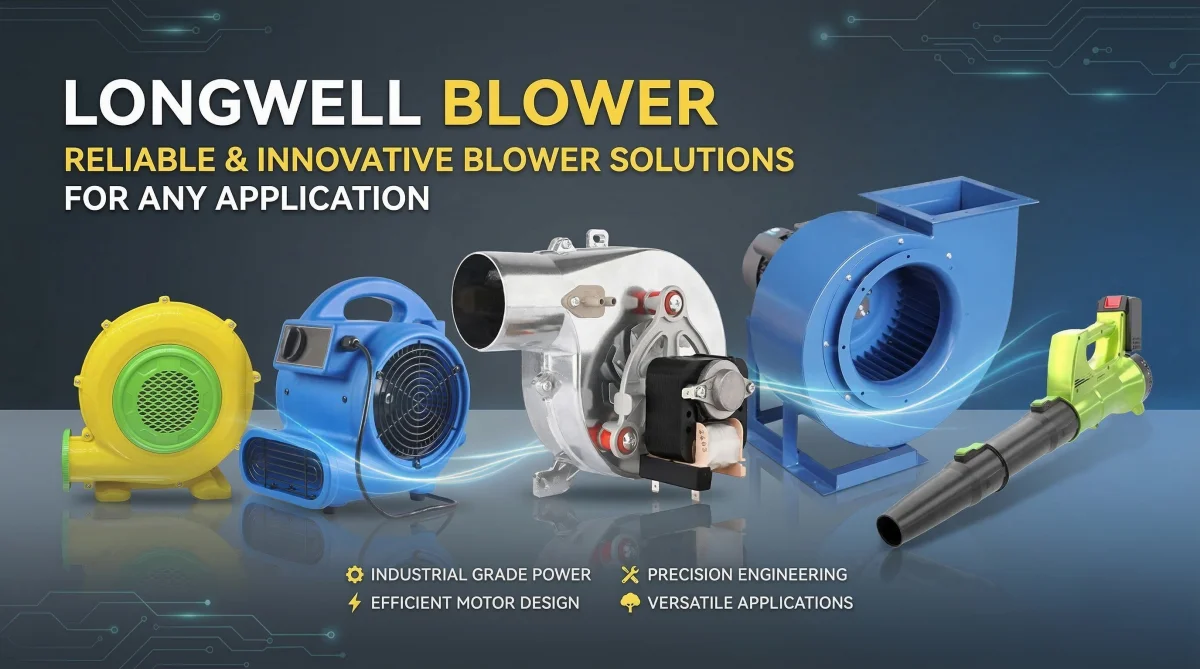
When do you absolutely need a blower? The moment your air needs to turn a corner, push through a barrier, carry heavy materials, or act with precision, a standard fan is useless. At LONGWELL, we engineer specialized air movement solutions for the world’s most demanding environments. To give you a clearer picture, here is how our targeted blower lineups solve complex industrial challenges:
1. Industrial Blowers: The Heart of Heavy Manufacturing
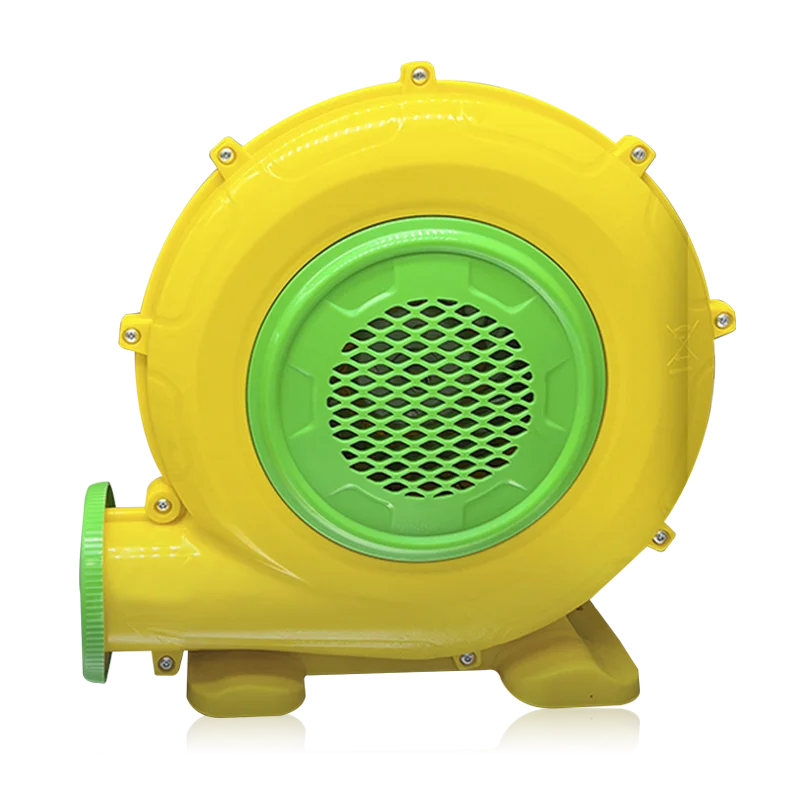
In industries like plastics, cement, and agriculture, facilities rely on “pneumatic conveying”—using directed air to transport heavy pellets, powders, or grains through long pipes from one silo to another. A gentle breeze won’t move solid mass. LONGWELL Industrial Blowers provide the sustained, high-static pressure required to keep heavy materials flowing through complex piping without clogging. They are also the only viable option for providing highly concentrated, high-pressure cooling directly to overheating engine components or forging equipment.
2. Exhaust Blowers: The Frontline of Worker Safety
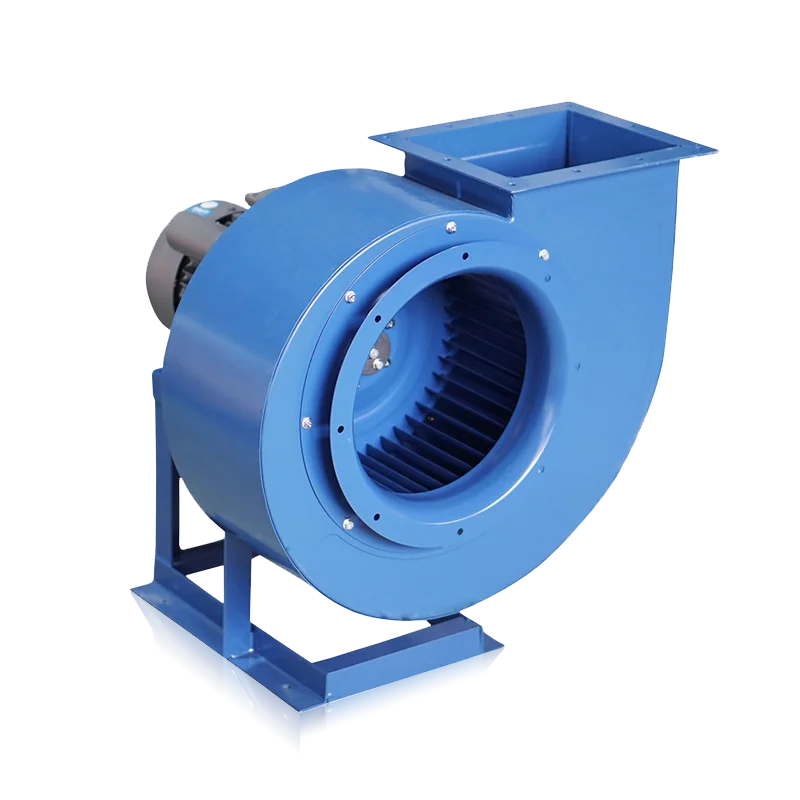
When dealing with hazardous environments, moving air isn’t enough; you must capture and remove it safely. If your facility produces dense welding smoke, chemical vapors, or heavy commercial kitchen grease, turning on a standard fan will just blow toxic air into the faces of your staff. LONGWELL Exhaust Blowers are engineered to create powerful negative pressure. They actively suck hazardous particulates directly from the source and aggressively force them out through dedicated exhaust networks, ensuring your facility remains compliant with strict OSHA and environmental health standards.
3. Floor Blowers: The Facility Manager’s Secret Weapon
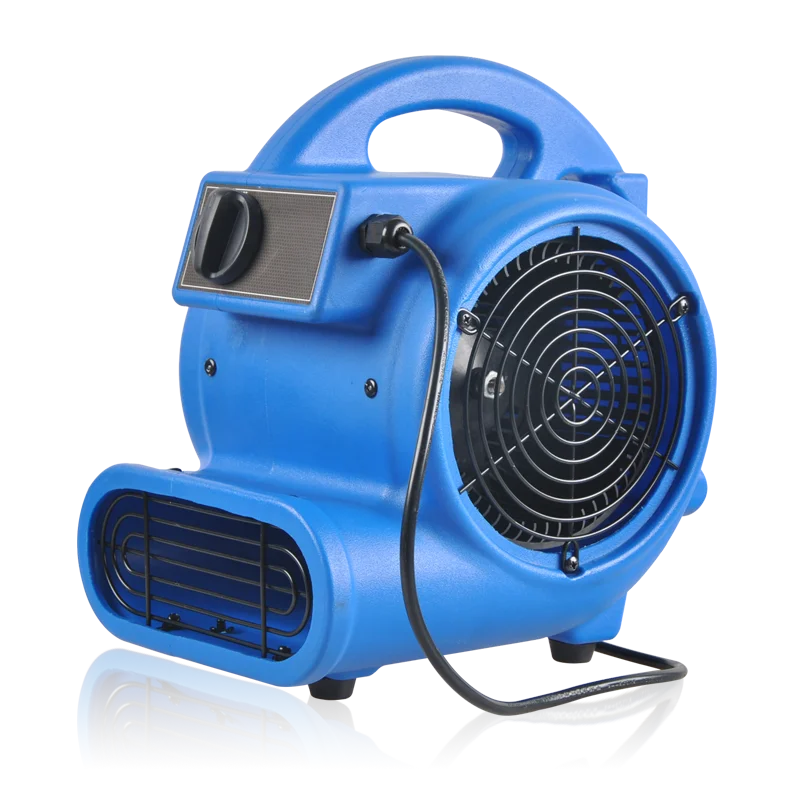
For massive warehouses, logistics centers, or cleanrooms, wet floors are a massive liability. Whether it’s an accidental chemical spill, a roof leak, or routine heavy-duty mopping, waiting for the floor to air-dry naturally invites forklift accidents and worker injury claims. A standard fan dissipates air too high up to help. LONGWELL Floor Blowers sit directly on the ground, shooting a highly concentrated, flat stream of high-velocity air across the surface. They act like an invisible squeegee, drastically cutting down drying times and keeping your operational zones safe.
4. Gas Blowers: The Precision Brain of Thermal Systems
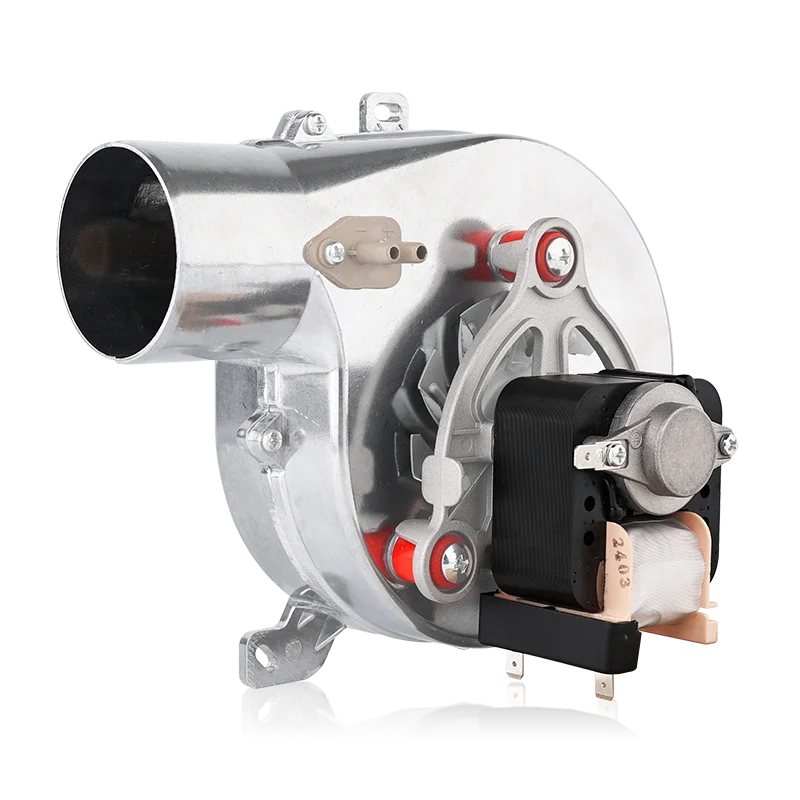
In commercial boilers, massive HVAC heating systems, and industrial dryers, combustion is a delicate science. If a fire doesn’t get enough oxygen, it produces lethal carbon monoxide and wastes fuel. If it gets too much, you lose heat efficiency. Gas blowers do not just “blow air”; they are precision instruments. A LONGWELL Gas Blower is integrated into the thermal system to push an exact, meticulously calculated volume of air into a pressurized combustion chamber. This ensures the perfect air-to-fuel ratio for clean, energy-efficient, and reliable heating.
5. Lawn Blowers: Heavy-Duty Outdoor Maintenance
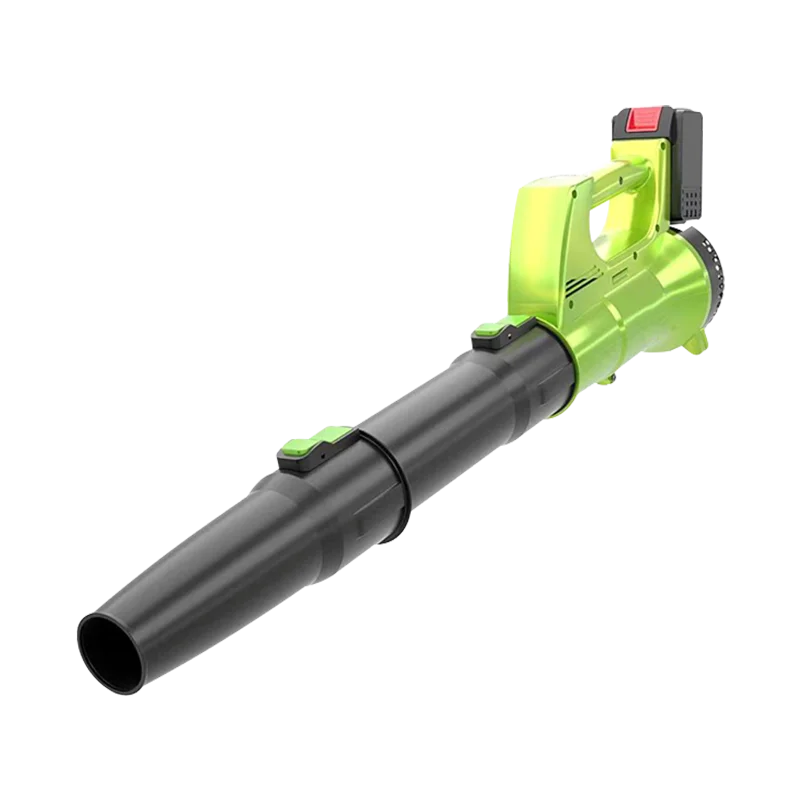
Industrial equipment management doesn’t stop at the factory doors. Maintaining the sprawling grounds, parking lots, and walkways of a commercial facility requires serious power. Traditional sweeping is far too labor-intensive when dealing with wet autumn leaves, dense gravel, and heavy dirt buildup. Commercial-grade Lawn Blowers deliver hurricane-force directed wind, allowing your maintenance crews to clear massive outdoor spaces in a fraction of the time, saving significant labor costs.
The Hidden Costs of Choosing the Wrong Equipment
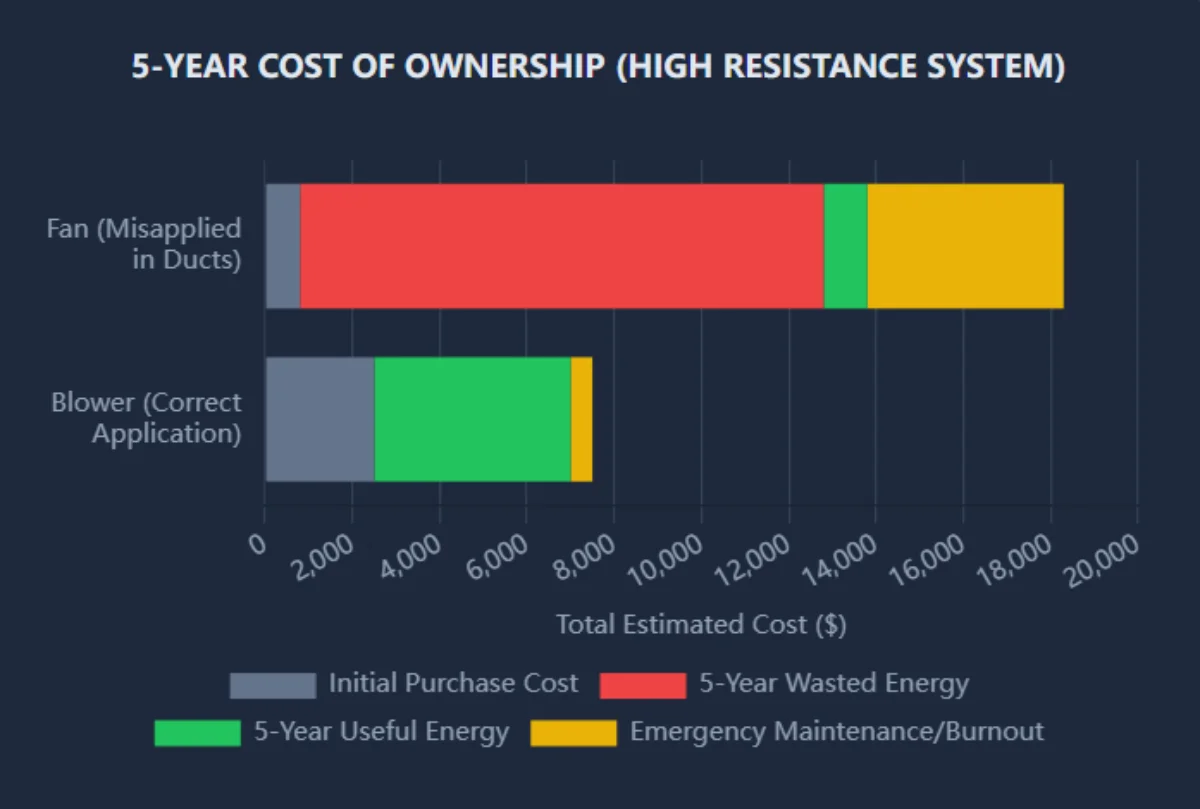
Many procurement teams fall into the trap of only looking at the initial purchase price. Yes, a large axial fan might be cheaper upfront than a precision-engineered centrifugal blower. But what happens when you install that fan into a high-resistance duct system?
Because the fan cannot overcome the static pressure of the ductwork, the air stops moving. However, the motor keeps spinning. Almost all the electrical energy being consumed is suddenly converted into wasted heat instead of kinetic airflow. Your electricity bill skyrockets while your ventilation fails.
Worse yet, running a fan in a state of constant “choke” drastically reduces its lifespan. A motor designed to last a decade might burn out its coils in three months. What follows is expensive downtime, emergency maintenance, and the eventual realization that you have to buy a blower anyway. Taking the time to evaluate your static pressure needs during your spring equipment renewal isn’t just a technical exercise—it’s a high-ROI cost-saving measure.
The Bottom Line: Let the Experts Guide Your Airflow
Choosing ventilation equipment ultimately comes down to knowing exactly where your air needs to go, and what stands in its way.
If you just need to move air around a big, open room: Buy a Fan. If your air needs to travel through ducts, carry heavy materials, exhaust dangerous fumes, or provide high-pressure precision: You must buy a Blower.
Aerodynamics is a strict science, but your procurement process shouldn’t have to be. If you are still looking at your facility’s blueprints or old exhaust ductwork and wondering which specific model will prevent a system failure, don’t guess.
Visit the experts at www.longwellfans.com. As a leading source manufacturer of precision ventilation equipment, LONGWELL doesn’t just sell blowers—we provide complete engineering consultations. Let our technical team calculate your required CFM and static pressure, and ensure every dollar you spend pushes your air exactly where it needs to go.