DC Axial Compact Fan vs AC Axial Fan: Key Differences Explained
When designing a cooling system for electronics, HVAC equipment, or industrial machinery, one of the first and most critical decisions engineers face is selecting the right motor type. While both DC axial compact fans and AC axial fans move air, their performance characteristics, energy efficiency, and control capabilities differ significantly.
For modern applications requiring precision, energy savings, and compact designs, the DC axial compact fan has largely become the industry standard. However, understanding why—and knowing when to choose one over the other—is essential for optimizing your system’s performance.
In this guide, we will break down the key differences between DC and AC fans, explore the benefits of 24V DC models, and provide a sizing guide to help you find the perfect match from Longwell’s extensive catalog.
What is an Axial Compact Fan?
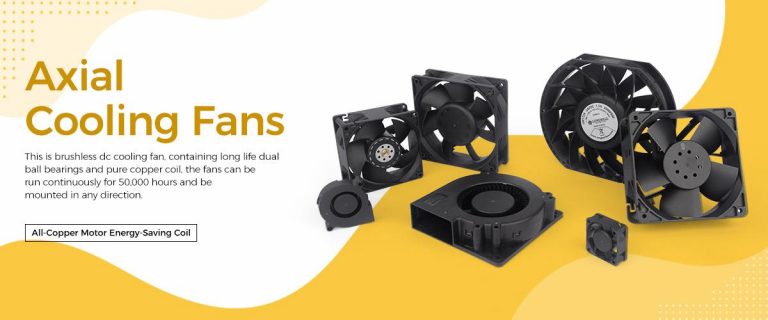
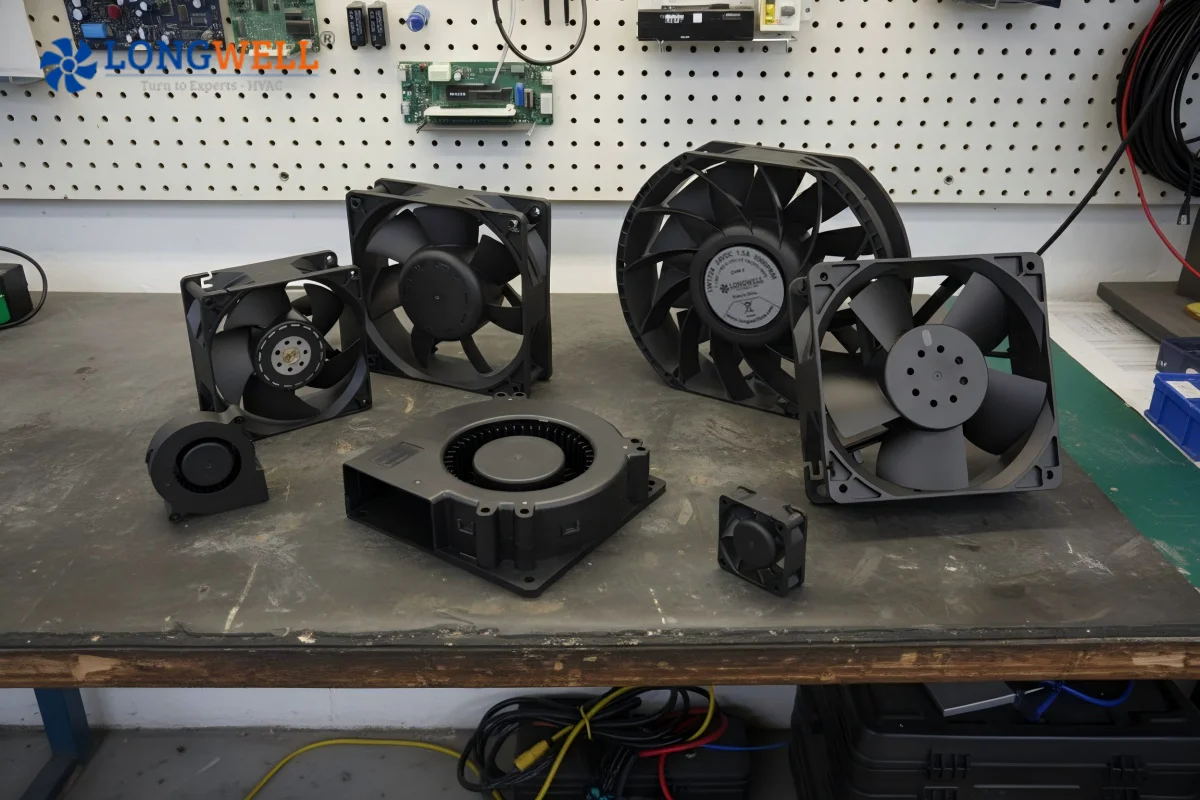
An axial compact fan is a type of fan that causes air to flow parallel to the shaft around which the blades rotate. The “compact” designation refers to their space-saving frame design, typically ranging from as small as 25mm (like the Longwell LWAD2510) up to 200mm or more.
These fans are ubiquitous in:
· Electronics Cooling: Servers, PCs, and power supplies.
· HVAC Systems: Ventilation for control panels and small duct spaces.
· Appliances: Refrigerators, purifiers, and humidifiers.
DC vs. AC Axial Fans: The Core Differences
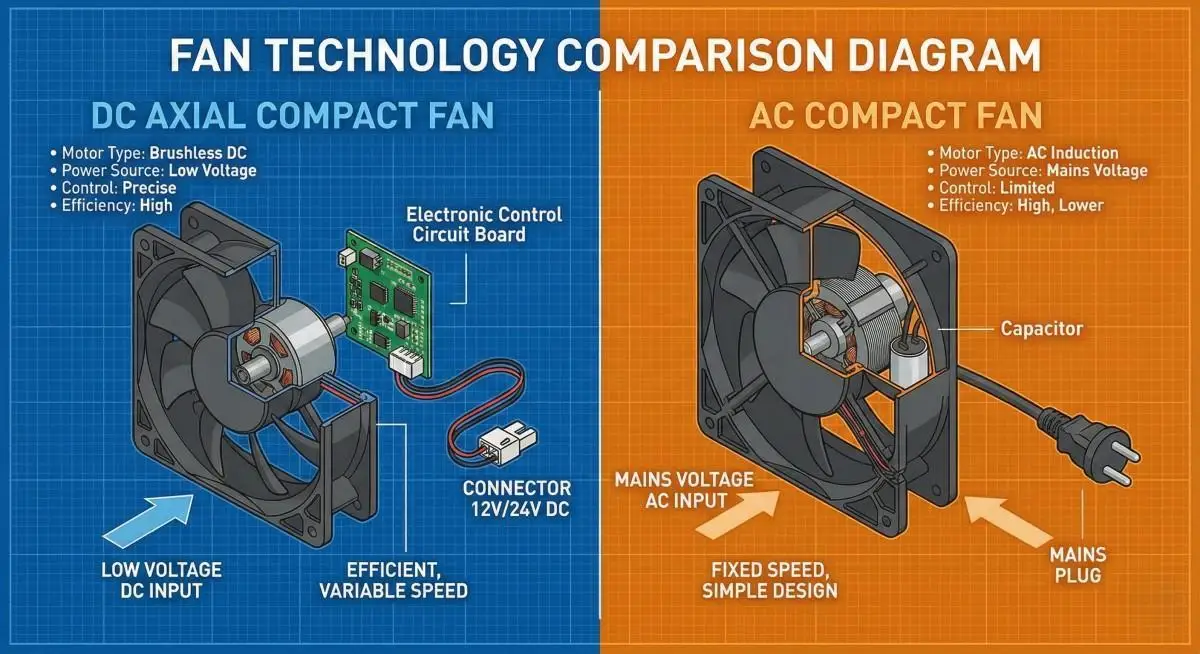
While AC (Alternating Current) fans connect directly to mains power (e.g., 115V or 230V), DC (Direct Current) axial compact fans operate on low voltage (typically 5V, 12V, 24V, or 48V). Here is how they stack up:
1. Energy Efficiency and Power Consumption
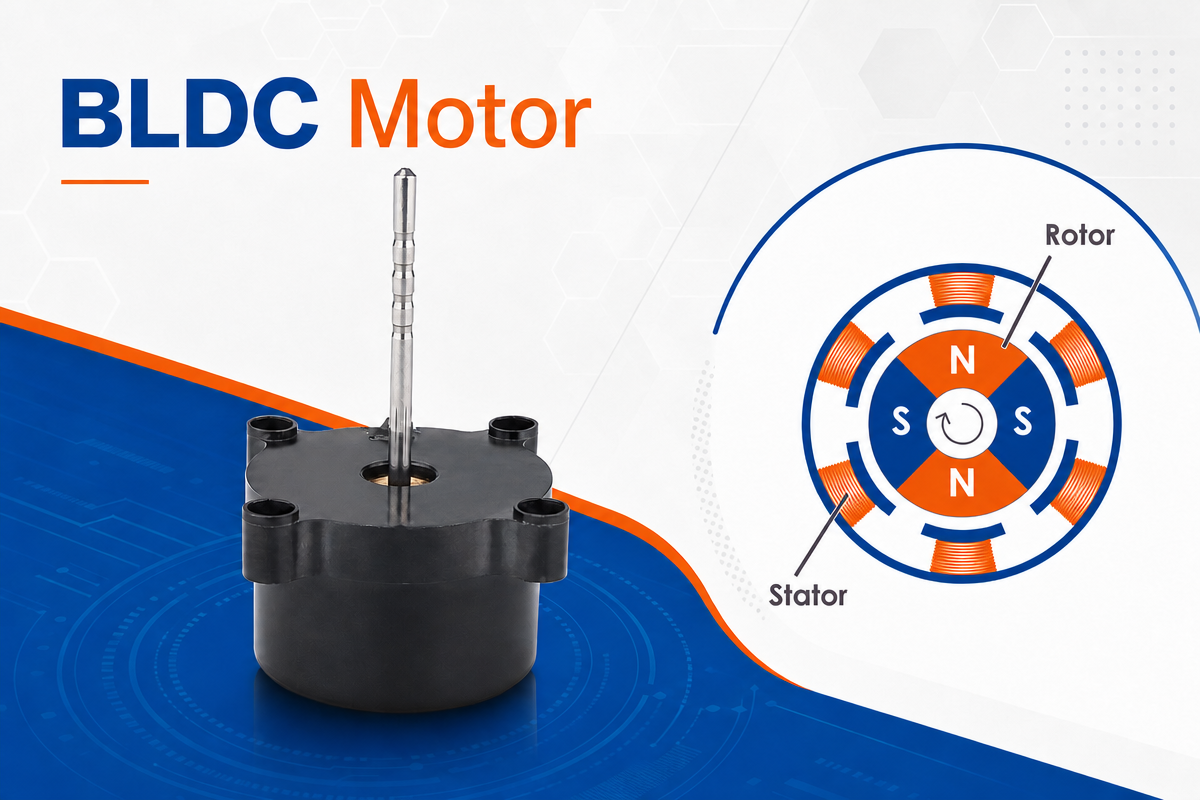
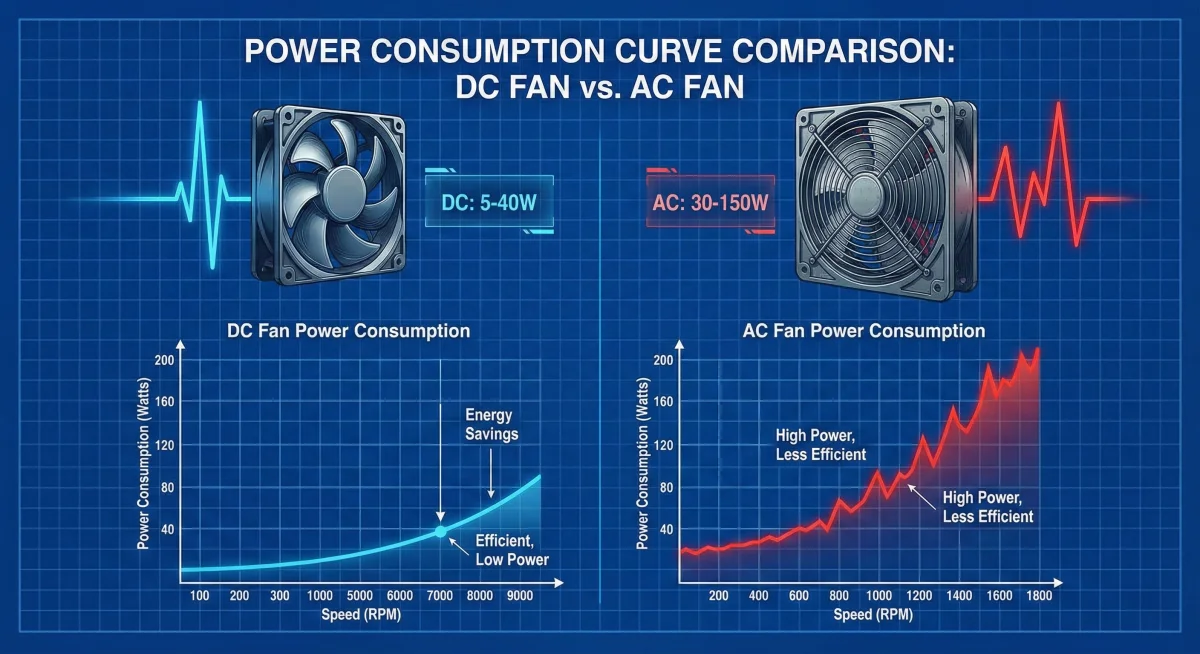
DC fans are significantly more efficient. A DC axial compact fan typically consumes up to 70% less energy than an AC counterpart of the same airflow. This is due to the efficiency of the brushless DC motors (BLDC) used by manufacturers like Longwell. For battery-operated devices or 24/7 server rooms, this energy saving is crucial.
2. Speed Control and Intelligence
This is the biggest game-changer.
· AC Fans: Usually run at a fixed speed determined by the line frequency (50Hz or 60Hz). Changing speed requires complex and inefficient voltage control.
· DC Fans: Offer precise speed control via PWM (Pulse Width Modulation) or 0-10V signals. You can program a Longwell LWAD series fan to run silent at low loads and ramp up to full speed only when temperatures rise. They also feature intelligent signals like Tachometer (FG) output to monitor RPM and Alarm (RD) signals to warn of fan failure.
3. Voltage and Safety
Axial compact fan voltage 24V DC is a sweet spot for industrial and safety-critical applications.
· Safety: Low voltages (12V/24V) eliminate the risk of electric shock during maintenance.
· Stability: DC fans handle voltage fluctuations better than AC fans, which can overheat or stall if the grid voltage is unstable.
4. Noise and EMI
DC fans generally operate more quietly and generate less Electromagnetic Interference (EMI), making them ideal for medical devices and telecommunications equipment where signal integrity is paramount.
|
Feature |
DC Axial Compact Fan (e.g., Longwell LWAD) |
AC Axial Fan |
|
Power Source |
5V, 12V, 24V, 48V DC |
115V, 230V AC |
|
Efficiency |
High (Energy Saving) |
Low to Moderate |
|
Speed Control |
Precise (PWM, Voltage) |
Difficult / Fixed |
|
Life Expectancy |
High (Long-life ball bearings common) |
Moderate |
|
Safety |
Low Voltage Safety |
Mains Voltage Risk |
Why 24V DC Axial Compact Fans Are Industry Favorites
Among the various voltage options, the axial compact fan voltage 24V DC configuration is particularly popular in industrial automation and HVAC control panels.
· Compatibility: Most industrial PLCs and power supplies output 24V.
· Power Density: 24V motors can deliver higher torque and static pressure than 5V or 12V counterparts in the same frame size, which is essential for pushing air through dense filters or tightly packed components.
 How to Choose Axial Compact Fan Size
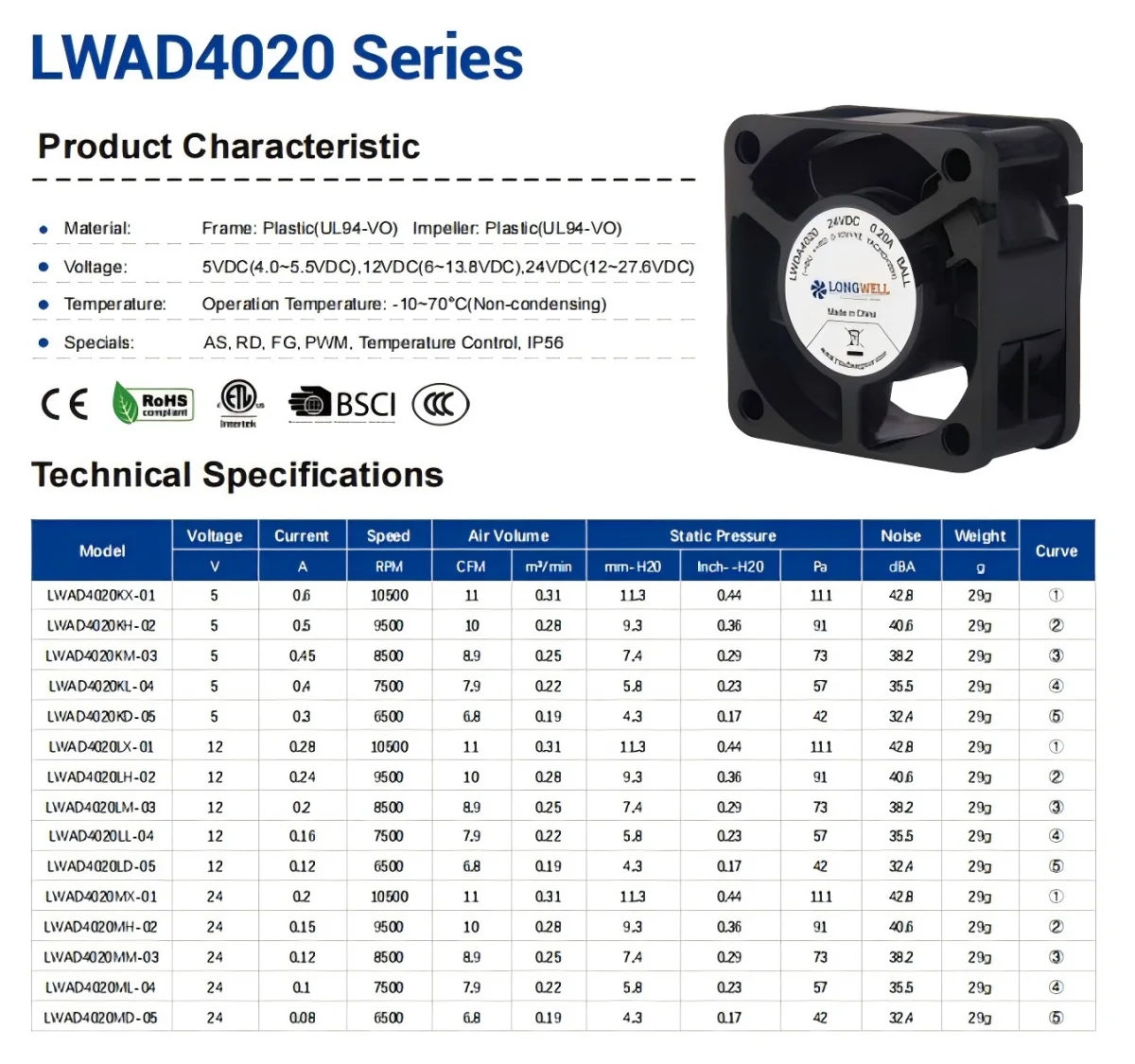
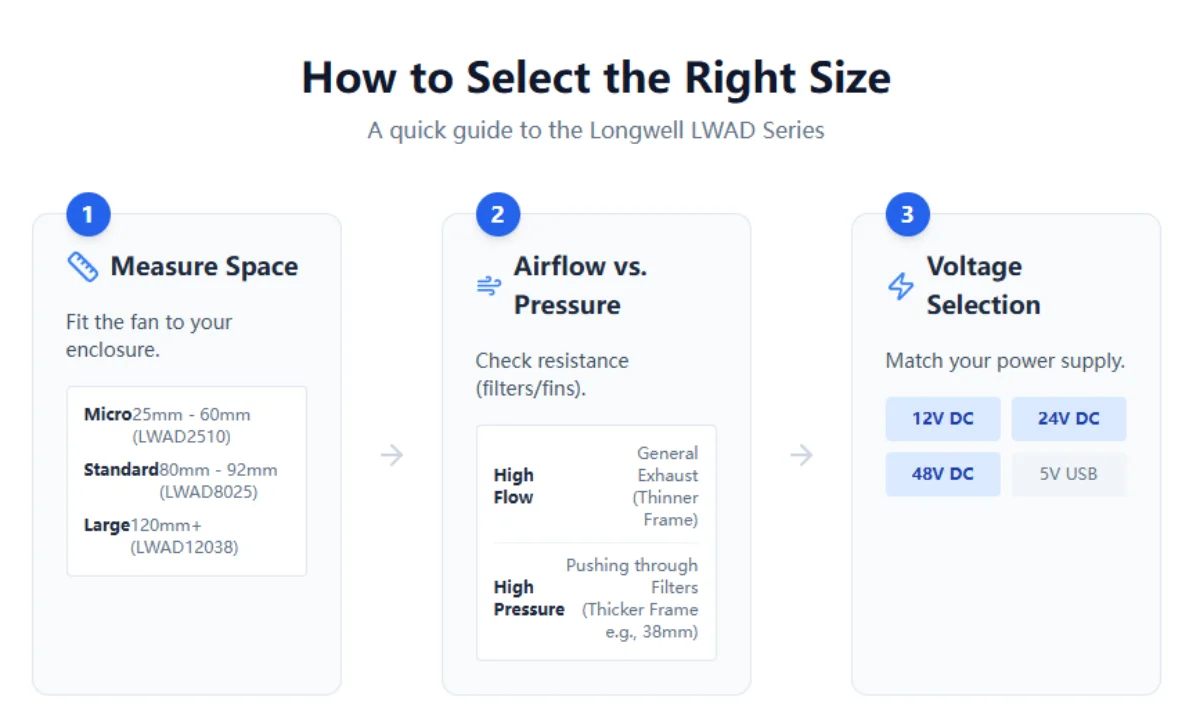
Selecting the right size involves balancing airflow (CFM), static pressure, and available physical space. As a leading DC axial compact fan supplier, Longwell offers a spectrum of sizes. Here is a quick guide based on our LWAD Series:
Step 1: Measure Your Space
· Tiny Spaces (25mm – 60mm): For handheld devices or small PCBs.
– Example: LWAD2510 (25x25x10mm) or LWAD4010 (40x40x10mm). These are ultra-compact solutions.
· Medium Spaces (80mm – 92mm): Standard PC cases and power supplies.
– Example: LWAD8025 or LWAD9225.
· Large Spaces (120mm – 172mm+): Server racks, large enclosures, and HVAC ventilation.
– Example: LWAD12038 (High static pressure) or the oval-shaped LWAD17251.
Step 2: Determine Airflow vs. Pressure
· High Airflow (CFM): Needed for exhausting heat from a general enclosure. Look for larger impellers.
· High Static Pressure (mmH2O): Required if the fan is pushing air through a heatsink, radiator, or filter.
– Pro Tip: A thicker fan (e.g., 38mm thick vs. 25mm thick) usually offers significantly higher static pressure. The Longwell LWAD12038 is a beast for high-pressure applications compared to the thinner LWAD12025.
Step 3: Select Bearing Type
· Sleeve Bearing: Cost-effective, good for vertical mounting.
· Ball Bearing: Higher cost but significantly longer lifespan (50,000+ hours) and suitable for any mounting orientation. Longwell typically recommends ball bearings for critical industrial exports.
Case Studies: Longwell Fans in Action
To demonstrate the versatility of our products, here are two real-world applications using Longwell DC fans.
Case Study 1: Precision Medical Ventilator
· Challenge: A US-based medical device manufacturer needed a cooling solution for a portable ventilator. The fan had to be ultra-quiet (bedroom use) and extremely reliable (life-critical).
· Solution: They selected the Longwell LWAD4010 (12V DC) with a customized low-noise bearing system and PWM control.
· Result: The variable speed allowed the fan to run silently at night. The compact 40mm size fit perfectly inside the portable housing, and the 12V DC input matched the device’s battery system.
Case Study 2: European Server Farm Retrofit
· Challenge: An axial compact fan exporter for Europe sought a replacement for aging AC fans in a data center. The goal was to reduce energy costs by 20%.
· Solution: We supplied the high-performance LWAD17251 (48V DC).
· Result: By switching to 48V DC fans with intelligent EC technology, the facility reduced cooling energy consumption by 35%. The 48V input minimized current draw on the DC bus, and the fans’ high static pressure efficiently managed the dense server racks.
About LONGWELL
Ningbo Longwell Electric Technology Co., Ltd. (Website: www.longwellfans.com) is a professional manufacturer of HVAC fans and motors. We provide a full range of aerodynamic products including centrifugal fans, axial fans, cross-flow fans, and EC/DC/AC motors. Our products are widely used in HVAC, refrigeration and cold chain, electronic cooling, and industrial purification fields. With strict adherence to CE, RoHS, and BSCI standards, Longwell is your trusted partner for high-performance air moving solutions.
What Customers Say
“We switched to Longwell for our 24V DC cabinet fans last year. The LWAD12038 series has incredible static pressure compared to the generic brands we used before. Zero failures in 18 months.”
— Mark D., Senior Sourcing Manager, Industrial Automation Systems (USA)
“Finding a reliable DC axial compact fan supplier who understands custom PWM requirements is hard. Longwell’s engineering team helped us tune the speed curve for our new air purifier line. Excellent service.”
— Sarah Jenkins, Product Developer, Smart Home Appliances (UK)
FAQ
Q1: What is the main advantage of a DC axial fan over an AC fan?
A: The main advantages are higher energy efficiency (up to 70% savings), variable speed control (PWM), and safety due to lower operating voltages.
Q2: Can I use a 24V DC fan with a 12V power supply?
A: Generally, no. A 24V fan might spin very slowly or not start at all on 12V. Always match the axial compact fan voltage to your power supply. Longwell offers models in 5V, 12V, 24V, and 48V.
Q3: How do I choose the right axial compact fan size?
A: Measure the mounting area available (e.g., 120x120mm) and determine the heat load. If you have high resistance (filters), choose a thicker fan like the LWAD12038 for better pressure. For tight spaces, look at the LWAD4010 or LWAD6015.
Q4: Are Longwell fans suitable for the European market?
A: Yes, we are experienced axial compact fan exporters for Europe. Our fans meet CE and RoHS standards, ensuring compliance with EU regulations.
Q5: What is the difference between Sleeve and Ball bearings?
A: Sleeve bearings are quieter initially and cheaper but have a shorter life. Dual Ball bearings (used in many Longwell high-performance models) last much longer and can be mounted in any orientation, making them ideal for “best price axial compact fan suppliers” who don’t want to sacrifice quality.
Q6: Does Longwell offer waterproof fans?
A: Yes, many of our LWAD series fans can be customized with IP55, IP56, or even IP68 ratings for moisture and dust protection.