Understanding Centrifugal Fan Curves: How to Read Performance Charts
Holding the test report sent by a supplier, many procurement managers—and even HVAC engineers with a few years under their belts—like to flip straight to the last page to look at the maximum parameters.
Wrong. Dead wrong.
The Performance Chart is the actual “Book of Life and Death” for your entire ventilation system. If you can’t read it, those Centrifugal Fans you bought, no matter how beautiful the nameplate data looks, might instantly turn into howling scrap metal once installed on-site.
Selection is never a guessing game. Reading the charts is the only way for technical professionals to avoid “parameter traps”. Today, we are digging deep. Let’s strip away the surface and look at the technical bottom lines hidden within these coordinates.
Shatter the “Maximum” Illusion: The Zero-Sum Game of Airflow and Static Pressure
At your first glance at a chart, stop staring at the maximum Static Pressure (SP) on the vertical axis and the maximum Airflow (CFM/CMH) on the horizontal axis.
These two extreme values can absolutely never coexist in the real physical world.
System Resistance is an invisible wall. It is not a fixed number, but a steep parabola. According to the iron law of fluid mechanics, the pressure loss of a system is proportional to the square of its flow rate (P=K·Q^2).
Your dampers, primary and high-efficiency filters, cooling coils, and those notoriously frustrating 90-degree elbows… they are all frantically devouring the fan’s kinetic energy. The only intersection point between the gliding performance curve on the chart and this steep system resistance parabola is your actual “Operating Point” in the field.
Calculate the resistance wrong? Then you are using a sledgehammer to crack a nut, or a pony to pull a heavy wagon. No matter how pretty the chart is drawn, it’s just waste paper.
![Shatter the [Maximum] Illusion- The Zero-Sum Game](https://www.longwellfans.com/wp-content/uploads/2026/03/bss_Understanding-Centrifugal-Fan-Curves-H_01.png)
Core Insight: Revealing the unique intersection of the “System Resistance” curve and the “Fan Performance” curve—this is the true Operating Point of the fan in the field. Stop staring at the false prosperity at the ends of the axes.
The Subtext of Curves: Impeller Determines Destiny
Even among centrifugal fans, different impeller designs result in two wildly extreme personalities on the charts.
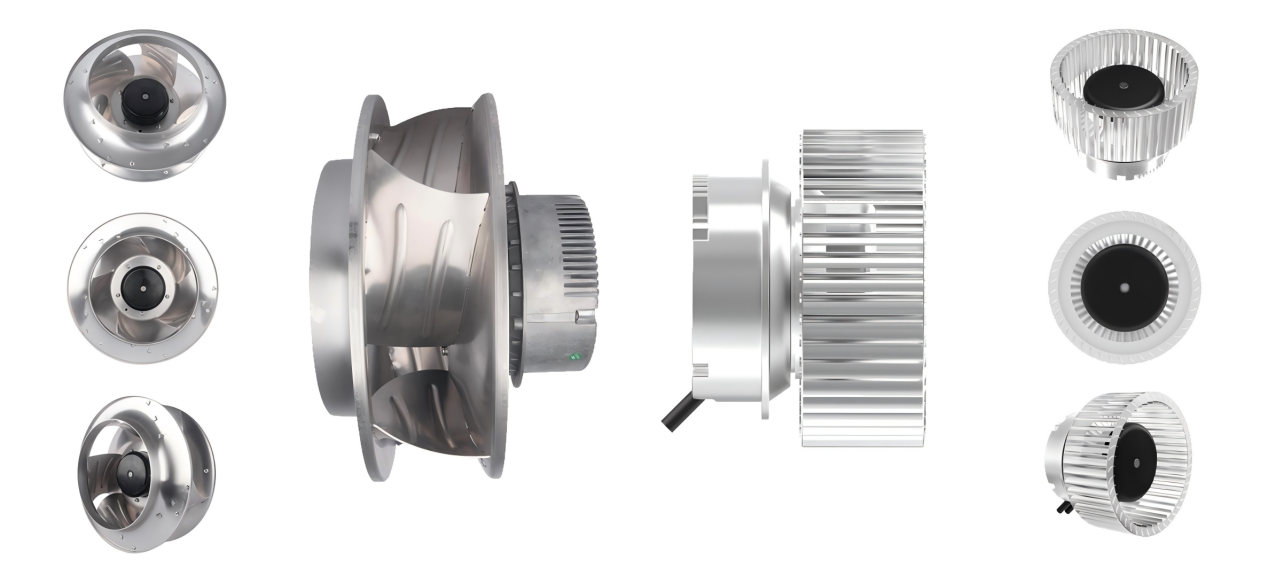
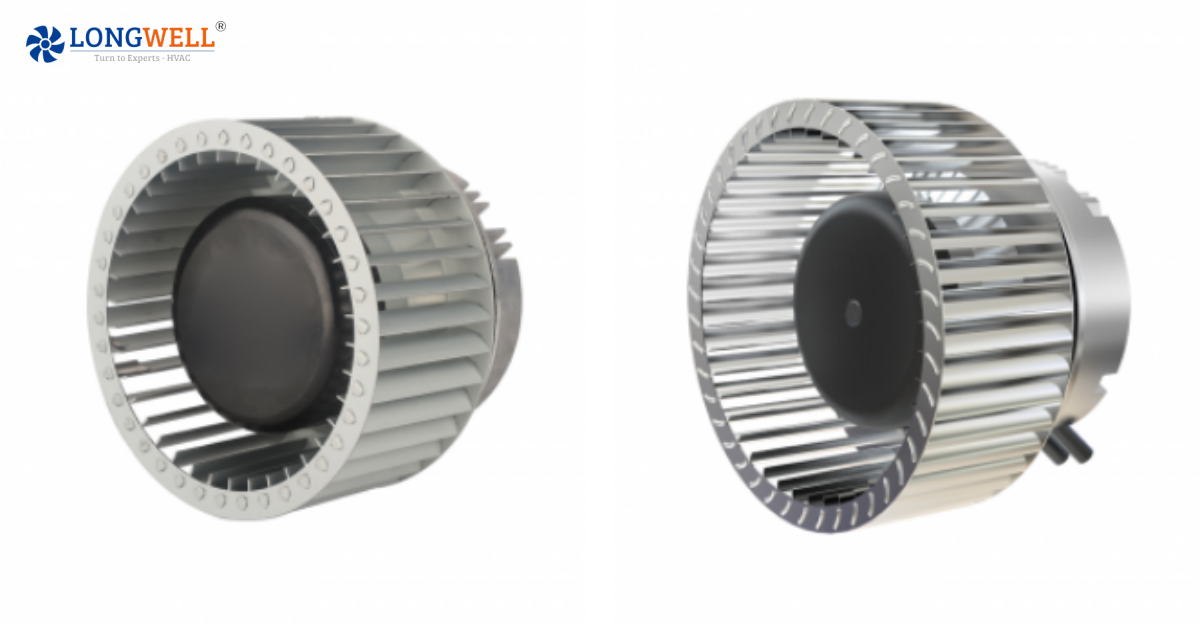
Forward Curved Centrifugal Fan: The Boiling Frog Overload Trap
Forward-curved impellers. Low speed, large airflow. It looks beautiful.
But look closely at its power curve (BHP – Brake Horsepower). It keeps rising. What does this mean? If the on-site system resistance drops suddenly—say, an inspection door isn’t closed tight, or a filter tears—the operating point will rush down and to the right along the curve. While airflow surges, the motor load instantly maxes out.
Burning out a motor often happens in this exact split second. Therefore, when choosing a forward-curved fan, you must lock your eyes on the maximum power point and leave plenty of motor margin.
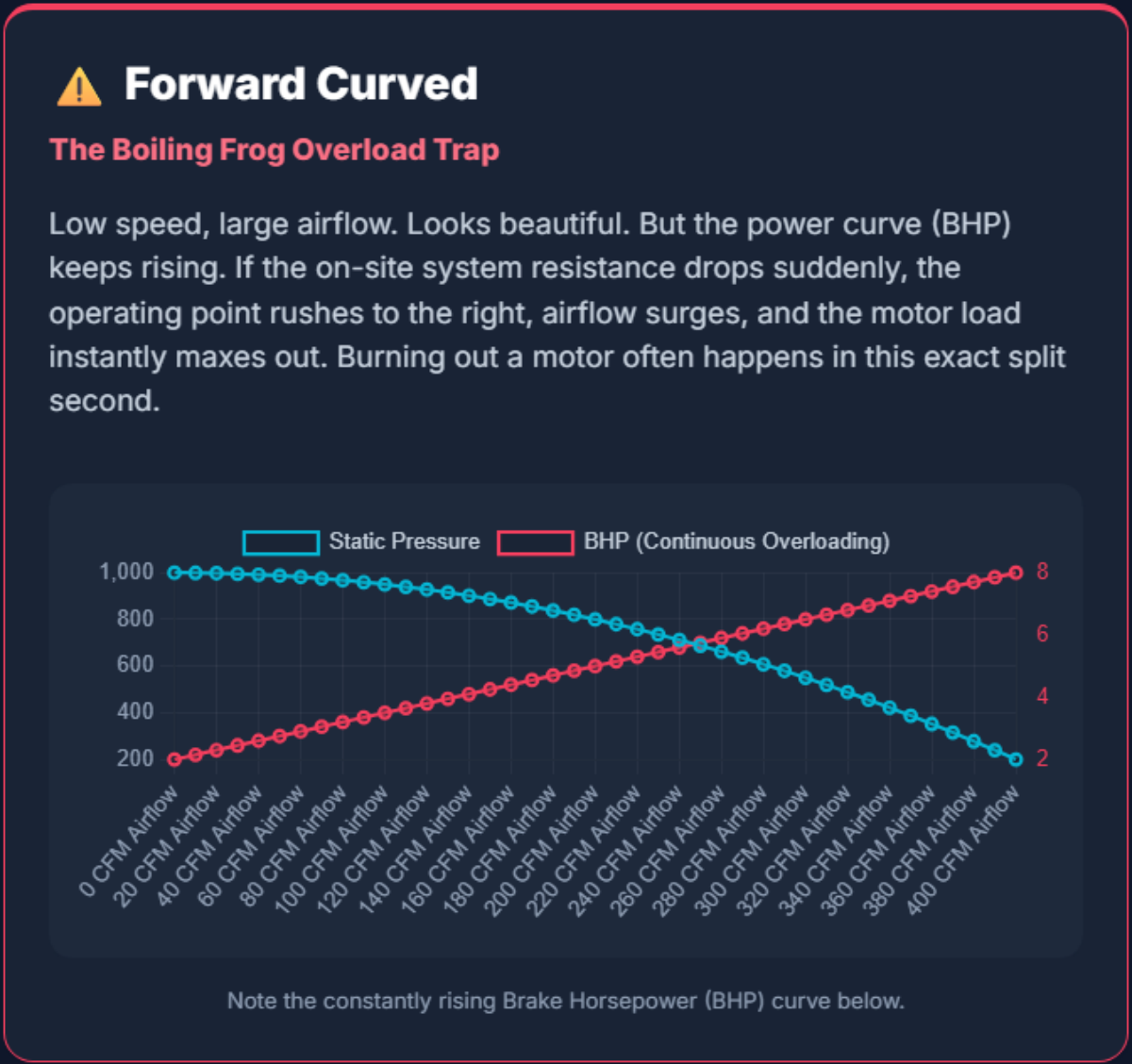
Core Insight: Forward Curved centrifugal fan characteristic curve. Note the constantly rising Brake Horsepower (BHP) curve below. Once system resistance unexpectedly drops, the surging airflow will directly cause motor overload and burnout—this is what the industry calls the “overload trap.”
Backward Curved Centrifugal Fan: The Failsafe for Hardcore Applications
Experienced engineers strongly prefer backward-curved impellers. Its static pressure curve is incredibly steep. Extremely hardcore.
When system resistance fluctuates, its airflow changes minimally, providing exceptional stability. Even better is its power curve, which forms a “hump” shape—after reaching a peak, power actually decreases even as airflow continues to rise.
This natural “Non-overloading” characteristic makes it the absolute hegemon in the Industrial Centrifugal Fan sector. High static pressure, long-distance ductwork, complex industrial exhaust? Choose this, and you’ll sleep soundly at night.
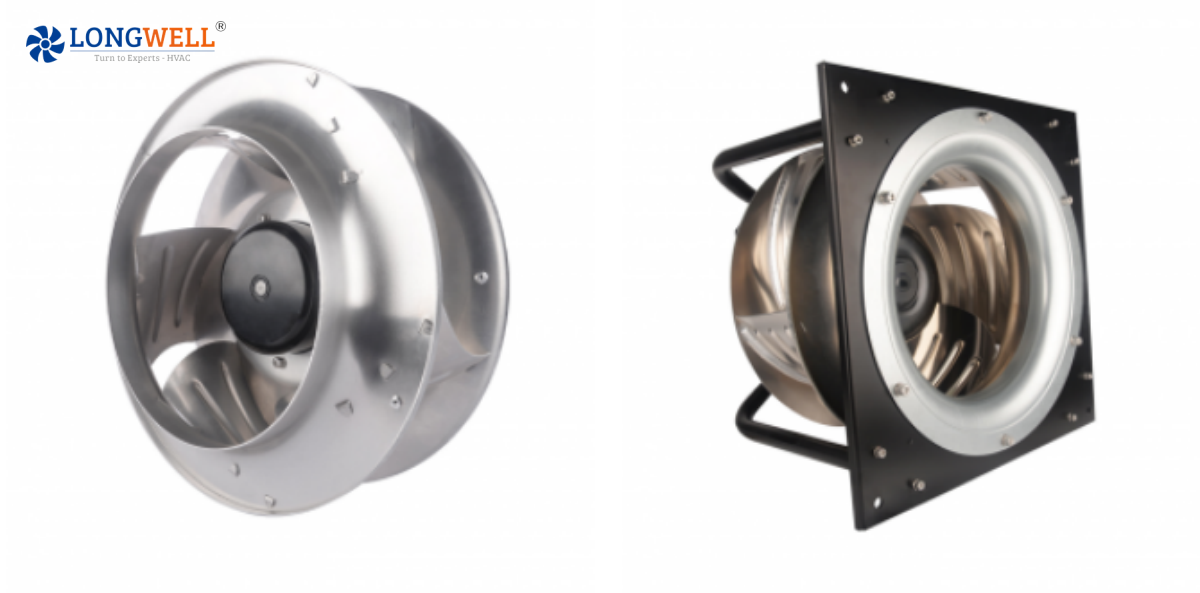
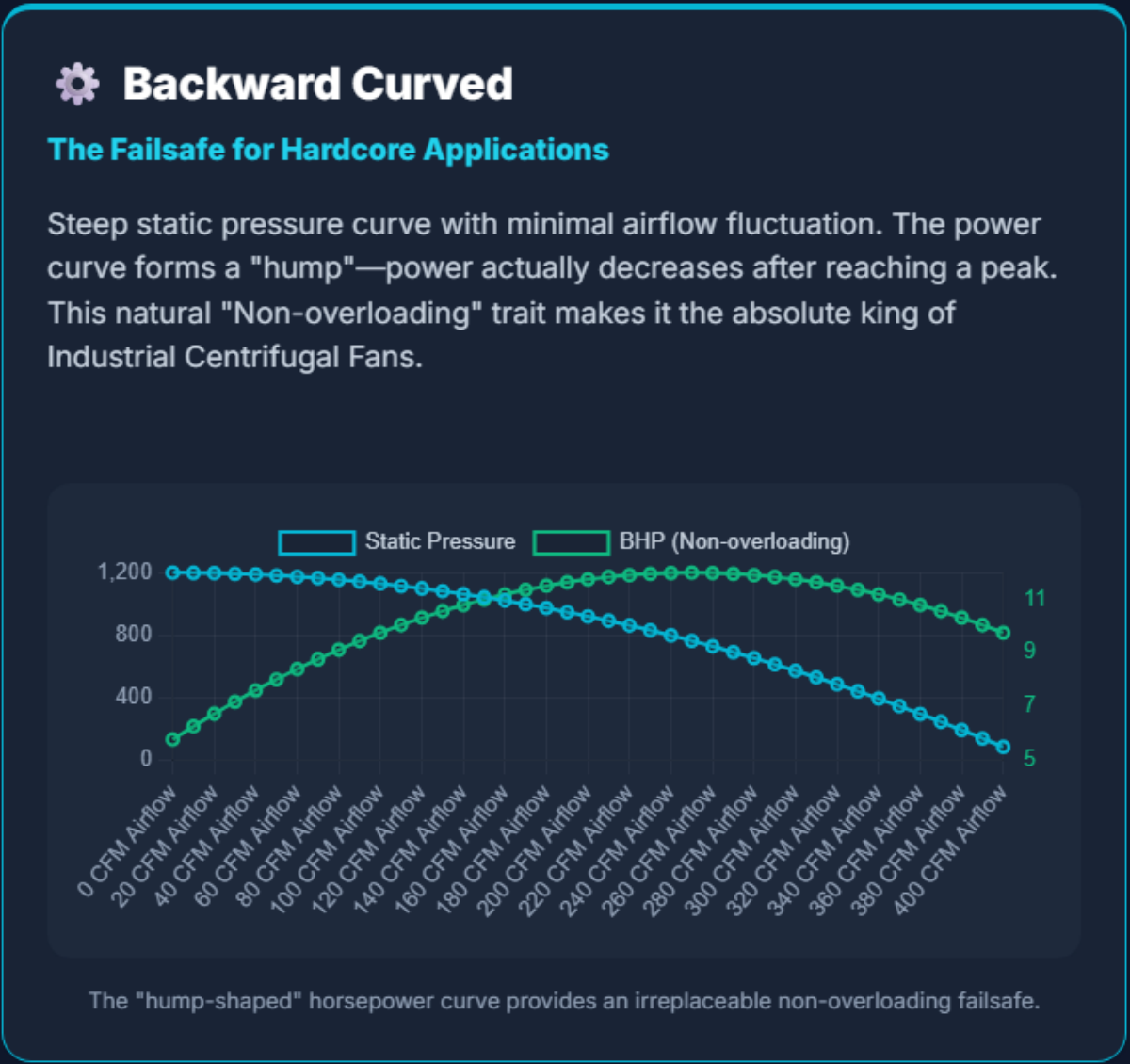
Core Insight: Backward Curved centrifugal fan characteristic curve. The steep static pressure curve guarantees operational stability, while the “hump-shaped” horsepower curve grants it an irreplaceable “non-overloading” failsafe. It won’t burn the motor, no matter how bad the ductwork gets.
The Darkest Hour: Plunging into the Stall and Surge Zones
Let’s talk about the harsh reality of the frontline. Last month at the AIRVent exhibition in Moscow, what many senior European engineering contractors pulled us aside to discuss wasn’t simple airflow matching, but how to desperately defend the “anti-surge line.”
Look at the far left of the chart curves, that obvious recessed area. That is a forbidden zone—the Stall Region.
If chaotic on-site duct modifications cause the actual resistance to far exceed the design value, the operating point is forced into this dead end. The airflow on the back of the blades will experience severe boundary layer separation.
The consequence? The ductwork vibrates violently, emitting an ear-piercing low-frequency howl. Your fan is doing useless work, and airflow is frantically reversing inside the impeller. In severe cases, it can literally tear the impeller apart. True veterans will always keep the operating point away from the left side of the main curve’s peak during selection.
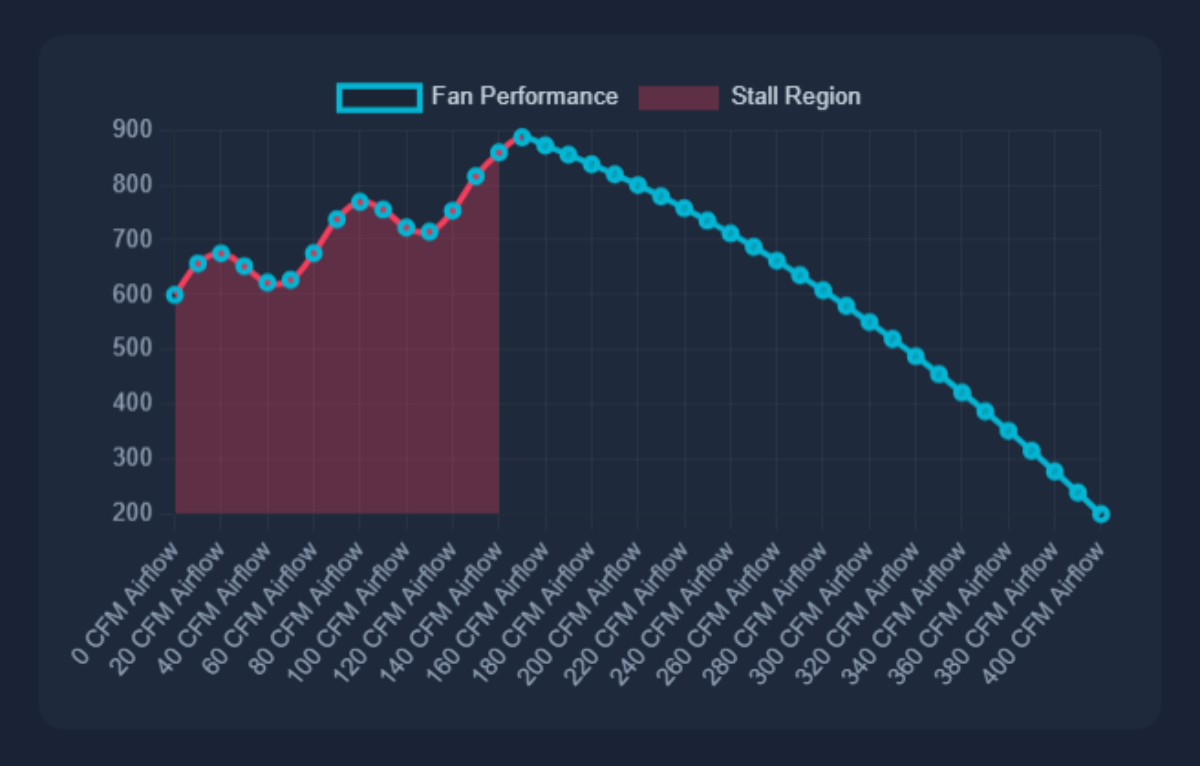
Core Insight: Diagram of the centrifugal fan Stall Region. The shaded recessed area on the left of the curve is the absolute forbidden zone. Excessive system resistance will force the operating point here, triggering airflow boundary layer separation and catastrophic equipment surge.
Squeezing the Chart Dry: Hidden Trump Cards
A qualified chart has many hidden lines:
· Best Efficiency Point (BEP): Like contour lines marking a core zone. The further your operating point drifts from the BEP, the more “idiot tax” you’re paying on your electricity bill.
· Sound Power Contours: Don’t just celebrate hitting the airflow target. If it lands in a high-noise zone, the later acoustic retrofitting costs will make you question your life choices.
· Shaft Power Margin: Especially for continuous, high-load Centrifugal Blower applications, never use the rated power to test the absolute limit. Savvy engineers always add a 15% to 20% margin on top of the actual calculated shaft power to survive brutal startup currents.
· Figure 5 Core Insight: Comprehensive fan performance chart. The Best Efficiency Point (BEP) and noise distribution zones are circled like contour lines. An excellent selection must land the operating point squarely in this bullseye. Deviating from the center means you are paying electricity bills with pure wasted cash.
 Charts are dead, but systems are alive.
Often, you hold a standard chart and find it just doesn’t quite fit no matter how you try. Compromise? Make do? Stop kidding yourself.
At LONGWELL, we never believe that tossing a standard test report at a client is what makes a “professional manufacturer.” With our formidable R&D team, what we do every single day is take the incredibly harsh, bizarre system resistance parameters from our clients and recalibrate them through aerodynamics—even directly opening new molds to customize impeller geometry and motor matching.
True matching is tailor-made. The pain points on your chart are smoothed out on our production line using our hardcore customization capabilities.
Visit our official website at www.longwellfans.com to see what true industrial-grade customization looks like. By the way, right in the middle of this current procurement peak season, we are currently offering free sample delivery for the first 10 new customers who place an order.
Throw your system resistance parameters at us. Let’s use real operating data to speak the truth and completely smash those inflated parameter illusions.